


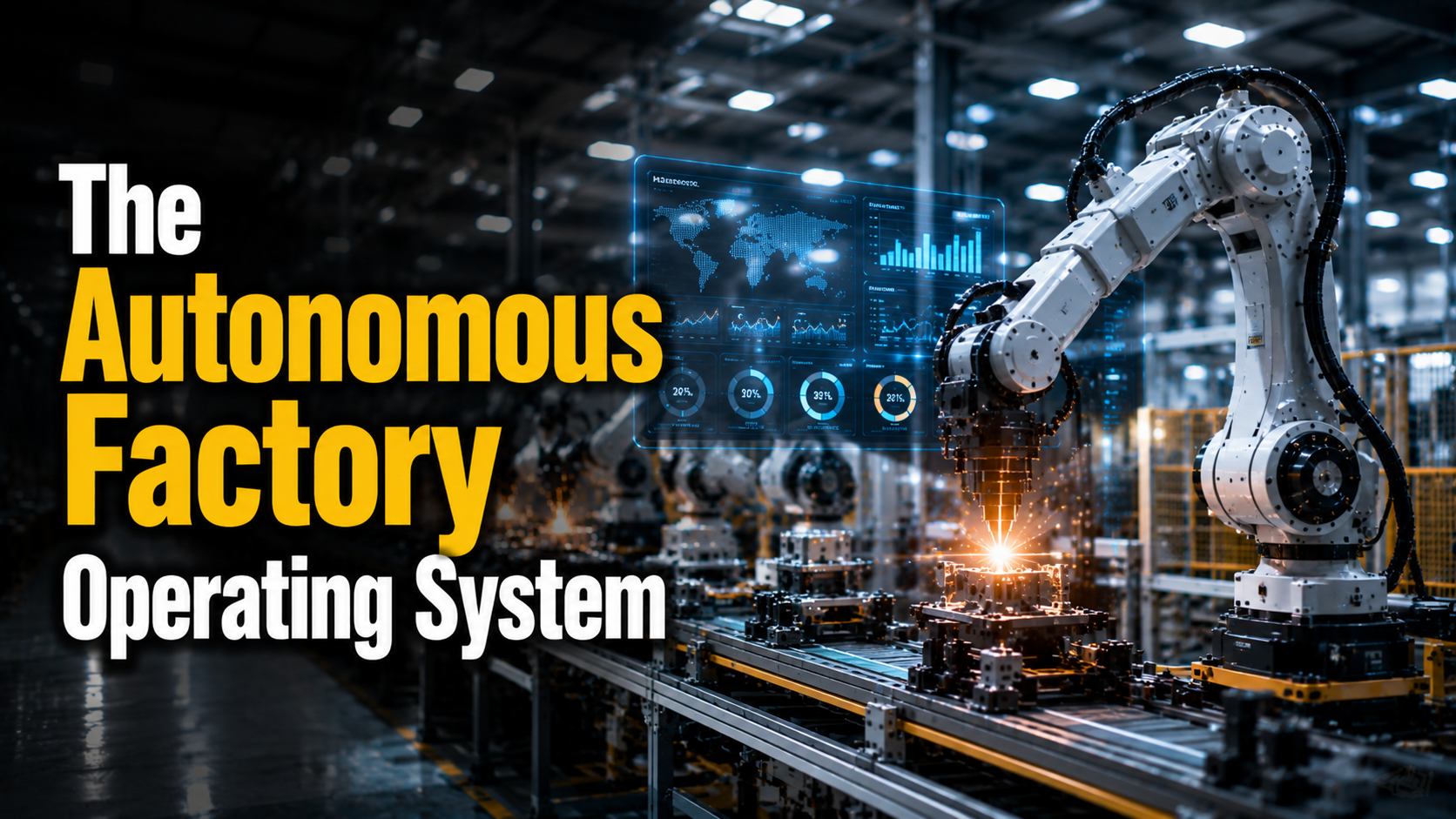
Manufacturing has entered a transformative period where digital intelligence is becoming as important as physical machinery. Over the past two decades, manufacturers have invested heavily in automation, robotics, Industrial Internet of Things (IIoT), cloud computing, advanced analytics, and artificial intelligence (AI). These technologies have significantly improved production efficiency, product quality, and operational visibility. Yet, despite these advances, many factories still depend on fragmented software systems and manual coordination to make critical operational decisions. The Autonomous Factory Operating System.
The next evolution in industrial innovation is the Autonomous Factory Operating System (AFOS), a unified digital intelligence layer that connects machines, software, people, and AI agents into a coordinated manufacturing ecosystem.
Unlike traditional manufacturing execution systems (MES) or enterprise resource planning (ERP) platforms, an Autonomous Factory Operating System does more than monitor production or store business data. It continuously observes factory operations, understands context, plans optimal actions, coordinates multiple systems, and executes approved workflows while keeping human operators informed and in control.
Think of it as the “operating system” of an intelligent factory. Just as a computer operating system coordinates hardware, applications, memory, and user interactions, an Autonomous Factory Operating System orchestrates production lines, robots, digital twins, quality systems, maintenance workflows, energy management, supply chains, and enterprise applications into one adaptive environment.
This concept is rapidly gaining attention as manufacturers seek to improve resilience, reduce downtime, address labor shortages, support sustainability goals, and respond more effectively to volatile market conditions. Powered by Agentic AI, machine learning, digital twins, cloud computing, and edge intelligence, AFOS represents the foundation for the factories of the future.
In this in-depth guide, we’ll explore what an Autonomous Factory Operating System is, how it works, the technologies behind it, its architecture, benefits, implementation roadmap, practical applications, challenges, and why it is becoming a defining capability of next-generation manufacturing.
Table of Contents
What Is an Autonomous Factory Operating System?
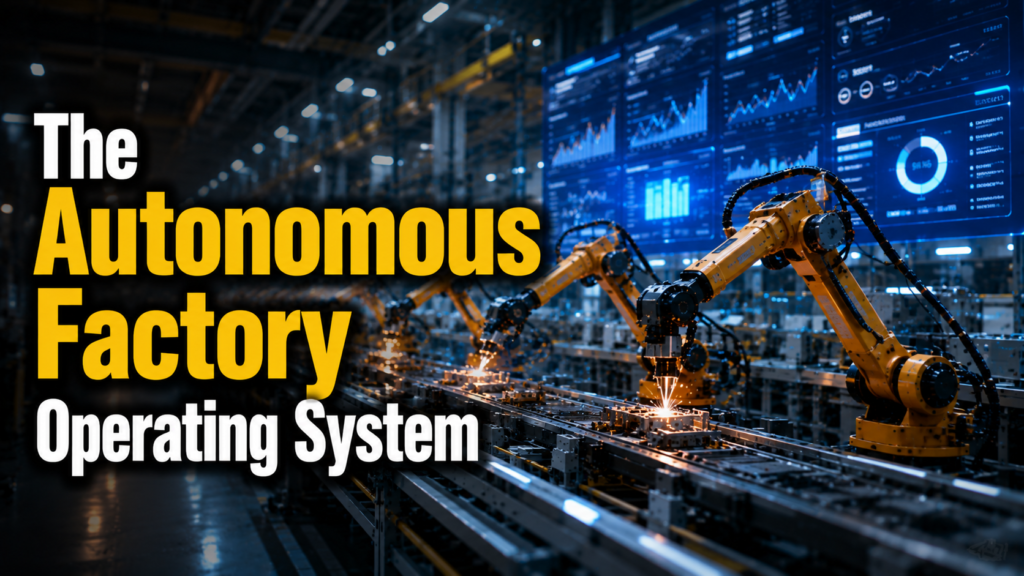
An Autonomous Factory Operating System is an integrated digital platform that coordinates manufacturing operations through continuous sensing, intelligent analysis, autonomous planning, and controlled execution.
Rather than functioning as a single software application, AFOS acts as an orchestration layer that connects operational technology (OT), information technology (IT), and artificial intelligence into one unified decision-making framework.
It continuously:
- Collects operational data from connected assets.
- Interprets factory conditions using AI.
- Coordinates production activities.
- Optimizes resources.
- Automates approved workflows.
- Learns from outcomes to improve future decisions.
The result is a factory capable of responding dynamically to changing conditions with greater speed, accuracy, and efficiency than traditional manufacturing systems.
Why Traditional Manufacturing Software Is No Longer Enough
Most factories rely on multiple independent systems such as:
- Enterprise Resource Planning (ERP)
- Manufacturing Execution Systems (MES)
- Supervisory Control and Data Acquisition (SCADA)
- Programmable Logic Controllers (PLCs)
- Computerized Maintenance Management Systems (CMMS)
- Warehouse Management Systems (WMS)
- Quality Management Systems (QMS)
Although these platforms perform essential functions, they often operate in silos. Human teams spend considerable time coordinating information between systems, resolving conflicts, and making operational decisions.
AFOS addresses this challenge by creating a unified intelligence layer capable of coordinating these systems in real time while preserving existing investments.
Evolution of Manufacturing Intelligence
| Industrial Stage | Primary Capability | Operational Focus |
|---|---|---|
| Industry 3.0 | Automation | Machine control |
| Industry 4.0 | Connected systems | Data-driven manufacturing |
| Industry 5.0 | Human-machine collaboration | Sustainable and resilient operations |
| Autonomous Factory | AI-driven orchestration | Goal-oriented autonomous operations |
Rather than replacing previous industrial models, the Autonomous Factory Operating System builds upon them to create a more adaptive and intelligent manufacturing environment.
Core Components of an Autonomous Factory Operating System
An AFOS integrates several advanced technologies into a unified architecture.
| Component | Function |
|---|---|
| Agentic AI | Goal-driven planning and operational coordination |
| Artificial Intelligence | Pattern recognition and optimization |
| Industrial IoT (IIoT) | Real-time data collection from equipment |
| Digital Twins | Virtual representation of machines, production lines, and factories |
| Edge Computing | Low-latency processing near industrial assets |
| Cloud Computing | Centralized analytics and orchestration |
| Machine Learning | Continuous improvement from operational data |
| Computer Vision | Automated quality inspection |
| Robotics & Cobots | Physical execution of manufacturing tasks |
| Cybersecurity Frameworks | Protection of IT and OT environments |
Together, these components create a continuously learning industrial ecosystem.
How an Autonomous Factory Operating System Works
The operating cycle of AFOS can be understood through five interconnected stages.
1. Sense
Industrial sensors, cameras, PLCs, enterprise systems, and connected machines continuously generate operational data.
Examples include:
- Machine temperature
- Production rates
- Equipment vibration
- Inventory levels
- Workforce availability
- Energy consumption
- Quality metrics
2. Understand
AI algorithms analyze operational conditions, detect anomalies, identify production bottlenecks, estimate equipment health, and interpret business priorities.
3. Plan
Agentic AI generates optimized action plans while considering
4. Execute
Within predefined governance policies, AFOS coordinates:
- Production schedules
- Robot assignments
- Maintenance workflows
- Warehouse operations
- Energy optimization
- Supply chain activities
5. Learn
Every operational outcome feeds machine learning models that improve prediction accuracy, planning quality, and future decision-making.
Key Technologies Enabling AFOS
Agentic AI
Unlike traditional AI, Agentic AI can pursue operational goals, coordinate multiple systems, and execute complex workflows with human oversight.
Industrial Internet of Things (IIoT)
Thousands of connected sensors provide real-time visibility into equipment performance, production conditions, and environmental factors.
Digital Twins
Digital twins create dynamic virtual models of physical assets and processes, allowing manufacturers to simulate operational changes before implementation.
Edge AI
Time-sensitive manufacturing decisions often require immediate processing near industrial equipment, reducing latency and improving responsiveness.
Cloud Computing
Cloud platforms support centralized analytics, enterprise integration, scalability, and collaboration across multiple manufacturing facilities.
Generative AI
Generative AI assists engineers and operators by creating documentation, summarizing maintenance records, generating troubleshooting guides, and supporting knowledge management.
Benefits of the Autonomous Factory Operating System
Unified Operational Visibility
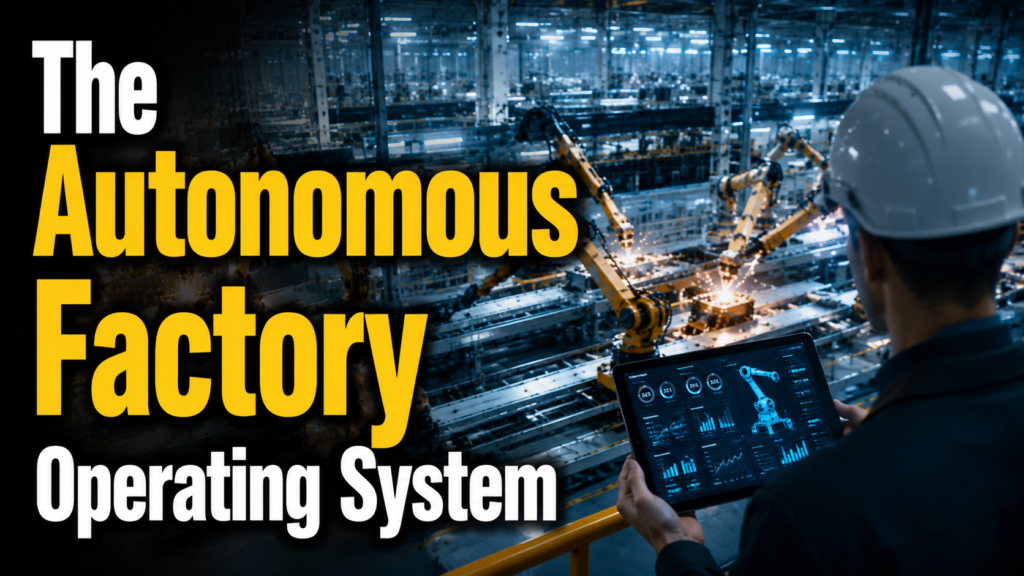
AFOS provides a comprehensive view of production, maintenance, inventory, quality, energy, and logistics through a single operational platform.
Faster Decision-Making
AI agents analyze thousands of variables simultaneously, enabling faster operational responses than manual coordination.
Improved Equipment Reliability
Continuous monitoring and predictive maintenance reduce unexpected downtime while extending equipment lifespan.
Intelligent Production Scheduling
Dynamic scheduling optimizes production based on customer priorities, machine availability, labor resources, and inventory constraints.
Enhanced Product Quality
Computer vision, statistical process control, and AI analytics identify quality issues early, reducing defects and rework.
Supply Chain Resilience
AFOS continuously monitors suppliers, inventory, logistics, and production plans, enabling rapid responses to disruptions.
Sustainability Optimization
Autonomous energy management reduces electricity consumption, material waste, emissions, and operational costs.
Human Empowerment
Rather than replacing employees, AFOS automates repetitive coordination tasks while supporting informed decision-making and continuous improvement.
Practical Applications
Predictive Maintenance
AI predicts equipment failures, schedules maintenance, reserves spare parts, and coordinates technician assignments before breakdowns occur.
Autonomous Quality Inspection
Computer vision systems inspect products continuously and automatically initiate corrective actions when defects are detected.
Smart Production Planning
AFOS dynamically adjusts production schedules based on real-time operational conditions.
Warehouse Automation
Autonomous mobile robots and AI-driven inventory systems optimize material movement throughout manufacturing facilities.
Energy Management
AI balances production loads to minimize energy costs while supporting sustainability objectives.
Digital Twin Simulation
Operational changes can be tested virtually before implementation, reducing operational risk and accelerating innovation.
Autonomous Factory Operating System vs Traditional MES
| Traditional MES | Autonomous Factory Operating System |
|---|---|
| Monitors production | Coordinates enterprise-wide operations |
| Human-driven decisions | AI-assisted and autonomous planning |
| Limited optimization | Continuous optimization |
| Reactive workflows | Predictive and proactive workflows |
| Static scheduling | Dynamic scheduling |
| Department-focused | Factory-wide orchestration |
Rather than replacing MES, AFOS enhances it by providing intelligent orchestration across multiple enterprise systems.
Human-AI Collaboration
Human expertise remains central to manufacturing success.
Employees increasingly focus on:
- Process innovation
- Engineering improvements
- Safety oversight
- Customer engagement
- Strategic planning
- Ethical governance
- Continuous improvement
AI handles repetitive coordination and data-intensive operational tasks while people guide strategy, creativity, and complex decision-making.
Implementation Roadmap
Step 1: Evaluate Digital Maturity
Assess current infrastructure, automation capabilities, data quality, and enterprise integration.
Step 2: Modernize Data Architecture
Reliable operational data is essential for autonomous decision-making.
Organizations should prioritize:
- Sensor deployment
- Connectivity
- Data governance
- Standardized data models
Step 3: Launch Pilot Projects
Begin with high-impact use cases such as:
- Predictive maintenance
- Production scheduling
- Energy optimization
- Quality inspection
Step 4: Integrate Enterprise Platforms
Connect ERP, MES, SCADA, WMS, CMMS, and digital twins into a unified operational ecosystem.
Step 5: Establish Governance
Define:
- Human approval thresholds
- AI accountability
- Safety protocols
- Compliance requirements
- Performance metrics
Step 6: Scale Across Operations
Expand successful implementations across production lines, factories, and supply chain networks.
Challenges
Legacy Equipment
Older industrial equipment may require retrofit sensors or communication gateways.
Cybersecurity
As IT and OT systems converge, organizations must strengthen industrial cybersecurity using Zero Trust principles, encryption, continuous monitoring, and network segmentation.
Workforce Readiness
Successful adoption depends on employee engagement, AI literacy, and continuous training.
Data Quality
Poor data quality reduces AI accuracy and limits operational effectiveness.
Organizational Change
Autonomous operations require cross-functional collaboration among engineering, operations, IT, cybersecurity, and executive leadership.
Best Practices
Manufacturers implementing AFOS should:
- Define measurable business objectives.
- Build a secure digital foundation.
- Invest in employee training.
- Maintain human oversight for critical operational decisions.
- Measure success through KPIs such as Overall Equipment Effectiveness (OEE), first-pass yield, Mean Time Between Failures (MTBF), energy efficiency, maintenance costs, and customer satisfaction.
- Continuously improve AI models using operational feedback.
Future Trends
Multi-Agent Factory Ecosystems
Specialized AI agents for production, logistics, procurement, maintenance, quality, and sustainability will collaborate across the enterprise.
Autonomous Supply Chains
Factories will coordinate directly with suppliers, warehouses, and transportation providers through intelligent AI-driven workflows.
Generative AI Integration
Engineers and operators will increasingly rely on generative AI for documentation, troubleshooting, process optimization, and knowledge management.
Enterprise-Scale Digital Twins
Entire manufacturing ecosystems, including factories, warehouses, suppliers, and distribution networks, will be represented as interconnected digital twins.
Sustainable Autonomous Manufacturing
AFOS platforms will optimize resource consumption, emissions, and waste while supporting environmental reporting and circular manufacturing initiatives.
Business Impact
Organizations implementing Autonomous Factory Operating Systems can expect improvements across multiple business metrics.
| Business Area | Expected Impact |
|---|---|
| Production Efficiency | Higher throughput |
| Equipment Availability | Reduced downtime |
| Product Quality | Improved consistency |
| Energy Efficiency | Lower operating costs |
| Workforce Productivity | Greater focus on high-value activities |
| Supply Chain Resilience | Faster disruption response |
| Operational Agility | Dynamic adaptation to demand |
| Competitive Advantage | Stronger innovation and profitability |
Conclusion
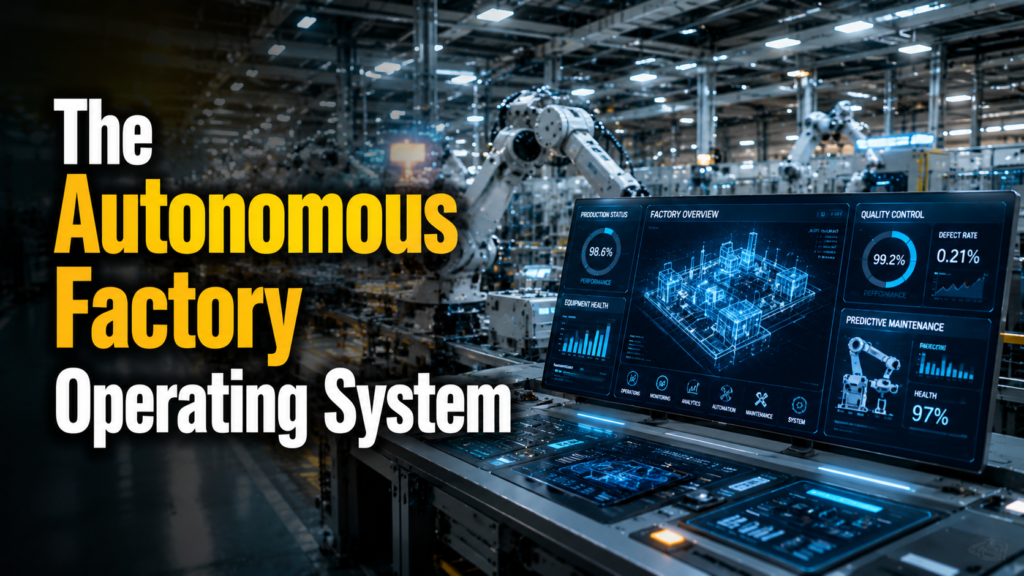
The Autonomous Factory Operating System represents one of the most significant advancements in modern manufacturing. By unifying artificial intelligence, Agentic AI, Industrial IoT, digital twins, robotics, cloud computing, and enterprise software into a coordinated operational platform, AFOS enables factories to move beyond disconnected automation toward intelligent, adaptive, and increasingly autonomous operations.
Its value extends far beyond technology. Manufacturers gain faster decision-making, improved equipment reliability, enhanced product quality, optimized resource utilization, greater supply chain resilience, and stronger sustainability performance. Equally important, AFOS supports a human-centric approach in which AI augments the capabilities of engineers, operators, and managers rather than replacing their expertise.
The journey to autonomous manufacturing requires careful planning, high-quality data, secure digital infrastructure, responsible AI governance, and continuous workforce development. Organizations that invest in these foundations today will be better equipped to respond to changing market demands, accelerate innovation, and remain competitive in the years ahead.
As industrial intelligence continues to evolve, the Autonomous Factory Operating System is poised to become the digital backbone of next-generation manufacturing, transforming factories into connected ecosystems that can sense, reason, adapt, and continuously improve while keeping people at the center of operational excellence.
Also Read: “Building a Business Around Autonomous Intelligence“
Author
Frequently Asked Questions (FAQs)
1. What is an Autonomous Factory Operating System?
An Autonomous Factory Operating System (AFOS) is a unified digital platform that connects manufacturing equipment, enterprise software, AI, and operational workflows. It continuously monitors factory conditions, analyzes data, coordinates production, and automates approved decisions while maintaining human oversight.
2. How is an Autonomous Factory Operating System different from a Manufacturing Execution System (MES)?
A Manufacturing Execution System focuses primarily on monitoring and managing production processes. An Autonomous Factory Operating System builds on MES capabilities by orchestrating enterprise-wide operations using AI, digital twins, predictive analytics, and autonomous decision-making across production, maintenance, logistics, quality, and energy management.
3. Which technologies are essential for building an Autonomous Factory Operating System?
Key technologies include Agentic AI, artificial intelligence, machine learning, Industrial IoT, digital twins, edge computing, cloud computing, robotics, computer vision, cybersecurity frameworks, and enterprise systems such as ERP, MES, SCADA, and CMMS.
4. Will Autonomous Factory Operating Systems replace human workers?
No. The primary goal of AFOS is to augment human capabilities by automating repetitive coordination and data-intensive operational tasks. Engineers, operators, managers, and technicians remain responsible for strategic planning, innovation, safety, governance, ethical oversight, and continuous improvement, with AI serving as an intelligent operational partner.