

Introduction
The manufacturing industry is moving toward a new era where factories are no longer just production facilities. They are becoming intelligent, connected, and adaptive environments capable of analyzing information, predicting challenges, and optimizing operations in real time.
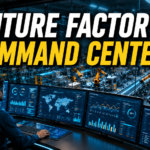
At the center of this transformation is a new concept known as the Future Factory Command Center. Future Factory Command Centers: The Intelligent Control Hubs Transforming Modern Manufacturing.
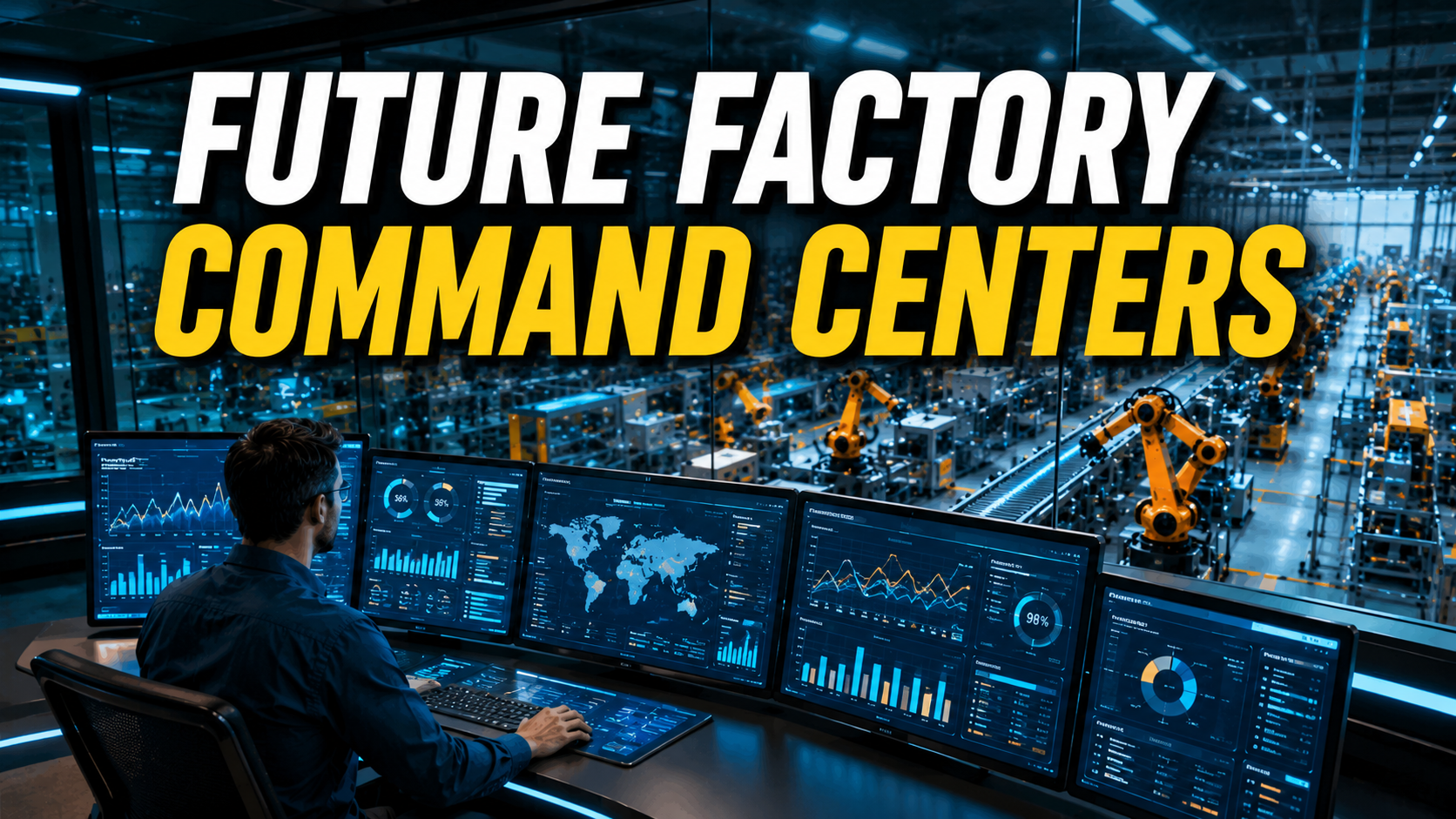
A Future Factory Command Center is an advanced industrial intelligence hub that provides centralized visibility, analysis, and control over modern manufacturing operations. It combines artificial intelligence, industrial data platforms, digital twins, automation systems, robotics, and advanced analytics to help organizations make faster and smarter decisions.
Traditional factory control rooms were mainly designed to monitor equipment and display operational information. Future factory command centers go much further. They act as intelligent decision-making environments where humans and artificial intelligence work together to manage complex industrial ecosystems.
These command centers can monitor production performance, identify operational risks, predict machine failures, optimize resources, and coordinate activities across entire manufacturing networks.
As industries become more connected and competitive, future factory command centers will become essential for companies seeking higher efficiency, better quality, improved sustainability, and greater operational flexibility.
The factory of tomorrow will not only produce goods.
It will think, analyze, and continuously improve through intelligent command systems.
Table of Contents
What Are Future Factory Command Centers?
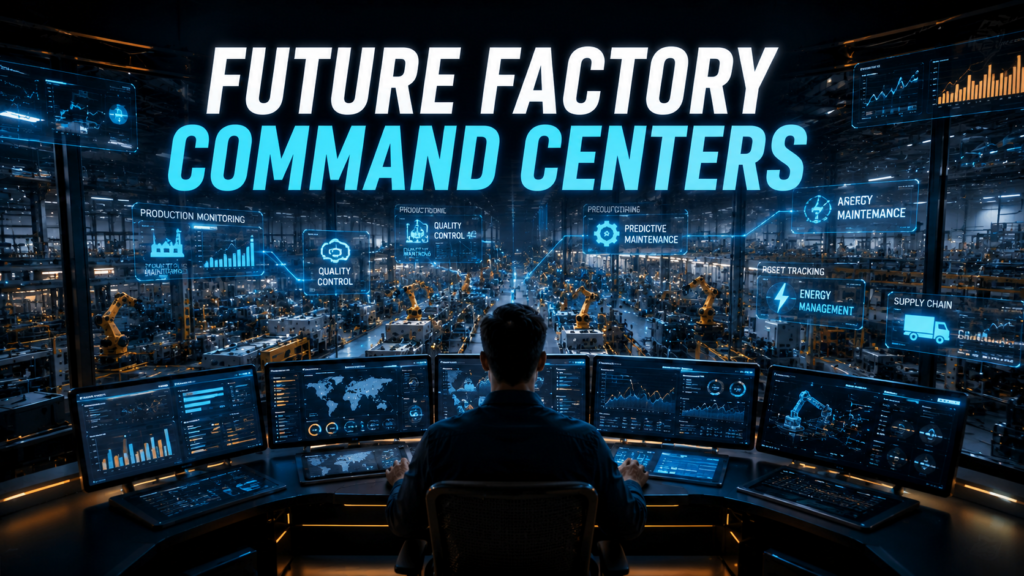
A Future Factory Command Center is a centralized digital intelligence platform that manages, analyzes, and optimizes manufacturing operations through advanced technologies.
It acts as the brain of an intelligent factory by connecting different industrial systems and transforming large amounts of operational data into meaningful insights.
A traditional control room mainly focuses on monitoring.
A future factory command center focuses on understanding and decision-making.
It integrates information from:
Production machines
Industrial sensors
Robotic systems
Supply chain platforms
Quality management systems
Energy monitoring solutions
Maintenance databases
Enterprise software
Artificial intelligence platforms
The command center analyzes this information and provides real-time recommendations or automated actions.
For example, if a production line begins showing unusual performance patterns, the command center can identify the issue, predict the possible cause, recommend corrective actions, and help prevent downtime.
This transforms manufacturing management from reactive problem solving into proactive intelligence.
The Evolution of Factory Control Systems
The development of future factory command centers is connected to the broader evolution of industrial technology.
Traditional Factory Monitoring
In traditional manufacturing environments, operators relied heavily on manual observation and physical inspections.
Information was often limited and distributed across different departments.
Decision-making depended largely on human experience.
Automated Control Systems
Automation introduced programmable systems that could control machines and production activities.
Factories became faster and more consistent.
However, these systems mainly followed predefined instructions.
Smart Factory Control Rooms
Smart factories introduced connected devices, sensors, and industrial networks.
Manufacturers gained real-time visibility into operations.
Data became a valuable resource for improving performance.
Intelligent Factory Command Centers
The next stage combines connectivity with artificial intelligence.
Future command centers can understand information, predict outcomes, and support autonomous decision-making.
They represent the transition from monitoring factories to managing intelligent industrial ecosystems.
Why Future Factory Command Centers Are Becoming Important
Modern manufacturing environments are becoming increasingly complex.
Companies must manage:
Global production networks
Changing customer demands
Supply chain disruptions
Energy challenges
Quality requirements
Increasing operational costs
Traditional management approaches often struggle to handle this complexity.
Future factory command centers provide a solution by creating a unified intelligence layer across manufacturing operations.
They help organizations:
Improve operational visibility
Reduce production downtime
Optimize resources
Respond faster to problems
Increase efficiency
Support strategic decisions
In highly competitive industries, the ability to understand and control operations in real time has become a major advantage.
Core Technologies Behind Future Factory Command Centers
Future factory command centers rely on multiple advanced technologies working together.
Artificial Intelligence
Artificial intelligence is the foundation of intelligent factory command systems.
AI analyzes massive amounts of industrial information and identifies patterns that humans may not easily detect.
AI supports:
Predictive maintenance
Production optimization
Quality improvement
Risk detection
Decision support
Through AI, command centers become intelligent rather than simply informative.
Industrial Internet of Things
Industrial Internet of Things connects machines, sensors, and industrial systems.
It provides continuous data from factory operations.
This allows command centers to understand:
Machine conditions
Production performance
Energy consumption
Environmental changes
Operational efficiency
Digital Twins
Digital twins create virtual representations of factories and production processes.
They allow command centers to simulate different scenarios before making operational changes.
Digital twins support:
Performance analysis
Production planning
Risk management
Process optimization
Advanced Analytics
Advanced analytics transforms industrial data into useful insights.
It helps identify:
Operational trends
Efficiency opportunities
Potential failures
Resource improvements
Cloud and Edge Computing
Cloud computing provides large-scale data processing and storage capabilities.
Edge computing enables faster decision-making by processing information closer to machines.
Together, they create a powerful infrastructure for intelligent factory management.
Robotics and Autonomous Systems
Robotics provides physical automation capabilities.
Future command centers can coordinate robotic systems to improve:
Material handling
Production processes
Inspection activities
Warehouse operations
How Future Factory Command Centers Work
A future factory command center operates through continuous monitoring, analysis, decision-making, and improvement.
Data Collection
Factories generate enormous amounts of information every second.
Sensors, machines, and software platforms continuously collect operational data.
This information includes:
Production output
Machine performance
Quality measurements
Energy usage
Maintenance conditions
Intelligent Processing
AI systems analyze collected information and identify important patterns.
They can detect:
Performance changes
Possible failures
Production bottlenecks
Efficiency opportunities
Decision Support
The command center provides recommendations to operators and managers.
Examples include:
Adjusting production schedules
Changing machine settings
Optimizing resource allocation
Planning maintenance activities
Autonomous Response
In advanced environments, command centers can automatically execute certain actions.
Examples include:
Adjusting equipment parameters
Redirecting production workflows
Activating maintenance procedures
Continuous Learning
AI systems learn from operational outcomes.
This allows the command center to improve decision-making over time.
Major Functions of Future Factory Command Centers
Real-Time Production Management
One of the most important roles of future command centers is managing production performance.
They provide complete visibility into manufacturing activities.
Managers can understand:
What is happening
Why it is happening
What action should be taken
This improves operational control.
Predictive Maintenance Management
Unexpected equipment failures can create significant losses.
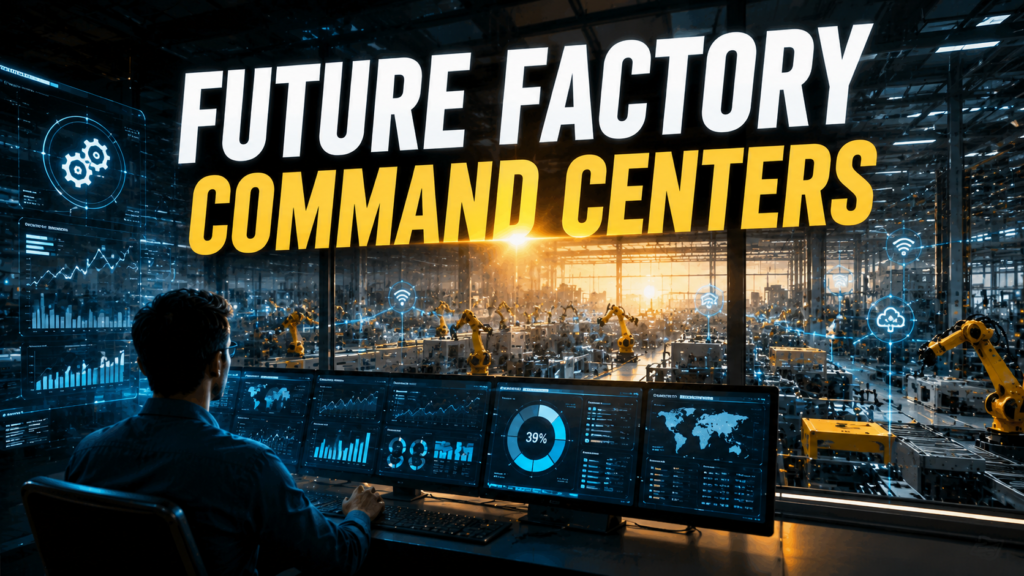
Future command centers use AI to predict maintenance requirements.
They analyze machine behavior and identify early warning signs.
This allows companies to reduce downtime and improve equipment reliability.
Intelligent Quality Management
Quality problems can affect customer satisfaction and business performance.
Command centers use AI and advanced analytics to monitor quality conditions.
They identify defects and analyze their causes.
This helps organizations prevent quality issues before they become larger problems.
Supply Chain Coordination
Manufacturing depends on efficient supply chains.
Future factory command centers connect production information with supply chain data.
They help companies manage:
Inventory
Materials
Supplier conditions
Production schedules
This creates more resilient operations.
Energy Optimization
Energy management is becoming increasingly important.
Command centers analyze energy usage and identify improvement opportunities.
They help manufacturers reduce:
Energy waste
Operational costs
Environmental impact
Workforce Support
Future command centers are not designed only for machines.
They support human workers by providing:
Real-time information
AI recommendations
Performance insights
Problem-solving assistance
This improves collaboration between humans and technology.
Benefits of Future Factory Command Centers
Future factory command centers provide significant advantages for manufacturing organizations.
Improved Operational Visibility
Companies gain a complete understanding of factory performance.
Faster Decision Making
AI-powered insights help managers make better decisions quickly.
Reduced Downtime
Predictive capabilities help prevent equipment failures.
Higher Productivity
Optimization improves production efficiency.
Better Quality Control
Continuous monitoring reduces defects and improves consistency.
Improved Sustainability
Better resource management reduces waste and energy consumption.
Challenges in Building Future Factory Command Centers
Although future command centers offer significant benefits, companies face several challenges.
Data Integration Complexity
Factories often use different systems and technologies.
Connecting these systems into a unified platform can be difficult.
Cybersecurity Risks
Connected industrial environments create security challenges.
Companies must protect:
Operational systems
Factory networks
Sensitive data
Artificial intelligence models
High Implementation Costs
Building advanced command centers requires investment in:
Technology infrastructure
AI platforms
Data systems
Employee training
Workforce Transformation
Employees need new skills to work effectively with intelligent systems.
Training is essential for successful adoption.
Trust and Explainability
Organizations must understand how AI systems make decisions.
Explainable AI helps build confidence in automated recommendations.
Human Role in Future Factory Command Centers
Future factory command centers will not eliminate human involvement.
Instead, they will change how people interact with manufacturing systems.
Workers will move from manual monitoring toward higher-value responsibilities such as:
Strategic planning
System supervision
Process improvement
Innovation
Decision-making
AI can analyze information quickly, but humans provide creativity, experience, and judgment.
The future factory will be powered by human and machine collaboration.
Future Factory Command Centers and Industry 5.0
Industry 5.0 focuses on creating a balance between technology and human capability.
While Industry 4.0 introduced connected and automated factories, Industry 5.0 emphasizes human-centered innovation.
Future factory command centers support this vision by enabling:
Human AI collaboration
Personalized production
Sustainable manufacturing
Flexible industrial systems
The goal is not a factory controlled only by machines.
The goal is a factory where humans and intelligent technologies work together.
Future Trends in Factory Command Centers
The next generation of command centers will become even more advanced.
Future developments may include:
Fully autonomous operational management
AI-powered industrial assistants
Self-optimizing factories
Advanced predictive intelligence
Real-time global factory coordination
More natural human-machine interaction
These developments will transform command centers from monitoring platforms into intelligent industrial decision engines.
How Businesses Can Prepare for Future Factory Command Centers
Organizations planning to adopt future command centers should focus on a strategic approach.
Important steps include:
Building strong digital infrastructure
Improving industrial data quality
Connecting existing systems
Investing in artificial intelligence capabilities
Training employees
Strengthening cybersecurity
Starting with focused transformation projects
Successful implementation requires both technology and organizational readiness.
The Future of Manufacturing Intelligence
Future factory command centers represent a major shift in industrial management.
Factories are moving from isolated production environments toward connected intelligent ecosystems.
The command center will become the place where humans, machines, and artificial intelligence collaborate to improve industrial performance.
Companies that successfully adopt these systems will gain advantages in:
Efficiency
Innovation
Resilience
Sustainability
Market competitiveness
The future factory will not simply be automated.
It will be intelligent.
Conclusion
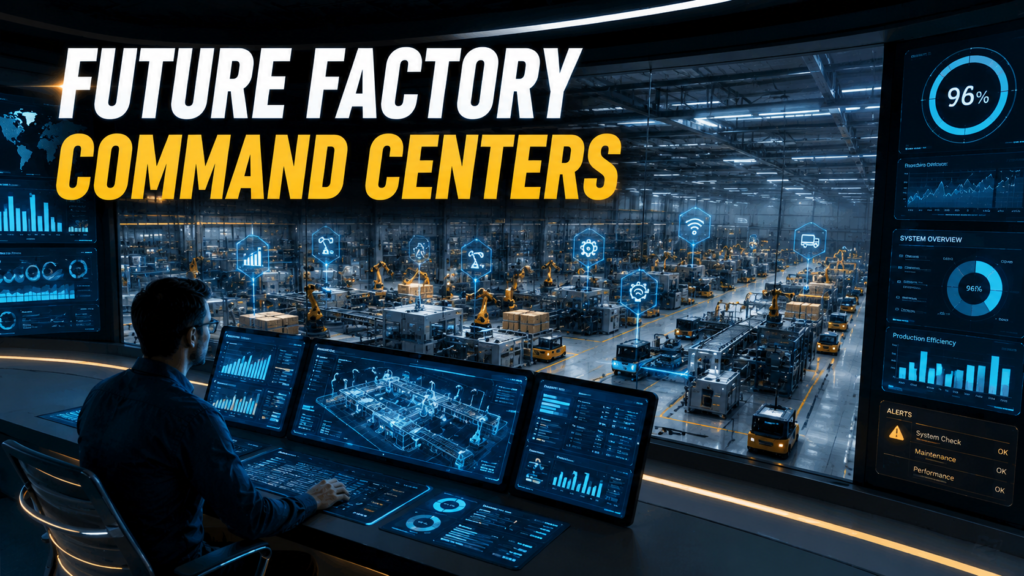
Future Factory Command Centers are becoming the central intelligence hubs of modern manufacturing.
By combining artificial intelligence, industrial data, robotics, digital twins, and advanced analytics, these systems provide manufacturers with the ability to understand operations, predict challenges, and make smarter decisions.
The evolution from traditional control rooms to intelligent command centers represents a fundamental change in how factories operate.
Manufacturing leaders of the future will not only manage machines.
They will manage intelligent ecosystems.
The factories of tomorrow will be guided by data, powered by AI, and enhanced by human expertise.
Also read: “Secure AI Infrastructure for Factories“
Author
Frequently Asked Questions
What is a Future Factory Command Center?
A Future Factory Command Center is an intelligent digital platform that monitors, analyzes, and optimizes manufacturing operations using artificial intelligence, industrial data, and advanced technologies.
How are future command centers different from traditional control rooms?
Traditional control rooms mainly monitor operations, while future command centers use AI to analyze information, predict problems, and support intelligent decision-making.
Will AI replace factory managers and operators?
AI will not completely replace humans. Instead, it will support workers by providing insights, automation, and better decision-making capabilities.