






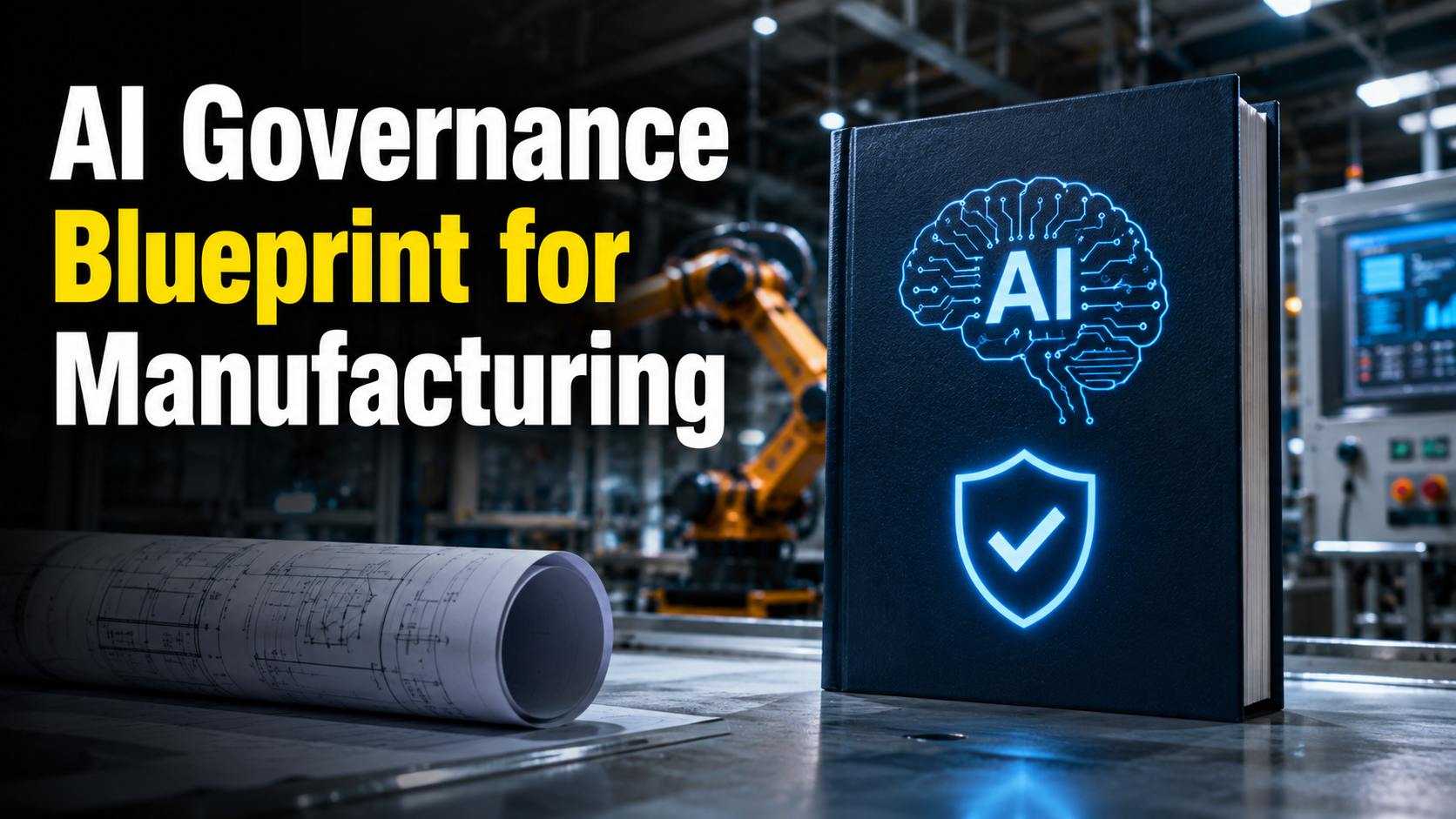
Artificial Intelligence has become one of the defining technologies of modern manufacturing. Smart factories now rely on AI to optimize production schedules, predict equipment failures, inspect product quality, manage supply chains, reduce energy consumption, and improve workplace safety. What was once considered a competitive advantage has rapidly evolved into a business necessity. As manufacturers continue investing in Industrial AI, another equally important question has emerged. How can organizations ensure that AI systems remain trustworthy, secure, transparent, and aligned with business objectives? AI Governance Blueprint for Manufacturing.
This is where AI governance becomes indispensable.
AI governance is no longer a topic reserved for technology companies or research institutions. Manufacturers are increasingly deploying AI across mission-critical operations where errors can affect employee safety, product quality, regulatory compliance, customer trust, and financial performance. A single inaccurate AI recommendation on a production line can trigger defective products, equipment damage, costly downtime, or supply chain disruptions. Without a structured governance framework, even the most advanced AI initiatives can expose organizations to significant operational and legal risks.
An AI governance blueprint provides manufacturers with a practical framework for managing AI responsibly throughout its entire lifecycle. Rather than limiting innovation, governance creates the foundation for scalable, reliable, and ethical AI adoption. It establishes clear policies for data management, model development, deployment, monitoring, accountability, cybersecurity, compliance, and continuous improvement. Organizations that implement effective governance are better positioned to maximize AI value while minimizing risks.
As governments introduce new AI regulations and customers demand greater transparency, AI governance is becoming a strategic requirement rather than a compliance exercise. Manufacturers that establish governance early will be better prepared for future regulatory changes while building stronger trust among employees, partners, investors, and customers.
Table of Contents
Understanding AI Governance in Manufacturing
AI governance refers to the collection of policies, processes, standards, technologies, and organizational responsibilities that ensure Artificial Intelligence systems are developed and used responsibly. It combines business strategy, risk management, cybersecurity, data governance, regulatory compliance, ethics, and operational oversight into a unified framework.
Unlike traditional IT governance, AI governance must account for systems that continuously learn from data, adapt to changing environments, and influence business decisions with varying degrees of autonomy. This makes governance substantially more complex than managing conventional software applications.
In manufacturing environments, AI systems often operate alongside industrial automation platforms, programmable logic controllers, manufacturing execution systems, enterprise resource planning platforms, Industrial Internet of Things devices, robotics, and cloud infrastructure. The interconnected nature of these technologies means governance cannot exist in isolation. It must integrate with broader operational excellence and digital transformation initiatives.
A well-designed governance framework ensures AI systems remain reliable throughout their lifecycle, from initial concept and data collection to deployment, monitoring, retraining, and retirement.
Why Manufacturing Needs AI Governance More Than Ever
Manufacturing environments differ significantly from many other industries because AI decisions frequently influence physical operations. A predictive maintenance model may recommend delaying equipment servicing. A computer vision system may approve or reject thousands of products every hour. An AI-powered production scheduler may reorganize factory workflows across multiple facilities.
When these decisions affect machinery, workers, production quality, or customer deliveries, the consequences become tangible.
Several factors are making AI governance increasingly essential for manufacturers.
The rapid expansion of Industrial AI means organizations often deploy dozens of independent AI applications across different departments. Without standardized governance, these systems can produce inconsistent decisions, duplicate data, or create security vulnerabilities.
Manufacturers also operate under strict regulatory requirements related to product safety, worker protection, environmental standards, and quality assurance. AI systems influencing regulated processes must demonstrate transparency, traceability, and accountability.
Cybersecurity has become another major concern. Connected AI systems process large volumes of operational data while communicating across factory networks and cloud environments. Weak governance can increase exposure to cyberattacks targeting sensitive manufacturing operations.
Finally, customer expectations continue evolving. Business partners increasingly expect manufacturers to demonstrate responsible AI practices, particularly in industries such as automotive, aerospace, pharmaceuticals, healthcare, food processing, and electronics.
Core Principles of an Effective AI Governance Blueprint
Successful AI governance begins with a clear set of guiding principles that influence every stage of implementation.
The first principle is accountability. Every AI system should have clearly defined ownership. Business leaders, engineers, data scientists, IT teams, cybersecurity specialists, and compliance officers must understand their respective responsibilities. Governance becomes ineffective when accountability remains unclear.
The second principle is transparency. AI decisions should be understandable and explainable, particularly when they influence production quality, maintenance planning, or worker safety. Manufacturing organizations should maintain documentation explaining how AI models are trained, validated, and updated.
The third principle focuses on fairness and consistency. AI systems should generate reliable outcomes regardless of operational conditions. Models should be evaluated regularly to ensure performance remains stable as production environments evolve.
Security represents another foundational principle. Industrial AI platforms must protect sensitive production data, intellectual property, and operational technology infrastructure against unauthorized access and cyber threats.
Continuous monitoring is equally important. Governance is not a one-time implementation activity. AI models require ongoing evaluation to detect performance degradation, data drift, changing production conditions, and emerging operational risks.
Finally, governance should encourage innovation rather than restrict it. Effective governance provides standardized processes that accelerate responsible AI adoption across the enterprise.
Building the Governance Structure
One of the first steps in developing an AI governance blueprint involves establishing an organizational structure capable of overseeing AI initiatives.
Many manufacturers create an AI Governance Committee that includes representatives from manufacturing operations, information technology, cybersecurity, legal, quality assurance, engineering, compliance, data science, and executive leadership.
This multidisciplinary approach ensures governance decisions consider both technical and business perspectives.
The governance committee typically defines enterprise AI policies, approves high-risk AI initiatives, reviews compliance requirements, establishes ethical guidelines, prioritizes investments, evaluates risks, and monitors overall AI performance.
Individual AI projects should also designate specific business owners responsible for measurable outcomes, operational performance, regulatory compliance, and continuous improvement.
Clearly defined governance roles reduce confusion while strengthening accountability throughout the organization.
Data Governance as the Foundation of AI Success
Artificial Intelligence performs only as well as the data supporting it. Poor data quality remains one of the primary reasons AI initiatives fail to deliver expected business value.
Manufacturing organizations generate enormous quantities of information from sensors, machines, enterprise applications, production systems, quality inspections, supply chains, maintenance records, and customer interactions. Without proper governance, this data may become incomplete, inconsistent, duplicated, or outdated.
An effective AI governance blueprint therefore begins with robust data governance.
Manufacturers should establish enterprise standards covering data ownership, quality validation, classification, access permissions, retention policies, metadata management, version control, and audit trails.
Data quality should be monitored continuously through automated validation processes capable of identifying anomalies before they affect AI performance.
Organizations should also ensure sensitive operational data receives appropriate protection through encryption, secure storage, access controls, and cybersecurity monitoring.
Reliable data governance directly improves AI accuracy while reducing operational risk.
Managing AI Risks Across the Manufacturing Lifecycle
Every AI deployment introduces different categories of risk depending on its intended purpose.
For example, an AI-powered demand forecasting model primarily influences inventory planning, whereas an autonomous robotic inspection system directly affects production quality and worker safety.
Manufacturers should classify AI systems according to operational impact.
Low-risk applications may require simplified approval processes, while high-risk systems should undergo comprehensive validation before deployment.
Risk assessments should examine factors including model accuracy, explainability, cybersecurity exposure, regulatory implications, operational dependencies, failure scenarios, recovery procedures, and human oversight requirements.
Documenting these assessments enables organizations to respond quickly if unexpected behavior occurs.
Governance teams should also define escalation procedures that specify how AI incidents are investigated, resolved, documented, and communicated across the business.
Establishing Policies for Responsible AI Development
Governance frameworks become effective only when supported by practical policies that guide AI development.
These policies should define standards for model design, data collection, validation testing, deployment approval, monitoring frequency, retraining schedules, documentation requirements, and retirement procedures.
Every AI model should include comprehensive documentation describing its business objective, training datasets, performance metrics, assumptions, known limitations, validation results, and responsible owners.
Standardized documentation improves transparency while simplifying future audits and regulatory reviews.
Equally important is change management. Any modification to AI models should follow controlled approval processes similar to those used for critical manufacturing systems.
Well-defined policies ensure consistency across all AI initiatives regardless of department or facility.
AI Model Lifecycle Governance
Successful AI governance extends far beyond the initial deployment of an AI model. Manufacturing environments are constantly evolving as production processes change, new machinery is installed, suppliers are replaced, customer requirements shift, and operating conditions fluctuate. AI models trained on historical data can gradually become less accurate if they are not monitored and updated regularly. This phenomenon, commonly known as model drift, can reduce prediction accuracy and increase operational risks.
An effective governance blueprint establishes clear oversight throughout the AI lifecycle. Every model should pass through structured stages that include business problem identification, data collection, model development, validation, deployment, performance monitoring, periodic retraining, and retirement. Each stage requires defined approval checkpoints and documentation.
Performance monitoring should be continuous rather than occasional. Manufacturers need dashboards that measure prediction accuracy, equipment performance, production outcomes, data quality, and operational KPIs. If performance begins to decline beyond predefined thresholds, governance teams should investigate the cause before business operations are affected.
Version control also plays an essential role. Every model update should be documented, tested in controlled environments, and approved before deployment. This ensures complete traceability while allowing organizations to roll back to previous versions if unexpected behavior occurs.
By treating AI models as living business assets rather than one-time software projects, manufacturers can maintain consistent performance while reducing operational risk.
Regulatory Compliance and the Growing AI Landscape
Artificial Intelligence regulation is rapidly becoming a global priority. Governments, industry bodies, and standards organizations are introducing frameworks that encourage responsible AI while protecting consumers, employees, and businesses.
Manufacturing organizations often operate across multiple countries, making regulatory compliance increasingly complex. AI systems may influence product quality, employee safety, environmental performance, medical devices, automotive components, aerospace manufacturing, or financial reporting. Each of these areas may be governed by different regulations.
A strong governance blueprint should map every AI application to the regulatory requirements that apply within each operating region. Compliance teams should participate throughout AI development instead of reviewing systems only after deployment.
Maintaining detailed documentation is equally important. Organizations should preserve records covering training datasets, validation procedures, testing results, model updates, risk assessments, and governance approvals. Comprehensive documentation not only simplifies audits but also demonstrates organizational accountability.
Manufacturers that prepare for future regulations today will avoid costly compliance challenges tomorrow while strengthening trust with customers and business partners.
Cybersecurity as a Core Element of AI Governance
Industrial AI relies heavily on connected devices, Industrial Internet of Things sensors, cloud computing, enterprise applications, and operational technology networks. While this connectivity creates enormous opportunities for automation and optimization, it also expands the organization’s cyber attack surface.
Cybersecurity should therefore be embedded into every aspect of AI governance.
Unauthorized access to AI systems could allow attackers to manipulate production schedules, alter quality inspection results, compromise sensitive intellectual property, or disrupt manufacturing operations. Such incidents can result in financial losses, production delays, reputational damage, and regulatory penalties.
A governance blueprint should require secure authentication, role-based access controls, encryption of sensitive data, continuous vulnerability assessments, network segmentation, and real-time security monitoring.
Manufacturers should also validate AI models against adversarial attacks designed to manipulate predictions through carefully crafted input data. As Industrial AI becomes more autonomous, protecting model integrity becomes just as important as protecting traditional IT systems.
Cybersecurity governance should involve close collaboration between information technology teams, operational technology specialists, cybersecurity professionals, and AI engineers to ensure comprehensive protection across the manufacturing ecosystem.
Ethical AI in Manufacturing
Responsible AI is no longer simply an ethical aspiration. It has become a strategic business requirement.
Manufacturers increasingly rely on AI to make decisions affecting employees, suppliers, customers, and production quality. Governance frameworks should therefore establish clear ethical principles that guide AI development and deployment.
Human oversight remains essential. Critical operational decisions involving safety, regulatory compliance, or product quality should include appropriate human review rather than relying entirely on automated recommendations.
Organizations should also evaluate AI systems for unintended bias. While manufacturing datasets generally focus on operational information, AI may also influence workforce scheduling, recruitment, supplier evaluations, or customer interactions. Governance teams should ensure these decisions remain objective and transparent.
Explainability is another important consideration. Engineers and plant managers should understand why AI generated a particular recommendation, particularly when maintenance schedules, production planning, or quality decisions are affected.
Ethical governance ultimately strengthens confidence in AI while encouraging broader adoption across manufacturing operations.
Governance for Generative AI and AI Agents
The emergence of Generative AI and autonomous AI agents introduces new governance challenges.
Unlike traditional predictive models that perform narrowly defined tasks, Generative AI systems can create reports, summarize operational data, generate maintenance instructions, answer employee questions, and assist engineering teams with documentation.
AI agents take automation further by executing workflows across multiple enterprise systems with limited human intervention.
These capabilities create tremendous productivity opportunities, but they also require stronger governance controls.
Manufacturers should define clear policies regarding approved use cases, sensitive information handling, intellectual property protection, employee responsibilities, and content verification.
AI-generated outputs should be reviewed before influencing critical production decisions. Organizations should also maintain comprehensive audit logs showing how AI agents reached decisions and what actions they performed.
As autonomous AI capabilities continue advancing, governance frameworks must evolve alongside them.
Creating an AI Governance Maturity Model
Every manufacturing organization begins its AI journey from a different starting point. Some companies operate isolated pilot projects, while others manage enterprise-wide AI platforms across multiple global facilities.
Developing a governance maturity model helps organizations evaluate their current capabilities and define future objectives.
AI Governance Maturity Overview
Stage
Initial
Characteristics
Limited governance, isolated AI projects, inconsistent documentation, reactive decision-making.
Stage
Developing
Characteristics
Basic governance policies, defined ownership, standardized documentation, early risk management practices.
Stage
Managed
Characteristics
Enterprise governance framework, regular audits, continuous monitoring, integrated cybersecurity and compliance processes.
Stage
Optimized
Characteristics
Automated governance, AI lifecycle management, advanced analytics, organization-wide standards, continuous improvement culture.
Organizations should periodically assess their maturity level and identify practical improvements that support long-term AI scalability.
Measuring the Success of AI Governance
Governance effectiveness should be measured just as carefully as AI performance.
Useful governance metrics include AI model accuracy, compliance audit success rates, cybersecurity incident frequency, policy adherence, data quality scores, employee training completion, documentation completeness, deployment approval times, operational risk reductions, and business value generated.
Executive dashboards should combine governance metrics with operational KPIs, enabling leadership teams to monitor AI performance alongside governance effectiveness.
Continuous measurement ensures governance evolves alongside changing business requirements.
Practical Roadmap for Building an AI Governance Blueprint
Implementing AI governance should follow a structured roadmap rather than attempting enterprise-wide transformation immediately.
The first step involves identifying all AI systems currently operating within the organization. Many companies discover numerous isolated AI initiatives developed independently by different departments.
The second step focuses on establishing governance leadership, defining responsibilities, and creating enterprise policies covering AI development, deployment, security, ethics, and compliance.
The third step strengthens data governance by improving data quality, ownership, validation procedures, and cybersecurity protections.
The fourth step introduces standardized AI lifecycle management, ensuring every model follows consistent approval, monitoring, retraining, and documentation processes.
Finally, organizations should implement continuous improvement programs that regularly review governance effectiveness while adapting policies to new technologies and regulations.
This phased approach minimizes disruption while enabling sustainable enterprise adoption.
Real World Applications of AI Governance in Manufacturing
Leading manufacturers increasingly recognize governance as a competitive advantage rather than an administrative requirement.
Automotive companies use governance frameworks to ensure AI-powered quality inspection systems remain accurate across multiple production plants.
Pharmaceutical manufacturers apply governance to maintain regulatory compliance while using AI for production monitoring and quality assurance.
Electronics manufacturers rely on governance to protect intellectual property while deploying AI across research, design, and manufacturing operations.
Food and beverage producers use AI governance to improve traceability, food safety, and supply chain transparency.
In each case, governance enables organizations to scale AI confidently while maintaining operational reliability.
The Future of AI Governance in Manufacturing
Over the next decade, AI governance will become increasingly automated.
Future governance platforms will continuously monitor AI models, detect performance degradation, evaluate regulatory compliance, identify cybersecurity threats, and recommend corrective actions without requiring extensive manual oversight.
Explainable AI technologies will improve transparency, allowing engineers to better understand AI recommendations.
International standards will gradually harmonize governance requirements, simplifying compliance for multinational manufacturers.
Autonomous factories will depend on governance frameworks capable of coordinating thousands of interconnected AI systems operating simultaneously across production, logistics, maintenance, energy management, and quality assurance.
Organizations investing in governance today will be better positioned to capitalize on these future innovations.
Conclusion
Artificial Intelligence is transforming manufacturing at an unprecedented pace. However, sustainable success depends not only on deploying intelligent technologies but also on governing them responsibly.
An effective AI governance blueprint provides the structure needed to ensure AI remains secure, transparent, ethical, compliant, and aligned with strategic business objectives. By integrating governance into every stage of the AI lifecycle, manufacturers can reduce operational risks, strengthen cybersecurity, improve regulatory compliance, increase stakeholder trust, and maximize long-term return on investment.
As Industrial AI continues evolving toward increasingly autonomous operations, governance will become one of the defining capabilities separating industry leaders from followers. Manufacturers that establish comprehensive governance frameworks today will build resilient, intelligent, and future-ready organizations capable of thriving in the next generation of smart manufacturing.
Also Read: “Industrial AI Security Architecture“
Author
Frequently Asked Questions
1. What is AI governance in manufacturing?
AI governance is the framework of policies, processes, technologies, and responsibilities that ensures Artificial Intelligence systems are developed, deployed, monitored, and managed responsibly while meeting business objectives, security requirements, and regulatory obligations.
2. Why is AI governance important for manufacturers?
Manufacturers use AI in mission-critical operations such as predictive maintenance, quality inspection, production scheduling, and supply chain optimization. Governance reduces operational risks, improves transparency, strengthens cybersecurity, and ensures regulatory compliance.
3. What are the key components of an AI governance blueprint?
An effective blueprint includes data governance, AI lifecycle management, cybersecurity, ethical AI principles, regulatory compliance, continuous monitoring, risk management, accountability, documentation, and performance measurement.