

Industrial automation has entered a new era where machines are no longer limited to following predefined instructions. Modern factories, energy systems, robotics platforms, and production facilities are becoming intelligent environments where machines can analyze information, predict failures, optimize operations, and make autonomous decisions. Physics Aware AI for Industrial Automation: How Intelligent Machines Are Transforming the Future of Manufacturing.
At the center of this transformation is a new generation of artificial intelligence known as Physics Aware AI. Unlike traditional artificial intelligence models that primarily learn patterns from large amounts of historical data, Physics Aware AI combines machine learning capabilities with scientific laws, engineering principles, and real world physical constraints.
This combination allows industrial systems to understand not only what is happening but also why it is happening.
For decades, industrial automation depended on programmed logic controllers, sensors, and rule based systems. These technologies created reliable production environments but had limitations when dealing with unexpected situations, complex processes, and changing operational conditions.
Physics Aware AI addresses these challenges by bringing together artificial intelligence, physics based modeling, and industrial domain knowledge. The result is a smarter automation approach capable of improving efficiency, reducing downtime, increasing safety, and enabling more sustainable industrial operations.
As industries move toward Industry 4.0 and autonomous manufacturing, Physics Aware AI is becoming a critical technology for companies seeking competitive advantages in a highly digital economy.
Table of Contents
What Is Physics Aware AI?
Physics Aware AI is an advanced artificial intelligence approach that integrates machine learning algorithms with established physical laws and engineering models.
Traditional AI systems learn by analyzing large datasets. For example, a machine learning model used for equipment monitoring may examine thousands of previous machine failures and operational patterns to predict future problems.
However, data driven AI has limitations. If a machine encounters a situation that was not present in its training data, the system may produce inaccurate predictions.
Physics Aware AI solves this problem by adding knowledge about how physical systems behave.
A physics aware model understands relationships such as:
• How heat moves through industrial equipment
• How mechanical forces affect machines
• How fluids behave inside pipelines
• How materials respond under pressure
• How energy systems operate under different conditions
By combining data intelligence with scientific principles, these AI models produce more accurate, reliable, and explainable results.
In industrial environments, this means AI systems can make decisions based on both historical experience and real world engineering understanding.
Why Traditional AI Is Not Enough for Industrial Automation
Artificial intelligence has already created significant improvements across industries. Machine vision systems, predictive maintenance platforms, and robotic automation solutions are helping companies increase productivity.
However, industrial environments are more complex than many digital applications.
Factories operate with physical machines, environmental conditions, safety requirements, and engineering limitations. A small error in prediction can result in expensive equipment damage, production delays, or safety risks.
Traditional AI models often face several challenges.
Limited Understanding of Physical Processes
Most machine learning systems identify patterns without understanding the underlying physical mechanism.
For example, an AI model may detect unusual vibration patterns in a motor and predict a possible failure. However, it may not understand whether the issue is caused by:
• Bearing damage
• Mechanical imbalance
• Temperature changes
• Lubrication problems
• External operating conditions
Physics Aware AI can incorporate mechanical engineering principles to provide deeper analysis.
Large Data Requirements
Industrial AI systems often require significant amounts of quality data for training.
However, many industrial processes do not generate enough failure examples because equipment failures are rare events.
Physics Aware AI reduces dependence on massive datasets by using scientific knowledge to fill information gaps.
Poor Adaptability
Industrial systems frequently experience changing conditions.
A manufacturing machine may operate with different materials, production speeds, temperatures, or environmental factors.
Traditional AI models may struggle when conditions change significantly.
Physics Aware AI can adapt more effectively because it understands the physical relationships behind the process.
How Physics Aware AI Works in Industrial Automation
Physics Aware AI combines multiple technologies to create intelligent industrial systems.
The core components include:
Machine Learning Models
Machine learning provides the ability to identify patterns, analyze operational data, and improve performance over time.
Industrial sensors generate enormous amounts of information, including:
• Temperature readings
• Pressure measurements
• Vibration signals
• Energy consumption data
• Production quality information
AI algorithms analyze this information to detect patterns and make predictions.
Physics Based Models
Physics based models represent the scientific behavior of industrial processes.
Examples include:
• Fluid dynamics models for chemical plants
• Thermal models for power systems
• Mechanical models for robotics
• Structural simulations for manufacturing equipment
These models provide AI systems with knowledge about real world behavior.
Digital Twins
Digital twins are virtual representations of physical assets or industrial processes.
A digital twin combines real time sensor data with simulation models to create a continuously updated digital version of equipment.
When integrated with Physics Aware AI, digital twins become powerful tools for:
• Predicting equipment failures
• Testing operational changes
• Improving production efficiency
• Reducing engineering costs
Real Time Sensor Integration
Industrial automation depends heavily on sensors.
Physics Aware AI systems continuously collect information from connected machines and analyze operational conditions in real time.
This allows factories to move from reactive maintenance toward predictive and preventive strategies.
Applications of Physics Aware AI in Industrial Automation
Physics Aware AI has applications across manufacturing, energy, transportation, healthcare equipment, aerospace, and many other industries.
The following table highlights some major applications.
| Industry Area | Application | Benefits |
|---|---|---|
| Manufacturing | Smart production optimization | Higher productivity and reduced waste |
| Automotive | Robotic process improvement | Better accuracy and faster production |
| Energy | Equipment monitoring | Improved reliability and lower maintenance costs |
| Aerospace | Aircraft system analysis | Enhanced safety and performance |
| Chemical Industry | Process optimization | Better resource efficiency |
| Healthcare Equipment | Machine reliability monitoring | Improved operational safety |
Predictive Maintenance Powered by Physics Aware AI
One of the most valuable applications of Physics Aware AI is predictive maintenance.
Traditional maintenance approaches usually follow two methods.
The first is reactive maintenance, where companies repair equipment after failure occurs.
The second is scheduled maintenance, where machines are serviced at fixed intervals.
Both approaches have limitations.
Reactive maintenance can lead to unexpected downtime, while scheduled maintenance may result in unnecessary servicing.
Physics Aware AI enables predictive maintenance by continuously analyzing machine behavior and identifying early warning signs.
For example, an AI system monitoring an industrial turbine can analyze:
• Temperature changes
• Pressure variations
• Vibration patterns
• Material stress levels
• Operating conditions
The system can then predict when maintenance may be required before a major breakdown occurs.
This approach helps organizations:
• Reduce operational downtime
• Extend equipment lifespan
• Lower maintenance expenses
• Improve workplace safety
According to industrial technology research trends, predictive maintenance is becoming one of the fastest growing applications of artificial intelligence in manufacturing environments.
Physics Aware AI and Smart Manufacturing
Smart manufacturing represents the next stage of industrial evolution.
Modern factories are becoming connected ecosystems where machines communicate, analyze information, and optimize production automatically.
Physics Aware AI plays a major role in creating these intelligent factories.
A smart factory powered by Physics Aware AI can:
• Automatically adjust production parameters
• Detect quality issues instantly
• Reduce energy consumption
• Improve supply chain efficiency
• Optimize machine performance
For example, in a semiconductor manufacturing facility, production conditions must remain extremely precise. Even small temperature or pressure changes can affect product quality.
Physics Aware AI can monitor these complex relationships and automatically maintain optimal conditions.
This creates manufacturing environments that are more efficient, flexible, and reliable.
Role of Physics Aware AI in Robotics and Autonomous Systems
Industrial robots have transformed manufacturing by improving speed and precision.
However, traditional robots usually operate based on programmed instructions. They may struggle when unexpected changes occur.
Physics Aware AI enables robots to understand their environment more effectively.
A physics aware robotic system can analyze:
• Movement dynamics
• Object weight distribution
• Mechanical limitations
• Environmental conditions
This allows robots to perform complex tasks with greater adaptability.
Applications include:
• Collaborative robots working alongside humans
• Autonomous warehouse systems
• Advanced assembly robots
• Inspection robots
By combining robotics with Physics Aware AI, industries can achieve higher levels of automation while maintaining safety and reliability.
Major Benefits of Physics Aware AI in Industrial Automation
The adoption of Physics Aware AI is creating significant improvements across industrial operations. By combining artificial intelligence with engineering knowledge, organizations can achieve higher levels of automation, accuracy, and operational intelligence.
Unlike conventional automation systems that depend on fixed programming, Physics Aware AI enables machines to understand complex industrial environments and respond intelligently to changing conditions.
Below are the major benefits driving the adoption of this technology.
1. Improved Accuracy and Decision Making
Industrial environments generate massive amounts of operational data every second. However, raw data alone is not enough to make reliable decisions.
Physics Aware AI improves decision making by combining sensor information with physical understanding.
For example, an industrial cooling system may experience temperature fluctuations. A traditional AI model may identify unusual temperature patterns, but it may not understand the engineering reason behind those changes.
A Physics Aware AI system can analyze:
• Heat transfer principles
• Equipment design parameters
• Environmental conditions
• Historical operational behavior
This enables the system to provide more accurate predictions and recommendations.
Better decision making helps companies reduce operational risks and improve overall productivity.
2. Reduced Industrial Downtime
Unplanned equipment failures are among the biggest challenges in manufacturing.
A single machine failure can stop an entire production line, resulting in financial losses, delayed deliveries, and increased maintenance expenses.
Physics Aware AI helps industries move from reactive maintenance to predictive maintenance.
By continuously monitoring machine health, AI systems can identify early indicators of failure before serious problems occur.
For example, a manufacturing robot may show small changes in movement accuracy. A Physics Aware AI system can analyze mechanical behavior and determine whether the issue is caused by:
• Motor degradation
• Mechanical stress
• Calibration problems
• Component wear
Early detection allows maintenance teams to solve problems before equipment failure occurs.
3. Enhanced Energy Efficiency
Energy consumption is a major concern for modern industries.
Factories, processing plants, and industrial facilities require significant amounts of electricity, gas, and other energy resources.
Physics Aware AI helps organizations optimize energy usage by understanding the relationship between operational performance and energy consumption.
AI systems can analyze:
• Machine efficiency
• Production schedules
• Temperature conditions
• Energy demand patterns
• Equipment performance
Based on this information, systems can automatically adjust operations to reduce unnecessary energy usage.
This provides two major advantages:
• Lower operational costs
• Reduced environmental impact
As industries focus more on sustainability, Physics Aware AI will become an important technology for achieving energy efficient manufacturing.
4. Better Product Quality Control
Product quality is one of the most important factors in industrial competitiveness.
Traditional quality inspection methods often rely on manual checking or rule based systems.
Physics Aware AI improves quality control by analyzing production processes in real time.
For example, in automotive manufacturing, small variations during assembly can affect vehicle performance.
A Physics Aware AI system can monitor:
• Manufacturing precision
• Material behavior
• Machine performance
• Production conditions
The system can identify potential quality issues before defective products reach customers.
This results in:
• Lower production waste
• Improved customer satisfaction
• Higher manufacturing consistency
5. Increased Safety in Industrial Environments
Industrial safety is a critical priority, especially in industries involving heavy machinery, chemicals, energy systems, and high temperature processes.
Physics Aware AI improves safety by predicting dangerous conditions before they become serious incidents.
Examples include:
• Detecting abnormal pressure changes in industrial pipelines
• Monitoring structural stress in machines
• Predicting overheating conditions
• Identifying equipment operating outside safe limits
By understanding physical constraints, AI systems can provide more reliable safety warnings.
This allows organizations to create safer workplaces while maintaining operational efficiency.
Physics Aware AI and Digital Twins: Creating Virtual Industrial Intelligence
Digital twins are becoming a foundation of modern industrial automation.
A digital twin is a virtual model of a physical object, machine, or complete industrial process.
It receives real time information from sensors and represents the current condition of the physical system.
When combined with Physics Aware AI, digital twins become much more powerful.
Traditional digital twins mainly display information.
Physics Aware AI enhanced digital twins can:
• Predict future behavior
• Simulate possible outcomes
• Recommend operational improvements
• Detect hidden problems
For example, a power generation company can create a digital twin of a turbine system.
The AI model can analyze:
• Mechanical stress
• Temperature changes
• Fuel efficiency
• Operating conditions
The system can then predict performance changes and suggest improvements.
This reduces the need for expensive physical testing and helps engineers make better decisions.
The Role of Physics Aware AI in Industry 4.0
Industry 4.0 represents the integration of digital technologies into industrial operations.
It includes technologies such as:
• Artificial intelligence
• Internet of Things
• Cloud computing
• Robotics
• Digital twins
• Advanced analytics
Physics Aware AI strengthens Industry 4.0 by adding scientific intelligence to digital systems.
In traditional Industry 4.0 environments, machines collect data and communicate with each other.
In advanced Industry 4.0 environments powered by Physics Aware AI, machines can understand operational conditions and make intelligent decisions.
This transformation supports the development of autonomous factories where production systems can optimize themselves with minimal human intervention.
Challenges of Implementing Physics Aware AI
Although Physics Aware AI offers significant advantages, organizations must overcome several challenges before large scale implementation.
1. Complexity of Industrial Systems
Industrial processes are often highly complex.
A factory may contain thousands of machines, sensors, and interconnected systems.
Creating accurate physics based models requires deep engineering knowledge and technical expertise.
Companies need collaboration between:
• Data scientists
• Software engineers
• Industrial engineers
• Domain specialists
Successful implementation requires both artificial intelligence skills and industrial knowledge.
2. Data Quality and Availability
AI systems depend on reliable data.
Industrial environments often contain:
• Missing sensor information
• Inconsistent data formats
• Equipment variations
• Legacy systems
Organizations must invest in modern data infrastructure to ensure AI systems receive accurate information.
Data management becomes a critical foundation for successful Physics Aware AI adoption.
3. High Initial Investment
Implementing Physics Aware AI requires investment in:
• Sensors
• Computing infrastructure
• Software platforms
• Employee training
• System integration
For small and medium sized manufacturers, these costs can become a barrier.
However, long term benefits such as reduced downtime, improved efficiency, and lower maintenance expenses can provide significant returns.
4. Need for Skilled Professionals
Physics Aware AI requires professionals who understand both artificial intelligence and industrial engineering.
The technology combines multiple fields, including:
• Machine learning
• Physics simulation
• Automation engineering
• Data science
• Industrial operations
Organizations will need to develop specialized skills to fully utilize this technology.
Future Trends of Physics Aware AI in Industrial Automation
The future of industrial automation will be shaped by intelligent systems capable of learning, adapting, and optimizing themselves.
Several important trends are expected to influence the growth of Physics Aware AI.
Autonomous Factories
Future factories will move beyond automated production toward autonomous operations.
Machines will be able to:
• Monitor their own condition
• Optimize production schedules
• Adjust operating parameters
• Predict maintenance requirements
Physics Aware AI will provide the intelligence required for these autonomous environments.
Integration With Edge Computing
Industrial automation requires fast decision making.
Sending all data to cloud systems can create delays.
Edge computing allows AI processing to happen closer to industrial equipment.
When Physics Aware AI operates at the edge, machines can make faster decisions in real time.
This is especially important for:
• Robotics
• Manufacturing control systems
• Safety applications
Advanced Human Machine Collaboration
The future of industrial automation is not only about replacing human workers.
Instead, AI will create better collaboration between humans and machines.
Engineers and operators will work alongside intelligent systems that provide:
• Real time recommendations
• Predictive insights
• Automated analysis
This partnership will improve productivity while allowing humans to focus on higher value tasks.
Growing Use in Sustainable Manufacturing
Sustainability is becoming a major focus for industries worldwide.
Physics Aware AI can support sustainable manufacturing by optimizing:
• Energy consumption
• Material usage
• Production efficiency
• Waste reduction
Companies adopting intelligent automation will be better positioned to meet environmental goals while improving profitability.
How Businesses Can Prepare for Physics Aware AI Adoption
Organizations interested in implementing Physics Aware AI should follow a structured approach.
Step One: Identify High Value Applications
Companies should begin by identifying processes where AI can provide measurable benefits.
Examples include:
• Equipment monitoring
• Quality inspection
• Energy optimization
• Production forecasting
Starting with specific use cases helps organizations achieve faster results.
Step Two: Improve Data Infrastructure
Reliable data is essential.
Businesses should invest in:
• Industrial sensors
• Data collection systems
• Cloud platforms
• Edge computing solutions
A strong data foundation improves AI performance.
Step Three: Combine Engineering and AI Expertise
Physics Aware AI works best when technology experts and industrial specialists collaborate.
Organizations should create teams that combine:
• Machine learning knowledge
• Automation expertise
• Engineering experience
This combination creates more effective AI solutions.
Step Four: Begin With Pilot Projects
Large scale transformation should start with smaller projects.
Pilot programs allow companies to:
• Test AI performance
• Measure business impact
• Identify challenges
• Improve implementation strategies
Successful pilots can later expand across entire operations.
Conclusion: Physics Aware AI Is Shaping the Next Generation of Industrial Automation
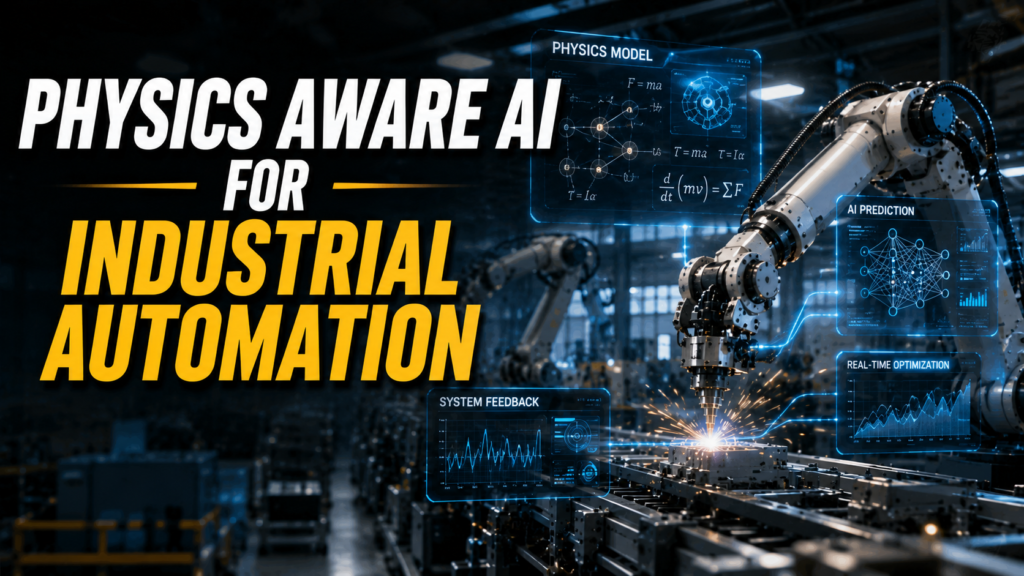
The future of industrial automation will not be defined only by faster machines or more connected devices. It will be defined by intelligent systems that understand the physical world around them.
Physics Aware AI represents a major advancement because it combines the power of artificial intelligence with scientific knowledge.
By enabling more accurate predictions, smarter decision making, improved efficiency, and safer operations, this technology is transforming how industries operate.
From predictive maintenance and autonomous factories to sustainable manufacturing and advanced robotics, Physics Aware AI is becoming a key foundation for the next generation of industrial innovation.
Organizations that adopt this technology early will gain significant advantages in efficiency, reliability, and competitiveness.
As industrial systems continue to evolve, Physics Aware AI will play a central role in creating smarter, safer, and more sustainable industries worldwide.
Also Read: “AI Powered Engineering Lifecycle Management“
Author
Frequently Asked Questions About Physics Aware AI for Industrial Automation
What is Physics Aware AI in industrial automation?
Physics Aware AI is an artificial intelligence approach that combines machine learning with scientific principles and engineering models. It allows industrial systems to make smarter decisions by understanding both data patterns and physical behavior.
How is Physics Aware AI different from traditional AI?
Traditional AI mainly learns from historical data, while Physics Aware AI combines data driven learning with physics based knowledge. This makes it more reliable when dealing with complex industrial processes where physical rules are important.
What industries can benefit from Physics Aware AI?
Many industries can benefit from this technology, including manufacturing, automotive, aerospace, energy, chemical processing, robotics, and healthcare equipment industries.