


Introduction
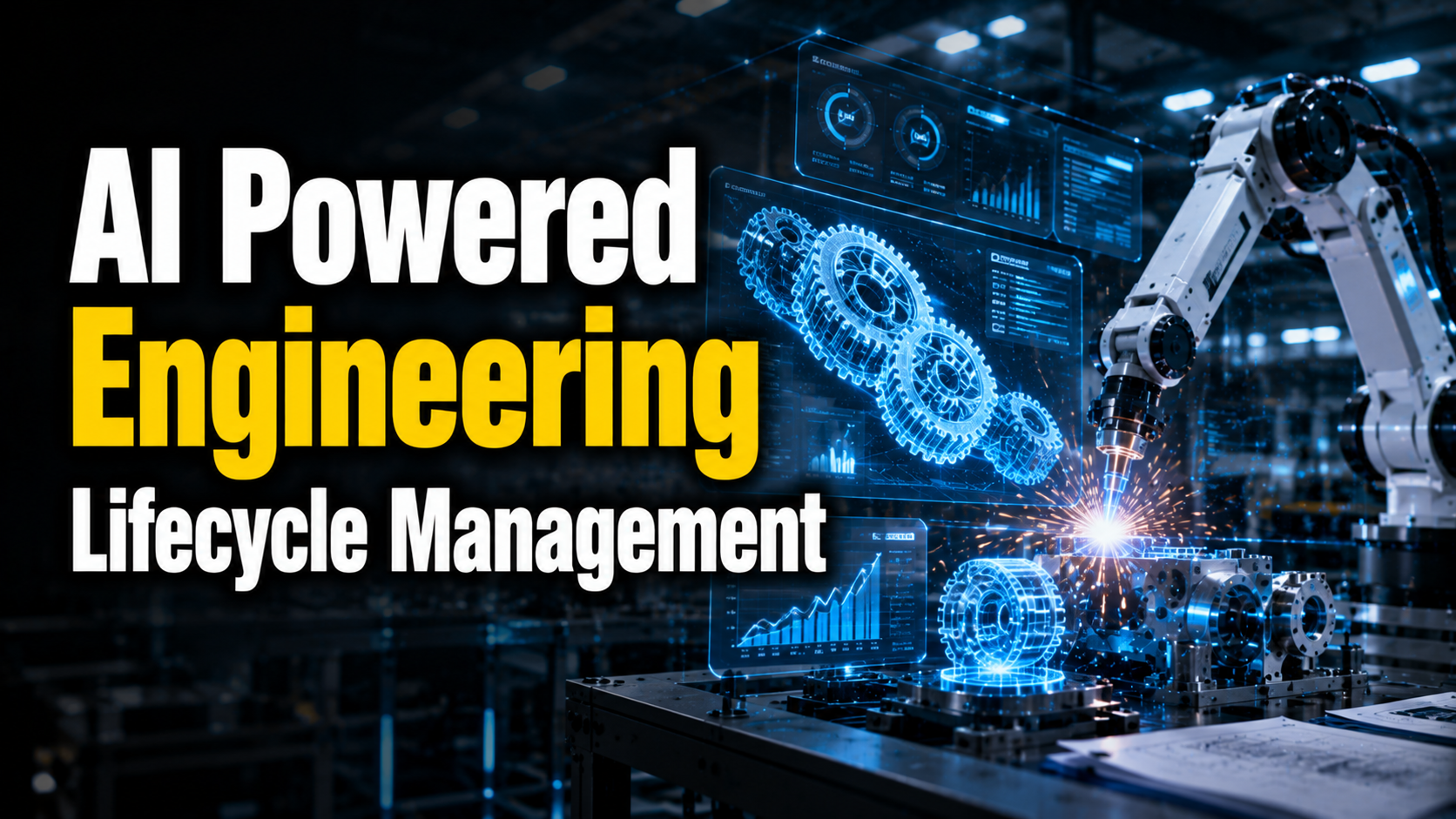
Engineering has always been the foundation of industrial innovation. Every product, machine, vehicle, software system, and industrial solution begins with engineering decisions that determine performance, reliability, safety, and long-term success. AI Powered Engineering Lifecycle Management.
However, modern engineering environments have become increasingly complex. Products are becoming more advanced, customer expectations are changing rapidly, and organizations must manage large amounts of technical information across multiple teams and development stages.
Traditional engineering lifecycle management methods are struggling to handle this growing complexity.
This is where AI Powered Engineering Lifecycle Management is becoming a major technological transformation.
AI Powered Engineering Lifecycle Management combines artificial intelligence, machine learning, automation, engineering data, simulation technologies, and digital collaboration platforms to improve every stage of product development.
From initial concept design and engineering analysis to testing, manufacturing, and product improvement, AI helps organizations make faster, smarter, and more accurate decisions.
Unlike traditional engineering management systems that mainly store and organize information, AI powered lifecycle platforms can understand data, identify patterns, predict challenges, automate repetitive activities, and provide intelligent recommendations.
The result is a more connected, efficient, and intelligent engineering ecosystem.
As industries such as automotive, aerospace, electronics, energy, healthcare technology, and industrial equipment become more competitive, AI powered engineering lifecycle management is becoming a critical capability for innovation and business growth.
Table of Contents
Understanding Engineering Lifecycle Management
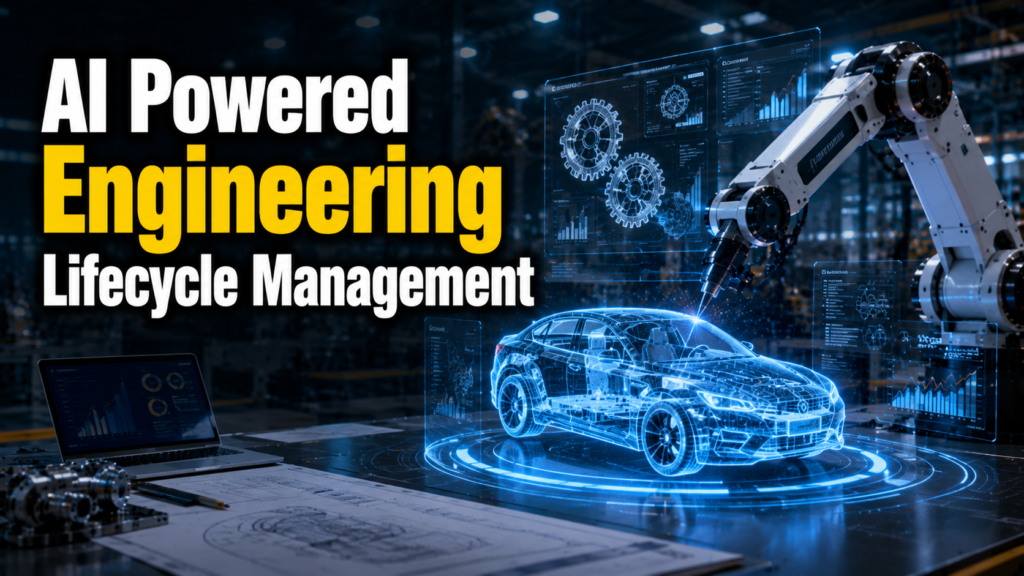
Engineering Lifecycle Management refers to the process of managing all activities involved in creating and improving a product throughout its entire journey.
The engineering lifecycle typically includes:
Concept development
Requirement analysis
Product design
Engineering simulation
Testing and validation
Manufacturing preparation
Product launch
Continuous improvement
Every stage generates valuable technical information.
In traditional engineering environments, this information is often distributed across different teams, software systems, documents, and databases.
This creates challenges such as:
Communication gaps
Data duplication
Slow decision making
Design errors
Difficulty tracking changes
Engineering Lifecycle Management systems were created to organize and manage this complexity.
When artificial intelligence is added, these systems become more powerful.
AI can analyze engineering information, discover hidden relationships, predict outcomes, and support engineers throughout the product development process.
What Is AI Powered Engineering Lifecycle Management?
AI Powered Engineering Lifecycle Management is an advanced approach that uses artificial intelligence technologies to improve the management, execution, and optimization of engineering processes.
It combines traditional lifecycle management capabilities with AI driven intelligence.
An AI powered engineering lifecycle platform can help organizations:
Analyze engineering requirements
Generate design recommendations
Predict product performance
Automate documentation
Identify potential failures
Optimize simulations
Improve collaboration
Accelerate innovation
The goal is not to replace engineers.
The goal is to provide engineers with intelligent tools that enhance creativity, accuracy, and productivity.
AI acts as a digital engineering assistant that helps teams make better decisions throughout the product lifecycle.
Why Engineering Lifecycle Management Needs AI
Modern products are becoming more complex than ever before.
A single product may involve:
Mechanical engineering
Electrical systems
Software development
Artificial intelligence
Materials science
Manufacturing processes
Regulatory requirements
Managing these interconnected areas requires enormous amounts of information.
Traditional approaches often create delays because engineers spend significant time searching for information, reviewing documents, analyzing data, and solving repetitive problems.
AI helps overcome these limitations by providing intelligent automation and advanced analysis.
For example, an AI system can review thousands of previous engineering projects and identify design patterns that may improve a new product.
It can analyze testing data and predict possible performance issues before physical prototypes are created.
This allows organizations to reduce development time and improve product quality.
The Evolution of Engineering Lifecycle Management
The transformation toward AI powered engineering lifecycle management has developed through several stages.
Traditional Engineering Management
Early engineering processes depended heavily on physical documents, manual calculations, and individual expertise.
Teams worked with limited collaboration and slower information exchange.
Digital Engineering Systems
Computer aided design and engineering software transformed product development.
Engineers could create digital models, perform simulations, and improve designs faster.
Integrated Lifecycle Management
Organizations began connecting engineering processes through lifecycle management platforms.
This improved collaboration and information management.
Intelligent Engineering Lifecycle Management
Artificial intelligence introduced prediction, automation, and decision support.
Engineering systems became capable of learning from previous projects and improving future outcomes.
Key Technologies Behind AI Powered Engineering Lifecycle Management
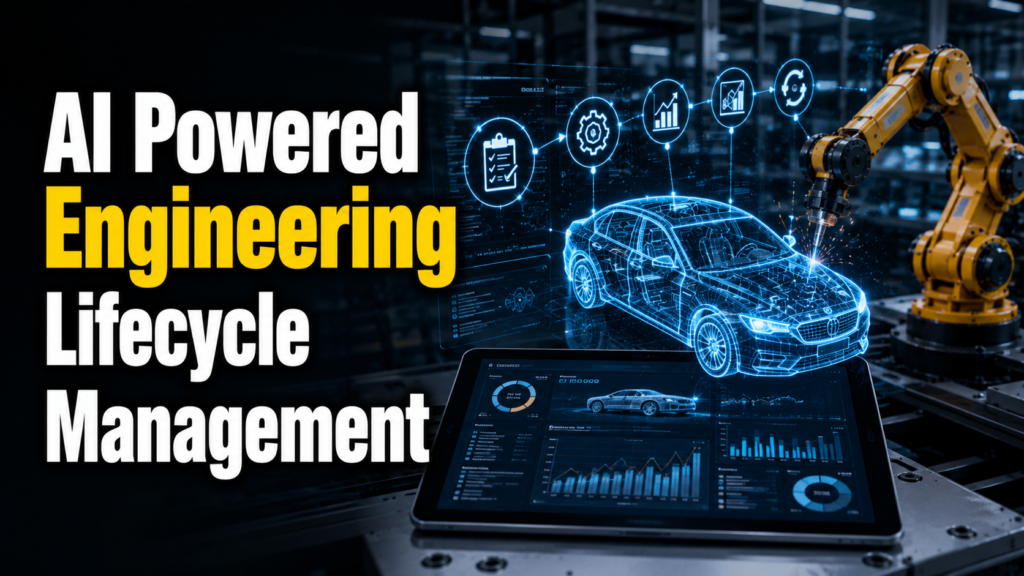
AI powered engineering lifecycle management depends on multiple advanced technologies.
Artificial Intelligence
Artificial intelligence provides the analytical capability behind intelligent engineering systems.
AI analyzes engineering data and supports:
Design optimization
Risk prediction
Performance analysis
Decision support
Process automation
AI allows engineering teams to work with greater speed and confidence.
Machine Learning
Machine learning enables engineering systems to learn from historical information.
It analyzes previous designs, test results, and performance data to identify patterns.
Machine learning supports:
Failure prediction
Design improvement
Manufacturing optimization
Engineering recommendations
Generative AI
Generative AI is becoming increasingly important in engineering workflows.
It can assist engineers by generating:
Design concepts
Technical documentation
Engineering explanations
Alternative solutions
Simulation suggestions
Generative AI acts as a creative partner that helps engineers explore more possibilities.
Digital Twins
Digital twins create virtual representations of physical products or systems.
They allow engineers to:
Test designs digitally
Predict performance
Identify problems early
Optimize product behavior
AI enhances digital twins by making them more intelligent and adaptive.
Simulation Intelligence
Engineering simulations generate large amounts of technical data.
AI helps analyze simulation results faster and identify important insights.
This improves:
Product reliability
Design decisions
Testing efficiency
Cloud Based Engineering Platforms
Cloud platforms enable global engineering collaboration.
AI integrated cloud systems allow teams to access:
Engineering data
Design information
Simulation results
Project insights
from different locations.
How AI Transforms the Engineering Lifecycle
AI impacts every stage of engineering development.
Intelligent Requirements Management
Requirements define what a product must achieve.
AI helps engineering teams analyze requirements by identifying:
Missing information
Conflicting requirements
Technical risks
Design dependencies
This improves project accuracy from the beginning.
AI Assisted Product Design
Design is one of the most creative stages of engineering.
AI supports engineers by suggesting improvements and generating alternative solutions.
It can analyze:
Performance requirements
Material choices
Manufacturing limitations
Historical designs
This helps engineers create better products faster.
Automated Engineering Analysis
Engineering analysis often requires complex calculations and simulations.
AI can accelerate analysis by identifying patterns and predicting outcomes.
This reduces the time needed for traditional evaluation processes.
Intelligent Testing and Validation
Testing is essential for product reliability.
AI analyzes testing information to identify:
Failure patterns
Performance issues
Potential improvements
This allows engineers to focus on solving important problems.
Manufacturing Integration
Engineering decisions directly affect manufacturing success.
AI helps connect engineering and production teams by analyzing:
Design feasibility
Manufacturing constraints
Material availability
Production efficiency
This reduces costly design changes later.
Product Improvement After Launch
Engineering does not end after product release.
AI continuously analyzes product performance data.
It identifies:
Customer usage patterns
Potential improvements
Reliability issues
Future design opportunities
This creates a continuous improvement cycle.
Major Benefits of AI Powered Engineering Lifecycle Management
AI powered engineering lifecycle management provides several advantages.
Faster Product Development
AI automation reduces repetitive tasks and accelerates engineering processes.
Companies can move from concept to production faster.
Improved Engineering Accuracy
AI helps identify potential issues early.
This reduces design mistakes and improves reliability.
Better Decision Making
Engineers receive data driven recommendations instead of relying only on assumptions.
Reduced Development Costs
Early problem detection reduces expensive redesign and testing cycles.
Enhanced Collaboration
AI powered platforms improve communication between engineering teams.
Increased Innovation
Engineers can explore more design possibilities with AI assistance.
Applications Across Industries
AI powered engineering lifecycle management is transforming many industries.
Automotive Industry
Automotive companies use AI to improve:
Vehicle design
Safety systems
Electric vehicle development
Autonomous driving technologies
Aerospace Industry
Aerospace engineering requires extreme precision.
AI supports:
Aircraft design
Performance analysis
Maintenance planning
Safety improvement
Electronics Industry
Electronics companies use AI to optimize:
Circuit design
Component selection
Testing processes
Product reliability
Energy Industry
Energy companies apply AI for:
Equipment optimization
System design
Predictive analysis
Sustainable engineering solutions
Healthcare Technology
Medical device companies use AI to improve:
Product development
Testing processes
Regulatory documentation
Challenges of AI Powered Engineering Lifecycle Management
Although AI provides significant benefits, organizations must address several challenges.
Data Quality Problems
AI requires high quality engineering data.
Incomplete or inconsistent information can affect results.
Integration Challenges
Companies often use multiple engineering systems.
Connecting these systems with AI platforms can be complex.
Security and Intellectual Property Protection
Engineering data contains valuable intellectual property.
Organizations must protect:
Design information
Technical documents
Product data
AI models
Workforce Adaptation
Engineers need new skills to work effectively with AI tools.
Training and learning are essential.
Trust in AI Recommendations
Engineers must understand how AI reaches conclusions.
Explainable AI helps improve confidence in AI generated insights.
Human Engineers and AI Collaboration
AI powered engineering lifecycle management is based on collaboration, not replacement.
Engineers provide:
Creativity
Experience
Strategic thinking
Technical judgment
AI provides:
Data analysis
Pattern recognition
Automation
Prediction
The combination creates stronger engineering capabilities.
The future engineer will not compete with AI.
The future engineer will use AI as a powerful innovation partner.
AI Powered Engineering Lifecycle Management and Industry Transformation
AI powered engineering lifecycle management is becoming a foundation for digital transformation.
Companies that successfully integrate AI into engineering processes can achieve:
Faster innovation cycles
Better product quality
Improved operational efficiency
Greater market responsiveness
In competitive industries, engineering intelligence has become a major advantage.
Future Trends in AI Powered Engineering Lifecycle Management
The future of engineering lifecycle management will continue evolving.
Several trends are expected to shape the industry.
Autonomous Engineering Assistance
AI systems will increasingly support engineers throughout product development.
Self Improving Design Systems
AI will learn from previous projects and continuously improve recommendations.
Real Time Engineering Optimization
Engineering decisions will become more dynamic through real time data analysis.
AI Integrated Digital Twins
Digital twins will become more intelligent and capable of predicting complex behaviors.
Collaborative Human AI Engineering Teams
Engineering teams will combine human creativity with AI capabilities.
How Organizations Can Prepare for AI Powered Engineering Lifecycle Management
Companies preparing for AI transformation should focus on a structured approach.
They should:
Improve engineering data management
Modernize digital infrastructure
Identify valuable AI applications
Train engineering teams
Develop responsible AI practices
Strengthen cybersecurity
Successful adoption requires technology, people, and processes working together.
Conclusion
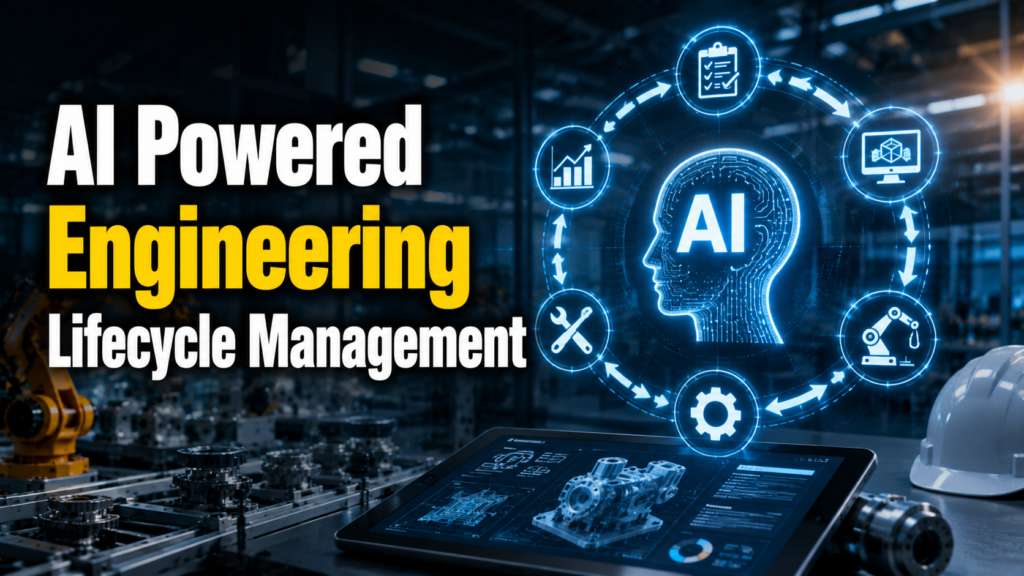
AI Powered Engineering Lifecycle Management represents a major shift in how products are designed, developed, tested, and improved.
By combining artificial intelligence, machine learning, digital twins, simulation technologies, and engineering expertise, organizations can create faster, smarter, and more innovative product development processes.
The future of engineering will not be defined only by human knowledge or machine intelligence.
It will be defined by collaboration between both.
AI will help engineers analyze complex challenges, discover new possibilities, and make better decisions.
Engineering teams that embrace AI powered lifecycle management will be better prepared to create the products and technologies of tomorrow.
Also Read: “Hyperconnected Manufacturing Networks“
Author
Frequently Asked Questions
What is AI Powered Engineering Lifecycle Management?
AI Powered Engineering Lifecycle Management is the use of artificial intelligence and advanced technologies to improve product development, engineering collaboration, decision making, and lifecycle management.
How does AI help engineers?
AI helps engineers by automating repetitive tasks, analyzing complex data, predicting problems, generating recommendations, and improving design decisions.
Can AI replace engineering professionals?
AI will not replace engineers. Instead, it will enhance engineering capabilities by helping professionals work faster, solve complex problems, and focus on innovation.