

Introduction
Manufacturing has always been shaped by technological evolution. From mechanical production lines to automated robotics and connected factories, every industrial revolution has introduced new ways to improve efficiency, quality, and productivity. Today, the manufacturing industry is entering another transformative phase driven by artificial intelligence, where machines are becoming more intelligent, adaptive, and capable of understanding complex industrial environments.
One of the most important advancements in this transformation is Context Aware AI in Manufacturing. Context Aware AI in Manufacturing: How Intelligent Systems Are Transforming the Future of Smart Factories.
Unlike traditional artificial intelligence systems that analyze data based on predefined instructions, context aware AI can understand the surrounding situation, recognize patterns, interpret operational conditions, and make more accurate decisions based on real world circumstances.
In a modern factory, millions of data points are generated every second from machines, sensors, production systems, supply chains, and human interactions. However, raw data alone does not create value. The real advantage comes from understanding the meaning behind that data.
Context aware AI provides this intelligence layer by connecting information from different sources and understanding why something is happening rather than simply identifying what is happening.
For manufacturers, this technology represents a major step toward creating truly intelligent factories where machines can predict failures, optimize production, improve worker safety, reduce waste, and continuously adapt to changing conditions.
As industries worldwide focus on automation, sustainability, and operational excellence, context aware AI is becoming a critical technology for the future of manufacturing.
Table of Contents
What Is Context Aware AI in Manufacturing?
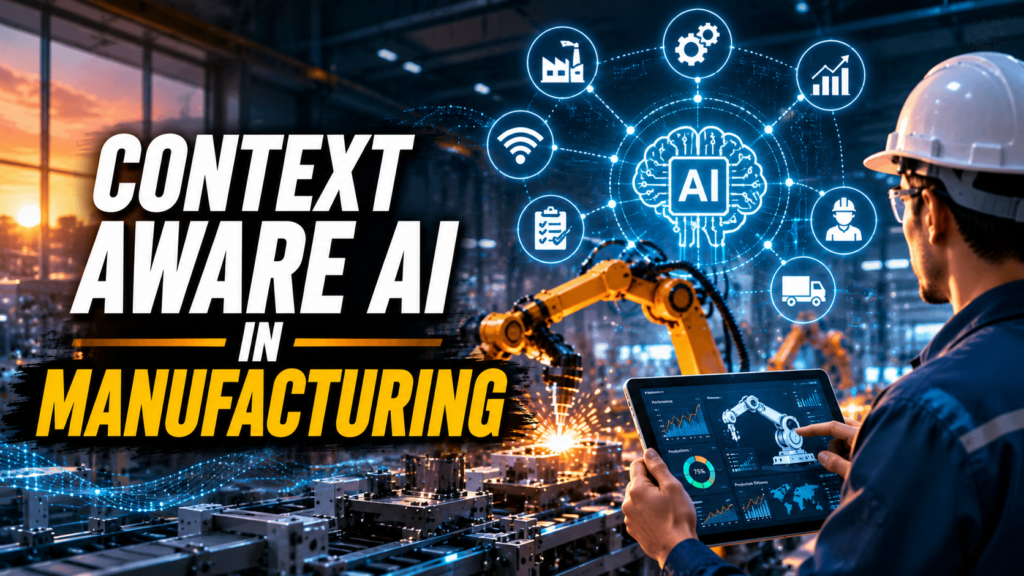
Context aware AI refers to artificial intelligence systems that can understand and respond to the environment, situation, and circumstances surrounding a specific task.
In manufacturing, this means AI systems do not simply analyze machine data in isolation. They consider multiple factors such as production schedules, equipment conditions, employee activity, environmental conditions, material availability, and historical performance.
For example, a traditional AI system may detect that a machine temperature is increasing. A context aware AI system goes further by analyzing additional information:
The current production workload
The machine’s maintenance history
The type of material being processed
Environmental temperature
Previous equipment behavior
Production deadlines
Based on this complete context, the AI system can determine whether the temperature increase is normal, requires maintenance, or could lead to a potential failure.
This ability to understand relationships between different factors makes context aware AI significantly more powerful than conventional automation systems.
Why Context Matters in Modern Manufacturing
Manufacturing environments are highly complex. Production decisions depend on hundreds of interconnected variables.
A machine problem may not always be caused by the machine itself. It could result from material quality, incorrect settings, environmental changes, operator actions, or supply chain disruptions.
Traditional systems often struggle because they evaluate individual data points without understanding the complete situation.
Context aware AI solves this challenge by creating a broader understanding of manufacturing operations.
For example, if a production line slows down, context aware AI can analyze:
Machine performance data
Operator workflow
Production targets
Inventory availability
Previous production patterns
Maintenance records
Instead of providing a simple alert, it can recommend the most effective solution.
This shift from data analysis to intelligent decision making is changing how factories operate.
How Context Aware AI Works in Manufacturing
Context aware AI combines multiple technologies to create intelligent industrial systems.
The process usually begins with data collection. Sensors, machines, enterprise software, and operational systems continuously generate information.
The AI system then processes this information and identifies relationships between different factors.
Machine learning models analyze previous events to understand patterns. Over time, the system becomes better at predicting outcomes and recommending actions.
The result is an intelligent manufacturing environment where decisions are based on real time understanding rather than fixed rules.
The Role of Context Aware AI in Smart Factories
Smart factories represent the future of manufacturing. They combine automation, connectivity, analytics, and artificial intelligence to create self improving production environments.
Context aware AI acts as the intelligence engine behind these factories.
A smart factory powered by context aware AI can:
Monitor equipment performance continuously
Predict maintenance requirements
Automatically adjust production settings
Improve product quality
Optimize energy usage
Support workers with real time recommendations
Respond quickly to unexpected situations
This creates a manufacturing environment that is more flexible, efficient, and resilient.
Key Applications of Context Aware AI in Manufacturing
Predictive Maintenance
Predictive maintenance is one of the most valuable applications of context aware AI.
Traditional maintenance schedules are often based on fixed time periods. However, machines do not always fail according to a schedule.
Context aware AI analyzes machine behavior, vibration patterns, temperature changes, energy consumption, and historical maintenance records to predict potential failures.
This allows manufacturers to repair equipment before breakdowns occur.
The benefits include:
Reduced downtime
Lower maintenance costs
Improved equipment lifespan
Higher production reliability
Quality Control and Defect Detection
Product quality is essential for manufacturing success.
AI powered computer vision systems can inspect products faster and more accurately than manual processes.
Context aware AI improves these systems by understanding production conditions.
For example, it can recognize whether a defect is caused by:
Machine calibration issues
Material problems
Environmental changes
Production speed
Previous manufacturing patterns
This helps manufacturers identify root causes instead of only detecting problems.
Production Optimization
Manufacturers constantly need to balance production speed, quality, and cost.
Context aware AI can analyze production workflows and recommend improvements.
It can identify:
Production bottlenecks
Resource inefficiencies
Energy waste
Scheduling conflicts
Process improvements
By understanding the complete production environment, AI can support better operational decisions.
Supply Chain Intelligence
Modern manufacturing depends on complex global supply chains.
Unexpected events such as transportation delays, material shortages, and market changes can disrupt production.
Context aware AI can analyze supply chain information and provide early warnings.
It can help manufacturers:
Predict demand changes
Optimize inventory levels
Identify supplier risks
Improve logistics planning
This creates more resilient supply networks.
Worker Safety Enhancement
Human safety remains one of the most important priorities in manufacturing.
Context aware AI can monitor workplace conditions and identify potential risks.
Examples include:
Detecting unsafe behavior
Monitoring hazardous environments
Analyzing equipment interactions
Providing safety recommendations
By combining sensor data and intelligent analysis, AI can create safer workplaces.
Benefits of Context Aware AI in Manufacturing
The adoption of context aware AI provides several advantages for manufacturers.
These benefits make context aware AI an important investment for companies seeking long term competitiveness.
Context Aware AI Compared With Traditional Manufacturing AI
Traditional manufacturing AI systems often rely on specific rules and limited datasets.
They may answer questions such as:
Is the machine temperature too high?
Is the product defective?
Has production slowed?
However, they may not understand the reason behind these situations.
Context aware AI provides deeper intelligence.
It asks:
Why did this happen?
What factors contributed to the problem?
What action will create the best outcome?
This difference allows manufacturers to move from reactive problem solving toward proactive optimization.
Challenges of Implementing Context Aware AI
Although context aware AI offers significant benefits, manufacturers must address several challenges.
Data Management
AI systems require high quality data. Many factories operate with older equipment that may not generate compatible digital information.
Companies often need to upgrade sensors, connectivity, and data infrastructure.
Integration With Existing Systems
Manufacturing environments usually contain multiple technologies from different vendors.
Integrating AI with existing systems can require careful planning.
Cybersecurity Risks
Connected factories create new cybersecurity challenges.
Manufacturers must protect industrial systems from unauthorized access and potential threats.
Workforce Training
Employees need appropriate skills to work with AI technologies.
Successful adoption requires training programs that help workers understand and effectively use intelligent systems.
Cost Considerations
Implementing advanced AI solutions requires investment in technology, infrastructure, and expertise.
However, many manufacturers view these costs as long term investments because of efficiency improvements and operational benefits.
The Future of Context Aware AI in Manufacturing
The future of manufacturing will increasingly depend on intelligent systems that can understand, learn, and adapt.
Future context aware AI solutions are expected to become more advanced through:
Improved machine reasoning
More accurate digital twins
Advanced robotics integration
Autonomous production decisions
Better human machine collaboration
Real time global supply chain intelligence
As artificial intelligence continues to evolve, factories may move closer to fully autonomous manufacturing environments.
However, the most successful future factories will likely combine human expertise with AI capabilities rather than completely replacing human involvement.
Human creativity, problem solving, and strategic thinking will remain essential.
How Businesses Can Prepare for Context Aware AI Adoption
Companies planning to adopt context aware AI should focus on a structured approach.
First, businesses should evaluate existing manufacturing processes and identify areas where AI can provide the greatest value.
Second, companies should improve data collection capabilities through connected devices and industrial sensors.
Third, organizations should develop cybersecurity strategies to protect intelligent systems.
Finally, businesses should invest in employee training to create a workforce capable of working alongside AI technologies.
A successful AI transformation requires both technological development and organizational readiness.
Context Aware AI and Sustainable Manufacturing
Sustainability has become a major priority for manufacturers worldwide.
Context aware AI can support sustainable production by reducing waste, optimizing energy consumption, and improving resource efficiency.
AI systems can analyze energy usage patterns and recommend adjustments.
They can also identify material waste and suggest process improvements.
By making manufacturing more efficient, context aware AI contributes to environmental goals while reducing operational expenses.
The Business Impact of Context Aware AI
For businesses, context aware AI is not only a technology upgrade. It represents a strategic advantage.
Companies using intelligent manufacturing systems can respond faster to market changes, improve customer satisfaction, and operate more efficiently.
Manufacturers that successfully adopt AI technologies may gain advantages through:
Faster production cycles
Higher product quality
Lower operational costs
Improved innovation capabilities
Stronger supply chain performance
As competition increases globally, intelligent manufacturing will become an important factor in business success.
Conclusion
Context Aware AI in Manufacturing is transforming traditional factories into intelligent, adaptive, and highly efficient environments.
By understanding operational context, AI systems can move beyond simple automation and provide meaningful insights, predictions, and recommendations.
From predictive maintenance and quality control to supply chain optimization and worker safety, context aware AI is creating new possibilities across the manufacturing industry.
The journey toward intelligent manufacturing requires investment, planning, and responsible implementation. Companies must focus on data quality, cybersecurity, workforce development, and ethical AI practices.
The future factory will not simply be automated. It will be intelligent, connected, and capable of continuously improving.
Context aware AI represents a major foundation for this future, helping manufacturers achieve greater efficiency, sustainability, and innovation in an increasingly competitive world.
Also Read: “AI Governance Blueprint for Manufacturing“
Author
Frequently Asked Questions
What is Context Aware AI in Manufacturing?
Context aware AI in manufacturing is an artificial intelligence technology that understands the surrounding conditions of industrial operations and makes decisions based on real time information, historical data, and operational factors.
How does Context Aware AI improve manufacturing efficiency?
It improves efficiency by predicting equipment problems, optimizing production processes, reducing waste, improving quality control, and providing faster decision support.
Is Context Aware AI replacing manufacturing workers?
Context aware AI is mainly designed to support workers by improving decision making, safety, and productivity. Human expertise remains important for managing complex operations and innovation.