
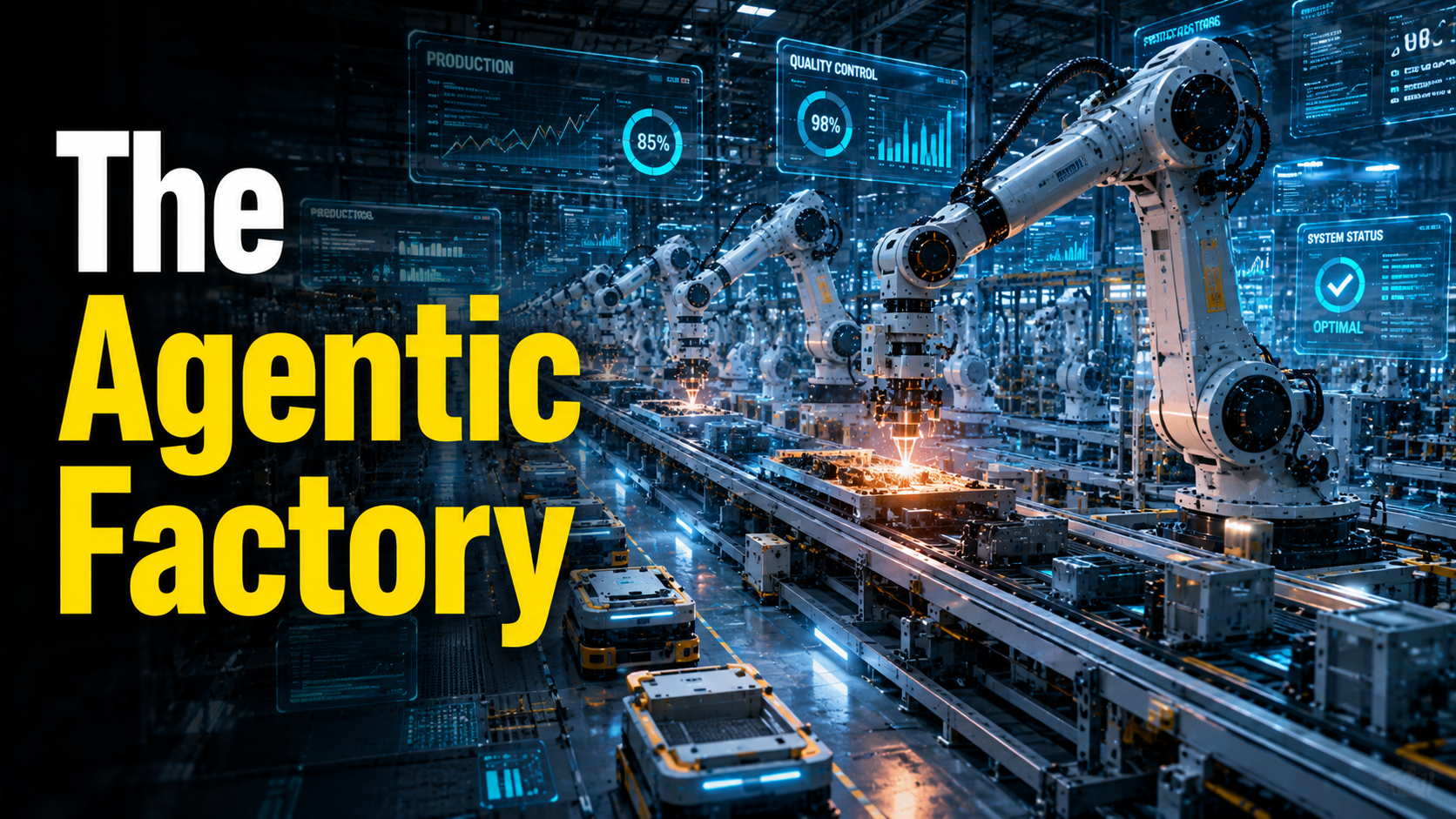
Manufacturing has always evolved alongside technology. From steam-powered machinery during the First Industrial Revolution to the connected smart factories of Industry 4.0, every industrial leap has fundamentally changed how products are designed, produced, and delivered. Today, the manufacturing sector stands at the threshold of another transformative era, one powered not merely by automation, but by Agentic AI. The Agentic Factory.
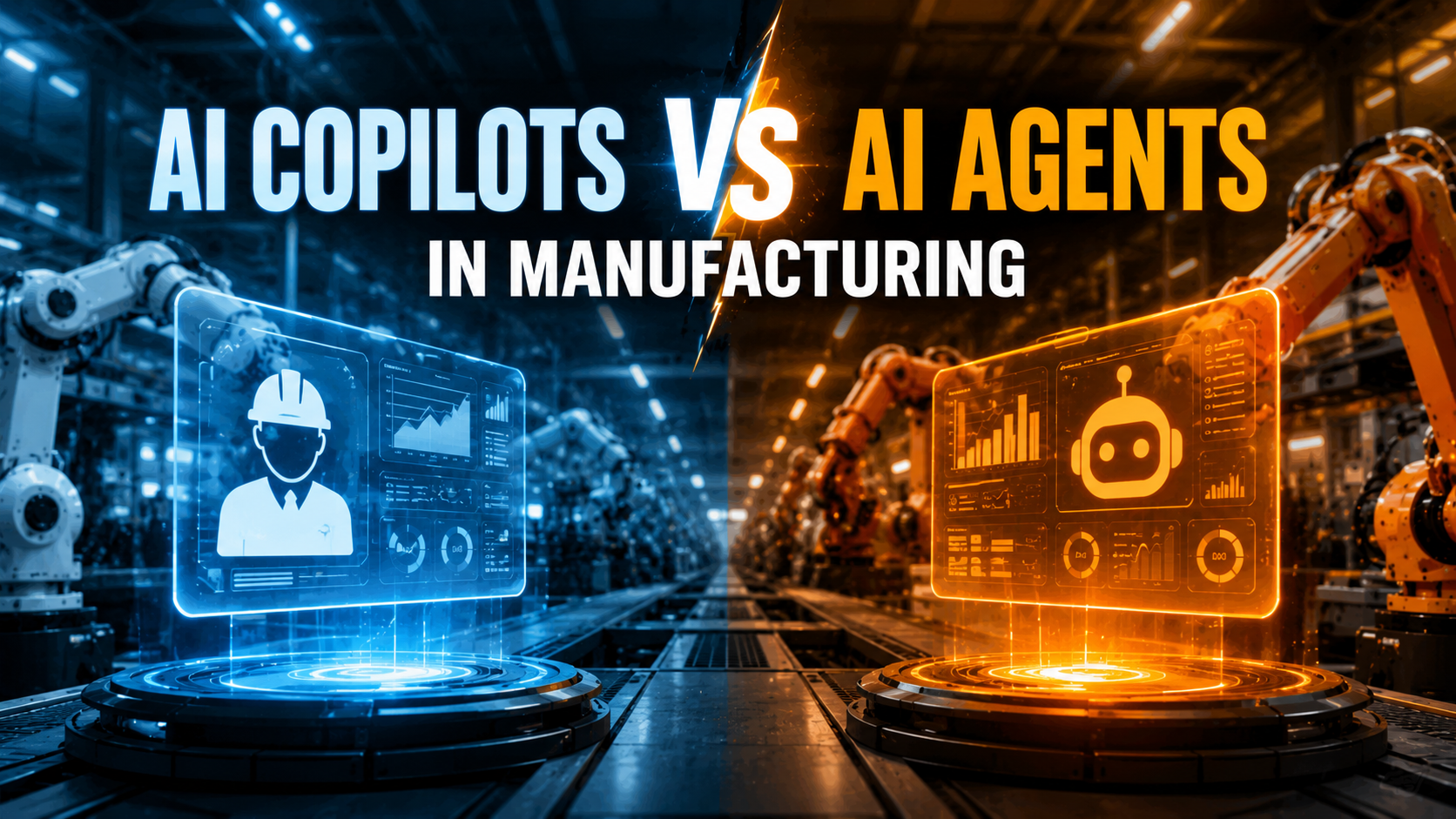
For years, manufacturers have invested heavily in artificial intelligence, Industrial Internet of Things (IIoT), robotics, cloud computing, digital twins, and advanced analytics. These technologies have improved efficiency, reduced downtime, and enabled data-driven decision-making. However, most AI systems still function as sophisticated assistants. They provide recommendations, generate insights, or automate predefined tasks while humans remain responsible for interpreting information and making final decisions.
The next evolution is different.
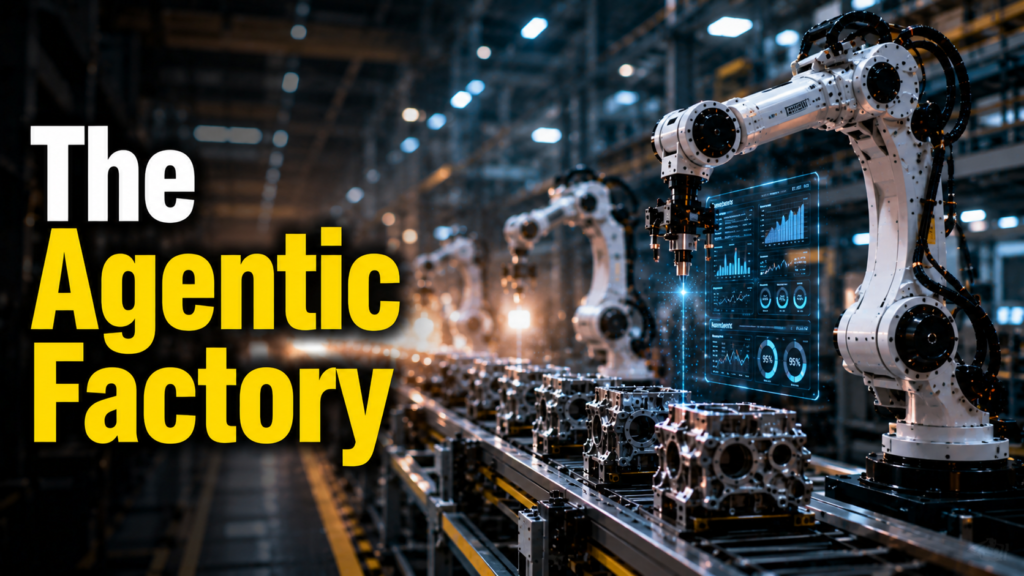
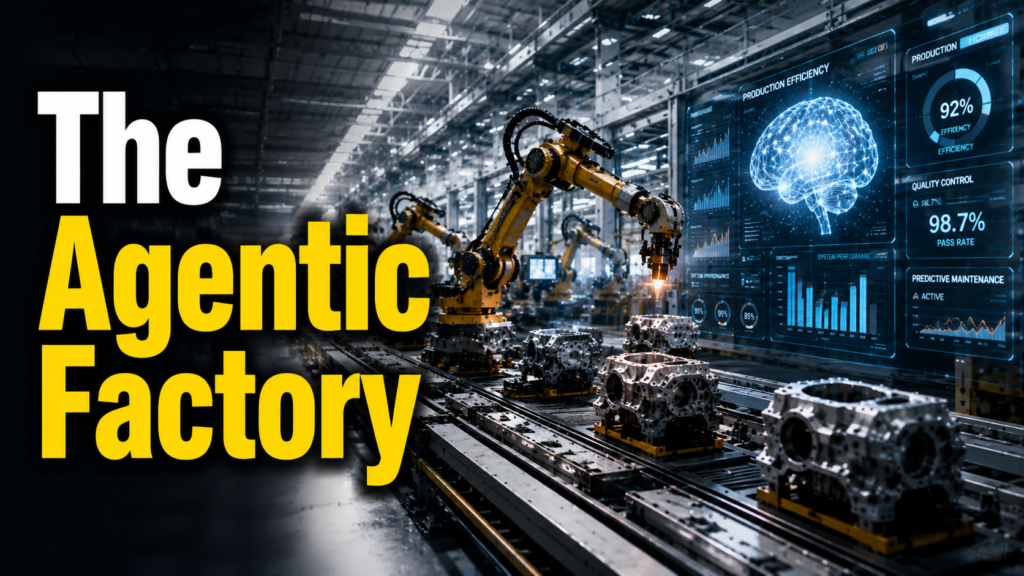
The Agentic Factory introduces intelligent AI agents capable of understanding goals, planning multi-step actions, collaborating with other systems, adapting to changing conditions, and executing decisions within predefined operational boundaries. Instead of waiting for instructions, these AI agents actively manage production schedules, monitor equipment health, optimize energy consumption, coordinate logistics, and support quality assurance, all while working alongside human experts.
This shift represents more than another technological upgrade. It marks the emergence of factories where intelligent software agents become active participants in manufacturing operations. Rather than replacing workers, Agentic AI augments human expertise by handling complex, repetitive, and data-intensive decision-making at machine speed.
As manufacturers face rising customer expectations, supply chain uncertainty, labor shortages, sustainability targets, and increasing operational complexity, the Agentic Factory offers a powerful framework for building agile, resilient, and human-centric production systems.
In this comprehensive guide, we’ll explore what the Agentic Factory is, how Agentic AI differs from traditional AI, the technologies enabling autonomous manufacturing, key benefits, practical applications, implementation strategies, challenges, and future trends shaping the next generation of industrial innovation.
Table of Contents
What Is the Agentic Factory?
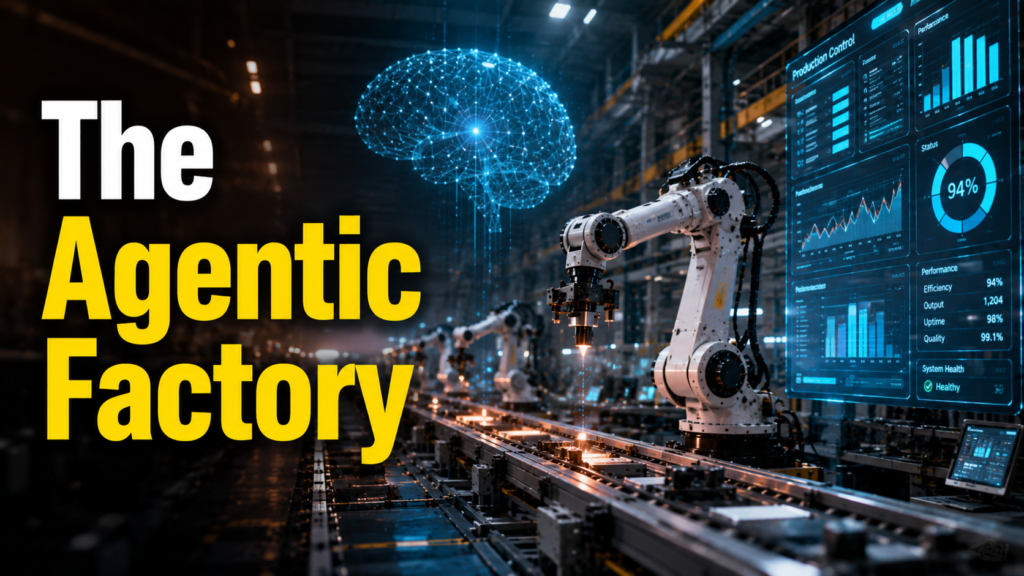
The Agentic Factory is a manufacturing environment where autonomous AI agents continuously monitor operations, interpret data, make context-aware decisions, coordinate actions across systems, and collaborate with human workers to achieve production objectives.
Unlike conventional automation, which follows predefined rules, Agentic AI is goal-oriented. It can evaluate multiple options, adapt to changing circumstances, and execute multi-step workflows while remaining aligned with organizational policies and human oversight.
An AI agent in a factory may:
- Detect a production bottleneck.
- Analyze machine performance and inventory levels.
- Reschedule production automatically.
- Coordinate with warehouse systems.
- Notify maintenance teams.
- Adjust robotic workflows.
- Generate reports for managers.
Rather than acting as a passive tool, the AI becomes an intelligent operational partner.
What Is Agentic AI?
Agentic AI refers to artificial intelligence systems capable of independently pursuing goals through reasoning, planning, decision-making, learning, and action.
Traditional AI typically performs narrow tasks such as image recognition, forecasting, or anomaly detection. Agentic AI goes further by combining these capabilities into end-to-end workflows.
Key characteristics include:
- Goal-oriented behavior
- Autonomous planning
- Multi-step reasoning
- Continuous learning
- Context awareness
- Collaboration with humans and other AI agents
- Adaptive decision-making
- Safe execution within predefined guardrails
Instead of simply answering questions or generating predictions, Agentic AI actively works toward achieving business outcomes
Why Manufacturing Needs Agentic AI
Manufacturing environments are becoming increasingly complex due to:
- Global supply chains
- Customized production
- Workforce shortages
- Sustainability regulations
- Equipment complexity
- Rising customer expectations
- Volatile market demand
Traditional automation cannot always respond effectively to rapidly changing conditions.
Agentic AI enables factories to become proactive rather than reactive.
For example, instead of alerting a supervisor about a delayed shipment, an AI agent could automatically:
- Identify alternative suppliers
- Update production schedules
- Notify affected departments
- Reallocate inventory
- Recommend cost-effective adjustments
This significantly reduces operational delays and manual coordination.
Evolution of Manufacturing Intelligence
| Manufacturing Era | Primary Technology | Decision-Making |
|---|---|---|
| Industry 3.0 | PLCs and automation | Human-led |
| Industry 4.0 | IoT, AI, analytics | AI-assisted |
| Industry 5.0 | Human-machine collaboration | Shared decision-making |
| Agentic Factory | Autonomous AI agents | Goal-driven with human oversight |
The Agentic Factory builds on Industry 4.0 and Industry 5.0 by introducing AI systems that can coordinate and execute complex operational tasks.
Core Technologies Behind the Agentic Factory
The Agentic Factory combines multiple technologies into an intelligent ecosystem.
| Technology | Role |
|---|---|
| Agentic AI | Autonomous planning and execution |
| Artificial Intelligence | Pattern recognition and optimization |
| Machine Learning | Continuous improvement from operational data |
| Industrial IoT (IIoT) | Real-time equipment monitoring |
| Digital Twins | Virtual simulation of assets and processes |
| Cloud Computing | Centralized analytics and orchestration |
| Edge Computing | Low-latency processing near equipment |
| Robotics & Cobots | Physical task execution |
| Computer Vision | AI-powered quality inspection |
| Generative AI | Documentation, recommendations, and knowledge support |
Together, these technologies create factories capable of sensing, reasoning, acting, and learning continuously.
How the Agentic Factory Works
An Agentic Factory operates through a continuous cycle:
1. Sense
IoT sensors, cameras, PLCs, ERP systems, MES platforms, and digital twins provide real-time operational data.
2. Understand
AI agents analyze production conditions, equipment status, inventory levels, and quality metrics.
3. Plan
Based on organizational goals, the AI generates optimized action plans while considering constraints such as production capacity, deadlines, workforce availability, and energy usage.
4. Act
Within approved policies, AI agents execute actions by interacting with manufacturing systems, scheduling software, robots, and enterprise applications.
5. Learn
Every action and outcome becomes training data that improves future decision-making.
Benefits of the Agentic Factory
Faster Decision-Making
AI agents evaluate thousands of variables in seconds, enabling faster operational responses than traditional manual processes.
Increased Productivity
Autonomous coordination reduces idle time, optimizes scheduling, and improves overall equipment effectiveness (OEE).
Predictive and Prescriptive Maintenance
Beyond predicting failures, AI agents can automatically create maintenance work orders, reserve spare parts, and coordinate technician availability.
Enhanced Supply Chain Resilience
Agentic AI continuously monitors suppliers, logistics, inventory, and demand forecasts to mitigate disruptions proactively.
Improved Product Quality
AI agents integrate computer vision, sensor data, and statistical process control to detect defects early and adjust production parameters before quality issues escalate.
Better Energy Optimization
Autonomous systems can balance machine utilization, production timing, and energy consumption to reduce operational costs and support sustainability goals.
Human Empowerment
Rather than replacing skilled workers, Agentic AI automates repetitive coordination tasks, allowing employees to focus on innovation, engineering, continuous improvement, and strategic decision-making.
Real-World Applications
Intelligent Production Scheduli
AI agents dynamically adjust schedules based on machine availability, customer priorities, workforce capacity, and material supply.
Autonomous Quality Assurance
Computer vision agents inspect products in real time, identify defects, and trigger corrective actions automatically.
AI-Driven Maintenance
Maintenance agents analyze sensor data, estimate remaining useful life, and coordinate repair activities before failures occur.
Smart Inventory Management
AI monitors stock levels, forecasts demand, and initiates replenishment workflows while minimizing excess inventory.
Energy Management
Autonomous agents optimize energy-intensive operations by scheduling production during lower-demand periods and reducing unnecessary equipment usage.
Digital Twin Coordination
AI agents interact with digital twins to simulate process changes, evaluate alternatives, and validate improvements before implementation.
Agentic AI vs Traditional Industrial AI
| Traditional Industrial AI | Agentic AI |
|---|---|
| Generates predictions | Pursues operational goals |
| Responds to queries | Initiates actions |
| Executes predefined workflows | Plans adaptive workflows |
| Limited collaboration | Coordinates across multiple systems |
| Human-driven execution | Shared autonomous execution |
| Static automation | Dynamic optimization |
This evolution transforms AI from an analytical tool into an operational collaborator.
The Role of Humans in the Agentic Factory
The rise of Agentic AI does not eliminate the need for human expertise. Instead, it redefines roles.
Employees increasingly focus on:
- Strategic planning
- Process innovation
- Ethical oversight
- Complex problem-solving
- Customer engagement
- Continuous improvement
- AI supervision
- Cross-functional collaboration
The most successful factories will combine human judgment with AI speed and scalability.
Implementation Strategy
Organizations adopting the Agentic Factory model should follow a phased approach.
1. Assess Digital Readiness
Evaluate existing data infrastructure, automation systems, and operational maturity.
2. Build Reliable Data Foundations
High-quality, secure, and integrated data is essential for effective AI decision-making.
3. Start with High-Impact Use Cases
Pilot projects such as predictive maintenance, production scheduling, or quality inspection provide measurable value and organizational learning.
4. Integrate AI Agents with Enterprise Systems
Connect AI agents to ERP, MES, CMMS, WMS, and SCADA platforms to enable coordinated decision-making.
5. Establish Human Governance
Define approval workflows, escalation procedures, accountability, and performance metrics to ensure AI operates within organizational policies.
6. Scale Gradually
Expand successful pilots across production lines, facilities, and supply chains while continuously refining AI models.
Challenges of the Agentic Factory
Data Quality
AI agents require accurate, timely, and consistent data. Poor data quality can lead to ineffective decisions.
Cybersecurity
As autonomous systems gain greater operational authority, protecting industrial networks from cyber threats becomes even more critical.
Legacy System Integration
Older manufacturing equipment may require modernization or retrofit solutions to communicate effectively with AI platforms.
Workforce Readiness
Employees need training to collaborate confidently with autonomous systems and interpret AI recommendations.
Ethical Governance
Organizations must establish clear policies covering transparency, accountability, safety, and responsible AI use.
Best Practices for Success
- Begin with clearly defined business objectives.
- Ensure robust cybersecurity across IT and OT environments.
- Involve operations, engineering, IT, and frontline employees early in the transformation process.
- Maintain human oversight for high-impact decisions.
- Measure success using KPIs such as OEE, downtime, first-pass yield, maintenance costs, energy efficiency, and customer satisfaction.
- Continuously improve AI models through feedback loops and operational learning.
Future Trends
Multi-Agent Collaboration
Specialized AI agents for production, maintenance, logistics, procurement, and sustainability will coordinate seamlessly across the enterprise.
Generative AI Integration
Generative AI will support engineers by creating reports, work instructions, simulations, troubleshooting guides, and optimization recommendations in natural language.
Autonomous Supply Chains
Agentic AI will extend beyond factories to coordinate suppliers, transportation providers, warehouses, and customers in real time.
Hyper-Personalized Manufacturing
AI agents will enable efficient production of highly customized products without sacrificing scalability or cost efficiency.
Sustainable Manufacturing
Agentic systems will optimize energy consumption, reduce waste, monitor emissions, and support circular manufacturing strategies.
Business Impact of the Agentic Factory
Organizations adopting Agentic AI can expect improvements across key operational metrics.
| Business Area | Expected Impact |
|---|---|
| Production Efficiency | Higher throughput and reduced bottlenecks |
| Equipment Availability | Improved uptime through intelligent maintenance |
| Product Quality | More consistent quality and fewer defects |
| Supply Chain Resilience | Faster response to disruptions |
| Energy Efficiency | Lower operating costs and emissions |
| Employee Productivity | Greater focus on innovation and high-value work |
| Decision Speed | Faster, data-driven operational responses |
| Competitive Advantage | Increased agility and customer responsiveness |
Conclusion
The Agentic Factory represents the next major milestone in manufacturing’s digital evolution. While Industry 4.0 connected machines and Industry 5.0 emphasized collaboration between people and technology, the Agentic Factory introduces intelligent AI agents capable of reasoning, planning, coordinating, and acting in pursuit of operational goals.
This transformation is not about removing humans from manufacturing. It is about creating a workplace where AI handles data-intensive coordination and routine operational decisions while people contribute creativity, engineering expertise, ethical judgment, and strategic leadership.
Manufacturers adopting Agentic AI stand to gain faster decision-making, improved operational resilience, predictive maintenance, enhanced product quality, optimized energy use, and greater adaptability in an increasingly complex global market. Success, however, depends on more than advanced algorithms. It requires trustworthy data, robust cybersecurity, effective governance, workforce development, and a clear commitment to human oversight.
As autonomous intelligence becomes more capable and industrial ecosystems become increasingly interconnected, the Agentic Factory is poised to become a defining model for the future of manufacturing. Organizations that begin building this foundation today will be better prepared to innovate, compete, and thrive in the era of intelligent, autonomous, and human-centered production.
Also Read: “The Shift From Software Tools to AI Systems“
Author
Frequently Asked Questions (FAQs)
1. What is an Agentic Factory?
An Agentic Factory is a manufacturing environment where autonomous AI agents monitor operations, analyze data, make context-aware decisions, coordinate workflows, and collaborate with human workers to optimize production, maintenance, quality, and supply chain activities.
2. How is Agentic AI different from traditional AI in manufacturing?
Traditional AI primarily provides predictions, analytics, or task-specific automation. Agentic AI goes further by pursuing goals, planning multi-step actions, coordinating with multiple systems, adapting to changing conditions, and executing approved workflows with human oversight.
3. Which industries can benefit from the Agentic Factory?
Industries such as automotive, aerospace, electronics, pharmaceuticals, food and beverage, chemicals, energy, logistics, and advanced manufacturing can benefit from Agentic AI through improved efficiency, predictive maintenance, quality assurance, and operational resilience.