


Introduction: A Fundamental Transformation in Computing
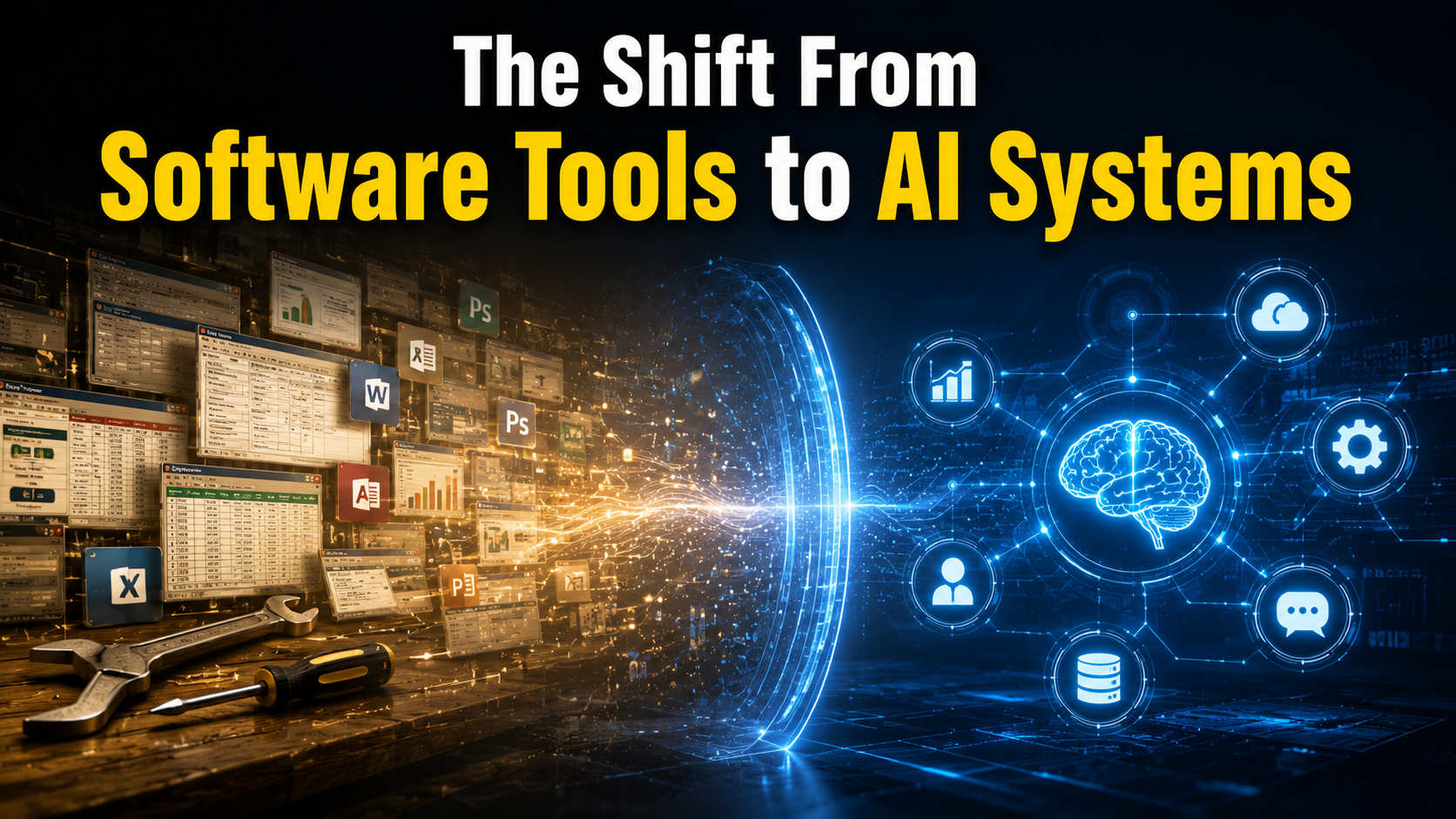
For decades, software has been the foundation of the digital economy. The Shift From Software Tools to AI Systems.
From spreadsheets and email applications to customer relationship management platforms and enterprise systems, software tools have enabled businesses and individuals to perform tasks more efficiently. Every major technological advancement over the past forty years has largely been built on a simple concept: humans use software tools to accomplish work.
Today, that model is beginning to change.
Artificial Intelligence is transforming software from passive tools into active systems capable of reasoning, learning, decision-making, and autonomous execution. Instead of simply responding to user commands, modern AI systems can understand goals, analyze situations, recommend actions, and increasingly perform tasks on behalf of users.
This shift represents one of the most significant technological transitions since the rise of personal computing and the internet.
Businesses are moving from software-centric operations to intelligence-centric operations. Employees are beginning to collaborate with AI agents rather than merely use software applications. Consumers are interacting with intelligent assistants instead of navigating traditional interfaces.
The future of technology may not be defined by better software tools.
It may be defined by intelligent systems capable of working alongside humans.
Understanding this shift is essential for organizations, professionals, entrepreneurs, and technology leaders preparing for the next era of digital transformation.
Table of Contents
The Era of Software Tools
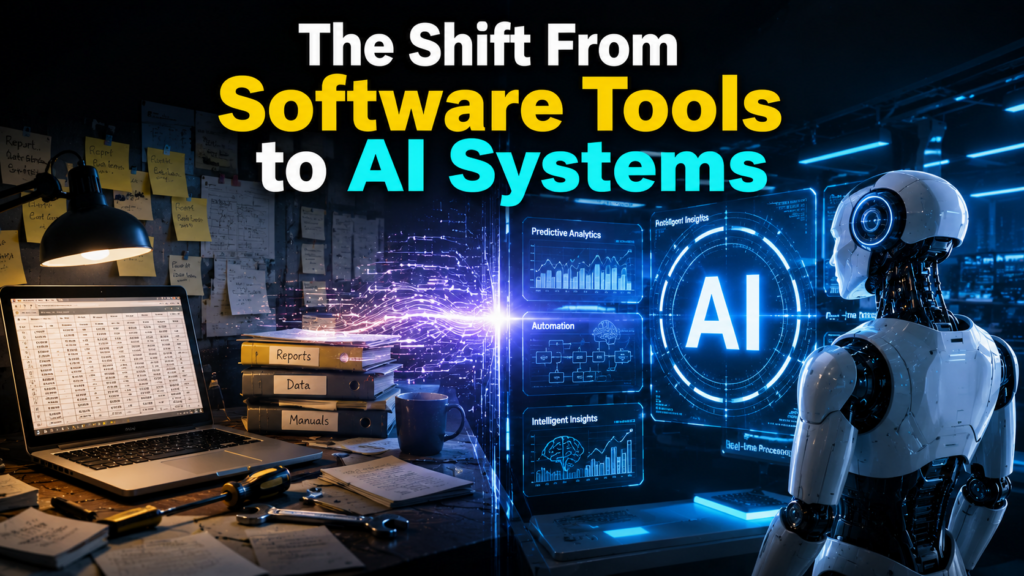
To appreciate the significance of AI systems, it is important to understand the limitations of traditional software.
Software tools were designed to help users perform specific tasks.
Examples include:
- Word processors
- Spreadsheets
- Accounting software
- Project management platforms
- Customer relationship management systems
- Design applications
These tools provided functionality, but they depended entirely on human operation.
The software itself did not understand objectives.
It simply executed commands.
Users needed to:
- Learn interfaces
- Understand workflows
- Enter data manually
- Make decisions
- Monitor outcomes
The software provided capability, but humans provided intelligence.
What Makes AI Systems Different?
AI systems fundamentally change the relationship between humans and technology.
Unlike traditional software, AI systems can:
- Understand natural language
- Interpret goals
- Analyze large datasets
- Generate recommendations
- Learn from interactions
- Adapt to changing situations
- Execute tasks autonomously
Instead of functioning as passive tools, AI systems become active participants in workflows.
The difference is profound.
A spreadsheet calculates numbers.
An AI system can analyze financial performance, identify trends, predict outcomes, and suggest strategic actions.
The software becomes intelligent.
The Evolution of Digital Technology
The transition from software tools to AI systems follows a broader pattern of technological evolution.
| Technology Era | Primary Capability |
|---|---|
| Mainframe Era | Computation |
| Personal Computer Era | Productivity |
| Internet Era | Connectivity |
| Cloud Era | Scalability |
| Mobile Era | Accessibility |
| AI Era | Intelligence |
Each era expanded what technology could accomplish.
The AI era expands what technology can understand and execute.
Why This Shift Is Happening Now
Several factors have accelerated the rise of AI systems.
Advances in Machine Learning
Modern machine learning models can recognize patterns at unprecedented scale.
Increased Computing Power
Cloud infrastructure provides the resources needed to train and deploy sophisticated AI.
Data Availability
Organizations generate massive amounts of information every day.
Natural Language Processing
AI can now understand and generate human language with remarkable accuracy.
Economic Pressure
Businesses continually seek higher productivity and efficiency.
Together, these factors have created ideal conditions for AI adoption.
From User Commands to Goal-Oriented Computing
Traditional software relies on commands.
AI systems focus on goals.
This distinction represents a major paradigm shift.
Consider a business analyst creating a report.
With traditional software:
- Gather data
- Clean information
- Analyze trends
- Create charts
- Write summaries
- Present findings
With AI systems:
“Create a quarterly performance report highlighting key trends and recommendations.”
The AI handles much of the execution.
The user focuses on objectives rather than processes.
The Rise of Autonomous Intelligence
Autonomous intelligence refers to AI systems capable of operating independently within defined parameters.
These systems can:
- Plan actions
- Execute workflows
- Monitor outcomes
- Adjust strategies
- Collaborate with users
Rather than simply assisting work, they increasingly perform work.
This evolution is driving the emergence of AI-powered business operations.
How AI Systems Are Transforming Business Operations
Organizations across industries are integrating AI into daily workflows.
Customer Service
AI systems can:
- Answer questions
- Resolve issues
- Escalate complex requests
- Personalize interactions
Marketing
Applications include:
- Audience analysis
- Content generation
- Campaign optimization
- Performance reporting
Human Resources
AI supports:
- Candidate screening
- Employee onboarding
- Workforce analytics
- Internal support services
Finance
Organizations use AI for:
- Forecasting
- Risk analysis
- Compliance monitoring
- Fraud detection
The scope of applications continues expanding rapidly.
The Emergence of AI Agents
One of the most important developments is the rise of AI agents.
AI agents differ from conventional software because they can pursue objectives autonomously.
Characteristics include:
- Goal-oriented behavior
- Context awareness
- Multi-step reasoning
- Tool usage
- Decision-making capabilities
These agents are increasingly becoming the operational layer of modern businesses.
Traditional Software vs AI Systems
| Traditional Software | AI Systems |
|---|---|
| Tool-based | Outcome-based |
| Requires explicit instructions | Understands goals |
| Static functionality | Adaptive behavior |
| User-driven workflows | Collaborative workflows |
| Fixed responses | Dynamic responses |
| Limited automation | Intelligent automation |
This transition fundamentally changes how work is performed.
Why Businesses Are Embracing AI Systems
Several compelling advantages are driving adoption.
Increased Productivity
AI reduces repetitive tasks.
Better Decision-Making
Organizations gain faster insights.
Cost Efficiency
Automation lowers operational expenses.
Scalability
AI systems support growth without proportional staffing increases.
Continuous Operation
Intelligent systems work around the clock.
These benefits create strong economic incentives.
The Transformation of Enterprise Software
Enterprise software has traditionally been complex.
Organizations often invest heavily in:
- Training
- Documentation
- Support
- Workflow management
AI systems simplify these processes.
Instead of navigating complicated interfaces, users increasingly communicate through natural language.
Enterprise software becomes more accessible and efficient.
The Future of SaaS in an AI-Driven World
Software-as-a-Service revolutionized business technology.
However, AI systems may redefine SaaS once again.
Future software platforms may focus less on interfaces and more on intelligence.
Users will increasingly expect software to:
- Understand requests
- Recommend actions
- Automate workflows
- Deliver outcomes
The value shifts from functionality to intelligence.
Human Skills Become More Important
Contrary to popular fears, the rise of AI systems increases the importance of uniquely human abilities.
These include:
Creativity
Generating original ideas.
Strategic Thinking
Planning long-term objectives.
Leadership
Guiding organizations through change.
Emotional Intelligence
Building relationships and trust.
Ethical Judgment
Making responsible decisions.
AI handles routine execution while humans focus on higher-level value creation.
Challenges of the Transition
Despite enormous potential, several challenges remain.
Trust
Organizations need confidence in AI outputs.
Security
Autonomous systems require safeguards.
Data Quality
Poor information produces poor outcomes.
Governance
Clear accountability is essential.
Regulation
Governments continue developing AI frameworks.
Responsible adoption remains critical.
The Role of Trust in Intelligent Systems
As AI systems become more influential, trust becomes increasingly important.
Organizations must ensure:
- Transparency
- Reliability
- Accountability
- Fairness
- Privacy protection
Trust may become one of the most valuable assets in the AI era.
Industry Impact Across the Global Economy
Virtually every sector is being affected.
Healthcare
Administrative and diagnostic support.
Finance
Automation and risk management.
Manufacturing
Predictive maintenance and operational optimization.
Retail
Personalized experiences and inventory management.
Education
Adaptive learning systems.
Technology
AI-native applications and services.
The transformation is broad and accelerating.
The Rise of AI-Native Organizations
Some companies are moving beyond AI adoption.
They are becoming AI-native.
Characteristics include:
- AI-first workflows
- Autonomous operations
- Intelligent decision support
- Digital workforces
- Continuous optimization
These organizations may gain significant competitive advantages.
The Future Workplace: Humans and AI Systems Together
The future workplace is unlikely to be fully automated.
Instead, it will be collaborative.
Humans provide:
- Vision
- Creativity
- Judgment
- Leadership
AI systems provide:
- Speed
- Scale
- Analysis
- Automation
Together, they create more effective organizations.
What Businesses Should Do Today
To prepare for this transition, organizations should:
Build AI Literacy
Educate employees about emerging technologies.
Modernize Infrastructure
Ensure systems support AI integration.
Improve Data Quality
Data remains the foundation of intelligent systems.
Experiment Strategically
Identify high-value use cases.
Develop Governance Policies
Create responsible AI frameworks.
Preparation creates long-term advantages.
Looking Ahead: The Next Decade of Intelligent Systems
Over the next ten years, AI systems are likely to become more capable, more autonomous, and more integrated into everyday operations.
Future developments may include:
- Autonomous workflows
- Multi-agent collaboration
- Personalized AI assistants
- Intelligent enterprise platforms
- Self-optimizing business processes
Technology will increasingly move from being a tool to becoming a partner.
Conclusion
The shift from software tools to AI systems represents one of the most important transformations in the history of computing. For decades, software functioned primarily as a passive instrument that required human direction. Today, artificial intelligence is turning software into active, intelligent systems capable of understanding objectives, executing tasks, and supporting decision-making.
This evolution is changing how businesses operate, how employees work, and how value is created across industries.
Organizations that embrace intelligent systems can achieve greater productivity, efficiency, and innovation. At the same time, success will depend on balancing technological capabilities with human judgment, ethical governance, and strategic leadership.
The future is not about replacing humans with machines.
It is about creating powerful partnerships between human intelligence and artificial intelligence.
As the transition accelerates, one reality is becoming increasingly clear:
The era of software tools is gradually giving way to the era of intelligent systems.
And that shift may define the next generation of digital transformation.
Also Read: “Understanding the AI Agent Revolution“
Frequently Asked Questions (FAQs)
1. What is the difference between software tools and AI systems?
Software tools execute predefined functions based on user commands, while AI systems can understand goals, analyze information, make recommendations, and perform tasks autonomously.
2. Why are businesses moving toward AI systems?
Organizations seek higher productivity, improved decision-making, lower operational costs, and greater scalability through intelligent automation.
3. Will AI systems replace traditional software?
Traditional software will continue to exist, but AI capabilities are increasingly becoming the primary value layer, making software more intelligent and autonomous.