



Introduction: The Interface Revolution Nobody Saw Coming
Every major computing era has been defined by its user interface.
The earliest computers relied on command-line inputs. The personal computer revolution introduced graphical user interfaces (GUIs). The internet era popularized browsers. Smartphones transformed interaction through touchscreens and mobile applications. Why AI Agents Could Become the New User Interface.
Each transition made technology more accessible and powerful.
Now another shift is underway.
Artificial Intelligence is beginning to change the very concept of a user interface.
For decades, humans have adapted themselves to software. We learned menus, buttons, forms, dashboards, and workflows. Every application required users to understand how the software worked.
AI agents reverse this relationship.
Instead of people learning software, software learns people.
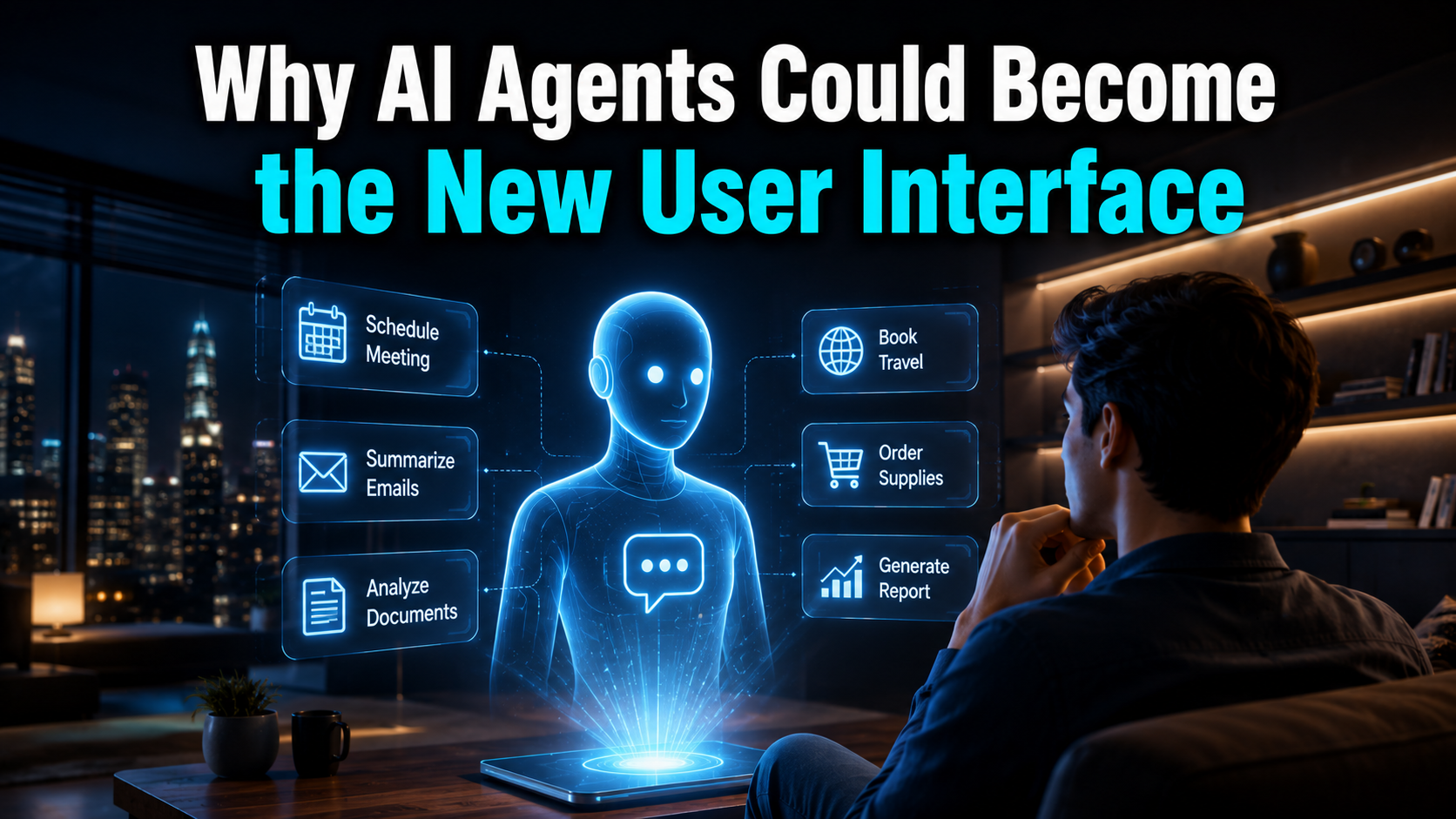
Rather than navigating dozens of applications, users increasingly communicate goals through natural language while intelligent agents execute the required actions.
This evolution may represent one of the most significant changes in computing history.
Many industry experts now believe AI agents could become the next major user interface layer, fundamentally altering how humans interact with digital systems.
The future of software may not be built around screens and menus.
It may be built around conversations, intentions, and autonomous action.
Table of Contents
Understanding the Traditional User Interface
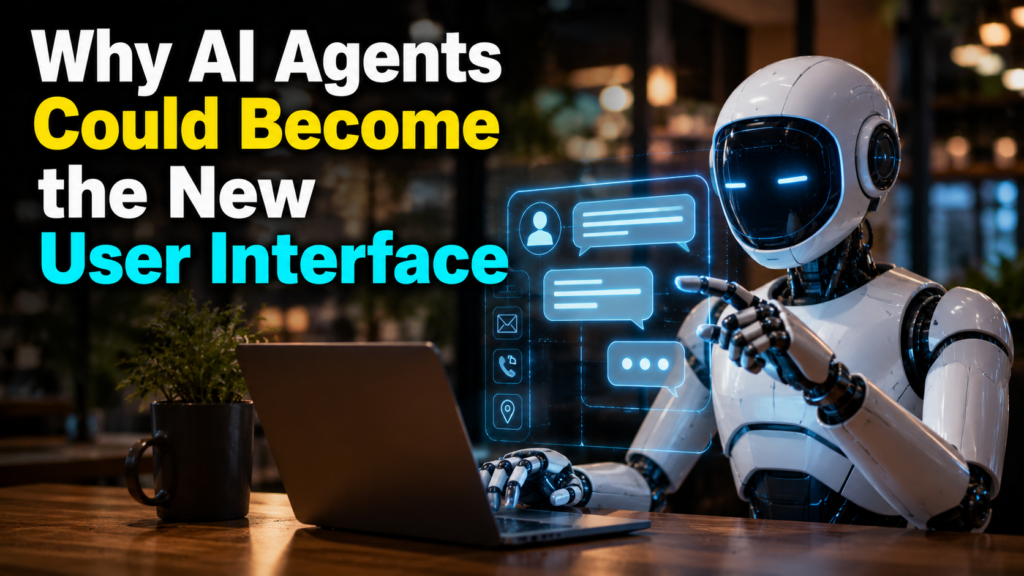
To understand why AI agents are so transformative, it is important to understand the limitations of traditional interfaces.
A user interface (UI) acts as the bridge between humans and computers.
Common examples include:
- Desktop applications
- Mobile apps
- Websites
- Dashboards
- Control panels
- Touchscreens
Traditional interfaces require users to:
- Learn navigation systems
- Understand workflows
- Perform manual actions
- Translate goals into software commands
This model has worked for decades.
However, it creates friction.
The software often dictates how users interact rather than adapting to human needs.
What Are AI Agents?
AI agents are intelligent software systems capable of independently pursuing objectives and completing tasks.
Unlike traditional software, AI agents can:
- Understand natural language
- Interpret goals
- Create plans
- Use tools
- Make decisions
- Execute actions
- Adapt to changing situations
Instead of responding to individual commands, they focus on outcomes.
For example:
Rather than manually creating a marketing report, a user could simply say:
“Analyze last month’s campaign performance and summarize the key insights.”
The AI agent performs the necessary tasks automatically.
This shift changes the role of software entirely.
The Evolution of Human-Computer Interaction
The history of computing can be viewed as a progression toward greater simplicity.
| Era | Primary Interface |
|---|---|
| Early Computing | Command Line |
| Personal Computing | Graphical User Interface (GUI) |
| Internet Age | Web Browser |
| Mobile Era | Touch Interface |
| AI Era | Intelligent Agents |
Each generation reduced complexity and improved accessibility.
AI agents continue this trend by eliminating the need to understand software workflows altogether.
Why Traditional Interfaces Are Reaching Their Limits
Modern software has become incredibly powerful.
Unfortunately, it has also become increasingly complex.
Employees often work across:
- Email systems
- CRM platforms
- Analytics tools
- Collaboration software
- Project management systems
- Marketing platforms
Switching between applications consumes significant time and attention.
Users must constantly adapt to different interfaces.
This creates inefficiency and cognitive overload.
AI agents offer a fundamentally different solution.
The Shift From Commands to Intentions
Traditional software requires commands.
AI agents respond to intentions.
This distinction is crucial.
Consider a project manager needing a status report.
Traditional approach:
- Open project software
- Collect updates
- Export data
- Create summaries
- Generate visuals
- Build presentation
AI agent approach:
“Create a project status report highlighting risks and progress.”
The agent performs the process automatically.
The user focuses on outcomes rather than mechanics.
Why AI Agents Could Replace Many Software Interfaces
AI agents have several advantages over traditional interfaces.
Natural Language Communication
Humans naturally communicate through language.
Agents allow users to interact conversationally rather than through menus.
Reduced Learning Curve
Users no longer need extensive software training.
Faster Task Completion
Complex workflows become simpler.
Personalization
Agents adapt to individual preferences.
Cross-Platform Functionality
Agents can operate across multiple systems simultaneously.
These capabilities make AI agents compelling candidates for becoming the next interface layer.
The Rise of Goal-Based Computing
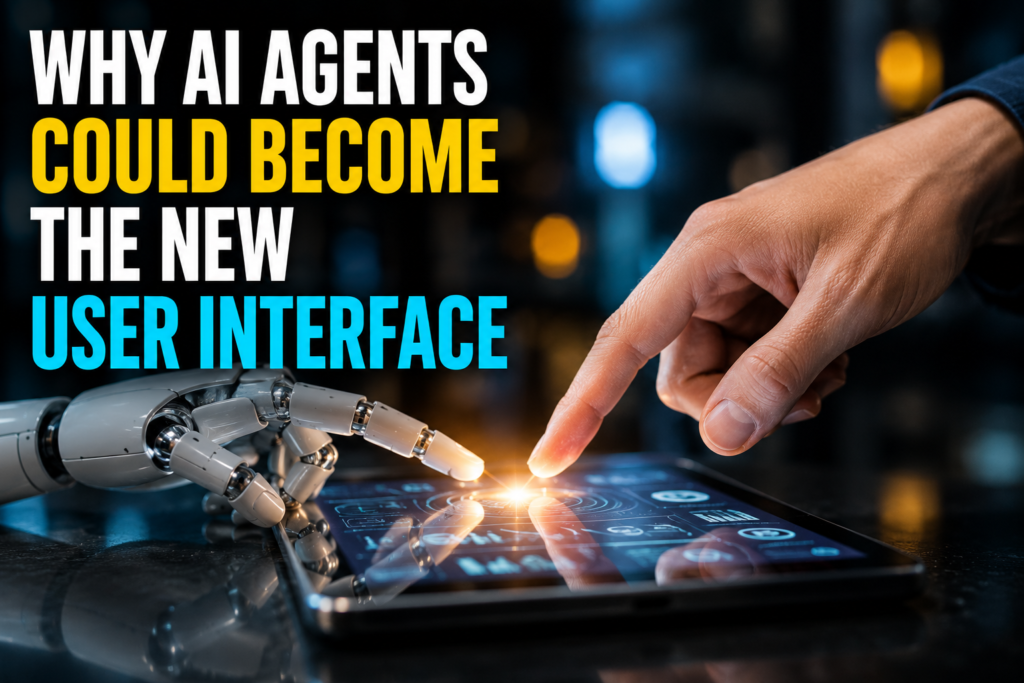
For decades, computing has been action-based.
Users tell software exactly what to do.
AI agents introduce goal-based computing.
Instead of specifying every step, users define objectives.
Examples:
- “Book my business trip.”
- “Prepare next week’s sales report.”
- “Analyze customer feedback trends.”
- “Schedule interviews with qualified candidates.”
The agent determines how to accomplish the task.
This dramatically changes the user experience.
AI Agents as Universal Interfaces
One of the most powerful aspects of AI agents is their potential to become universal interfaces.
Today, each application has its own interface.
Users must learn multiple systems.
AI agents could unify access across:
- Calendars
- CRM systems
- Financial software
- Marketing platforms
- Customer support tools
Instead of interacting with individual applications, users interact with a single intelligent layer.
This simplifies digital experiences considerably.
How Businesses Benefit From Agent-Based Interfaces
Organizations stand to gain significant advantages.
Increased Productivity
Employees spend less time navigating software.
Faster Decision-Making
Information becomes easier to access and analyze.
Reduced Training Costs
New employees learn systems more quickly.
Improved Efficiency
Tasks require fewer manual steps.
Better User Experiences
Technology becomes more intuitive.
These benefits explain growing investment in AI agents.
Enterprise Software Is Being Reinvented
Enterprise applications have historically been complex.
Organizations invest heavily in:
- Training programs
- Documentation
- Workflow design
- User support
AI agents can simplify enterprise software dramatically.
Future enterprise systems may rely less on dashboards and more on conversational interactions.
The interface becomes intelligence itself.
AI Agents and the Future of SaaS
Software-as-a-Service (SaaS) transformed business technology.
However, AI agents may reshape SaaS once again.
Instead of:
- Logging into applications
- Navigating menus
- Executing workflows manually
Users may simply communicate goals.
The software remains in the background while AI agents become the primary interaction layer.
This could fundamentally change software design.
Multi-Agent Ecosystems and Digital Collaboration
The future may involve multiple specialized agents working together.
For example:
| Agent Type | Responsibility |
|---|---|
| Research Agent | Information gathering |
| Analytics Agent | Data interpretation |
| Communication Agent | Messaging and coordination |
| Scheduling Agent | Calendar management |
| Operations Agent | Workflow execution |
Users interact with a single interface while multiple agents coordinate behind the scenes.
This creates powerful digital ecosystems.
Challenges to AI Agents Becoming the New Interface
Despite enormous potential, several challenges remain.
Reliability
AI agents can occasionally produce errors.
Security
Autonomous actions require safeguards.
Privacy
Sensitive information must remain protected.
Transparency
Users need visibility into decisions.
Regulation
Governments are developing AI governance frameworks.
These challenges must be addressed before widespread adoption occurs.
Why Human Oversight Remains Essential
Even as AI agents become more capable, human involvement remains critical.
Humans provide:
- Strategic direction
- Ethical judgment
- Contextual understanding
- Creativity
- Accountability
The most effective systems combine human intelligence with AI efficiency.
The future is collaborative rather than fully autonomous.
The Impact on Digital Product Design
If AI agents become the primary interface, software design will change dramatically.
Future products may prioritize:
APIs Over Dashboards
Machines interact directly with software.
Outcome-Oriented Experiences
Users focus on goals rather than actions.
Conversational Design
Natural language becomes central.
Adaptive Interfaces
Systems personalize interactions.
Agent Collaboration
Multiple agents coordinate tasks.
This represents a fundamental redesign of digital experiences.
The Economic Implications
The emergence of AI-agent interfaces could reshape software economics.
Potential outcomes include:
- Reduced software complexity
- Increased productivity
- Lower training costs
- New business models
- Greater automation
Companies that adapt early may gain significant competitive advantages.
What Businesses Should Do Today
Organizations preparing for this transition should:
Invest in AI Literacy
Educate teams about agent-based systems.
Modernize Infrastructure
Ensure software can integrate with AI agents.
Improve Data Quality
High-quality data improves outcomes.
Experiment With AI Workflows
Identify practical applications.
Strengthen Governance
Develop responsible AI policies.
Preparation today creates long-term advantages.
The Future of Human-Computer Interaction
The history of technology is a history of reducing friction.
Every major interface innovation has made computing more natural.
AI agents may represent the next logical step.
Future interactions could involve:
- Conversational computing
- Goal-based workflows
- Autonomous task execution
- Personalized digital assistants
- Intelligent collaboration
The computer becomes less visible while outcomes become more important.
Users focus on what they want to achieve rather than how to achieve it.
Conclusion
The idea that AI agents could become the new user interface is no longer a futuristic concept. It is an emerging reality driven by advances in artificial intelligence, natural language processing, and autonomous systems.
For decades, humans adapted themselves to software by learning interfaces, workflows, and application logic. AI agents reverse that relationship by adapting software to human intentions.
As intelligent agents become more capable, they have the potential to simplify digital experiences, increase productivity, reduce complexity, and transform how businesses and individuals interact with technology.
Traditional interfaces will not disappear overnight.
However, they may increasingly move into the background as AI agents become the primary layer connecting people with digital systems.
The future of computing may not be defined by better dashboards, larger screens, or more sophisticated menus.
It may be defined by intelligent agents that understand goals and deliver outcomes.
And that could make AI agents the most important user interface innovation since the graphical user interface itself.
Also Read: “AI Transformation Beyond Automation“
Frequently Asked Questions (FAQs)
1. What is an AI agent?
An AI agent is an intelligent software system capable of understanding goals, making decisions, using tools, and completing tasks autonomously.
2. How could AI agents replace traditional user interfaces?
AI agents allow users to communicate goals through natural language rather than navigating menus, forms, and dashboards, making software interactions simpler and more intuitive.
3. Will graphical user interfaces disappear?
Traditional interfaces are unlikely to disappear completely, but they may become secondary as conversational and agent-based interactions become more common.