






Introduction: Search Is No Longer Just About Search Engines
For more than twenty years, search engines have served as the primary gateway to the internet.
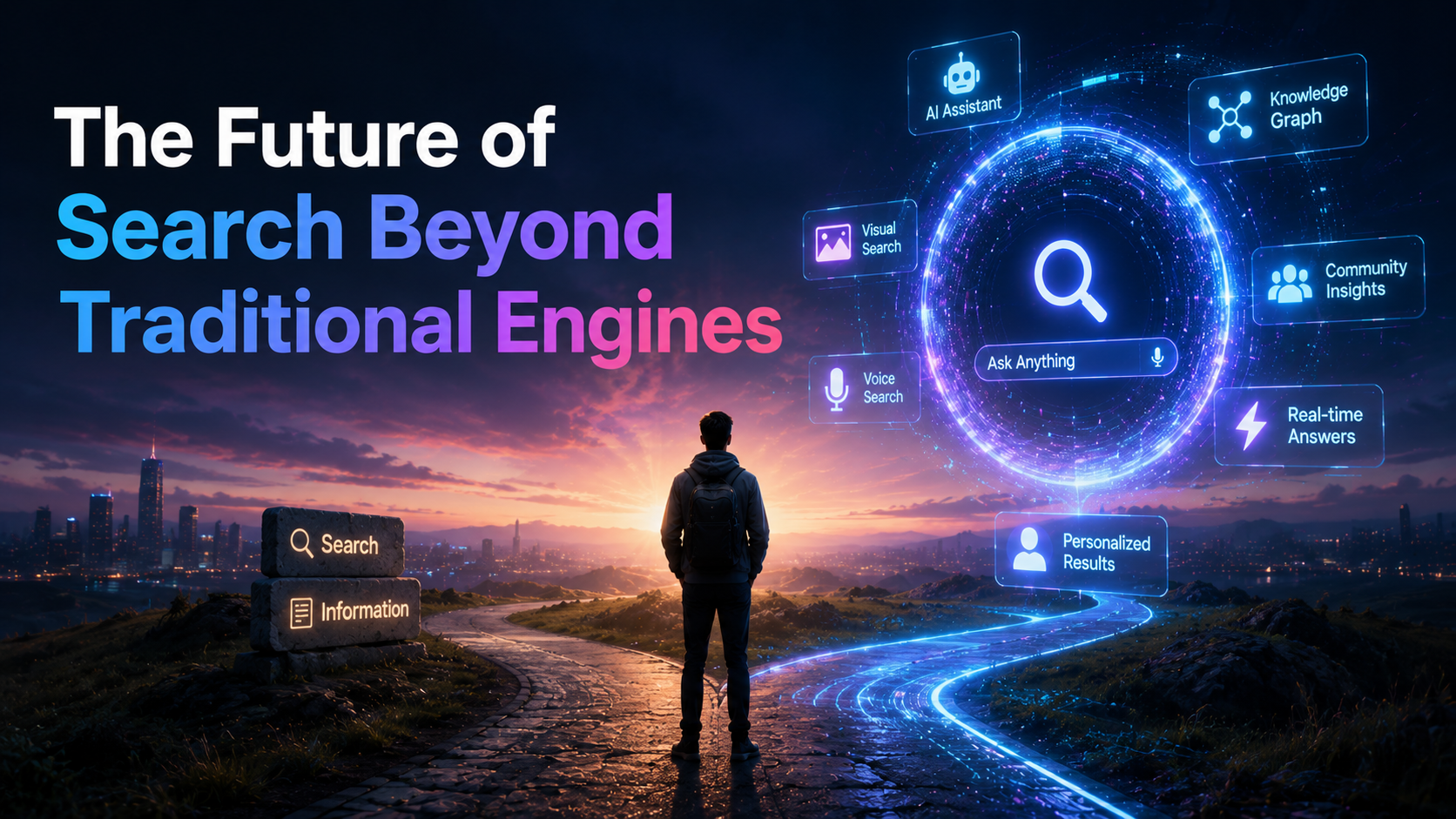
Whenever users needed information, they opened a browser, typed a query into a search engine, reviewed a list of links, and clicked on the most relevant result. This simple interaction became one of the most influential behaviors in the digital age. The Future of Search Beyond Traditional Engines.
Search engines transformed how people learn, shop, travel, communicate, and make decisions. Entire industries emerged around Search Engine Optimization (SEO), paid advertising, content marketing, and digital publishing.
However, a major shift is underway.
Search is no longer confined to traditional search engines.
Artificial Intelligence, generative AI, voice assistants, recommendation algorithms, social discovery platforms, and autonomous digital agents are creating entirely new ways for people to discover information.
Increasingly, users are finding answers without ever visiting a traditional search results page.
Instead of searching, they are asking.
Instead of browsing, they are receiving recommendations.
Instead of navigating the web manually, intelligent systems are navigating it for them.
This transformation represents one of the most significant changes in the history of the internet.
The future of search extends far beyond traditional engines, and understanding this evolution is essential for businesses, publishers, marketers, and consumers alike.
Table of Contents
The Evolution of Search: A Brief Historical Perspective
Search has never remained static.
The methods people use to find information have continuously evolved alongside technology.
| Era | Primary Discovery Method |
|---|---|
| Early Internet (1990s) | Directories and Portals |
| Search Engine Era (2000s) | Keyword-Based Search |
| Mobile Era (2010s) | App-Centric Discovery |
| Social Era (2010s–2020s) | Algorithmic Feeds |
| AI Era (2020s+) | Conversational and Generative Search |
Each phase reduced friction and improved accessibility.
The AI era is accelerating this trend by eliminating many of the steps users previously performed themselves.
Why Traditional Search Engines Are Facing Disruption
Traditional search engines remain powerful, but they face growing challenges.
Information Overload
The internet contains billions of pages of content.
Users often struggle to identify the most useful information quickly.
Search Fatigue
Many users are tired of clicking through multiple websites to find simple answers.
Rising Expectations
People increasingly expect personalized and immediate responses.
Conversational Behavior
Natural language interaction feels more intuitive than keyword-based searches.
These factors have created opportunities for AI-powered alternatives to emerge.
The Rise of AI-Powered Search Experiences
Artificial Intelligence is changing the very purpose of search.
Historically, search engines acted as directories.
Their primary role was to retrieve information.
Modern AI systems increasingly act as advisors.
They do not simply locate information.
They interpret, summarize, compare, and explain it.
For users, this means:
- Faster answers
- Less research effort
- More personalized recommendations
- Simplified decision-making
The focus shifts from finding information to understanding information.
Generative Search: The Next Evolution
Generative search represents one of the most important developments in modern digital experiences.
Unlike traditional search engines that return lists of links, generative systems create comprehensive responses.
A user asking:
“What is the best laptop for remote work?”
may receive:
- Product recommendations
- Feature comparisons
- Buying advice
- Personalized suggestions
without visiting multiple websites.
This fundamentally changes how content is discovered and consumed.
Search Is Becoming Conversational
One of the defining characteristics of future search is conversation.
Instead of typing fragmented keywords such as:
“best smartphone under 500”
Users increasingly ask:
“Which smartphone offers the best camera and battery life under $500 for travel photography?”
AI systems understand context, intent, and nuance.
This makes interactions feel more natural.
The search experience becomes a dialogue rather than a transaction.
Voice Search and the Future of Discovery
Voice technology continues to influence search behavior.
Smart speakers, smartphones, vehicles, and wearable devices have made voice interaction increasingly common.
Voice search offers several advantages:
- Hands-free convenience
- Faster interactions
- Natural language input
- Accessibility improvements
As AI models improve, voice search may become one of the dominant forms of information discovery.
Future generations may view typing search queries as an outdated practice.
The Emergence of AI Assistants
AI assistants are becoming central to the future of search.
Unlike search engines, AI assistants can:
- Remember context
- Handle follow-up questions
- Perform tasks
- Offer recommendations
- Personalize responses
Rather than helping users find information, they help users accomplish goals.
This distinction is critical.
Search is evolving from information retrieval into digital assistance.
Personalized Search Experiences
The future of search will be highly personalized.
Traditional search engines often provide similar results to everyone.
AI-powered systems increasingly tailor results based on:
- User preferences
- Past interactions
- Location
- Interests
- Behavioral patterns
This personalization creates more relevant experiences but also raises questions about transparency and diversity of information.
Search Without Search: Predictive Discovery
One of the most fascinating developments is predictive discovery.
Future systems may anticipate user needs before searches occur.
Examples include:
- Travel recommendations before planning a trip
- Product suggestions before shopping
- Learning resources before asking questions
- Health insights based on lifestyle patterns
In many cases, information may arrive proactively rather than reactively.
This represents a fundamental shift in how people interact with digital systems.
The Growing Role of Recommendation Engines
Recommendation engines are becoming as important as search engines.
Platforms increasingly use AI to determine:
- Which articles users see
- Which videos appear next
- Which products are recommended
- Which news stories gain visibility
Recommendation-driven discovery reduces the need for active searching.
Content increasingly finds users rather than users finding content.
The Future of Search and SEO
SEO is evolving rapidly.
Traditional SEO focused heavily on:
- Keywords
- Backlinks
- Rankings
- Technical optimization
Future SEO will increasingly focus on:
| Traditional SEO | Future SEO |
|---|---|
| Keywords | Intent |
| Rankings | Authority |
| Backlinks | Trust Signals |
| Search Traffic | AI Visibility |
| Optimization | User Experience |
Businesses must optimize not only for search engines but also for AI systems.
Why Authority Matters More Than Ever
In an AI-driven environment, authority becomes a crucial ranking factor.
AI systems need trusted information sources.
Authority is built through:
Expertise
Deep subject knowledge.
Experience
Real-world insights.
Trustworthiness
Accurate and transparent information.
Credibility
Industry recognition and reputation.
Organizations that demonstrate these qualities are more likely to be referenced by AI systems.
Google’s EEAT Framework in the Future of Search
Google’s EEAT framework remains highly relevant.
EEAT stands for:
- Experience
- Expertise
- Authoritativeness
- Trustworthiness
These principles align closely with how AI systems evaluate information quality.
As AI-generated answers become more common, EEAT signals become increasingly valuable.
The Impact on Publishers and Content Creators
The future of search creates both opportunities and challenges.
Opportunities
- Greater value for expert content
- Increased demand for original research
- New discovery channels
Challenges
- Reduced click-through rates
- Increased competition for attention
- Dependence on AI recommendations
Content creators must focus on quality, originality, and trust.
The Rise of Autonomous AI Agents
Future search may not involve direct human interaction at all.
Autonomous AI agents could:
- Research products
- Compare services
- Analyze options
- Make recommendations
- Complete transactions
Users may delegate information gathering to intelligent agents.
This could dramatically reduce traditional search behavior.
Search Across Multiple Modalities
Future search will be multimodal.
Users may search using:
- Text
- Voice
- Images
- Video
- Augmented reality
- Wearable devices
The boundaries between search, communication, and interaction will continue to blur.
Information discovery will become more immersive and intuitive.
The Economics of Future Search
As search evolves, business models will evolve as well.
Potential revenue streams include:
- AI subscriptions
- Conversational advertising
- Commerce integrations
- Affiliate partnerships
- Content licensing agreements
The search economy of the future will likely look very different from today’s advertising-driven ecosystem.
Key Trends Shaping the Future of Search
Generative AI
AI-generated answers replacing lists of links.
Conversational Interfaces
Natural interactions becoming standard.
Personalization
Tailored recommendations and responses.
Autonomous Agents
AI conducting research independently.
Voice and Multimodal Search
More intuitive discovery experiences.
Authority-Based Visibility
Trust becoming a ranking signal.
Together, these trends are redefining how information is accessed online.
What Businesses Must Do to Prepare
Organizations should begin preparing today.
Invest in Expertise
Expert content earns trust.
Build Brand Authority
Strong brands gain visibility advantages.
Create Original Research
Unique insights attract citations.
Focus on User Intent
Solve real-world problems.
Optimize for AI Discovery
Structure content clearly and comprehensively.
Future success depends on adaptability.
Conclusion
The future of search beyond traditional engines is already unfolding. Artificial Intelligence, conversational interfaces, recommendation systems, voice assistants, and autonomous agents are fundamentally changing how people discover information.
Search is evolving from a process of navigating links into an experience centered on understanding, guidance, and personalized assistance.
For businesses, publishers, marketers, and creators, this transformation requires a new mindset. Visibility will increasingly depend on trust, authority, expertise, and the ability to provide unique value in an AI-driven ecosystem.
Traditional search engines will not disappear overnight.
However, they will become part of a broader discovery ecosystem where AI acts as the primary intermediary between users and information.
The organizations that adapt early will gain a powerful advantage.
Those that continue relying solely on yesterday’s search strategies may find themselves increasingly invisible.
The future of search is not just about finding answers.
It is about creating intelligent experiences that help people make better decisions, faster than ever before
Also Read: “How Technology Is Redefining Human Potential“
Frequently Asked Questions (FAQs)
1. What does “search beyond traditional engines” mean?
It refers to new methods of discovering information through AI assistants, generative search, recommendation engines, voice interfaces, and autonomous digital agents rather than relying solely on conventional search engines.
2. Will AI replace traditional search engines?
AI is unlikely to completely replace traditional search engines in the near future, but it is transforming how search works by providing direct answers, personalized recommendations, and conversational experiences.
3. How will SEO change in the future?
SEO will evolve from a keyword-focused discipline toward authority building, trust signals, user intent optimization, and visibility within AI-generated answers.