


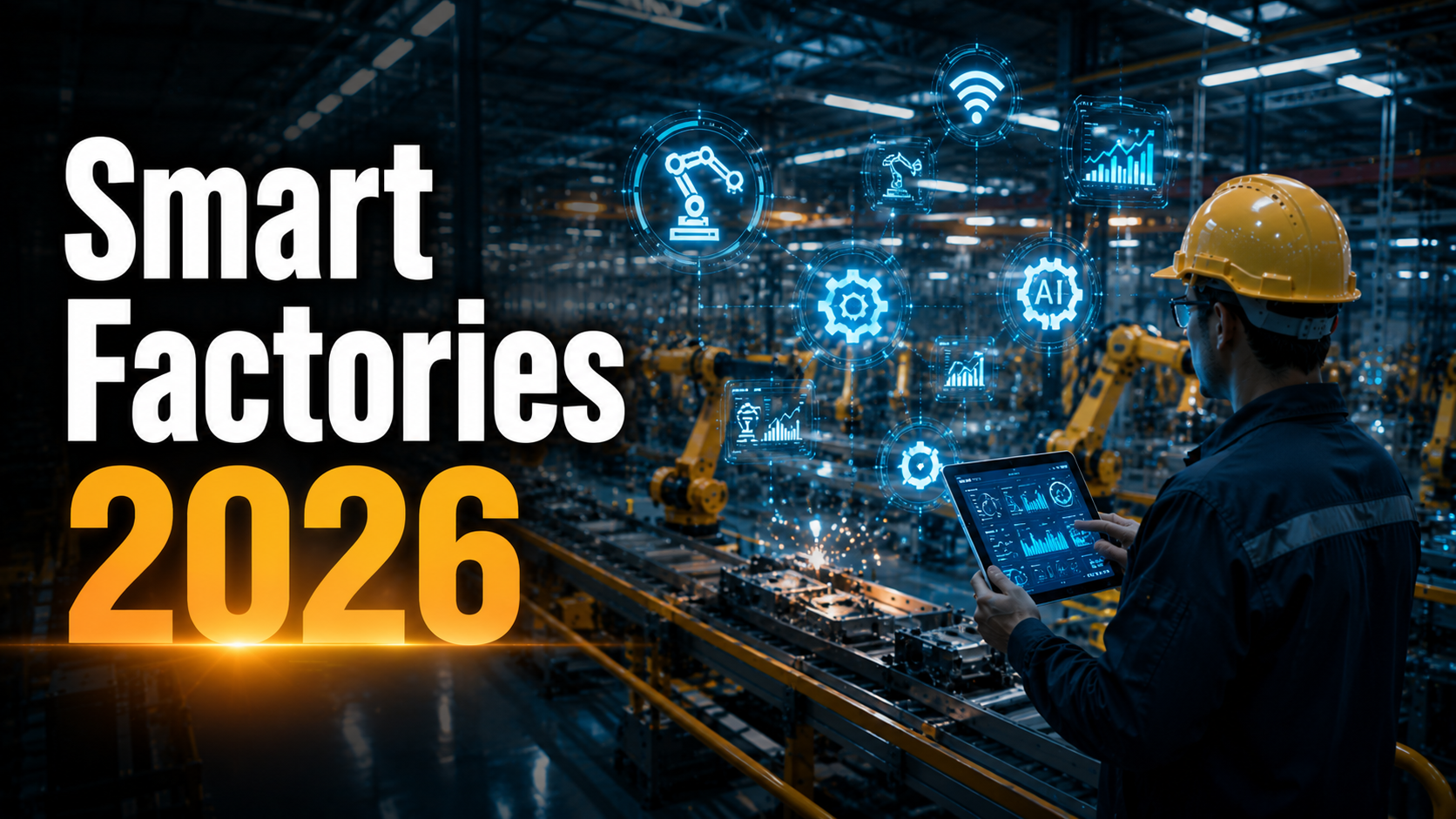
Manufacturing is entering a transformative era unlike anything seen since the Industrial Revolution. As businesses worldwide face increasing customer demands, supply chain uncertainties, labor shortages, and sustainability challenges, a new generation of intelligent manufacturing facilities is emerging. Smart Factories 2026.
Welcome to the age of Smart Factories 2026.
Powered by Artificial Intelligence (AI), Industrial Internet of Things (IIoT), cloud computing, robotics, digital twins, edge computing, and advanced analytics, smart factories are becoming highly autonomous ecosystems capable of learning, adapting, and optimizing themselves in real time.
Unlike traditional factories that rely heavily on manual intervention and scheduled maintenance, smart factories use AI-driven intelligence to predict failures before they happen, improve product quality automatically, optimize energy usage, reduce waste, and increase production efficiency.
The AI manufacturing revolution is not replacing humans, it is empowering workers with intelligent tools that make factories safer, faster, and significantly more productive.
In this comprehensive guide, we’ll explore everything you need to know about Smart Factories in 2026, including technologies, benefits, real-world applications, future trends, implementation strategies, challenges, and frequently asked questions.
Table of Contents
What Is a Smart Factory?
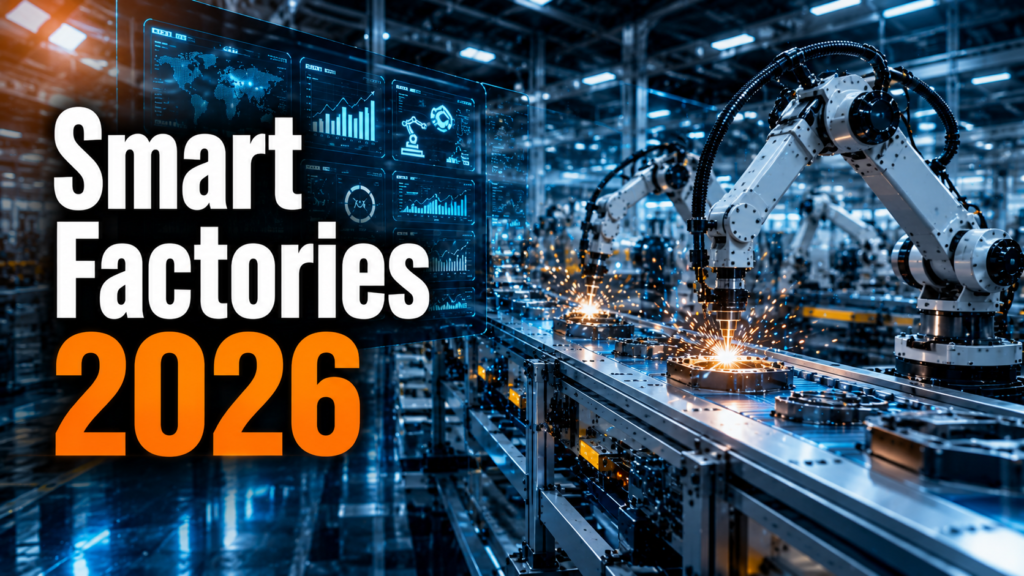
A smart factory is a digitally connected manufacturing facility where machines, sensors, software, robotics, and AI systems communicate continuously to automate production processes and make intelligent decisions with minimal human intervention.
Unlike conventional manufacturing plants, smart factories can:
- Monitor operations in real time
- Predict machine failures
- Automatically optimize production schedules
- Reduce manufacturing defects
- Improve worker safety
- Increase operational efficiency
- Lower production costs
Every connected machine generates valuable data that AI systems analyze to improve performance continuously.
Why Smart Factories Matter in 2026
Manufacturing companies face growing pressure to produce faster while maintaining quality and reducing operational costs.
Several global trends are accelerating smart factory adoption:
- Rising labor shortages
- Increasing customer personalization demands
- Global supply chain disruptions
- Higher energy costs
- Sustainability regulations
- Competitive market pressures
- Growing demand for real-time production visibility
AI enables manufacturers to respond instantly to these challenges through intelligent automation.
Key Technologies Powering Smart Factories 2026
1. Artificial Intelligence (AI)
Artificial Intelligence is the brain of every smart factory.
AI analyzes massive amounts of manufacturing data to:
- Predict equipment failures
- Detect production anomalies
- Improve product quality
- Forecast customer demand
- Optimize scheduling
- Enhance supply chain management
Machine learning models continuously improve as they process more operational data.
2. Industrial Internet of Things (IIoT)
IIoT connects machines, sensors, robots, and production equipment into one intelligent network.
Connected devices monitor:
- Temperature
- Pressure
- Humidity
- Machine vibration
- Production speed
- Energy consumption
- Inventory levels
Real-time monitoring enables immediate decision-making.
3. Digital Twins
Digital twins create virtual replicas of factories, machines, and production lines.
Manufacturers can simulate:
- New production layouts
- Equipment upgrades
- Maintenance schedules
- Process improvements
- Capacity planning
This significantly reduces implementation risks
4. Industrial Robotics
Modern AI-powered robots are far more advanced than traditional automation systems.
Today’s robots can:
- Learn from experience
- Detect defects
- Collaborate with workers
- Adjust production automatically
- Improve precision
- Handle repetitive tasks safely
Collaborative robots (Cobots) are becoming increasingly popular.
5. Edge Computing
Instead of sending all factory data to cloud servers, edge computing processes information directly on-site.
Benefits include:
- Faster decision-making
- Lower latency
- Better cybersecurity
- Reduced bandwidth usage
- Real-time machine control
6. Computer Vision
AI-powered cameras inspect products with exceptional precision.
Applications include:
- Surface inspection
- Quality control
- Barcode reading
- Defect detection
- Safety monitoring
- Packaging verification
Computer vision dramatically improves manufacturing accuracy.
7. Predictive Maintenance
Predictive maintenance is among the biggest advantages of AI manufacturing.
Instead of repairing equipment after failures, AI predicts maintenance needs before breakdowns occur.
Benefits include:
- Less downtime
- Longer equipment lifespan
- Reduced maintenance costs
- Improved production efficiency
Core Features of Smart Factories
| Feature | Traditional Factory | Smart Factory 2026 |
|---|---|---|
| Monitoring | Manual | Real-Time AI Monitoring |
| Maintenance | Reactive | Predictive |
| Decision Making | Human-Based | AI-Assisted |
| Quality Inspection | Sampling | 100% Automated |
| Inventory | Periodic | Live Tracking |
| Production Planning | Static | Dynamic AI Optimization |
| Data Analysis | Limited | Continuous Analytics |
| Energy Management | Manual | AI Optimization |
Benefits of Smart Factories
Increased Productivity
AI continuously optimizes production schedules, machine usage, and workflow efficiency.
Manufacturers often experience substantial improvements in operational productivity.
Reduced Downtime
Unexpected equipment failures become far less common because AI predicts problems before they occur.
Maintenance teams receive alerts weeks in advance.
Improved Product Quality
AI inspection systems detect microscopic defects that human inspectors might overlook.
This reduces recalls and improves customer satisfaction.
Lower Manufacturing Costs
Smart factories reduce:
- Material waste
- Energy consumption
- Machine downtime
- Labor inefficiencies
- Inventory costs
The result is significantly lower operational expenses.
Better Worker Safety
AI monitors factory environments for:
- Hazardous temperatures
- Gas leaks
- Unsafe movements
- Equipment malfunctions
- Restricted area violations
Workers receive immediate alerts.
Sustainability
Environmental responsibility has become a major priority.
AI helps manufacturers reduce:
- Carbon emissions
- Water usage
- Energy waste
- Raw material consumption
Smart factories contribute directly to greener manufacturing.
Industries Embracing Smart Factories
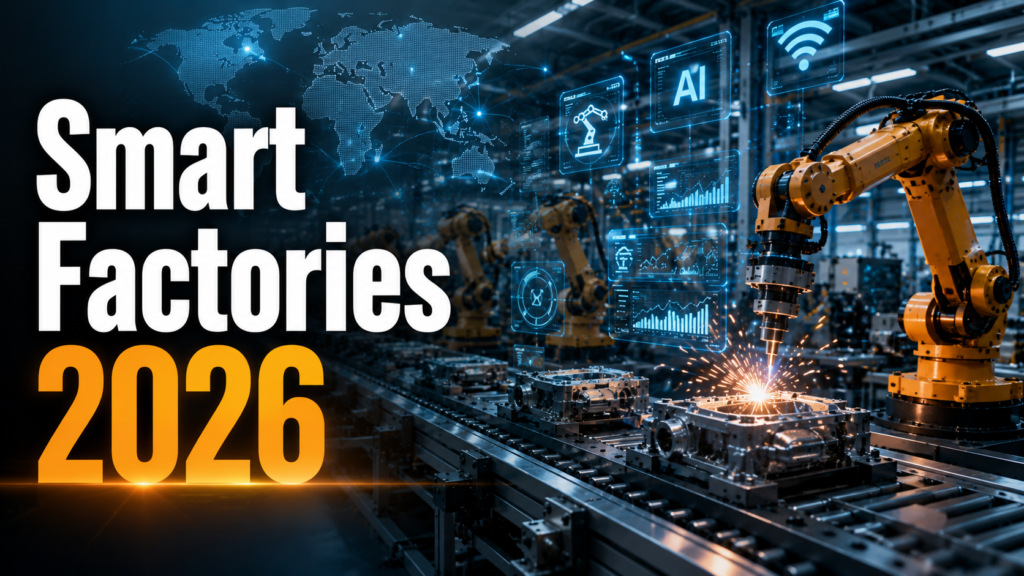
Automotive Manufacturing
Automotive companies use AI for:
- Robotic assembly
- Quality inspection
- Supply chain optimization
- Predictive maintenance
Electronics Manufacturing
Electronics manufacturers rely on AI for:
- Circuit board inspection
- Precision assembly
- Inventory automation
- Yield optimization
Pharmaceutical Industry
Smart factories improve:
- Drug manufacturing
- Regulatory compliance
- Batch tracking
- Sterile production monitoring
Food and Beverage
AI helps monitor:
- Food safety
- Packaging quality
- Temperature control
- Shelf-life prediction
Aerospace
Precision manufacturing requires AI-assisted:
- Defect detection
- Material optimization
- Component tracking
- Safety inspections
Real-World Applications of AI Manufacturing
Modern factories are using AI to solve everyday operational challenges.
Examples include:
Automated Quality Inspection
Computer vision cameras inspect every product in milliseconds.
Demand Forecasting
AI predicts customer demand using historical sales data.
Supply Chain Optimization
AI automatically recommends inventory adjustments.
Energy Management
Smart systems reduce electricity consumption during low-demand periods.
Warehouse Automation
Autonomous robots transport materials without human intervention.
AI and Human Workers: Collaboration, Not Replacement
A common misconception is that AI will eliminate manufacturing jobs.
In reality, AI changes the nature of work.
Employees increasingly focus on:
- Process improvement
- Robot supervision
- Data analysis
- Equipment management
- Innovation
- Customer support
Routine and repetitive tasks become automated, while people concentrate on higher-value activities.
Challenges of Smart Factory Implementation
Although the benefits are significant, implementation comes with challenges.
High Initial Investment
AI infrastructure, robotics, sensors, and software require substantial capital investment.
However, long-term savings often outweigh initial costs.
Cybersecurity Risks
Connected factories become potential targets for cyberattacks.
Manufacturers must invest in:
- Zero-trust security
- Network monitoring
- Data encryption
- Multi-factor authentication
Skills Gap
Companies need professionals skilled in:
- AI
- Robotics
- Cloud computing
- Industrial automation
- Data science
Continuous workforce training is essential.
Data Quality
AI depends on accurate data.
Poor-quality data leads to poor AI decisions.
Proper data governance is critical.
Future Trends in Smart Factories Beyond 2026
The evolution of AI manufacturing is only beginning.
Key trends include:
Autonomous Factories
Factories will increasingly operate with minimal human intervention.
AI-Powered Supply Chains
Entire supply chains will optimize automatically.
Self-Healing Machines
Equipment will diagnose and correct certain issues independently.
Generative AI for Manufacturing
Generative AI will assist engineers by creating optimized product designs, generating maintenance documentation, and improving production workflows.
Hyper-Personalized Manufacturing
AI will make mass customization faster and more cost-effective, enabling products tailored to individual customer preferences without sacrificing efficiency.
Sustainable AI Manufacturing
Future factories will use AI to achieve ambitious sustainability goals by reducing waste, optimizing renewable energy use, and improving circular manufacturing practices.
How Businesses Can Start Their Smart Factory Journey
Transitioning to a smart factory does not have to happen all at once. A phased approach often delivers the best results.
Step 1: Assess Current Operations
Identify bottlenecks, inefficiencies, and areas where automation can create measurable value.
Step 2: Collect Reliable Data
Install sensors and connected devices to gather accurate production data.
Step 3: Implement Predictive Maintenance
Start with AI-powered maintenance to reduce downtime and demonstrate quick returns on investment.
Step 4: Introduce Intelligent Automation
Deploy collaborative robots and AI systems where repetitive tasks limit productivity.
Step 5: Scale Across the Factory
Expand successful AI initiatives to quality control, inventory management, logistics, and production planning.
Best Practices for Successful AI Manufacturing
Organizations that achieve lasting success with smart factories often follow these principles:
- Define clear business objectives before adopting new technologies.
- Invest in employee training alongside automation.
- Prioritize cybersecurity from the beginning.
- Start with pilot projects before scaling.
- Use reliable, high-quality data to train AI models.
- Continuously monitor performance and refine AI systems.
- Measure success using key performance indicators such as uptime, production efficiency, quality, and energy consumption.
Conclusion
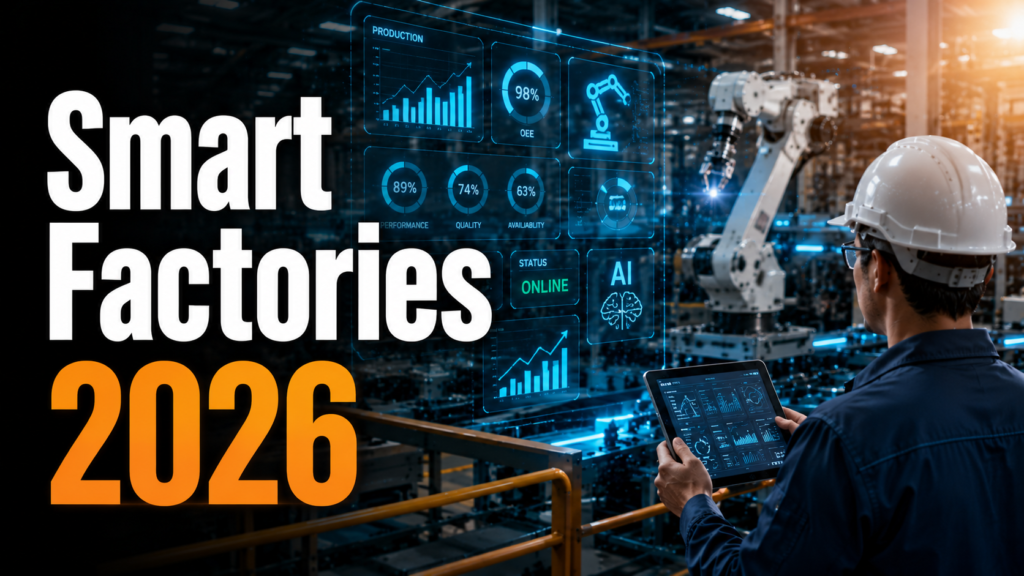
Smart Factories 2026 represent one of the most significant technological transformations in modern manufacturing. Artificial Intelligence, Industrial IoT, robotics, digital twins, and predictive analytics are reshaping how products are designed, produced, inspected, and delivered.
Rather than replacing human expertise, AI augments it by automating repetitive tasks, improving decision-making, and enabling workers to focus on innovation and problem-solving. Businesses that embrace this transformation can improve productivity, reduce costs, enhance product quality, strengthen resilience, and support long-term sustainability.
The journey toward intelligent manufacturing is no longer a distant vision, it is already underway. Companies that invest strategically in smart factory technologies today will be better positioned to compete in an increasingly connected, data-driven, and customer-focused global economy.
Also Read: “The Connected Factory Ecosystem“
Author
Frequently Asked Questions (FAQs)
1. What is a Smart Factory?
A smart factory is a digitally connected manufacturing facility that uses Artificial Intelligence, Industrial IoT, robotics, cloud computing, sensors, and data analytics to automate production, improve efficiency, reduce downtime, and optimize decision-making in real time.
2. How does AI improve manufacturing?
AI improves manufacturing by predicting equipment failures, automating quality inspections, optimizing production schedules, reducing waste, enhancing supply chain efficiency, and enabling data-driven decisions that increase productivity and lower operational costs.
3. Are Smart Factories replacing human workers?
No. Smart factories are designed to complement human workers rather than replace them. AI and automation handle repetitive or hazardous tasks, while employees focus on supervision, maintenance, innovation, quality improvement, and strategic decision-making.
4. What are the biggest challenges of implementing a Smart Factory?
The primary challenges include high initial investment, cybersecurity risks, integrating legacy equipment, ensuring high-quality data, and addressing the skills gap through employee training and change management