


The Connected Factory Ecosystem
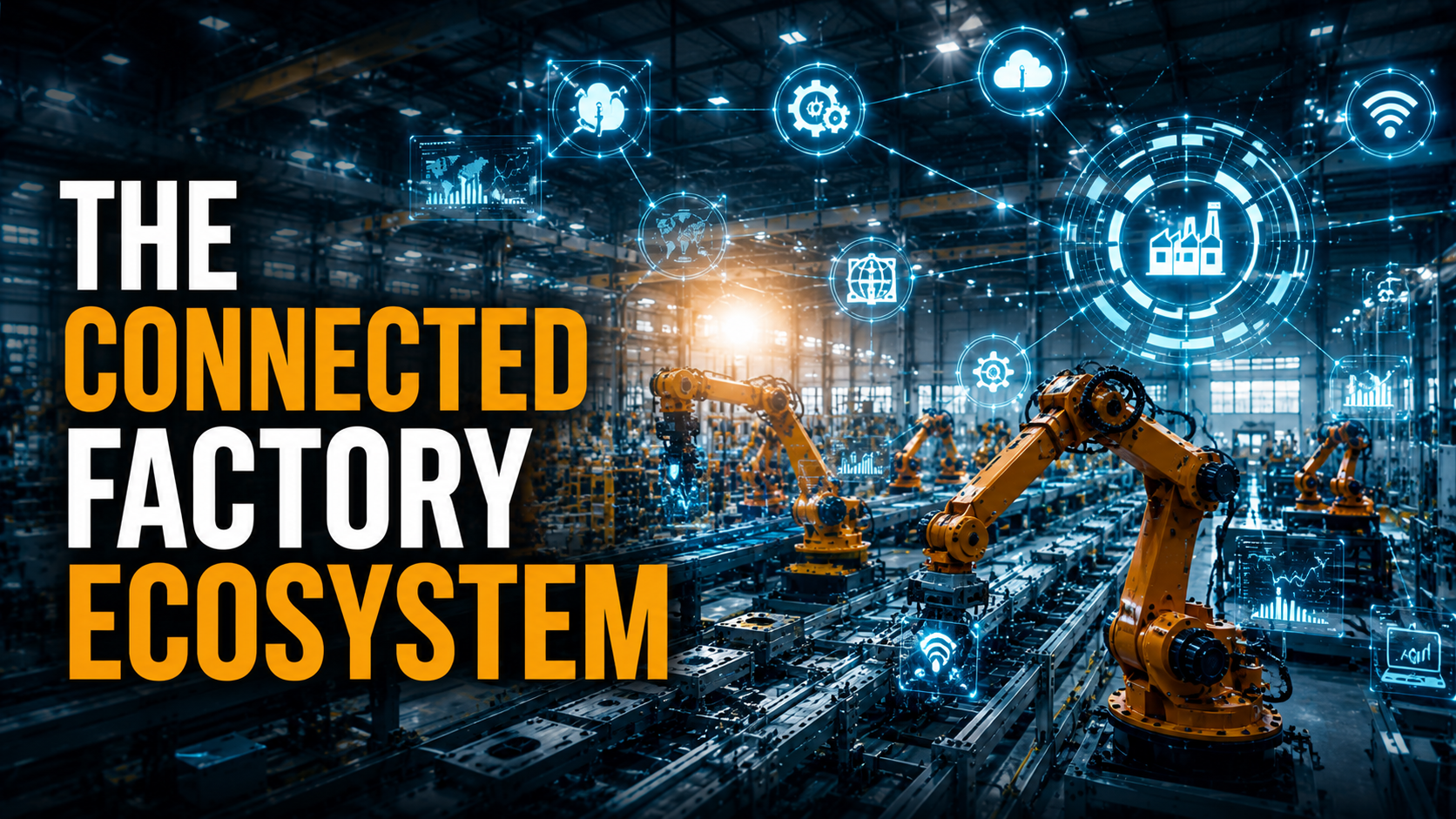
Manufacturing has entered a new era where factories are no longer isolated production environments. Modern industrial facilities are becoming intelligent, interconnected ecosystems where machines, people, software platforms, supply chains, and data networks communicate continuously to improve productivity and efficiency. The Connected Factory Ecosystem.
This transformation is known as the Connected Factory Ecosystem.
A connected factory goes beyond traditional automation. It creates a digital environment where every component of manufacturing operations works together through advanced technologies such as Industrial Internet of Things, Artificial Intelligence, cloud computing, robotics, edge computing, digital twins, and advanced analytics.
In traditional factories, machines often operate independently with limited communication between departments. Production managers rely heavily on historical reports, manual inspections, and human experience to make decisions. In contrast, connected factories collect real-time information from every stage of production and transform that data into actionable intelligence.
The result is a manufacturing environment that can predict problems before they happen, optimize production automatically, reduce waste, improve quality, and respond quickly to changing market demands.
As industries move toward Industry 4.0 and Industry 5.0, the Connected Factory Ecosystem is becoming a strategic foundation for companies seeking greater efficiency, resilience, sustainability, and competitive advantage.
Table of Contents
What Is a Connected Factory Ecosystem?
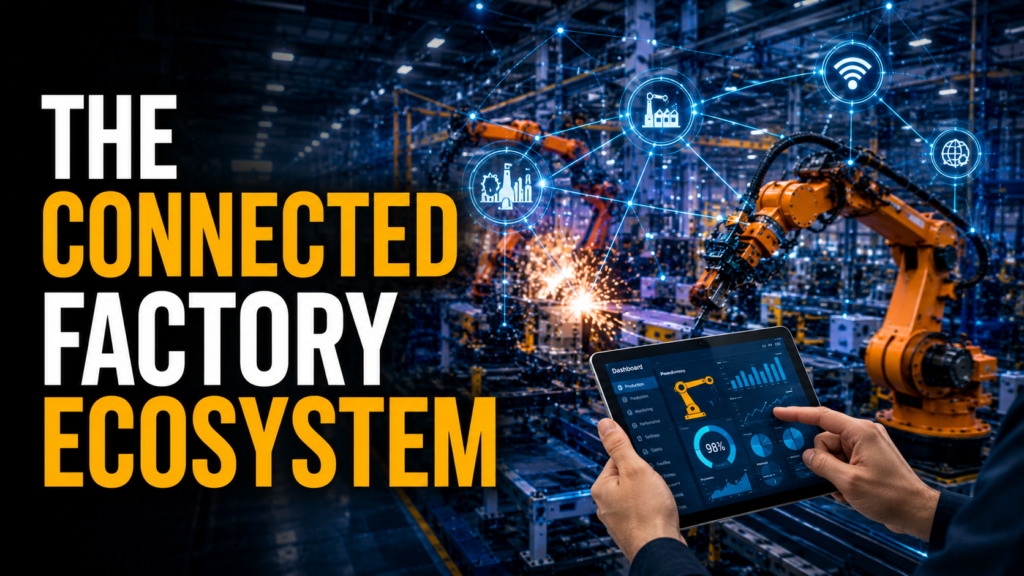
A Connected Factory Ecosystem is an integrated manufacturing environment where machines, systems, employees, suppliers, and business processes are digitally connected to share information and make intelligent decisions.
The core idea behind a connected factory is simple:
Every asset generates valuable data.
Every process creates insights.
Every decision becomes smarter through connectivity.
A connected factory combines physical manufacturing operations with digital intelligence. Machines equipped with sensors continuously monitor performance. Software platforms analyze operational data. Artificial Intelligence identifies patterns. Employees receive real-time insights. Automated systems respond to changing conditions.
Instead of operating as separate departments, the entire factory functions as a unified intelligent ecosystem.
The Evolution From Traditional Factory to Connected Factory
The manufacturing industry has experienced several major transformations.
| Manufacturing Era | Main Technology | Manufacturing Approach |
|---|---|---|
| Industry 1.0 | Steam Power | Mechanized production |
| Industry 2.0 | Electricity | Mass production and assembly lines |
| Industry 3.0 | Computers and Automation | Digital manufacturing systems |
| Industry 4.0 | IoT, AI, Cloud Computing | Connected and intelligent factories |
| Industry 5.0 | Human and AI Collaboration | Sustainable and personalized manufacturing |
The Connected Factory Ecosystem represents the practical implementation of Industry 4.0 principles while supporting the human-centered approach of Industry 5.0.
Why Connected Factory Ecosystems Are Becoming Essential
Manufacturers today face increasing pressure from global competition, customer expectations, supply chain uncertainty, and sustainability requirements.
Companies must achieve:
Higher production efficiency
Faster product development
Improved product quality
Lower operational costs
Greater supply chain visibility
Reduced environmental impact
More flexible production systems
Traditional manufacturing models struggle to meet these demands because they depend on disconnected systems and delayed information.
Connected factories solve this challenge by creating real-time visibility across operations.
Key Components of a Connected Factory Ecosystem
A connected factory is built through the integration of multiple technologies and systems.
Industrial Internet of Things
The Industrial Internet of Things is the foundation of connected manufacturing.
IIoT connects machines, sensors, equipment, and production systems through digital networks.
Industrial sensors collect information such as:
Machine temperature
Equipment vibration
Production speed
Energy consumption
Pressure levels
Material usage
Operating conditions
This continuous data stream allows manufacturers to monitor operations and make faster decisions.
Smart Machines and Intelligent Equipment
Modern factories use intelligent machines capable of communication, self-monitoring, and automated adjustment.
Smart machines can:
Detect performance issues
Adjust operating parameters
Communicate maintenance requirements
Optimize production processes
Improve energy efficiency
Unlike traditional equipment, smart machines actively participate in factory decision-making.
Artificial Intelligence and Machine Learning
Artificial Intelligence transforms factory data into meaningful insights.
AI systems analyze production information to identify patterns, predict future outcomes, and recommend improvements.
Manufacturers use AI for:
Predictive maintenance
Quality inspection
Production optimization
Demand forecasting
Supply chain planning
Energy management
Machine performance analysis
Machine Learning models continuously improve as they process more operational data.
Digital Twin Technology
A digital twin is a virtual representation of a physical machine, production line, or entire factory.
It allows manufacturers to simulate real-world operations digitally before making physical changes.
Digital twins help organizations:
Test production improvements
Predict equipment behavior
Optimize factory layouts
Reduce operational risks
Improve product development
For example, a manufacturer can simulate a new production workflow digitally before investing in equipment changes.
Cloud Computing Infrastructure
Cloud computing provides the scalable digital foundation required for connected factories.
Cloud platforms allow manufacturers to:
Store large volumes of industrial data
Run advanced analytics
Deploy AI models
Connect multiple factory locations
Access real-time dashboards
Improve collaboration
Cloud technology enables global organizations to manage manufacturing operations across different locations from a unified platform.
Edge Computing
While cloud computing provides large-scale processing capabilities, edge computing enables immediate decision-making close to the production equipment.
Edge devices analyze data locally rather than sending every piece of information to centralized systems.
Benefits include:
Faster response times
Lower network dependency
Improved reliability
Enhanced security
Real-time machine control
Edge computing is especially important for applications where milliseconds matter, such as robotics and automated quality inspection.
Robotics and Automation
Robotics plays a critical role in connected factory ecosystems.
Modern industrial robots are becoming more intelligent, flexible, and collaborative.
Connected robots can:
Communicate with other machines
Adjust tasks automatically
Work alongside employees
Improve production accuracy
Reduce repetitive manual activities
Collaborative robots allow humans and machines to work together safely, combining human creativity with machine precision.
Manufacturing Execution Systems
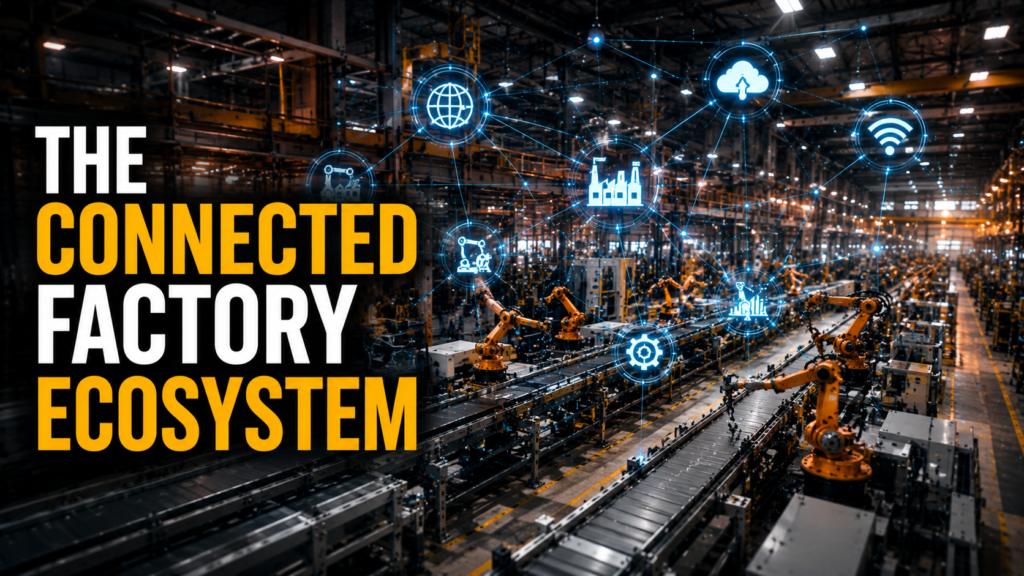
Manufacturing Execution Systems connect production activities with business operations.
MES platforms provide visibility into:
Production scheduling
Work orders
Material tracking
Quality information
Equipment performance
Employee activities
They act as a bridge between enterprise software and factory-floor operations.
Data Analytics and Real-Time Intelligence
Data is the most valuable resource in connected manufacturing.
Factories generate enormous amounts of information every second.
Advanced analytics transforms this information into:
Operational insights
Performance improvements
Risk predictions
Optimization opportunities
Real-time dashboards help managers understand factory conditions immediately instead of waiting for daily or weekly reports.
How the Connected Factory Ecosystem Works
A connected factory operates through a continuous information cycle.
Data Generation
Machines, sensors, employees, and systems generate operational data.
Data Collection
Connected devices collect information from production environments.
Data Processing
Edge devices and cloud platforms analyze the collected information.
Intelligent Decision Making
AI algorithms identify opportunities, risks, and recommended actions.
Automated Response
Systems adjust processes automatically or provide recommendations to employees.
Continuous Improvement
New data improves future decision-making.
This cycle creates a factory that continuously learns and improves.
Benefits of a Connected Factory Ecosystem
Increased Operational Efficiency
Connected factories identify production bottlenecks and optimize workflows.
Manufacturers achieve:
Higher equipment utilization
Reduced production delays
Improved resource allocation
Better workflow management
Predictive Maintenance and Reduced Downtime
One of the biggest advantages of connected factories is predictive maintenance.
Traditional maintenance follows fixed schedules or reacts after equipment failure.
Connected factories use real-time equipment data to predict failures before they occur.
Benefits include:
Reduced unexpected downtime
Lower repair costs
Extended machine lifespan
Improved production reliability
Improved Quality Control
Connected factories use AI-powered inspection systems to detect defects automatically.
Computer vision technology can identify:
Surface defects
Assembly errors
Measurement variations
Packaging problems
Product inconsistencies
This improves quality while reducing inspection time.
Enhanced Supply Chain Visibility
A connected factory does not operate independently.
It connects with suppliers, logistics providers, warehouses, and customers.
Manufacturers gain visibility into:
Material availability
Supplier performance
Transportation status
Inventory levels
Customer demand
This enables faster responses to supply chain disruptions.
Greater Production Flexibility
Modern customers increasingly demand personalized products.
Connected factories support flexible manufacturing by allowing production systems to adjust quickly.
Benefits include:
Small-batch production
Customized products
Faster product changes
Reduced setup times
Improved Sustainability
Sustainability has become a major priority for modern manufacturers.
Connected factories reduce environmental impact through:
Energy optimization
Waste reduction
Resource monitoring
Smart production planning
Emission tracking
Sustainable manufacturing improves both environmental performance and operational efficiency.
Connected Factory Ecosystem Architecture
| Layer | Purpose | Examples |
|---|---|---|
| Physical Layer | Equipment and machines | Robots, sensors, production systems |
| Connectivity Layer | Data communication | Industrial networks, gateways |
| Data Layer | Information management | Databases, cloud platforms |
| Intelligence Layer | Analysis and decisions | AI, analytics, machine learning |
| Application Layer | Business operations | MES, ERP, dashboards |
| Human Layer | Collaboration | Employees, engineers, managers |
Real-World Applications of Connected Factories
Automotive Industry
Automotive manufacturers use connected factories for:
Robotic assembly
Vehicle customization
Quality inspection
Supply chain coordination
Predictive maintenance
Battery production optimization
Electronics Manufacturing
Electronics companies rely on connected ecosystems for:
Precision manufacturing
Chip inspection
Automated testing
Production tracking
Yield improvement
Pharmaceutical Manufacturing
Connected pharmaceutical factories improve:
Production compliance
Batch monitoring
Quality control
Equipment reliability
Regulatory reporting
Food Manufacturing
Food manufacturers use connected systems for:
Production monitoring
Cold storage management
Quality inspection
Waste reduction
Supply chain tracking
Aerospace Manufacturing
Aerospace companies use connected factories for:
Complex assembly processes
Equipment monitoring
Quality assurance
Digital engineering
Maintenance optimization
Challenges of Building Connected Factory Ecosystems
Although connected factories provide significant advantages, implementation requires careful planning.
Legacy Equipment Integration
Many factories operate older machines that were not designed for digital connectivity.
Manufacturers often need:
IoT upgrades
Sensor installation
Industrial gateways
System integration solutions
Cybersecurity Risks
More connectivity creates new security challenges.
Manufacturers must protect:
Production networks
Industrial control systems
Sensitive designs
Operational data
Strong cybersecurity strategies are essential.
Data Management Complexity
Factories generate massive amounts of information.
Organizations need effective systems for:
Data storage
Data quality management
Analytics
Governance
Security
Workforce Skills Gap
Connected factories require employees with digital skills.
Organizations must invest in training related to:
Data analytics
Automation systems
AI technologies
Cybersecurity
Digital manufacturing tools
The Future of Connected Factory Ecosystems
The next generation of factories will become even more intelligent.
Future developments include:
Fully autonomous production lines
AI-powered factory managers
Self-optimizing machines
Advanced human-machine collaboration
Real-time global manufacturing networks
Autonomous supply chains
AI-driven sustainability management
Immersive industrial experiences using augmented reality
Connected factories will continue evolving from automated environments into intelligent systems capable of learning and adapting.
How Businesses Can Build a Connected Factory Strategy
Successful transformation requires a structured approach.
Define Business Objectives
Companies should identify specific goals such as reducing downtime, improving quality, or increasing production flexibility.
Establish Data Infrastructure
Reliable data collection and management are essential.
Connect Existing Equipment
Factories can gradually modernize through sensors and connectivity solutions.
Implement AI and Analytics
Organizations should use data intelligence to improve decision-making.
Train Employees
Technology adoption succeeds when employees understand and trust new systems.
Scale Successful Projects
Companies should expand proven solutions across manufacturing operations.
Why Connected Factory Ecosystems Will Shape Manufacturing Competition
The future of manufacturing competition will not only depend on production capacity.
It will depend on intelligence.
Companies that understand their operations in real time, predict challenges before they occur, and optimize resources continuously will gain a significant advantage.
Connected factories provide the foundation for:
Faster innovation
Higher efficiency
Improved resilience
Better customer experiences
Sustainable growth
The manufacturers that successfully combine technology, data, and human expertise will define the next generation of industrial leadership.
Conclusion
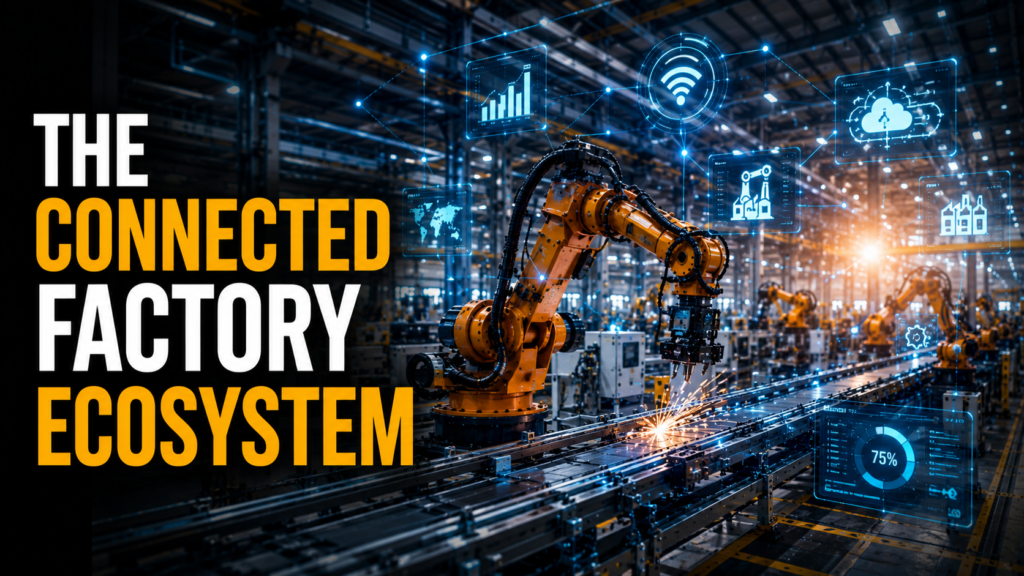
The Connected Factory Ecosystem represents a fundamental transformation in how manufacturing operates. It connects machines, people, software, and business systems into a unified intelligent environment capable of continuous improvement.
Through Industrial IoT, Artificial Intelligence, digital twins, robotics, cloud computing, and advanced analytics, factories are becoming smarter, more efficient, and more sustainable.
The connected factory is not simply about adding new technology to existing operations. It is about creating a new manufacturing model where data-driven decisions, automation, and human expertise work together to achieve higher levels of performance.
As industries continue moving toward Industry 5.0, connected factory ecosystems will become a defining factor in global manufacturing success. Organizations that invest in digital transformation today will be better prepared to compete in the intelligent industrial economy of tomorrow.
Also Read: “The Convergence of AI, Robotics, and Digital Twins“
Author
Frequently Asked Questions
What is a Connected Factory Ecosystem?
A Connected Factory Ecosystem is a digitally integrated manufacturing environment where machines, systems, employees, and business processes communicate through advanced technologies to improve production efficiency and decision-making.
How does a connected factory differ from a traditional factory?
Traditional factories rely heavily on manual processes and isolated systems. Connected factories use real-time data, AI, automation, and digital connectivity to create intelligent and adaptive manufacturing operations.
What technologies power connected factories?
Key technologies include Industrial Internet of Things, Artificial Intelligence, Machine Learning, cloud computing, edge computing, robotics, digital twins, manufacturing execution systems, and advanced analytics.