


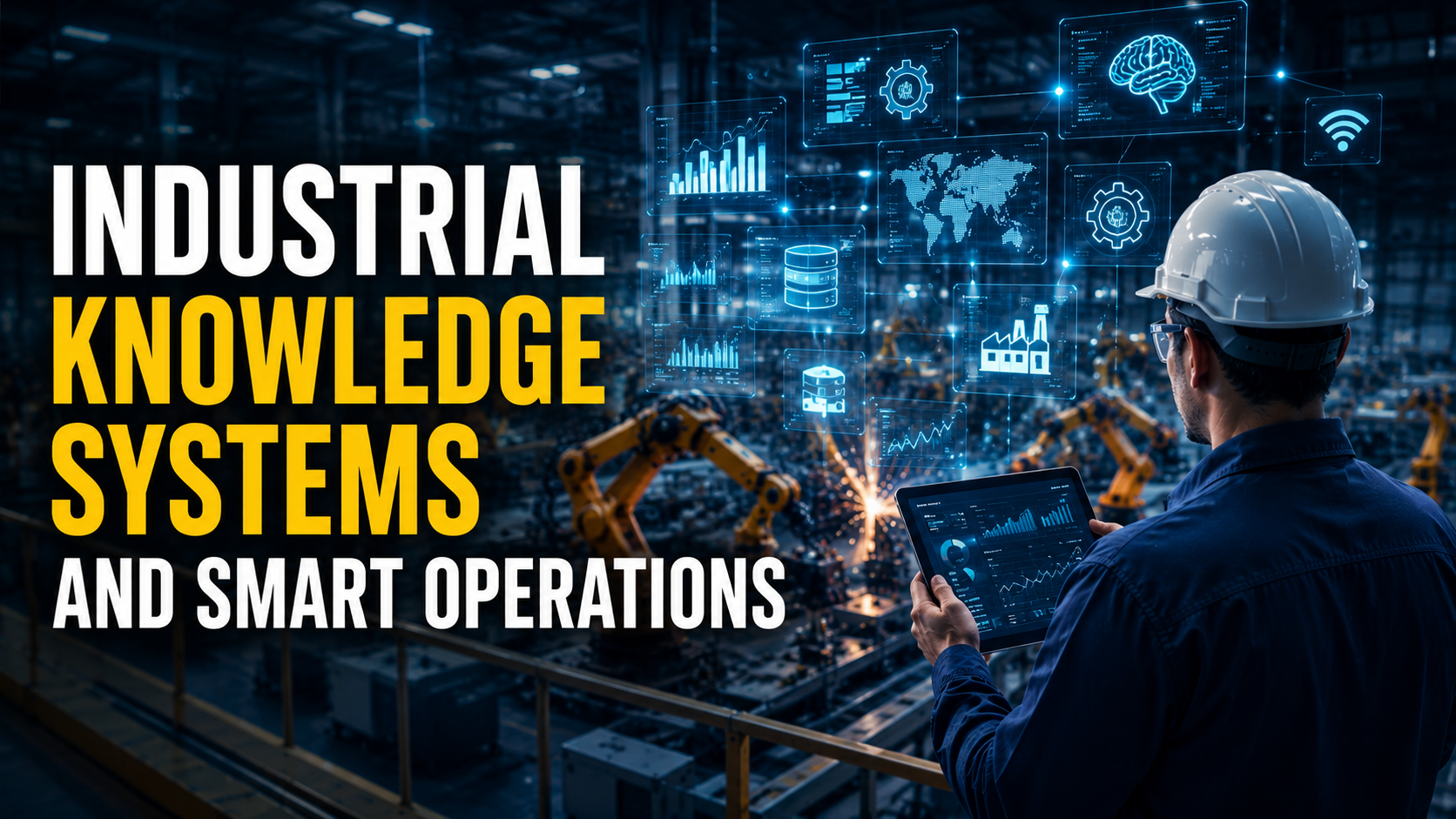
Manufacturing has always depended on knowledge. Engineers understand machines, operators understand processes, technicians understand equipment behavior, and managers understand production goals. For decades, this knowledge remained scattered across human experience, technical documents, maintenance records, production reports, and operational practices. Industrial Knowledge Systems and Smart Operations,
Today, manufacturing is entering a new phase where industrial knowledge is becoming digital, connected, and intelligent.
Industrial Knowledge Systems are emerging as a critical foundation for smart operations by capturing, organizing, analyzing, and applying industrial knowledge across the entire manufacturing ecosystem. These systems combine Artificial Intelligence, Machine Learning, Industrial Internet of Things, data analytics, digital twins, knowledge graphs, automation platforms, and human expertise to create factories that can learn, adapt, and continuously improve.
Smart operations are no longer limited to automated machines performing repetitive tasks. They represent a broader transformation where manufacturing organizations use intelligent knowledge systems to make better decisions, optimize resources, reduce downtime, improve quality, and respond faster to changing market conditions.
As industries move toward Industry 4.0 and Industry 5.0, companies that successfully manage industrial knowledge will gain a significant competitive advantage.
The future factory will not only produce products. It will understand processes, learn from experience, predict challenges, and continuously optimize operations.
Table of Contents
What Are Industrial Knowledge Systems?
Industrial Knowledge Systems are digital platforms designed to collect, organize, analyze, and apply knowledge generated throughout industrial operations.
They combine data from multiple sources, including:
Production equipment
Industrial sensors
Maintenance records
Engineering documents
Operator experience
Quality reports
Supply chain information
Enterprise software
Simulation models
Artificial Intelligence systems
The purpose of an Industrial Knowledge System is to transform disconnected information into meaningful operational intelligence.
Traditional manufacturing systems answer questions such as:
What happened?
Industrial Knowledge Systems answer deeper questions:
Why did it happen?
What could happen next?
What action should be taken?
How can operations improve continuously?
These systems create a knowledge-driven manufacturing environment where decisions are supported by data, experience, and intelligent recommendations.
The Evolution of Industrial Knowledge Management
Manufacturing knowledge management has evolved significantly over time.
| Manufacturing Stage | Knowledge Approach | Main Characteristics |
|---|---|---|
| Traditional Factory | Human expertise | Knowledge stored in employee experience |
| Digital Manufacturing | Information systems | Electronic records and databases |
| Industry 4.0 | Connected intelligence | Real-time data and analytics |
| Industry 5.0 | Human and AI collaboration | Intelligent knowledge-driven operations |
Earlier manufacturing environments depended heavily on experienced employees. While human expertise remains valuable, organizations faced challenges when knowledge was difficult to capture or when skilled workers retired.
Industrial Knowledge Systems solve this problem by preserving expertise digitally and making it available across the organization.
Why Industrial Knowledge Systems Matter Today
Modern manufacturing environments are becoming increasingly complex.
Companies manage:
Global production networks
Advanced machinery
Highly customized products
Strict quality standards
Complex supply chains
Environmental requirements
Rapid technology changes
In such environments, relying only on human memory or traditional reporting methods is insufficient.
Industrial Knowledge Systems help organizations create a continuous learning environment where every production activity contributes to future improvement.
The Relationship Between Knowledge Systems and Smart Operations
Smart operations depend on the ability to transform information into intelligent action.
Industrial Knowledge Systems provide the intelligence layer that connects manufacturing data with operational decisions.
The relationship works through three stages:
Data Collection
Manufacturing systems collect information from machines, sensors, employees, and business platforms.
Knowledge Creation
Artificial Intelligence and analytics transform raw data into meaningful insights.
Operational Action
Smart systems recommend or automate decisions that improve performance.
This creates a continuous improvement cycle where operations become more intelligent over time.
Core Components of Industrial Knowledge Systems
Industrial Data Infrastructure
Data is the foundation of every knowledge system.
Modern factories generate information from:
Machines
Sensors
Robots
Quality systems
Enterprise applications
Maintenance platforms
Supply chain networks
A strong data infrastructure ensures that information is collected, stored, and processed effectively.
Knowledge Graphs
Knowledge graphs help organizations understand relationships between different industrial elements.
For example, a knowledge graph can connect:
A machine
Its operating conditions
Maintenance history
Replacement parts
Failure patterns
Production impact
Technician recommendations
This allows AI systems to understand industrial relationships rather than analyzing isolated data points.
Artificial Intelligence and Machine Learning
AI enables Industrial Knowledge Systems to discover patterns and generate recommendations.
Manufacturers use AI for:
Failure prediction
Process optimization
Quality improvement
Root cause analysis
Production forecasting
Energy optimization
Machine performance analysis
Machine Learning models become more accurate as they learn from additional operational data.
Digital Twins
Digital twins create virtual representations of physical assets, production lines, or complete factories.
They allow organizations to combine operational knowledge with simulation capabilities.
Manufacturers can use digital twins to:
Test process changes
Analyze equipment behavior
Predict future performance
Optimize production workflows
Reduce implementation risks
Digital twins become knowledge platforms that continuously reflect real-world factory conditions.
Industrial Internet of Things
Industrial IoT connects physical equipment with digital intelligence.
Sensors collect real-time information about:
Machine health
Temperature
Pressure
Energy consumption
Production speed
Material usage
Operational conditions
This data becomes a valuable knowledge source for improving operations.
Human Expertise Integration
One of the most important aspects of Industrial Knowledge Systems is the integration of human experience.
Experienced engineers and operators possess valuable knowledge that cannot always be captured through machine data alone.
Modern systems combine:
Machine-generated insights
Historical records
Expert recommendations
Operational procedures
Employee feedback
This creates a powerful collaboration between humans and intelligent technologies.
Smart Operations Explained
Smart operations refer to manufacturing processes that use connected technologies, automation, analytics, and intelligent decision-making to improve performance.
A smart operation environment can:
Monitor itself
Analyze performance
Predict problems
Optimize processes
Adapt to changing conditions
Support employees
Improve continuously
Smart operations transform factories from reactive environments into proactive and intelligent systems.
Key Benefits of Industrial Knowledge Systems in Smart Operations
Improved Decision-Making
Manufacturing decisions often involve multiple variables.
Industrial Knowledge Systems analyze large amounts of operational information and provide recommendations based on real-time conditions.
Managers gain better visibility into:
Production performance
Equipment health
Quality issues
Resource utilization
Operational risks
Faster Problem Resolution
Manufacturing problems can create significant financial losses.
Knowledge systems accelerate troubleshooting by connecting current issues with historical solutions.
For example, when equipment performance declines, the system can analyze previous failures and recommend corrective actions.
Predictive Maintenance
Traditional maintenance often follows fixed schedules.
Smart operations use knowledge-driven predictive maintenance.
The system analyzes:
Machine behavior
Sensor data
Historical failures
Operating conditions
Maintenance records
It predicts potential failures before they occur.
Benefits include:
Reduced downtime
Lower repair costs
Improved equipment reliability
Longer asset life
Better Knowledge Retention
Industrial expertise is one of the most valuable assets of any manufacturing organization.
Knowledge systems preserve:
Technical procedures
Maintenance knowledge
Engineering solutions
Production experience
Troubleshooting methods
This prevents critical knowledge loss and supports workforce development.
Enhanced Quality Management
Quality improvement requires understanding the relationship between processes and outcomes.
Industrial Knowledge Systems analyze:
Production parameters
Material characteristics
Machine conditions
Inspection results
Historical quality data
This helps manufacturers identify quality risks before defects occur.
Increased Operational Efficiency
Smart operations optimize resource usage.
Knowledge systems help improve:
Production scheduling
Equipment utilization
Energy management
Material consumption
Labor allocation
Process efficiency
Support for Continuous Improvement
Manufacturing excellence depends on continuous improvement.
Industrial Knowledge Systems support improvement initiatives by identifying:
Performance gaps
Optimization opportunities
Process variations
Efficiency improvements
Innovation possibilities
Industrial Knowledge Systems Across Manufacturing Functions
| Manufacturing Area | Knowledge System Application |
|---|---|
| Production | Process optimization and scheduling |
| Maintenance | Predictive analysis and troubleshooting |
| Quality | Defect prevention and root cause analysis |
| Engineering | Design knowledge management |
| Supply Chain | Supplier intelligence |
| Safety | Risk identification |
| Workforce | Skill development and knowledge sharing |
| Management | Strategic decision support |
Real-World Applications of Industrial Knowledge Systems
Automotive Manufacturing
Automotive companies use knowledge systems to manage complex production processes.
Applications include:
Vehicle assembly optimization
Robot performance monitoring
Quality analysis
Maintenance intelligence
Supplier coordination
Production planning
Aerospace Manufacturing
Aerospace manufacturing requires extremely high precision.
Knowledge systems support:
Engineering knowledge management
Aircraft component production
Maintenance analysis
Quality compliance
Manufacturing simulation
Pharmaceutical Manufacturing
Pharmaceutical companies use intelligent knowledge systems for:
Process monitoring
Regulatory compliance
Batch quality control
Production optimization
Documentation management
Electronics Manufacturing
Electronics production requires advanced precision.
Knowledge systems help with:
Defect analysis
Equipment monitoring
Yield improvement
Production optimization
Component management
Food and Beverage Manufacturing
Food manufacturers apply knowledge systems for:
Quality control
Production consistency
Supply chain tracking
Waste reduction
Energy optimization
Challenges of Implementing Industrial Knowledge Systems
Data Complexity
Manufacturing environments generate enormous amounts of data.
Organizations must ensure:
Data accuracy
Data consistency
Data accessibility
Data security
Legacy System Integration
Many factories still use older equipment and software.
Successful implementation requires integration between:
Existing machines
Modern sensors
Enterprise software
Cloud platforms
Analytics systems
Cybersecurity Concerns
Connected industrial environments create cybersecurity challenges.
Organizations must protect:
Operational technology
Production data
Intellectual property
Industrial networks
Strong security practices are essential for reliable smart operations.
Workforce Adoption
Technology transformation requires employee acceptance.
Organizations should focus on:
Training programs
Digital skills development
Change management
Human-AI collaboration
Employees should view intelligent systems as tools that enhance expertise rather than replace human knowledge.
Cost and Implementation Complexity
Building Industrial Knowledge Systems requires investment in:
Technology infrastructure
Software platforms
Data management
Employee training
Integration projects
A phased implementation approach helps organizations achieve measurable value while reducing risk.
The Role of Generative AI in Industrial Knowledge Systems
Generative AI is creating new possibilities for industrial knowledge management.
Manufacturers can use Generative AI for:
Technical documentation
Maintenance assistance
Engineering support
Operational recommendations
Employee training
Natural language search across industrial knowledge
Factory employees can interact with AI assistants to quickly access technical information and solve operational challenges.
Future Trends in Industrial Knowledge Systems
The future of industrial knowledge management will be shaped by several emerging trends.
Autonomous Smart Operations
Factories will increasingly use AI systems capable of monitoring, analyzing, and optimizing operations automatically.
AI Industrial Assistants
Employees will use intelligent assistants for troubleshooting, engineering analysis, and operational guidance.
Self-Learning Manufacturing Systems
Future factories will continuously learn from production experiences and improve automatically.
Advanced Digital Twins
Digital twins will become complete knowledge environments representing entire organizations.
Human-Centered Industry 5.0
The future will focus on collaboration between humans and intelligent systems.
Machines will provide analytical capabilities while humans contribute creativity, judgment, and strategic thinking.
How Organizations Can Build Industrial Knowledge Systems
Successful implementation requires a strategic approach.
Identify Critical Knowledge Areas
Companies should determine where knowledge has the greatest operational value.
Examples:
Maintenance expertise
Production optimization
Quality improvement
Engineering knowledge
Create Strong Data Foundations
Reliable data is essential for intelligent systems.
Organizations should improve:
Data collection
Data management
Data governance
Data integration
Combine AI With Human Expertise
The strongest knowledge systems combine machine intelligence with employee experience.
Start With High-Value Use Cases
Organizations can begin with:
Predictive maintenance
Quality improvement
Production optimization
Knowledge search systems
Develop Digital Skills
Employees need training in:
Data analysis
AI collaboration
Digital tools
Smart manufacturing technologies
Measuring the Success of Smart Operations
Organizations should track measurable improvements.
Important metrics include:
Equipment uptime
Production efficiency
Defect reduction
Maintenance costs
Energy consumption
Production speed
Knowledge accessibility
Employee productivity
Customer satisfaction
Why Industrial Knowledge Systems Will Define Future Manufacturing
The future of manufacturing will be determined by how effectively organizations use knowledge.
Machines alone cannot create intelligent operations.
Data alone cannot create improvement.
The combination of industrial knowledge, artificial intelligence, automation, and human expertise creates the foundation for the next generation of manufacturing.
Companies that successfully build knowledge-driven operations will achieve:
Greater efficiency
Faster innovation
Improved resilience
Better decision-making
Sustainable growth
Industrial Knowledge Systems are becoming the strategic intelligence layer of modern manufacturing enterprises.
Conclusion
Industrial Knowledge Systems and Smart Operations represent a major shift in manufacturing transformation. They allow organizations to capture valuable industrial expertise, connect operational data, apply Artificial Intelligence, and create factories that continuously learn and improve.
The modern factory is no longer defined only by machines and production lines. It is defined by its ability to understand processes, learn from experience, and make intelligent decisions.
As manufacturing moves deeper into Industry 4.0 and Industry 5.0, organizations that successfully combine human expertise with intelligent knowledge systems will lead the future of industrial innovation.
The next generation of manufacturing will not simply be automated. It will be intelligent, adaptive, and knowledge-driven.
Also Read: “How Intelligent Machines Are Reshaping the Future“
Author
Frequently Asked Questions
What are Industrial Knowledge Systems?
Industrial Knowledge Systems are digital platforms that capture, organize, analyze, and apply manufacturing knowledge using technologies such as Artificial Intelligence, analytics, Industrial IoT, and digital twins.
How do Industrial Knowledge Systems improve manufacturing?
They improve manufacturing by enabling better decision-making, predictive maintenance, faster problem-solving, improved quality control, and continuous operational improvement.
What technologies support Industrial Knowledge Systems?
Key technologies include Artificial Intelligence, Machine Learning, Industrial Internet of Things, digital twins, knowledge graphs, cloud computing, edge computing, and advanced analytics.