

Self-Healing Production Lines Powered by AI
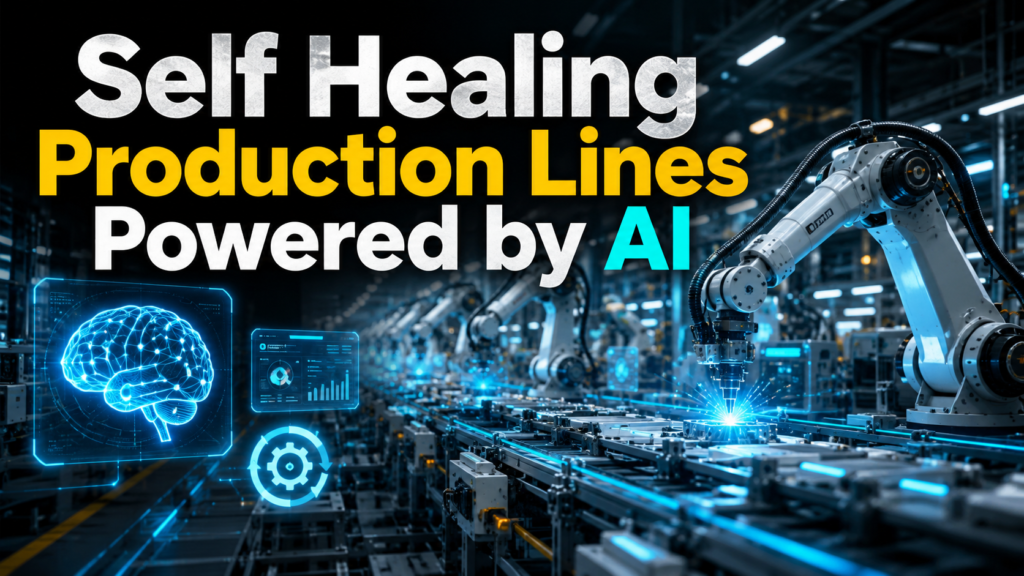
Manufacturing has entered a new era where production lines are no longer limited to following predefined instructions. Modern factories are becoming intelligent ecosystems capable of monitoring themselves, identifying problems before they occur, and automatically correcting issues with minimal human intervention. This revolutionary concept is known as self-healing production lines powered by Artificial Intelligence. Self Healing Production Lines Powered by AI: The Future of Smart Manufacturing.
For decades, manufacturers relied on preventive maintenance schedules, manual inspections, and reactive repairs to keep operations running. While these approaches reduced some downtime, they often resulted in unnecessary maintenance costs or unexpected equipment failures.
Artificial Intelligence is changing that reality. Instead of waiting for machines to fail, AI continuously analyzes data from sensors, cameras, robotics, programmable logic controllers, and industrial Internet of Things devices. It detects abnormalities, predicts failures, and initiates corrective actions before production is affected.
Self-healing production lines represent one of the biggest milestones in Industry 4.0 and smart manufacturing. They combine machine learning, predictive analytics, digital twins, robotics, computer vision, and automation into a unified ecosystem capable of maintaining production with minimal interruption.
This article explores how AI-powered self-healing production lines work, their technologies, benefits, challenges, real-world applications, future developments, and why they are becoming the backbone of modern manufacturing.
Table of Contents
What Are Self-Healing Production Lines?
A self-healing production line is an intelligent manufacturing system that can automatically detect, diagnose, and recover from operational problems without requiring significant human intervention.
Unlike traditional automation systems that simply execute programmed commands, self-healing systems continuously learn from production data and adapt to changing conditions.
The core objective is simple.
Instead of stopping production after a fault occurs, the system prevents failures before they happen and restores normal operations automatically whenever possible.
Examples include:
Machine recalibrating itself after detecting dimensional deviations.
Robotic arms automatically adjusting movement when sensors detect wear.
Production schedules instantly changing after equipment degradation.
Alternative machines taking over when another machine predicts failure.
Automatic ordering of replacement components before breakdown occurs.
This level of intelligence significantly improves productivity while reducing downtime and maintenance expenses.
Why Manufacturers Need Self-Healing Production Lines
Modern manufacturing faces increasing challenges.
Growing customer demand.
Labor shortages.
Supply chain disruptions.
Rising operational costs.
Shorter product life cycles.
Increasing product customization.
Unexpected equipment failures.
Traditional manufacturing methods struggle to cope with these demands.
AI-driven production lines help manufacturers maintain efficiency while reducing risks associated with equipment failure and operational disruptions.
Evolution of Manufacturing Maintenance
| Generation | Maintenance Strategy | Characteristics |
|---|---|---|
| Traditional Manufacturing | Reactive Maintenance | Repair after breakdown |
| Preventive Maintenance | Scheduled Maintenance | Fixed inspection intervals |
| Predictive Maintenance | AI Predictions | Failure forecasting |
| Self-Healing Manufacturing | Autonomous Recovery | Automatic diagnosis and correction |
The final stage represents today’s intelligent manufacturing revolution.
Core Technologies Behind Self-Healing Production Lines
Several advanced technologies work together to create autonomous manufacturing systems.
Artificial Intelligence
AI serves as the brain of the production line.
Machine learning algorithms analyze millions of sensor readings, production records, historical failures, and environmental conditions to recognize hidden patterns.
The system continuously improves its decision-making abilities through experience.
Industrial Internet of Things
Industrial IoT connects every machine, conveyor, robot, motor, and sensor into one intelligent network.
Thousands of sensors continuously monitor:
Temperature
Pressure
Vibration
Speed
Humidity
Current consumption
Noise
Alignment
Tool wear
Every second, enormous amounts of production data become available for AI analysis.
Machine Learning
Machine learning identifies patterns humans cannot easily recognize.
Examples include:
Subtle vibration changes before motor failure.
Minor increases in energy consumption.
Microscopic quality deviations.
Unexpected production cycle delays.
These early warning signs allow intervention before actual failures occur.
Predictive Analytics
Predictive analytics estimates the remaining useful life of equipment.
Instead of asking whether a machine may fail, AI predicts:
When it will fail.
Why it will fail.
How severe the failure may become.
What actions should be taken.
This transforms maintenance into a highly optimized process.
Computer Vision
AI-powered cameras inspect products continuously.
Computer vision detects:
Surface defects.
Assembly errors.
Color inconsistencies.
Missing components.
Cracks.
Scratches.
Incorrect labels.
Unlike manual inspection, AI operates continuously with consistent accuracy.
Digital Twins
A digital twin is a virtual replica of a physical production line.
Every machine has a digital version receiving live operational data.
Engineers simulate repairs, optimize settings, and predict failures without disrupting production.
Digital twins make self-healing much faster and safer.
Edge Computing
Manufacturing environments require instant decision-making.
Sending every data point to cloud servers introduces delays.
Edge computing processes information directly at the factory.
Benefits include:
Ultra-fast response.
Lower network traffic.
Improved cybersecurity.
Reduced latency.
Higher operational reliability.
How Self-Healing Production Lines Work
The self-healing process generally follows several intelligent stages.
Step 1: Continuous Monitoring
Sensors collect operational data every second.
Examples include:
Motor vibration.
Bearing temperature.
Power consumption.
Hydraulic pressure.
Robot positioning.
Conveyor speed.
Step 2: AI Detects Abnormalities
Machine learning compares live performance against historical behavior.
Even tiny deviations trigger further analysis.
Step 3: Root Cause Analysis
Instead of only identifying symptoms, AI determines the underlying cause.
For example:
Loose bearing.
Lubrication failure.
Motor imbalance.
Misaligned conveyor.
Software configuration error.
Step 4: Decision Making
AI evaluates multiple possible responses.
Continue production safely.
Reduce machine speed.
Switch workload.
Activate backup equipment.
Schedule maintenance.
Order spare parts.
Notify technicians.
Step 5: Autonomous Recovery
If safe to do so, AI automatically performs corrective actions.
Examples include:
Adjusting robotic calibration.
Changing machine parameters.
Restarting software.
Balancing production loads.
Redirecting materials.
Optimizing energy usage.
Step 6: Learning
Every incident becomes new training data.
The AI system improves continuously, making future decisions more accurate.
Major Benefits of Self-Healing Production Lines
Reduced Downtime
Unexpected downtime is among the largest manufacturing expenses.
Self-healing systems dramatically reduce production interruptions by preventing failures before they happen.
Lower Maintenance Costs
Traditional preventive maintenance often replaces perfectly functional components.
AI performs maintenance only when necessary.
This reduces:
Labor costs.
Replacement part expenses.
Maintenance frequency.
Inventory costs.
Improved Product Quality
Real-time monitoring ensures consistent production quality.
Defects are identified immediately instead of after large production batches.
This minimizes waste and customer complaints.
Higher Equipment Lifespan
Equipment operating under optimized conditions experiences less wear.
This extends the life of expensive manufacturing assets.
Better Workplace Safety
AI detects dangerous operating conditions before accidents occur.
Examples include:
Overheating.
Gas leaks.
Electrical anomalies.
Excessive vibration.
Robot path deviations.
Safer workplaces reduce injuries and compliance risks.
Energy Efficiency
AI continuously optimizes power consumption.
Idle machines automatically enter low-energy modes.
Production schedules minimize peak electricity usage.
Energy savings contribute directly to sustainability goals.
Improved Supply Chain Coordination
Self-healing production lines communicate with inventory systems.
When failures occur, AI adjusts:
Material ordering.
Delivery schedules.
Production planning.
Warehouse operations.
This minimizes supply chain disruptions.
Real-World Applications
Automotive Manufacturing
Vehicle production involves thousands of robotic operations.
AI identifies robotic wear before accuracy declines.
This prevents assembly defects and costly recalls.
Semiconductor Manufacturing
Chip manufacturing requires extreme precision.
AI monitors microscopic production variations.
Self-healing adjustments maintain product quality while reducing waste.
Pharmaceutical Manufacturing
Medicine production requires strict compliance.
AI continuously verifies:
Temperature.
Sterility.
Mixing accuracy.
Packaging integrity.
Automatic corrections improve regulatory compliance.
Food Processing
Food manufacturers use AI for:
Quality inspection.
Packaging verification.
Cold chain monitoring.
Equipment sanitation monitoring.
This ensures product safety while reducing waste.
Electronics Manufacturing
Electronic assembly lines contain highly sensitive equipment.
AI prevents soldering defects, machine misalignment, and component placement errors.
Aerospace Manufacturing
Aircraft components demand exceptional precision.
Self-healing systems continuously monitor machining tolerances, ensuring consistent quality throughout production.
AI Technologies Driving Autonomous Recovery
| Technology | Primary Function |
|---|---|
| Machine Learning | Pattern recognition |
| Computer Vision | Visual inspection |
| Industrial IoT | Real-time monitoring |
| Predictive Analytics | Failure prediction |
| Digital Twins | Simulation and optimization |
| Robotics | Automated corrective actions |
| Edge Computing | Instant local processing |
| Cloud AI | Long-term learning |
Challenges of Implementing Self-Healing Production Lines
Despite significant benefits, implementation presents challenges.
High Initial Investment
Advanced sensors, AI software, industrial networking, and automation infrastructure require substantial capital investment.
However, long-term savings often justify these costs.
Legacy Equipment Integration
Older manufacturing equipment may lack digital connectivity.
Retrofitting existing factories can be complex.
Cybersecurity Risks
Connected factories face increasing cybersecurity threats.
Strong security measures include:
Encryption.
Network segmentation.
Identity management.
Continuous monitoring.
Zero-trust architecture.
Data Quality
AI performs only as well as the data it receives.
Poor sensor accuracy or incomplete datasets reduce prediction reliability.
Workforce Training
Employees must learn:
AI monitoring.
Data interpretation.
Automation management.
Predictive maintenance.
Human expertise remains essential.
Best Practices for Successful Implementation
Manufacturers should follow a phased strategy.
Start with predictive maintenance.
Install industrial IoT sensors.
Develop high-quality data collection systems.
Implement AI gradually.
Use digital twins for testing.
Train employees continuously.
Measure performance improvements.
Expand automation step by step.
Future Trends in Self-Healing Manufacturing
The next decade will introduce even more advanced capabilities.
Autonomous Factories
Entire manufacturing plants will optimize themselves with minimal human intervention.
AI will coordinate production, logistics, maintenance, and quality control simultaneously.
Collaborative Robots
Future robots will work safely alongside humans while continuously learning new tasks.
Generative AI for Manufacturing
Generative AI will automatically design production improvements, optimize workflows, and recommend engineering changes.
AI-Driven Supply Chains
Factories will connect directly with suppliers.
Material shortages will trigger automatic sourcing from alternative vendors.
Quantum Computing
Quantum computing may eventually solve manufacturing optimization problems that are currently impossible for classical computers.
Sustainable Smart Manufacturing
AI will optimize:
Water usage.
Energy consumption.
Waste reduction.
Carbon emissions.
This supports global sustainability initiatives while lowering operating costs.
Business Benefits for Manufacturers
Organizations adopting self-healing production lines often experience:
Higher productivity.
Reduced downtime.
Improved customer satisfaction.
Greater product consistency.
Lower operating costs.
Enhanced regulatory compliance.
Improved worker safety.
Longer equipment lifespan.
Faster decision-making.
Greater competitiveness.
These advantages create a strong return on investment over time.
Self-Healing Production Lines and Industry 4.0
Industry 4.0 is built upon intelligent connectivity.
Self-healing production lines represent one of its most advanced applications.
Rather than relying solely on automation, these systems combine intelligence, adaptability, and continuous learning.
Manufacturers gain the ability to respond instantly to changing production demands while minimizing disruptions.
As technologies mature, self-healing capabilities will become standard across factories of every size.
Conclusion
Self-healing production lines powered by Artificial Intelligence are redefining the future of manufacturing. By combining AI, Industrial IoT, machine learning, computer vision, predictive analytics, digital twins, robotics, and edge computing, factories can identify issues before they become failures and resolve many of them automatically.
The benefits extend far beyond reducing downtime. Organizations gain improved product quality, lower operational costs, enhanced worker safety, greater energy efficiency, and stronger supply chain resilience. These intelligent systems continuously learn from every production cycle, making manufacturing smarter, faster, and more reliable over time.
Although implementing self-healing production lines requires investment, skilled personnel, and robust cybersecurity, the long-term advantages significantly outweigh the initial challenges. Businesses that embrace AI-driven manufacturing today are positioning themselves for greater competitiveness, innovation, and sustainable growth in the years ahead.
As Industry 4.0 continues to evolve, self-healing production lines will transition from being an advanced competitive advantage to becoming an essential capability for modern factories. Companies that adopt this technology early will be better equipped to meet changing customer demands, maintain consistent quality, and thrive in an increasingly digital industrial landscape.
Also Read: “AI Control Towers“
Author
Frequently Asked Questions
What is a self-healing production line?
A self-healing production line is an AI-powered manufacturing system that automatically detects equipment issues, predicts failures, and performs corrective actions with minimal human intervention.
How does AI enable self-healing manufacturing?
AI analyzes real-time data from sensors, cameras, and connected machines to identify anomalies, predict failures, diagnose root causes, and recommend or execute corrective actions.
What technologies are used in self-healing production lines?
The primary technologies include Artificial Intelligence, Machine Learning, Industrial Internet of Things, Predictive Analytics, Computer Vision, Digital Twins, Robotics, Edge Computing, and Cloud Computing.