


How Artificial Intelligence Is Transforming Problem Solving, Quality Improvement, and Operational Excellence in Smart Factories
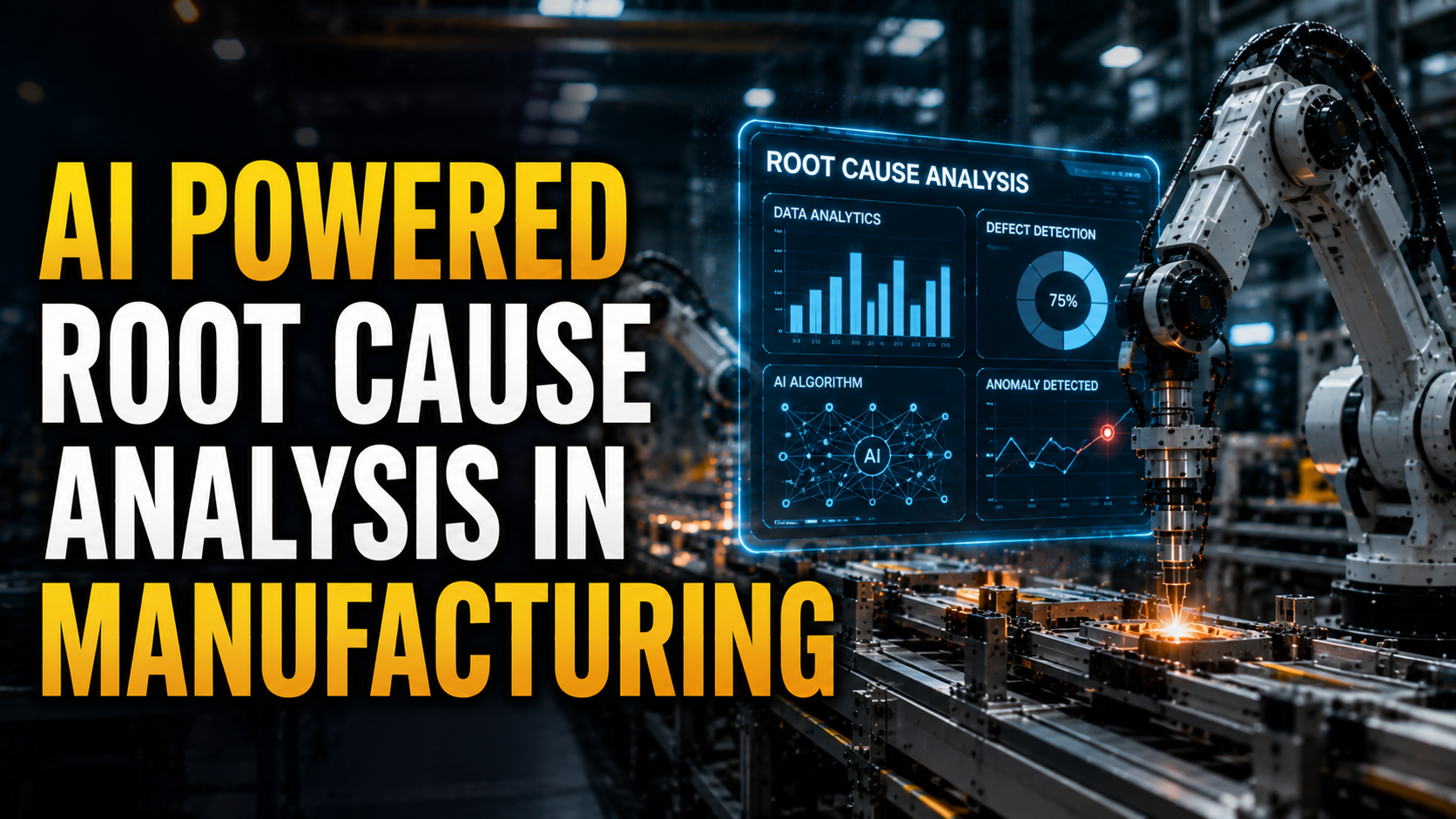
Manufacturing has always been an industry where problems require fast, accurate, and practical solutions. A production line stopping unexpectedly, a sudden increase in product defects, equipment performance degradation, or supply chain disruptions can create significant financial losses and operational challenges. AI Powered Root Cause Analysis in Manufacturing.
Traditionally, manufacturers have relied on experienced engineers, maintenance specialists, quality teams, and structured problem-solving methods to identify the causes behind operational issues. Techniques such as the Five Whys, Fishbone Analysis, Failure Mode and Effects Analysis, and statistical process control have helped organizations improve reliability for decades.
However, modern factories have become significantly more complex.
Today’s manufacturing environments include thousands of connected machines, millions of sensor readings, advanced robotics, automated inspection systems, enterprise applications, and highly interconnected supply chains. The amount of information involved in identifying the true cause of a problem has exceeded human analytical capacity.
This is where AI Powered Root Cause Analysis in Manufacturing is creating a major transformation.
Artificial Intelligence enables manufacturers to analyze large volumes of operational data, identify hidden relationships, detect patterns, and discover the underlying causes of failures faster and more accurately than traditional approaches.
AI powered root cause analysis does not simply identify what happened. It helps explain why it happened and recommends actions to prevent similar problems in the future.
As manufacturers move toward smart factories, Industry 4.0, Industry 5.0, autonomous production, and AI driven operations, intelligent root cause analysis is becoming an essential capability for improving efficiency, quality, reliability, and competitiveness.
This comprehensive guide explains what AI powered root cause analysis is, how it works, its manufacturing applications, benefits, challenges, implementation strategies, and its role in the future of intelligent factories.
Table of Contents
What Is Root Cause Analysis in Manufacturing?
Root Cause Analysis (RCA) is a systematic approach used to identify the fundamental reason behind a problem or failure.
The objective is not only to fix the immediate issue but to eliminate the underlying cause to prevent recurrence.
For example, if a production line produces defective components, a traditional approach may focus on correcting the defective output.
Root cause analysis investigates deeper questions:
Was the machine calibration incorrect?
Did material quality change?
Was there a process variation?
Did environmental conditions affect production?
Was maintenance performed incorrectly?
Did an operator procedure change?
Finding the true cause allows manufacturers to implement permanent improvements.
What Is AI Powered Root Cause Analysis?
AI Powered Root Cause Analysis combines Artificial Intelligence, Machine Learning, industrial analytics, knowledge graphs, and advanced data processing to automatically investigate manufacturing problems.
Instead of depending only on manual analysis, AI systems examine relationships across multiple data sources.
These sources may include:
Machine sensor data
Production records
Maintenance history
Quality inspection results
Engineering documents
Operator logs
Environmental conditions
Supply chain information
Process parameters
AI identifies patterns that may not be visible to human analysts.
For example, an AI system may discover that a quality defect is not caused by the production machine itself but by a combination of:
A specific supplier material batch
A temperature variation
A machine operating speed
A maintenance delay
This deeper understanding enables faster and more accurate problem resolution.
Why Traditional Root Cause Analysis Is Becoming Challenging
Traditional RCA methods remain valuable, but modern manufacturing complexity creates several limitations.
Increasing Data Volume
Factories generate enormous amounts of information from connected devices and systems.
Analyzing this data manually is extremely difficult.
Complex Manufacturing Relationships
Modern production problems often involve multiple interacting factors.
A failure may involve equipment, materials, processes, people, and environmental conditions simultaneously.
Faster Production Requirements
Manufacturers cannot afford long investigation cycles.
Customers expect high quality and reliable delivery.
Knowledge Loss
Many manufacturing organizations depend on experienced employees who possess valuable troubleshooting expertise.
When experts retire, important knowledge can disappear.
Global Manufacturing Networks
Large manufacturers operate multiple facilities with different systems, processes, and equipment.
Finding common failure patterns across locations is challenging.
Traditional RCA vs AI Powered Root Cause Analysis
| Traditional Root Cause Analysis | AI Powered Root Cause Analysis |
|---|---|
| Human driven investigation | AI assisted investigation |
| Limited data analysis | Processes massive datasets |
| Depends heavily on experience | Learns from historical events |
| Slower problem identification | Faster diagnosis |
| Often analyzes isolated events | Finds cross system relationships |
| Reactive approach | Predictive and preventive approach |
How AI Powered Root Cause Analysis Works
AI powered RCA combines several technologies to investigate manufacturing problems.
Data Collection
The first step involves collecting information from multiple industrial sources.
Examples include:
Sensors
Industrial machines
Manufacturing Execution Systems
Quality systems
Maintenance platforms
Enterprise applications
Production databases
This creates a complete operational picture.
Data Processing and Analysis
AI systems clean, organize, and analyze collected information.
Machine learning algorithms identify unusual patterns and correlations.
Pattern Recognition
AI compares current problems with historical events.
It identifies similarities between present conditions and previous failures.
Causal Analysis
Advanced AI models examine relationships between different factors.
They determine which variables are most likely responsible for a problem.
Human Validation
In many manufacturing environments, engineers review AI recommendations.
Human expertise improves reliability and ensures practical implementation.
Continuous Learning
The AI system learns from confirmed root causes and corrective actions.
Future investigations become more accurate.
Technologies Behind AI Powered Root Cause Analysis
Machine Learning
Machine learning identifies patterns in large operational datasets.
It helps detect relationships between process conditions and failures.
Deep Learning
Deep learning analyzes complex data sources such as:
Images
Signals
Time series data
Sensor patterns
This improves defect and anomaly detection.
Knowledge Graphs
Manufacturing Knowledge Graphs connect relationships between:
Machines
Products
Processes
Materials
Suppliers
Maintenance activities
Knowledge graphs help AI understand manufacturing context.
Digital Twins
Digital twins provide virtual representations of equipment and production systems.
AI uses digital twins to simulate possible causes and outcomes.
Natural Language Processing
Manufacturing information often exists in documents.
NLP allows AI to analyze:
Maintenance reports
Engineering notes
Work instructions
Failure descriptions
Technical documents
Generative AI
Generative AI can summarize investigations, explain findings, and create corrective action recommendations.
Applications of AI Powered Root Cause Analysis in Manufacturing
Equipment Failure Investigation
Equipment failures are among the most expensive manufacturing problems.
AI analyzes:
Machine conditions
Vibration patterns
Temperature changes
Maintenance history
Operating cycles
Previous failures
The system identifies likely failure causes before major downtime occurs.
Quality Defect Analysis
Product defects often result from multiple interacting factors.
AI powered RCA analyzes:
Production parameters
Material characteristics
Inspection data
Machine settings
Environmental conditions
This helps manufacturers move from defect detection to defect prevention.
Production Process Optimization
Manufacturing processes involve hundreds of variables.
AI identifies which parameters influence:
Cycle time
Product quality
Energy consumption
Equipment performance
This enables continuous process improvement.
Predictive Maintenance
AI powered RCA enhances predictive maintenance by identifying why equipment degradation occurs.
Instead of simply predicting failure, AI explains the contributing factors.
Supply Chain Problem Analysis
Manufacturing problems may originate outside the factory.
AI connects supplier information, material quality, logistics data, and production outcomes to identify supply chain causes.
Energy Efficiency Improvement
AI analyzes energy consumption patterns to identify causes of waste.
It can reveal relationships between:
Production schedules
Equipment settings
Environmental factors
Energy usage
Benefits of AI Powered Root Cause Analysis
Faster Problem Resolution
AI analyzes thousands of variables quickly, reducing investigation time.
Improved Accuracy
AI identifies hidden relationships that may be missed during manual analysis.
Reduced Downtime
Faster diagnosis leads to quicker recovery and improved equipment availability.
Higher Product Quality
Understanding defect causes helps manufacturers prevent recurring issues.
Knowledge Preservation
AI captures organizational learning from previous incidents.
Better Decision Making
Engineers receive evidence based recommendations.
Continuous Improvement
AI creates a learning system that improves over time.
AI Powered Root Cause Analysis and Smart Factories
Smart factories depend on connected systems, automation, and intelligent decision making.
AI powered RCA strengthens smart manufacturing by creating a feedback loop:
Data collection
AI analysis
Root cause identification
Corrective action
Learning
Continuous improvement
This allows factories to become more adaptive and self improving.
AI Powered Root Cause Analysis and Industry 5.0
Industry 5.0 focuses on human machine collaboration.
AI powered RCA supports this vision by assisting engineers rather than replacing them.
AI provides:
Faster investigations
Data driven insights
Historical knowledge
Predictive recommendations
Human experts provide:
Experience
Context
Creativity
Final judgment
Together, they create more effective problem solving.
Challenges of Implementing AI Powered Root Cause Analysis
Data Quality Problems
Poor or incomplete data can reduce AI accuracy.
Manufacturers need strong data governance practices.
Integration Complexity
Factories often use many disconnected systems.
Connecting these systems requires careful planning.
Lack of AI Expertise
Organizations may need specialists in:
Artificial Intelligence
Industrial data engineering
Manufacturing systems
Analytics
Trust and Adoption
Employees need confidence in AI recommendations.
Explainable AI improves acceptance.
Change Management
Successful implementation requires workforce training and organizational alignment.
Best Practices for Implementing AI Powered RCA
Manufacturers should begin with clearly defined operational problems.
High value starting areas include:
Equipment reliability
Quality improvement
Production bottlenecks
Maintenance optimization
Energy management
Organizations should create a strong industrial data foundation before deploying advanced AI.
Combining AI powered RCA with Industrial Data Fabric, Digital Twins, Manufacturing Knowledge Graphs, and Explainable AI creates stronger results.
Human experts should remain involved in critical decision processes.
AI models should be continuously monitored and improved.
Organizations should measure success using practical business outcomes such as reduced downtime, improved quality, and increased productivity.
Future Trends in AI Powered Root Cause Analysis
The future of manufacturing RCA will become increasingly intelligent.
Important trends include:
Autonomous AI agents performing investigations
Generative AI assistants for engineers
Industrial Foundation Models with manufacturing knowledge
Real time causal analysis
Self improving factories
AI based process optimization
Connected enterprise knowledge systems
Digital twins combined with causal AI
These technologies will enable factories to identify and solve problems before they significantly impact operations.
Why AI Powered Root Cause Analysis Creates Competitive Advantage
Manufacturing competitiveness depends on continuous improvement.
Companies that can identify problems faster and prevent recurrence achieve higher productivity, better quality, and stronger customer satisfaction.
AI powered root cause analysis transforms problem solving from a reactive process into a proactive intelligence capability.
It allows manufacturers to move beyond asking:
“What went wrong?”
toward answering:
“Why did it happen, and how can we prevent it permanently?”
This shift represents a major step toward intelligent, adaptive, and autonomous manufacturing.
Conclusion
AI Powered Root Cause Analysis is transforming manufacturing problem solving by combining industrial expertise with advanced Artificial Intelligence capabilities.
As factories become more connected and complex, traditional approaches alone are no longer sufficient to understand every operational challenge. AI enables manufacturers to analyze massive amounts of information, discover hidden relationships, and identify the true causes behind failures.
By integrating AI powered RCA with Digital Twins, Industrial Data Fabric, Knowledge Graphs, Explainable AI, and Human expertise, manufacturers can create continuously improving production environments.
The future of manufacturing will belong to organizations that can not only detect problems quickly but also understand why they occur and prevent them from happening again.
AI powered root cause analysis provides the intelligence foundation needed to build smarter, more reliable, and more autonomous factories.
Also Read: “Industrial Foundation Models“
Author
Frequently Asked Questions
What is AI Powered Root Cause Analysis in manufacturing?
AI Powered Root Cause Analysis uses Artificial Intelligence and advanced analytics to identify the underlying causes of manufacturing problems by analyzing large amounts of operational data.
How does AI improve traditional root cause analysis?
AI improves RCA by analyzing more data, identifying hidden relationships, recognizing patterns, and providing faster evidence based recommendations.
What manufacturing problems can AI powered RCA solve?
It can help investigate equipment failures, quality defects, production delays, supply chain issues, process variations, and energy inefficiencies.