


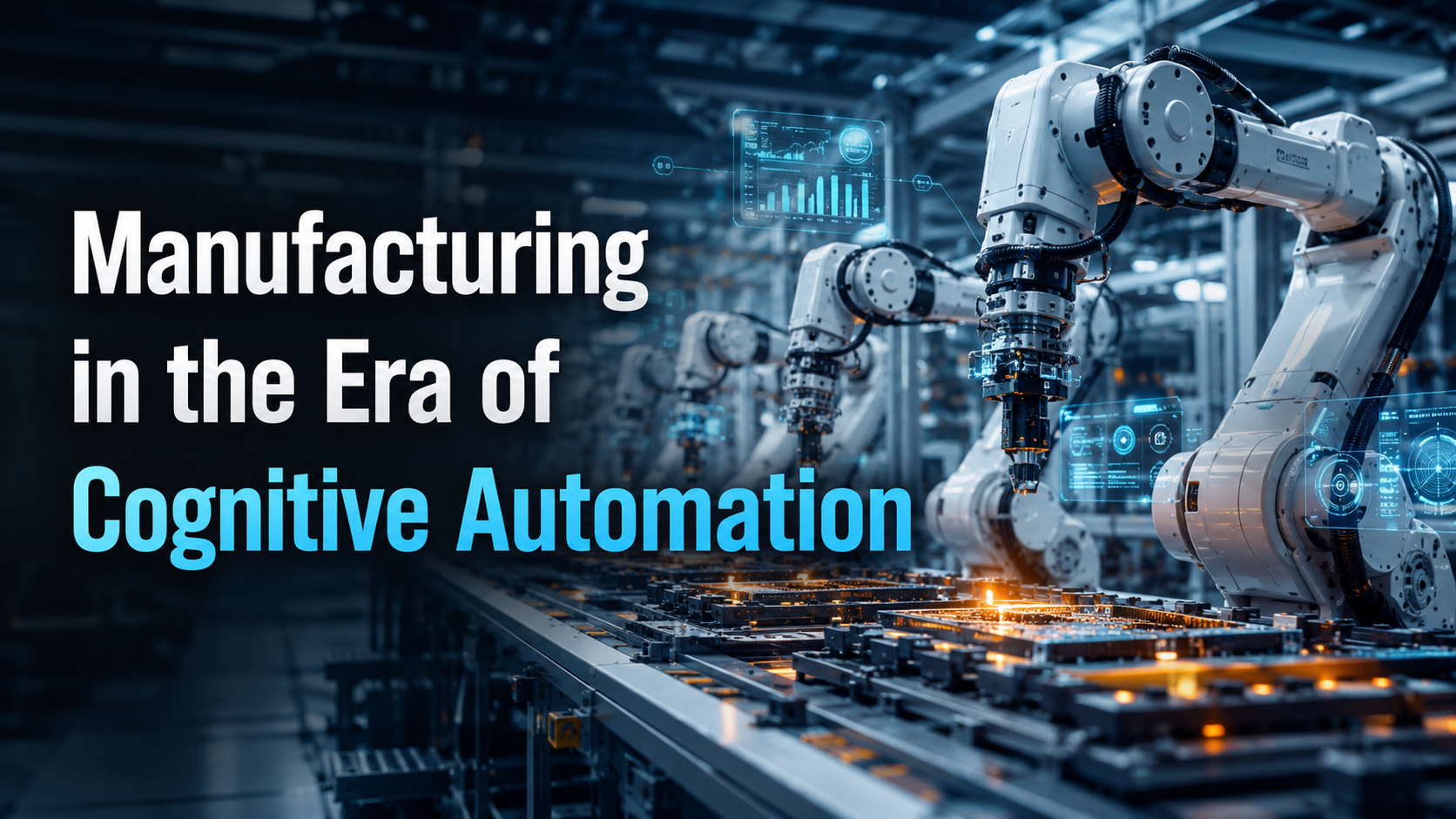
Manufacturing in the Era of Cognitive Automation
Manufacturing has always been driven by innovation. From mechanical production systems and assembly lines to industrial robots and connected factories, every technological revolution has changed how products are designed, produced, and delivered. Manufacturing in the Era of Cognitive Automation.
Today, manufacturing is entering a new era defined by cognitive automation.
Cognitive automation represents the convergence of Artificial Intelligence, Machine Learning, robotics, advanced analytics, natural language processing, computer vision, and human expertise. Unlike traditional automation systems that follow fixed instructions, cognitive automation enables machines and software platforms to understand information, learn from experience, make decisions, and improve operations over time.
This transformation is creating a new generation of intelligent factories where machines do more than execute tasks. They analyze situations, identify problems, recommend solutions, and collaborate with human workers to achieve higher levels of efficiency and innovation.
Modern manufacturers face increasing challenges including global competition, supply chain uncertainty, skilled labor shortages, rising operational costs, and growing customer expectations for personalized products. Cognitive automation provides the intelligence required to address these challenges while creating more flexible, sustainable, and resilient manufacturing operations.
The future of manufacturing will not be defined only by automation. It will be defined by intelligent automation.
Table of Contents
What Is Cognitive Automation in Manufacturing?
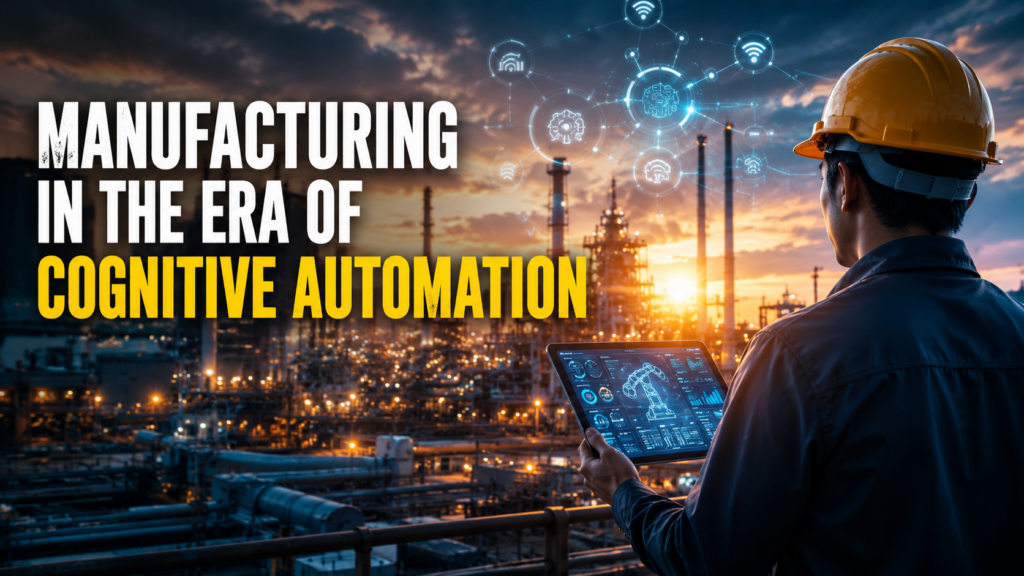
Cognitive automation is an advanced form of automation that combines traditional process automation with Artificial Intelligence capabilities.
Traditional automation follows predefined rules.
Cognitive automation understands context, analyzes information, learns from previous experiences, and adapts to changing situations.
In manufacturing environments, cognitive automation enables systems to:
Analyze production data
Identify operational patterns
Predict equipment failures
Detect quality issues
Optimize workflows
Support employee decisions
Automate complex processes
Improve continuously through learning
The objective is not to replace human intelligence but to enhance human capabilities by allowing machines to handle complex analysis and repetitive decision-making.
The Evolution of Manufacturing Automation
The manufacturing industry has progressed through multiple stages of automation.
| Manufacturing Era | Main Technology | Operational Capability |
|---|---|---|
| Early Industrial Era | Mechanical systems | Basic mechanization |
| Mass Production Era | Electricity and assembly lines | Large-scale production |
| Digital Manufacturing Era | Computers and software | Automated control systems |
| Smart Manufacturing Era | IoT and analytics | Connected operations |
| Cognitive Automation Era | AI and intelligent systems | Adaptive and self-improving factories |
Traditional automation focused on speed and consistency.
Smart manufacturing introduced connectivity.
Cognitive automation introduces intelligence
Why Cognitive Automation Is Transforming Manufacturing
Manufacturing environments generate enormous amounts of data every day.
Factories produce information from:
Machines
Sensors
Production lines
Quality systems
Supply chains
Maintenance records
Customer requirements
Enterprise platforms
However, data alone does not create value. The ability to interpret data and make intelligent decisions creates competitive advantage.
Cognitive automation allows manufacturers to convert operational data into actionable intelligence.
Organizations can identify problems earlier, optimize processes faster, and make better decisions across the entire manufacturing lifecycle.
Core Technologies Behind Cognitive Automation
Artificial Intelligence
Artificial Intelligence provides the reasoning capability behind cognitive automation.
AI systems analyze large volumes of industrial data to identify patterns, detect anomalies, and generate recommendations.
Manufacturing applications include:
Production optimization
Demand forecasting
Quality prediction
Process improvement
Supply chain planning
Resource allocation
Energy management
AI enables factories to move from reactive operations toward proactive decision-making.
Machine Learning
Machine Learning allows manufacturing systems to improve through experience.
Instead of relying only on programmed instructions, machine learning models learn from historical and real-time data.
Applications include:
Predicting machine failures
Improving production schedules
Reducing defects
Optimizing manufacturing parameters
Identifying hidden operational patterns
As more data becomes available, these systems become increasingly accurate.
Computer Vision
Computer vision enables machines to understand and analyze visual information.
In manufacturing, computer vision systems inspect products, monitor processes, and detect abnormalities.
Applications include:
Defect detection
Product inspection
Assembly verification
Packaging analysis
Safety monitoring
Computer vision improves accuracy while reducing manual inspection requirements.
Robotics and Intelligent Automation
Robotics has been a core part of manufacturing for decades.
Cognitive automation introduces a new generation of intelligent robots capable of adapting to changing environments.
Modern intelligent robots can:
Recognize objects
Adjust movements
Collaborate with humans
Learn new tasks
Communicate with other systems
This creates flexible production environments capable of handling complex manufacturing requirements.
Industrial Internet of Things
Industrial IoT connects physical manufacturing assets with digital intelligence.
Sensors collect real-time information about:
Machine conditions
Temperature
Pressure
Energy usage
Production speed
Material consumption
Operational performance
This information provides the foundation for cognitive automation systems.
Natural Language Processing
Natural Language Processing allows humans to interact with industrial systems using everyday language.
Manufacturing employees can use AI assistants to:
Search technical information
Analyze reports
Access maintenance knowledge
Generate documentation
Receive operational guidance
This improves productivity and makes advanced technology accessible to more employees.
Digital Twins
Digital twins create virtual models of physical manufacturing systems.
They allow companies to simulate operations, test improvements, and predict outcomes before making real-world changes.
Cognitive automation uses digital twins for:
Production optimization
Equipment analysis
Process simulation
Factory planning
Risk reduction
How Cognitive Automation Works in Manufacturing
Cognitive automation follows a continuous intelligence cycle.
Data Collection
Sensors, machines, employees, and business systems generate operational information.
Data Processing
Advanced platforms organize and analyze the information.
Intelligent Understanding
AI models identify patterns, relationships, and potential issues.
Decision Support
The system provides recommendations or automatically executes actions.
Continuous Learning
The system improves based on results and new experiences.
This cycle creates manufacturing environments that become smarter over time.
Benefits of Cognitive Automation in Manufacturing
Higher Operational Efficiency
Cognitive automation identifies inefficiencies and recommends improvements.
Manufacturers benefit through:
Reduced production delays
Optimized workflows
Better equipment utilization
Improved resource allocation
Predictive Maintenance
Equipment failures can cause significant financial losses.
Cognitive automation predicts maintenance needs before failures occur.
AI analyzes:
Machine vibration
Temperature changes
Operating conditions
Historical maintenance records
Performance trends
Benefits include:
Reduced downtime
Lower repair expenses
Longer equipment life
Improved reliability
Improved Product Quality
Quality control is one of the most important applications of cognitive automation.
AI-powered inspection systems identify defects faster and more accurately than traditional methods.
Manufacturers achieve:
Lower rejection rates
Reduced waste
Improved consistency
Higher customer satisfaction
Smarter Production Planning
Production planning involves complex decisions involving:
Customer demand
Machine availability
Labor capacity
Material availability
Delivery requirements
Cognitive automation analyzes these factors and creates optimized production schedules.
Supply Chain Optimization
Manufacturing success depends on efficient supply chains.
Cognitive automation improves:
Demand forecasting
Inventory planning
Supplier management
Logistics optimization
Risk prediction
This helps companies respond quickly to disruptions.
Energy Efficiency and Sustainability
Manufacturing consumes significant amounts of energy and resources.
Cognitive automation helps optimize:
Energy consumption
Machine operation
Material usage
Waste reduction
Carbon emissions
Sustainable manufacturing becomes more achievable through intelligent optimization.
Workforce Productivity Enhancement
Cognitive automation does not eliminate the importance of human workers.
Instead, it allows employees to focus on higher-value activities.
Workers gain support through:
AI assistants
Automated analysis
Real-time recommendations
Digital knowledge systems
Improved decision support
Human expertise combined with machine intelligence creates stronger manufacturing operations.
Cognitive Automation Applications Across Industries
Automotive Manufacturing
The automotive industry uses cognitive automation for:
Robotic assembly
Quality inspection
Vehicle customization
Supply chain optimization
Predictive maintenance
Battery manufacturing
Electronics Manufacturing
Electronics production requires extreme accuracy.
Cognitive automation supports:
Component inspection
Precision assembly
Production optimization
Defect analysis
Yield improvement
Pharmaceutical Manufacturing
Pharmaceutical companies use cognitive automation for:
Process monitoring
Quality assurance
Compliance management
Production optimization
Research support
Aerospace Manufacturing
Aerospace manufacturing requires advanced precision.
Applications include:
Engineering analysis
Component inspection
Maintenance prediction
Production planning
Digital simulation
Food and Beverage Manufacturing
Cognitive automation improves:
Production consistency
Packaging quality
Supply chain visibility
Waste reduction
Demand forecasting
Cognitive Automation and Industry 5.0
Industry 5.0 focuses on collaboration between humans and intelligent machines.
Cognitive automation supports this vision by creating systems that enhance human decision-making.
The future factory will combine:
Human creativity
Machine intelligence
Collaborative robotics
Real-time insights
Sustainable practices
Rather than replacing people, cognitive automation creates a more capable workforce.
Challenges of Cognitive Automation Adoption
Implementation Complexity
Cognitive automation requires integration between:
Legacy equipment
Modern software
Data platforms
AI systems
Industrial networks
A structured transformation strategy is essential.
Data Quality Issues
AI systems depend on accurate data.
Poor data quality can lead to unreliable recommendations.
Manufacturers need strong data governance practices.
Cybersecurity Risks
Connected intelligent systems create cybersecurity challenges.
Organizations must protect:
Industrial networks
Production data
AI models
Operational technology
Security must become a core part of manufacturing transformation.
Workforce Skills Gap
Cognitive automation requires new technical capabilities.
Employees need skills in:
Digital technologies
Data analysis
AI collaboration
Automation systems
Organizations must invest in continuous learning.
Trust and AI Transparency
Manufacturers must understand how AI systems make decisions.
Explainable AI and responsible governance help build confidence among employees and business leaders.
Future Trends in Cognitive Automation
The next generation of manufacturing will experience several important developments.
Autonomous Factories
Factories will increasingly operate with minimal human intervention while maintaining human oversight.
AI Manufacturing Assistants
Employees will use intelligent assistants for:
Troubleshooting
Engineering support
Maintenance guidance
Operational decisions
Self Learning Production Systems
Manufacturing systems will continuously improve based on operational experience.
Advanced Human Machine Collaboration
Robots and humans will work together in increasingly flexible environments.
Real Time Enterprise Intelligence
Manufacturing organizations will connect production, supply chains, and business decisions through intelligent platforms.
How Manufacturers Can Prepare for Cognitive Automation
Successful adoption requires a clear strategy.
Build Strong Data Foundations
Manufacturers should establish reliable systems for collecting and managing operational data.
Modernize Manufacturing Infrastructure
Existing equipment can be upgraded through sensors, connectivity, and intelligent software.
Identify High Value Automation Opportunities
Companies should focus on areas with measurable impact.
Examples include:
Predictive maintenance
Quality inspection
Production scheduling
Energy optimization
Develop Employee Skills
Training programs should prepare employees for collaboration with intelligent systems.
Implement Responsible AI Practices
Organizations should establish governance frameworks for transparency, security, and ethical technology use.
Measuring Cognitive Automation Success
Manufacturers should track measurable outcomes.
Important performance indicators include:
Production efficiency
Equipment uptime
Quality improvement
Maintenance cost reduction
Energy savings
Waste reduction
Delivery performance
Employee productivity
Customer satisfaction
Why Cognitive Automation Will Define the Future of Manufacturing
The future of manufacturing will belong to organizations that can combine technology, intelligence, and human expertise.
Automation alone improves speed.
Connectivity improves visibility.
Cognitive automation creates intelligence.
Manufacturers that adopt cognitive automation will achieve stronger competitive advantages through:
Faster innovation
Improved efficiency
Better quality
Greater flexibility
Stronger resilience
Sustainable growth
The intelligent factory will become the foundation of future industrial success.
Conclusion
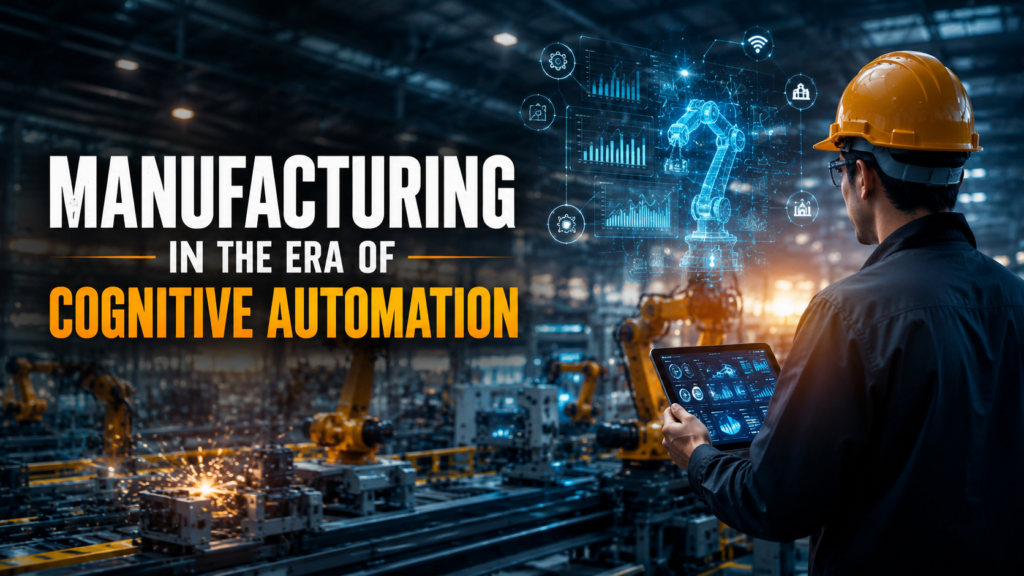
Manufacturing in the era of cognitive automation represents a fundamental transformation in how industries operate. Intelligent systems are enabling factories to move beyond traditional automation toward environments that can understand, learn, predict, and improve.
Through Artificial Intelligence, Machine Learning, robotics, Industrial IoT, digital twins, and advanced analytics, manufacturers are creating smarter operations that deliver higher productivity, better quality, and greater sustainability.
The future will not be defined by machines replacing humans. It will be defined by humans and intelligent systems working together to solve complex challenges and create new possibilities.
Cognitive automation is not simply the next step in manufacturing technology. It is the foundation of a new industrial era where factories become intelligent, adaptive, and continuously evolving.
Also Read: “The Autonomous Factory Operating System“
Author
Frequently Asked Questions
What is cognitive automation in manufacturing?
Cognitive automation is the combination of traditional automation with Artificial Intelligence, Machine Learning, analytics, and intelligent decision-making capabilities to create adaptive manufacturing systems.
How is cognitive automation different from traditional automation?
Traditional automation follows fixed rules and instructions, while cognitive automation can learn, analyze information, make decisions, and adapt to changing conditions.
What technologies support cognitive automation?
Key technologies include Artificial Intelligence, Machine Learning, robotics, Industrial IoT, computer vision, digital twins, cloud computing, edge computing, and natural language processing.