

Introduction
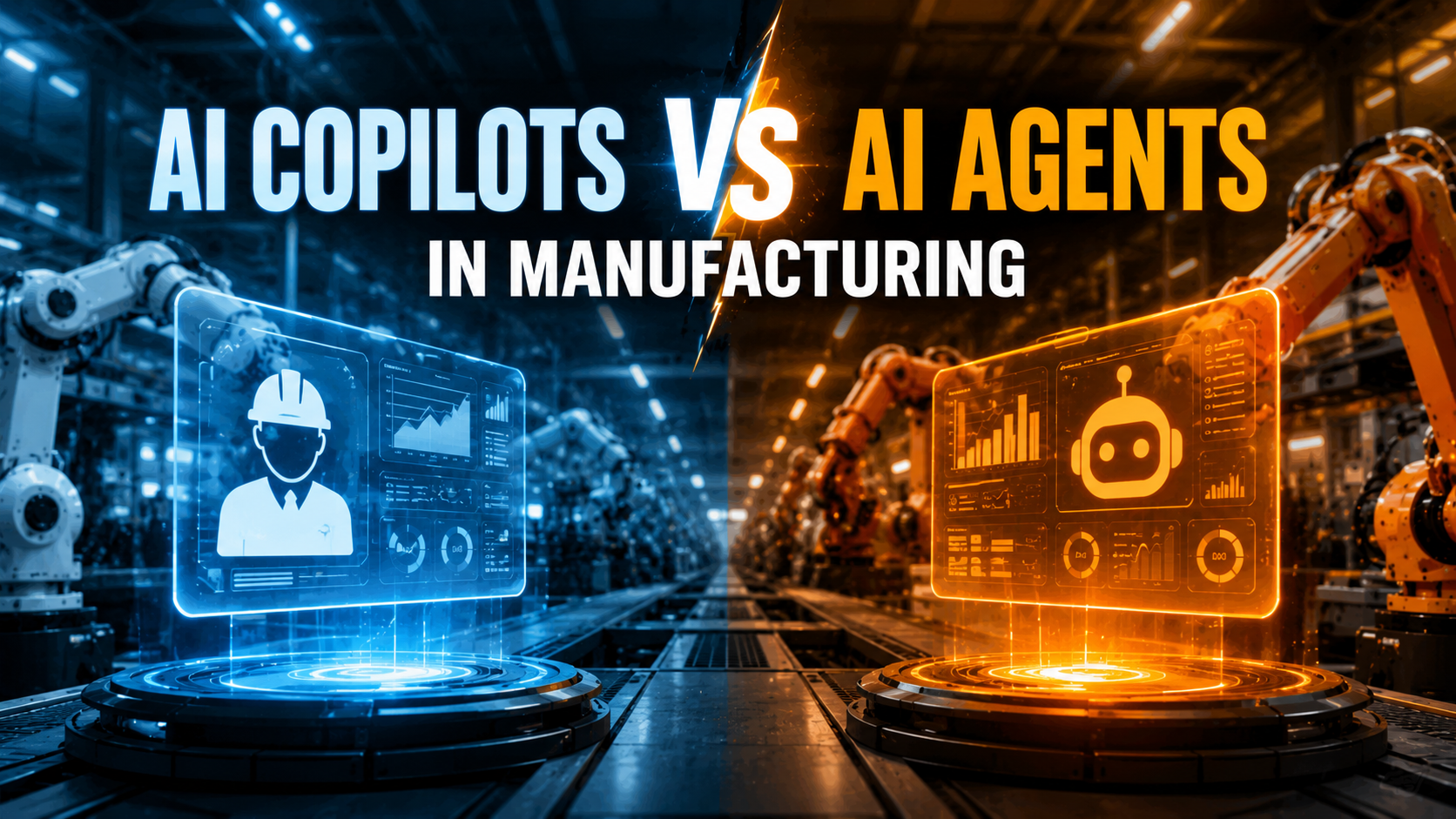
Manufacturing is experiencing one of the most significant technology transformations in history. AI Copilots vs AI Agents in Manufacturing: Understanding the Next Generation of Industrial Intelligence.
For decades, industrial innovation focused on automation. Factories introduced programmable machines, robotics, manufacturing software, and connected systems to improve efficiency and reduce manual effort.
Today, the next wave of transformation is being driven by artificial intelligence.
However, artificial intelligence in manufacturing is evolving beyond simple automation. Organizations are now exploring two powerful concepts that are reshaping industrial operations:
AI Copilots.
AI Agents.
Both technologies use artificial intelligence to improve manufacturing performance, but they serve different purposes.
AI Copilots are designed to assist humans by providing knowledge, recommendations, insights, and decision support.
AI Agents are designed to perform autonomous tasks by analyzing situations, making decisions, coordinating systems, and executing actions.
The difference is important because the future smart factory will require both human intelligence and machine autonomy.
A factory engineer may use an AI Copilot to analyze a production problem and receive recommendations.
An AI Agent may independently monitor equipment, optimize schedules, and coordinate maintenance activities.
Understanding the difference between AI Copilots and AI Agents is essential for manufacturers planning their digital transformation strategies.
This article explores AI Copilots vs AI Agents in Manufacturing, including their architecture, capabilities, applications, benefits, challenges, and their role in building future intelligent factories.
Table of Contents
What Are AI Copilots in Manufacturing?
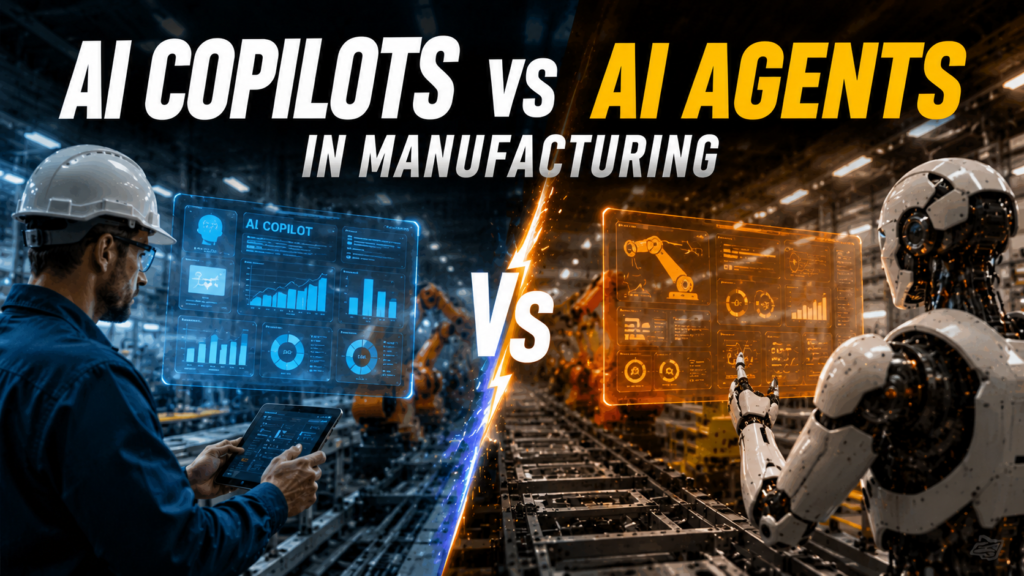
AI Copilots are intelligent assistants designed to support manufacturing professionals by providing information, recommendations, and operational guidance.
They work alongside humans rather than replacing human decision makers.
An AI Copilot acts like a digital expert assistant.
It helps operators, engineers, managers, and technicians by analyzing information and presenting useful insights.
Examples of manufacturing AI Copilot capabilities include:
Explaining machine conditions.
Summarizing production reports.
Providing troubleshooting guidance.
Searching technical documentation.
Assisting engineering decisions.
Analyzing quality issues.
Supporting maintenance teams.
The primary goal of an AI Copilot is augmentation.
It makes human workers more effective by giving them faster access to knowledge and insights.
What Are AI Agents in Manufacturing?
AI Agents are autonomous artificial intelligence systems capable of understanding objectives, making decisions, interacting with systems, and taking actions.
Unlike AI Copilots, AI Agents are designed to operate with greater independence.
An AI Agent can:
Monitor factory conditions.
Analyze operational data.
Decide appropriate actions.
Communicate with other systems.
Execute workflows.
Learn from previous outcomes.
For example:
A maintenance AI Agent continuously monitors equipment health.
It detects unusual behavior.
It analyzes historical failure patterns.
It checks production schedules.
It creates an optimized maintenance plan.
It communicates with maintenance systems.
It updates operational workflows.
The agent acts as an autonomous digital worker.
Why the Difference Matters in Manufacturing
Manufacturing environments are becoming increasingly complex.
Factories must manage:
Thousands of connected machines.
Global supply networks.
Customized production requirements.
Strict quality standards.
Energy efficiency goals.
Workforce knowledge challenges.
In this environment, organizations need different levels of intelligence.
Some tasks require human expertise enhanced by AI.
Other tasks require autonomous systems that operate continuously.
AI Copilots and AI Agents address these different needs.
AI Copilots vs AI Agents: Core Differences
The main difference is the level of autonomy.
| AI Copilots | AI Agents |
|---|---|
| Assist human users | Perform autonomous tasks |
| Provide recommendations | Execute actions |
| Human remains decision maker | AI can make operational decisions |
| Knowledge focused | Goal focused |
| Reactive assistance | Proactive operation |
| Support workflows | Manage workflows |
AI Copilots answer:
How can I make this decision better?
AI Agents answer:
How can this objective be achieved?
How AI Copilots Work in Manufacturing
AI Copilots operate as intelligent interfaces between humans and industrial information.
Their workflow includes several steps.
Data Access
The Copilot collects information from:
Manufacturing systems.
Engineering databases.
Maintenance records.
Quality platforms.
Operational documents.
AI Analysis
The system analyzes information using:
Large Language Models.
Machine learning.
Knowledge systems.
Industrial data models.
Human Interaction
The Copilot communicates insights through:
Chat interfaces.
Dashboards.
Voice systems.
Operational applications.
Decision Support
The human user evaluates recommendations and makes final decisions.
How AI Agents Work in Manufacturing
AI Agents operate through autonomous intelligence cycles.
Observation
The agent monitors factory conditions.
Examples:
Machine status.
Production performance.
Quality data.
Inventory levels.
Reasoning
The agent evaluates information.
It considers:
Goals.
Constraints.
Historical knowledge.
Business priorities.
Planning
The agent determines possible actions.
Execution
The agent performs actions through connected systems.
Learning
The agent improves based on results.
Architecture Comparison
| Technology | Architecture Approach |
|---|---|
| AI Copilot | Human centered intelligence layer |
| AI Agent | Autonomous operational intelligence layer |
AI Copilots focus on improving human decisions.
AI Agents focus on improving operational outcomes.
Manufacturing Use Cases for AI Copilots
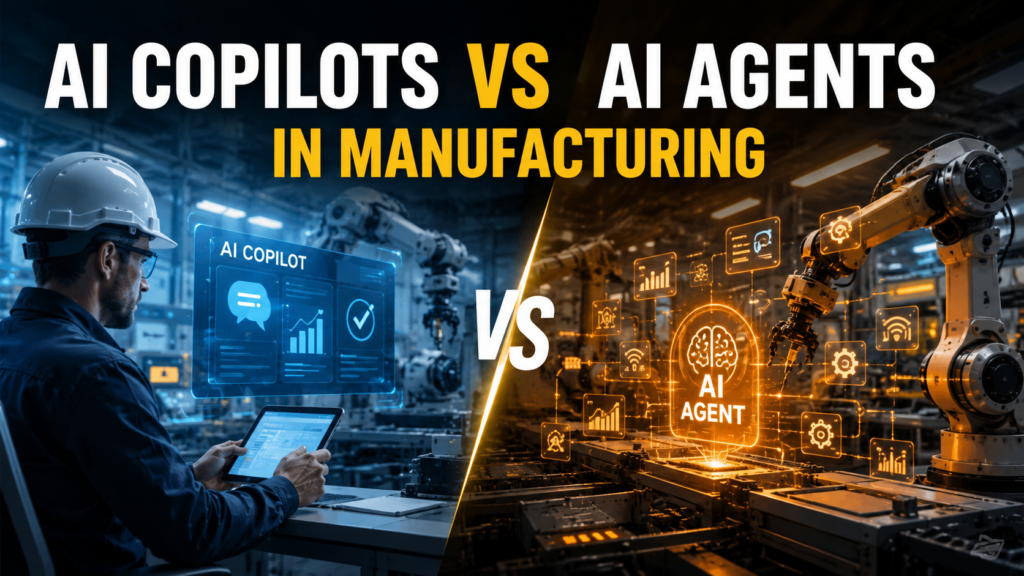
AI Copilots provide value across many factory functions.
Engineering Assistance
Engineers can use AI Copilots to:
Analyze technical problems.
Review design information.
Access documentation.
Generate reports.
Understand machine behavior.
A Copilot becomes a digital engineering assistant.
Maintenance Support
Maintenance technicians can receive:
Troubleshooting recommendations.
Repair instructions.
Equipment history summaries.
Failure analysis support.
Quality Analysis
Quality teams can use AI Copilots to:
Investigate defects.
Analyze production trends.
Understand process variations.
Generate quality reports.
Operator Assistance
Operators receive:
Work instructions.
Safety guidance.
Machine explanations.
Process recommendations.
Manufacturing Management
Managers can use AI Copilots for:
Performance analysis.
Production reporting.
Decision preparation.
Manufacturing Use Cases for AI Agents
AI Agents are suited for autonomous operations.
Predictive Maintenance Agents
Maintenance Agents monitor equipment continuously.
They can:
Detect anomalies.
Predict failures.
Schedule maintenance.
Coordinate resources.
Production Optimization Agents
Production Agents optimize:
Schedules.
Machine utilization.
Resource allocation.
Workflow priorities.
Quality Management Agents
Quality Agents analyze:
Defect patterns.
Process conditions.
Inspection results.
They recommend corrective actions.
Supply Chain Agents
Supply Chain Agents manage:
Material availability.
Inventory optimization.
Supplier risks.
Production requirements.
Energy Optimization Agents
Energy Agents optimize:
Power consumption.
Equipment usage.
Production timing.
AI Copilots and AI Agents Together
The future factory will not choose between AI Copilots and AI Agents.
It will use both.
They serve complementary purposes.
An example:
A production problem occurs.
The AI Agent detects the issue automatically.
The Agent analyzes possible solutions.
The AI Copilot explains the situation to the engineer.
The engineer reviews recommendations.
The Agent executes approved actions.
This creates effective human AI collaboration.
Role of Large Language Models
Large Language Models are important technologies behind many AI Copilots and AI Agents.
They provide capabilities such as:
Natural language understanding.
Knowledge retrieval.
Reasoning assistance.
Communication.
However, manufacturing AI requires more than language capability.
Industrial intelligence also requires:
Machine data.
Operational context.
Process knowledge.
Physical understanding.
This is why manufacturing AI systems often combine Large Language Models with industrial knowledge graphs, digital twins, and operational data platforms.
AI Copilots vs AI Agents and Smart Factory Evolution
Smart factories are evolving through multiple stages.
| Stage | Capability |
|---|---|
| Automation | Machines execute programmed tasks |
| Analytics | Systems provide operational insights |
| AI Copilots | Humans receive intelligent assistance |
| AI Agents | Systems perform autonomous operations |
| Autonomous Factory | Humans and AI collaborate continuously |
AI Copilots improve human intelligence.
AI Agents expand machine intelligence.
Benefits of AI Copilots in Manufacturing
AI Copilots provide several advantages.
Faster Access to Knowledge
Employees can quickly find technical information.
Improved Productivity
Workers spend less time searching for answers.
Better Decision Quality
Employees receive AI supported insights.
Reduced Training Time
New workers gain access to digital expertise.
Knowledge Preservation
Industrial experience becomes easier to access.
Benefits of AI Agents in Manufacturing
AI Agents provide different advantages.
Autonomous Operations
Agents can continuously manage processes.
Faster Response Times
Systems react immediately to changing conditions.
Improved Efficiency
Agents optimize operations automatically.
Reduced Downtime
Agents identify problems earlier.
Better Scalability
Factories can manage increasing complexity.
Challenges of AI Copilots
Although valuable, AI Copilots have challenges.
Information Accuracy
AI recommendations must be validated.
Data Availability
Copilots require access to reliable information.
User Trust
Employees need confidence in AI outputs.
Challenges of AI Agents
AI Agents introduce additional challenges.
Autonomous Decision Risks
Organizations need proper controls.
Security Requirements
Agents require secure access to industrial systems.
Explainability
Users must understand agent decisions.
Governance
Companies need clear policies for AI behavior.
Implementation Strategy for Manufacturers
Organizations should adopt AI technologies strategically.
Start With High Value Problems
Examples:
Reducing downtime.
Improving quality.
Supporting engineering teams.
Optimizing production.
Build Strong Data Foundations
Successful AI requires:
Reliable data.
Connected systems.
Industrial knowledge.
Begin With AI Copilots
Many organizations start with Copilots because they provide value while maintaining human control.
Introduce AI Agents Gradually
Autonomous agents should be deployed carefully in suitable areas.
Maintain Human Oversight
Human expertise remains important for safety and strategic decisions.
Future of AI Copilots and AI Agents in Manufacturing
The future factory will combine both technologies.
Future developments include:
Intelligent Factory Assistants
Every worker may have AI support tools.
Autonomous Industrial Agents
AI Agents will manage operational processes.
Collaborative AI Ecosystems
Multiple agents will communicate and coordinate.
Self Optimizing Factories
Factories will continuously improve performance.
Human AI Partnerships
Workers and AI systems will operate together.
Best Practices for AI Adoption
Manufacturers should:
Define clear business objectives.
Prioritize data quality.
Protect industrial systems.
Use explainable AI.
Train employees.
Combine AI with human expertise.
Deploy technologies gradually.
Measure business outcomes.
Conclusion
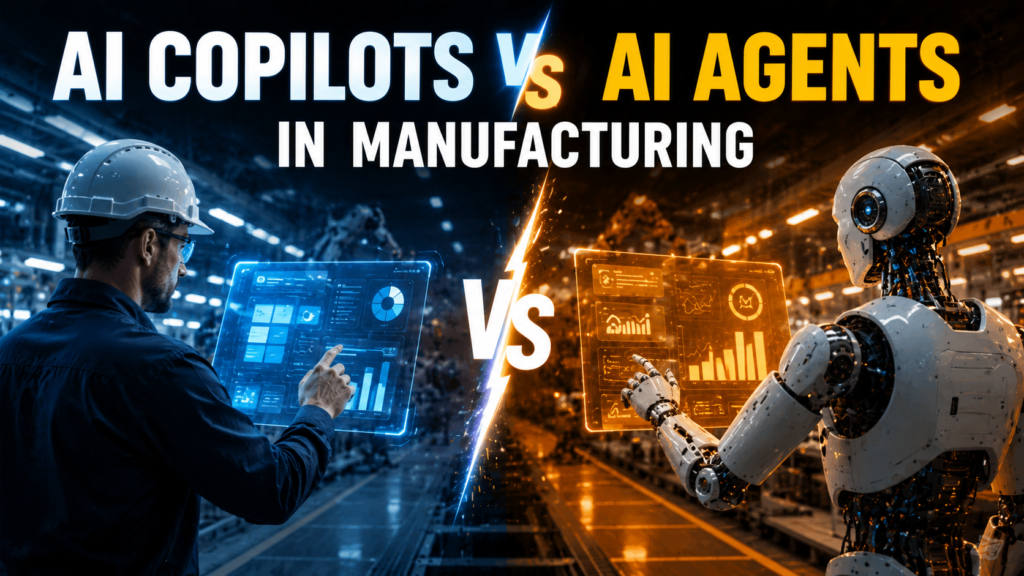
AI Copilots and AI Agents represent two important paths toward intelligent manufacturing.
AI Copilots enhance human expertise by providing knowledge, recommendations, and operational support.
AI Agents extend automation by enabling autonomous decision making, coordination, and optimization.
The future smart factory will not depend on one technology alone.
It will combine human creativity, AI assistance, and autonomous intelligence.
Manufacturers that understand how to use both AI Copilots and AI Agents will be better positioned to build efficient, adaptive, and intelligent industrial environments.
The next generation of manufacturing will not simply automate work.
It will augment people, empower machines, and create a new era of collaborative industrial intelligence.
Also Read: “Securing AI Agents in Manufacturing“
Author
Frequently Asked Questions
What is the difference between AI Copilots and AI Agents in manufacturing?
AI Copilots assist humans by providing recommendations, while AI Agents perform autonomous tasks and make operational decisions.
Are AI Copilots replacing factory workers?
No. AI Copilots enhance worker capabilities by providing information and decision support.
Can AI Agents operate factories independently?
AI Agents can manage specific operations autonomously, but human oversight remains important.
Which is better for manufacturing, AI Copilots or AI Agents?
Both technologies serve different purposes. Copilots improve human productivity, while Agents enable autonomous operations.