

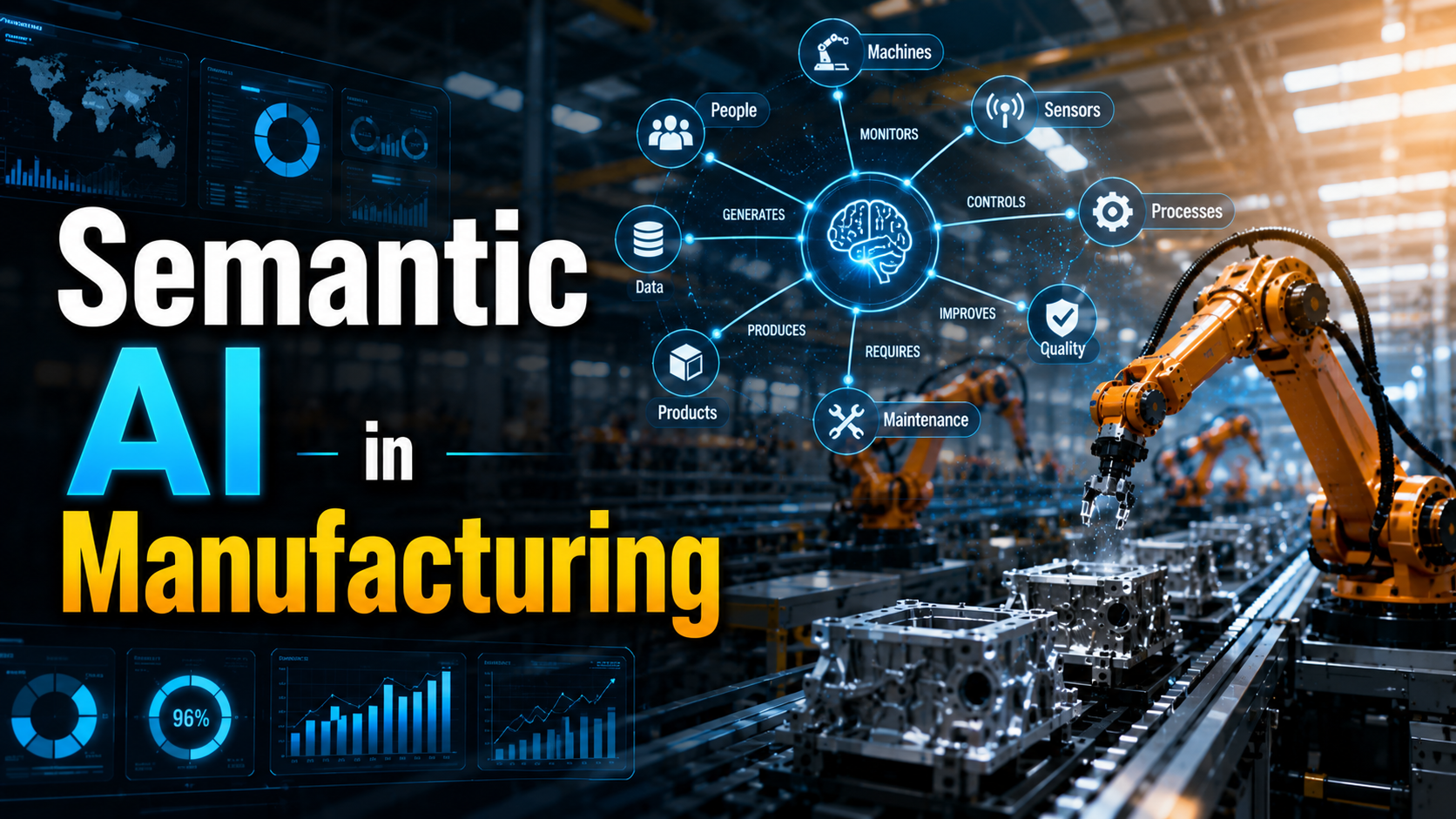
How Semantic Artificial Intelligence Is Creating Smarter, More Connected, and Context Aware Factories
Manufacturing has always been driven by information. Engineers rely on technical documents, operators monitor production data, maintenance teams analyze equipment history, and managers make decisions based on operational insights. However, as factories become increasingly digital, the volume and complexity of industrial information have grown beyond what traditional systems can effectively manage. Semantic AI in Manufacturing.
Modern manufacturing environments generate enormous amounts of data from machines, sensors, enterprise applications, engineering systems, supply chains, and human interactions. The challenge is no longer simply collecting data. The real challenge is understanding the meaning behind that data and connecting information across the entire industrial ecosystem.
This is where Semantic AI in Manufacturing is becoming a transformative technology.
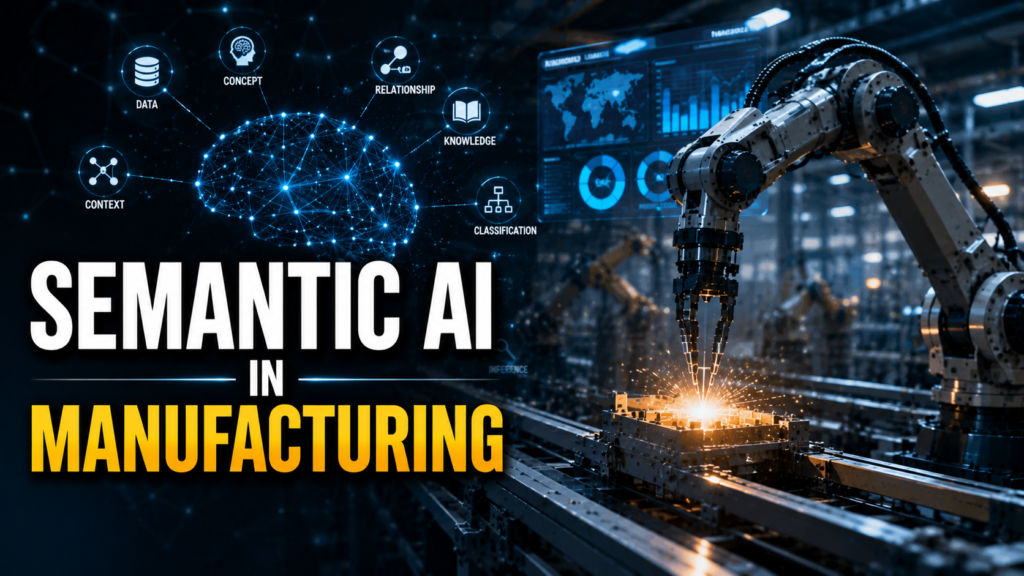
Semantic AI enables machines and Artificial Intelligence systems to understand relationships, context, concepts, and meanings within industrial information. Instead of analyzing isolated data points, Semantic AI understands how machines, products, processes, materials, documents, suppliers, and operational events are connected.
By combining Artificial Intelligence with semantic technologies such as knowledge graphs, ontologies, natural language processing, and contextual reasoning, manufacturers can build intelligent systems that understand industrial knowledge much closer to the way humans do.
Semantic AI is becoming a critical foundation for smart factories, autonomous manufacturing, Industrial AI platforms, digital twins, engineering copilots, and Industry 5.0 initiatives.
This comprehensive guide explains what Semantic AI is, how it works, why it matters in manufacturing, its applications, benefits, challenges, implementation strategies, and how it is shaping the future of intelligent factories.
Table of Contents
What Is Semantic AI?
Semantic AI is a branch of Artificial Intelligence focused on enabling machines to understand the meaning, relationships, and context behind information rather than simply processing raw data.
Traditional AI systems often identify patterns within datasets. Semantic AI goes further by understanding concepts and connections.
For example, a traditional AI system may recognize that a machine sensor shows abnormal temperature readings.
A Semantic AI system understands that:
The machine belongs to a specific production line.
The machine produces a particular product.
The product requires specific quality standards.
The machine recently underwent maintenance.
A certain supplier provided replacement components.
Similar temperature patterns previously caused a specific failure.
This deeper understanding allows AI systems to generate more accurate, explainable, and useful recommendations.
Why Semantic AI Matters in Manufacturing
Manufacturing organizations operate through complex networks of relationships.
A single production issue may involve:
Equipment conditions
Raw materials
Production parameters
Operator actions
Maintenance history
Engineering specifications
Supplier information
Quality requirements
Customer expectations
Traditional data systems often store this information separately.
Semantic AI connects these disconnected sources and creates a unified understanding of industrial operations.
This enables manufacturers to move from data-driven decision-making toward knowledge-driven intelligence.
Traditional AI vs Semantic AI in Manufacturing
| Traditional AI | Semantic AI |
|---|---|
| Finds patterns in data | Understands meaning and relationships |
| Depends heavily on historical examples | Uses contextual industrial knowledge |
| Limited understanding of concepts | Understands entities and connections |
| Produces predictions | Produces contextual recommendations |
| Requires structured datasets | Works with structured and unstructured information |
| Limited reasoning ability | Supports advanced reasoning |
How Semantic AI Works
Semantic AI combines several technologies to create contextual industrial intelligence.
Knowledge Graphs
Knowledge graphs form the foundation of Semantic AI.
They represent manufacturing information as interconnected entities and relationships.
For example:
Machine A produces Component B.
Component B requires Material C.
Material C comes from Supplier D.
Machine A requires Maintenance Procedure E.
This network creates a digital representation of manufacturing knowledge.
Ontologies
Ontologies define how industrial concepts relate to each other.
They establish common meanings across different systems.
For example, different departments may use different terms for the same equipment.
An ontology ensures that Artificial Intelligence understands these terms represent the same concept.
This improves interoperability.
Natural Language Processing
Manufacturing organizations contain enormous amounts of unstructured information.
Examples include:
Maintenance manuals
Engineering reports
Safety documents
Work instructions
Technical specifications
Quality reports
Natural Language Processing enables AI systems to understand and extract valuable knowledge from these documents.
Machine Learning
Machine learning identifies patterns and predicts future events.
When combined with semantic understanding, machine learning models become more accurate because they operate with richer context.
Reasoning Engines
Reasoning systems allow AI to draw conclusions based on relationships and rules.
For example, Semantic AI can determine that a machine failure risk is increasing because:
A sensor indicates abnormal vibration.
The machine uses an aging component.
Similar equipment failed under comparable conditions.
Maintenance history shows increasing repair frequency.
This reasoning capability creates more intelligent recommendations.
Key Components of Semantic AI Architecture
A manufacturing Semantic AI platform typically includes several layers.
| Layer | Purpose |
|---|---|
| Data Layer | Collects information from industrial systems |
| Semantic Layer | Defines meaning and relationships |
| Knowledge Layer | Stores connected industrial knowledge |
| AI Layer | Performs prediction and reasoning |
| Application Layer | Delivers insights through industrial tools |
Applications of Semantic AI in Manufacturing
Predictive Maintenance
Predictive maintenance is one of the strongest applications of Semantic AI.
Traditional predictive maintenance models analyze sensor data to predict equipment failure.
Semantic AI adds context.
It understands:
Machine specifications
Operating conditions
Maintenance history
Spare parts information
Engineering documentation
Previous failures
Technician knowledge
This creates more accurate maintenance recommendations.
Intelligent Quality Management
Quality problems often involve multiple factors.
A product defect may result from:
Material variation
Machine settings
Environmental conditions
Operator actions
Supplier issues
Semantic AI connects these factors to identify root causes faster.
Quality teams can move from detecting defects to preventing them.
Engineering Knowledge Management
Manufacturing organizations possess decades of valuable engineering knowledge.
However, this knowledge is often stored across documents, databases, and employee experience.
Semantic AI transforms scattered information into accessible industrial knowledge.
Engineers can ask questions using natural language and receive context-aware answers.
Industrial Copilots
AI copilots are becoming increasingly important in manufacturing.
Semantic AI enables copilots to understand:
Factory processes
Equipment relationships
Engineering terminology
Maintenance procedures
Production requirements
Instead of providing generic answers, industrial copilots deliver manufacturing-specific intelligence.
Supply Chain Intelligence
Modern supply chains involve complex relationships between suppliers, materials, logistics providers, production facilities, and customers.
Semantic AI helps manufacturers understand these connections.
It improves:
Supplier risk analysis
Inventory optimization
Demand planning
Logistics coordination
Supply chain resilience
Digital Twins
Digital twins become more powerful when combined with Semantic AI.
Knowledge graphs provide context while digital twins simulate operational behavior.
Together, they create intelligent virtual representations of factories and equipment.
Autonomous Manufacturing
Future autonomous factories will require AI systems capable of understanding complex industrial environments.
Semantic AI provides the contextual intelligence required for autonomous decision-making.
Benefits of Semantic AI in Manufacturing
Improved Decision Making
Semantic AI provides deeper insights by connecting information across multiple systems.
Managers and engineers make better decisions using complete operational context.
Reduced Data Silos
Semantic AI connects information from different departments and software platforms.
This creates a unified enterprise knowledge environment.
Better Artificial Intelligence Performance
AI models perform better when they understand context.
Semantic information improves accuracy and reduces incorrect recommendations.
Faster Problem Resolution
Engineers can identify root causes faster because AI understands relationships between different operational factors.
Enhanced Knowledge Sharing
Semantic AI preserves institutional knowledge and makes it accessible across the organization.
Improved Explainability
Because Semantic AI understands relationships, it can provide clearer explanations behind AI recommendations.
This strengthens trust.
Increased Operational Efficiency
Connected knowledge enables better maintenance planning, production optimization, quality improvement, and resource management.
Semantic AI and Industry 4.0
Industry 4.0 introduced connected factories powered by automation, sensors, robotics, cloud computing, and analytics.
However, connectivity alone does not create intelligence.
Semantic AI adds meaning to connected information.
It transforms large volumes of industrial data into actionable knowledge.
This makes factories more adaptive, efficient, and intelligent.
Semantic AI and Industry 5.0
Industry 5.0 focuses on collaboration between humans and intelligent technologies.
Semantic AI supports this vision by enabling AI systems to understand human knowledge, engineering expertise, and operational context.
Instead of replacing workers, Semantic AI enhances human capabilities.
Engineers gain intelligent assistants.
Operators receive contextual recommendations.
Maintenance teams access deeper insights.
This creates human-centered intelligent manufacturing.
Challenges of Implementing Semantic AI
Despite its potential, manufacturers must overcome several challenges.
Data Integration Complexity
Manufacturing environments contain many disconnected systems.
Connecting these sources requires careful planning and integration strategies.
Ontology Development
Creating industrial ontologies requires collaboration between technical experts and manufacturing specialists.
Poor semantic models reduce effectiveness.
Data Quality Issues
Semantic AI depends on accurate information.
Incomplete or inconsistent data affects results.
Strong data governance remains essential.
Legacy Infrastructure
Older manufacturing systems may lack modern connectivity.
Organizations may require gradual modernization.
Workforce Skills
Successful implementation requires expertise in:
Artificial Intelligence
Industrial systems
Data engineering
Knowledge management
Manufacturing processes
Training programs are necessary.
Best Practices for Implementing Semantic AI
Manufacturers should begin with clearly defined business challenges rather than technology experimentation.
Identify high-value areas such as predictive maintenance, quality improvement, engineering knowledge management, or supply chain optimization.
Develop standardized industrial ontologies that reflect business processes and operational requirements.
Build strong data governance practices covering ownership, quality, security, and lifecycle management.
Integrate Semantic AI gradually with existing manufacturing platforms.
Involve engineers and operational experts throughout development.
Continuously improve semantic models as manufacturing processes evolve.
Combine Semantic AI with Digital Twins, Industrial Foundation Models, Explainable AI, and Industrial AI Governance frameworks for maximum value.
Future Trends in Semantic AI for Manufacturing
Semantic AI will become increasingly important as factories become more autonomous.
Future developments include:
Industrial Foundation Models with built-in semantic understanding.
Autonomous AI agents capable of reasoning about manufacturing operations.
Generative AI systems connected to industrial knowledge graphs.
Self-learning factories that continuously update operational knowledge.
Advanced digital twins powered by semantic intelligence.
Real-time enterprise knowledge networks.
Standardized industrial ontologies enabling global manufacturing collaboration.
These developments will accelerate the transition toward intelligent autonomous factories.
Why Semantic AI Is a Strategic Advantage
Manufacturing competitiveness increasingly depends on how effectively organizations use knowledge.
Machines, data, and automation create value only when information can be understood and applied intelligently.
Semantic AI transforms disconnected industrial data into meaningful knowledge.
Organizations that adopt Semantic AI can improve operational visibility, accelerate innovation, preserve expertise, strengthen AI performance, and create more resilient manufacturing systems.
It provides the intelligence layer required for the next generation of smart factories.
Conclusion
Semantic AI represents a major evolution in manufacturing intelligence by helping machines understand not only data but also the meaning behind that data. As factories become more connected and autonomous, the ability to transform information into actionable knowledge will become a critical competitive advantage.
By combining Artificial Intelligence with knowledge graphs, ontologies, natural language processing, and contextual reasoning, Semantic AI enables manufacturers to build smarter predictive maintenance systems, more accurate quality solutions, intelligent engineering assistants, resilient supply chains, and truly adaptive factories.
The future of manufacturing will not be defined only by how much data factories generate, but by how intelligently they understand and use that data. Semantic AI provides the foundation for this transformation by creating connected, context-aware, and knowledge-driven industrial ecosystems.
As organizations move toward Industry 5.0 and autonomous manufacturing, Semantic AI will become one of the most important technologies powering the factories of the future.
Also Read: “Building an AI-First Manufacturing Enterprise“
Author
Frequently Asked Questions
What is Semantic AI in manufacturing?
Semantic AI in manufacturing is Artificial Intelligence technology that understands industrial data by analyzing meaning, relationships, and context rather than only identifying statistical patterns.
How is Semantic AI different from traditional AI?
Traditional AI focuses mainly on pattern recognition, while Semantic AI combines AI with knowledge graphs, ontologies, and reasoning systems to understand industrial relationships and context.
Why are knowledge graphs important for Semantic AI?
Knowledge graphs connect manufacturing entities such as machines, products, suppliers, processes, and documents, allowing AI systems to understand relationships and generate better insights.