

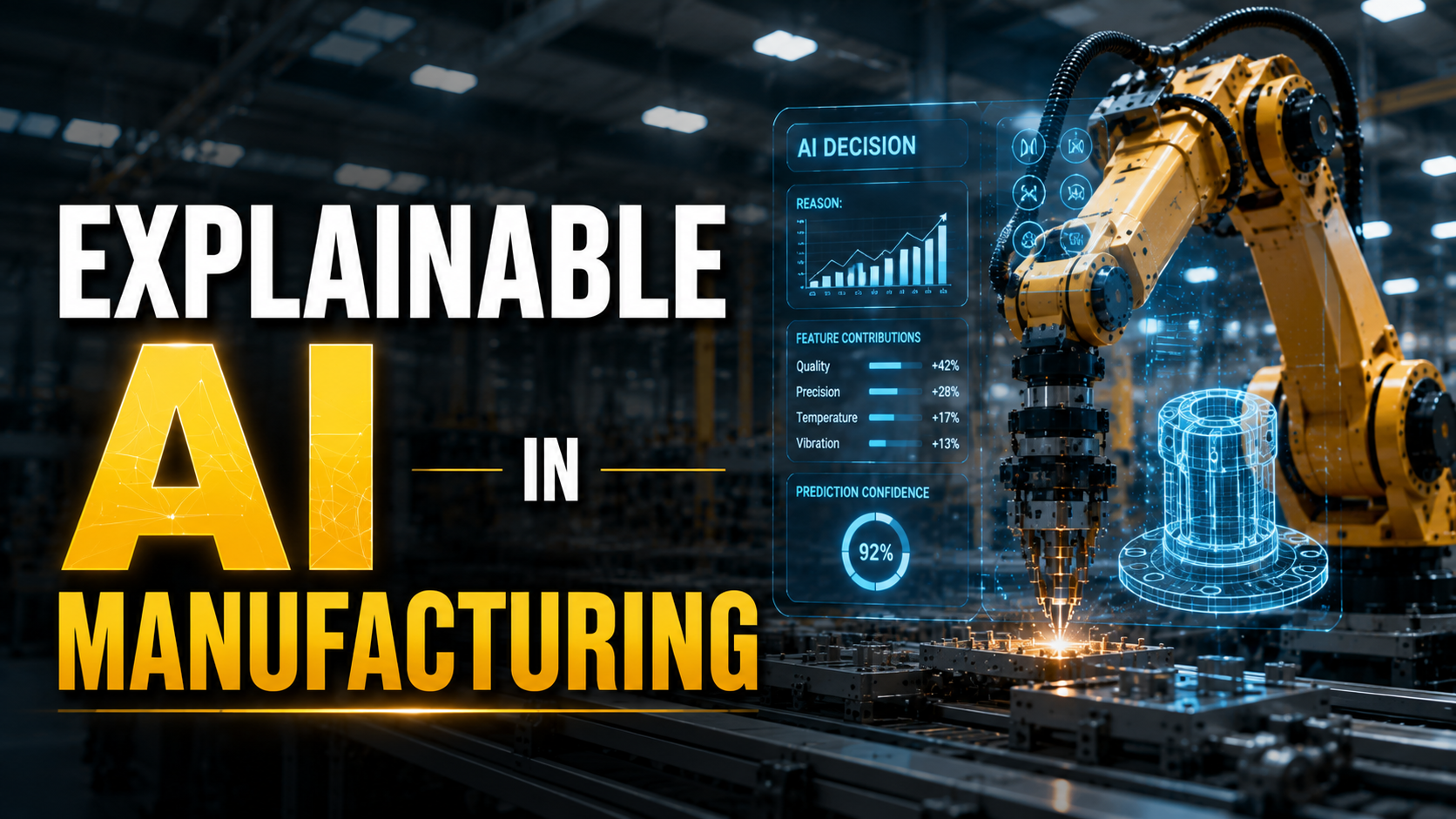
How Explainable Artificial Intelligence Is Building Trust, Transparency, and Smarter Decision Making in Modern Manufacturing
Artificial Intelligence has become one of the most transformative technologies in modern manufacturing. From predictive maintenance and computer vision quality inspection to production scheduling, supply chain optimization, digital twins, and industrial robots, AI is helping manufacturers improve productivity, reduce costs, enhance quality, and build more resilient operations. Explainable AI in Manufacturing.
As AI systems become increasingly capable, they are also becoming more complex. Many advanced machine learning models can generate highly accurate predictions, but they often provide little insight into how those predictions were made. These systems are frequently referred to as “black box” models because users can see the output but cannot easily understand the reasoning behind it.
In manufacturing, where AI decisions can influence production quality, equipment reliability, worker safety, regulatory compliance, and customer satisfaction, relying on unexplained recommendations is rarely acceptable. Engineers, plant managers, maintenance teams, and executives need confidence that AI decisions are logical, reliable, and based on meaningful operational evidence.
This is where Explainable AI, often abbreviated as XAI, becomes essential.
Explainable AI provides transparency into how AI models generate predictions and recommendations. Instead of delivering answers without context, XAI helps manufacturers understand which data influenced a decision, why the model reached a particular conclusion, how confident the prediction is, and what actions should be taken.
As manufacturers move toward Industry 5.0 and increasingly autonomous factories, Explainable AI is becoming a critical capability for building trustworthy, responsible, and scalable industrial AI systems.
This comprehensive guide explores what Explainable AI is, why it matters in manufacturing, how it works, its business benefits, practical applications, implementation strategies, common challenges, and future trends shaping transparent AI in industrial environments.
Table of Contents
What Is Explainable AI?
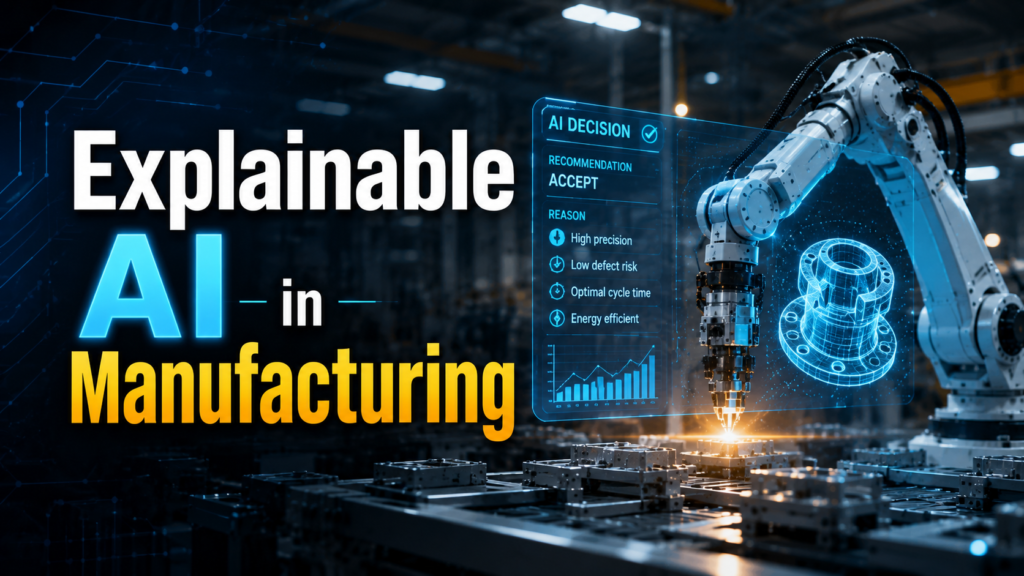
Explainable AI is a collection of methods, technologies, and design principles that make Artificial Intelligence models understandable to humans.
Rather than treating AI as an opaque decision engine, Explainable AI reveals the factors that contributed to predictions, classifications, recommendations, or optimization decisions.
Its purpose is to increase trust, improve accountability, simplify troubleshooting, support regulatory compliance, and enable better collaboration between people and intelligent systems.
In manufacturing, Explainable AI helps engineers understand why a machine is predicted to fail, why a product was classified as defective, why production parameters were adjusted, or why inventory recommendations changed.
Instead of simply accepting AI output, decision makers can evaluate the reasoning behind it.
Why Explainable AI Matters in Manufacturing
Manufacturing differs from many other industries because AI decisions frequently influence physical processes.
An incorrect recommendation may result in equipment damage, product defects, production downtime, safety incidents, or regulatory violations.
Without transparency, engineers may hesitate to trust AI recommendations.
Explainable AI reduces this uncertainty by providing visibility into the model’s reasoning.
It strengthens collaboration between human expertise and machine intelligence while improving operational confidence.
Black Box AI vs Explainable AI
| Black Box AI | Explainable AI |
|---|---|
| Limited visibility into decision making | Transparent reasoning behind predictions |
| Difficult to validate recommendations | Engineers understand contributing factors |
| Lower user trust | Higher organizational confidence |
| Challenging regulatory compliance | Improved auditability |
| Harder to identify errors | Easier troubleshooting and validation |
| Limited accountability | Clear decision traceability |
| Reduced human collaboration | Strong human AI partnership |
Core Principles of Explainable AI
Successful Explainable AI systems are built on several key principles.
Transparency
Users should understand how AI reaches conclusions.
Models should clearly communicate the information used during decision making.
Transparency improves confidence across engineering, operations, maintenance, quality assurance, and executive leadership.
Interpretability
AI outputs should be understandable without requiring deep expertise in machine learning.
Visual explanations, feature rankings, confidence scores, and natural language summaries simplify interpretation.
Accountability
Organizations should identify who developed, validated, approved, monitored, and maintains each AI model.
Clear accountability strengthens governance.
Fairness
AI should make consistent recommendations regardless of production shifts, equipment variations, or operational conditions.
Fairness reduces unintended bias.
Reliability
Explainable AI should consistently produce accurate explanations alongside reliable predictions.
Both outputs require continuous validation.
Human Oversight
Critical manufacturing decisions should remain subject to appropriate human review.
Explainability supports informed human judgment rather than replacing it.
How Explainable AI Works
Explainable AI combines multiple analytical techniques to interpret model behavior.
Some methods examine which input variables most influenced predictions.
Others compare alternative outcomes under different operating conditions.
Certain approaches visualize neural network attention while others generate human-readable explanations.
Together, these techniques help engineers understand why AI reached a specific conclusion.
The explanation becomes almost as valuable as the prediction itself.
Types of Explainable AI
Global Explainability
Global explanations describe how an AI model behaves overall.
Engineers understand general decision patterns, important variables, and model logic.
This supports model validation and governance.
Local Explainability
Local explanations focus on individual predictions.
For example, a predictive maintenance system may explain why one particular machine has a high failure probability.
Local explanations support operational decisions.
Model Specific Explainability
Some machine learning algorithms naturally provide understandable decision structures.
Decision trees and linear models often fall into this category.
These models are inherently interpretable.
Model Agnostic Explainability
Certain explanation techniques work independently of the underlying AI model.
These methods interpret predictions without requiring changes to the model architecture.
They support greater flexibility.
Technologies Supporting Explainable AI
Several technologies strengthen industrial explainability.
Manufacturing Knowledge Graphs
Knowledge graphs provide contextual relationships between equipment, production lines, suppliers, maintenance records, engineering documentation, and quality information.
These relationships improve explanation quality.
Digital Twins
Digital twins simulate manufacturing operations and validate AI recommendations before physical implementation.
Simulation results strengthen confidence in AI decisions.
Industrial Foundation Models
Industrial Foundation Models combine manufacturing knowledge with AI reasoning.
Explainability ensures users understand how these models generate industrial recommendations.
Industrial Internet of Things
Connected sensors provide continuous operational information that supports transparent AI predictions.
Reliable sensor data improves explanation accuracy.
Industrial AI Governance
Governance frameworks define standards for explainability, validation, auditing, monitoring, and responsible AI deployment.
Explainable AI becomes an essential governance requirement.
Applications of Explainable AI in Manufacturing
Predictive Maintenance
Rather than simply predicting equipment failure, Explainable AI identifies the operational conditions contributing to increased risk.
Engineers can prioritize maintenance with greater confidence.
Quality Inspection
Computer vision systems explain why products are classified as defective by highlighting visual characteristics, measurements, or manufacturing deviations influencing the decision.
This improves quality assurance.
Production Scheduling
AI optimization engines explain why production sequences changed based on equipment availability, inventory levels, customer demand, or workforce capacity.
Managers understand scheduling recommendations more clearly.
Supply Chain Optimization
Explainable AI identifies the factors driving supplier recommendations, inventory adjustments, logistics decisions, and procurement strategies.
Decision makers gain operational transparency.
Energy Management
AI explains how equipment settings, environmental conditions, production loads, and scheduling influence energy optimization recommendations.
Sustainability initiatives become easier to evaluate.
Industrial Robotics
Collaborative robots increasingly rely on AI.
Explainability helps operators understand robotic behavior, improving safety and operational trust.
Benefits of Explainable AI
Increased Trust
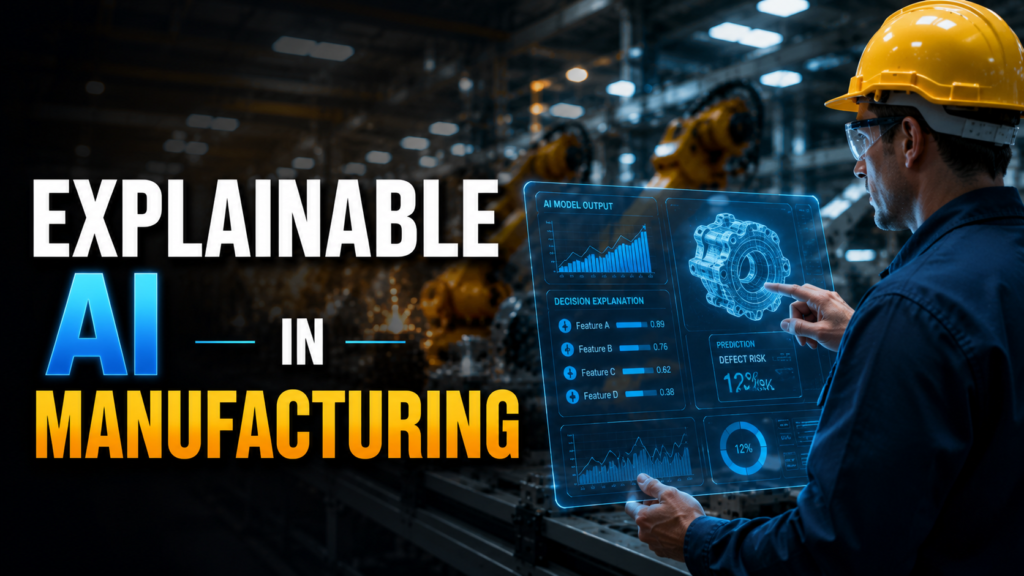
Employees are more likely to adopt AI when they understand its reasoning.
Trust significantly improves implementation success.
Better Decision Making
Transparent recommendations allow engineers to combine AI insights with practical experience.
Decision quality improves.
Easier Troubleshooting
Engineers identify incorrect assumptions, poor data quality, or unusual operating conditions more quickly.
Problem resolution accelerates.
Improved Compliance
Regulated industries require documented decision-making processes.
Explainable AI simplifies audits and regulatory reporting.
Stronger Governance
Organizations monitor AI behavior more effectively when model reasoning remains visible.
Governance becomes more practical.
Enhanced Collaboration
Explainability strengthens communication between engineering, manufacturing, information technology, operations, and executive leadership.
Shared understanding improves teamwork.
Explainable AI and Industry 5.0
Industry 5.0 emphasizes collaboration between humans and intelligent technologies.
Explainable AI supports this vision by ensuring employees understand AI recommendations rather than simply receiving automated instructions.
Transparency empowers workers while maintaining human authority over important operational decisions.
Human-centered manufacturing depends on explainability.
Explainable AI and Responsible Manufacturing
Responsible AI extends beyond technical performance.
Manufacturers increasingly evaluate whether AI systems operate ethically, consistently, securely, transparently, and responsibly.
Explainable AI contributes directly to these objectives by making decision-making visible.
This strengthens customer confidence, regulatory compliance, and organizational accountability.
Challenges of Implementing Explainable AI
Despite its advantages, implementation presents several challenges.
Model Complexity
Deep learning models often generate highly accurate predictions but remain difficult to interpret.
Balancing performance with explainability requires careful model selection.
Data Quality
Explanations remain only as reliable as the underlying data.
Poor industrial data reduces explanation accuracy.
Strong governance becomes essential.
Performance Tradeoffs
Highly interpretable models occasionally sacrifice predictive performance.
Organizations must balance accuracy with transparency according to operational requirements.
Workforce Understanding
Employees require education to interpret AI explanations effectively.
Training programs should accompany deployment.
Legacy Systems
Older manufacturing platforms may lack the integration capabilities needed for advanced explainability tools.
Modernization may be necessary.
Best Practices for Implementing Explainable AI
Begin by identifying manufacturing applications where explainability delivers the greatest business value, particularly safety-critical processes, predictive maintenance, quality inspection, and regulatory reporting.
Prioritize high-quality industrial data through comprehensive governance programs.
Use Manufacturing Knowledge Graphs to strengthen contextual reasoning.
Integrate Digital Twins for validating AI recommendations before operational deployment.
Develop standardized AI documentation describing model objectives, assumptions, validation procedures, limitations, and update history.
Train employees to interpret explanations confidently.
Continuously monitor both prediction accuracy and explanation quality.
Treat explainability as a core design requirement rather than an optional feature.
Emerging Trends
Several innovations are expanding Explainable AI capabilities.
Generative AI systems increasingly produce natural language explanations alongside industrial recommendations.
Industrial Foundation Models provide richer contextual understanding supported by Manufacturing Knowledge Graphs.
Physics-Informed AI strengthens explainability by incorporating engineering principles into machine learning models.
Autonomous AI agents increasingly justify their operational decisions before execution.
Regulatory expectations surrounding AI transparency continue evolving, encouraging broader adoption of explainability standards.
These developments position Explainable AI as a foundational capability for future autonomous manufacturing.
Why Explainable AI Creates Competitive Advantage
Manufacturers increasingly compete not only on operational efficiency but also on trust.
Organizations capable of deploying transparent AI systems gain stronger employee acceptance, faster regulatory approval, improved customer confidence, better operational decision-making, and lower implementation risks.
Explainability transforms Artificial Intelligence from a technical tool into a trusted business capability.
As AI becomes more deeply integrated into manufacturing, organizations investing in explainability today will be better prepared for tomorrow’s intelligent factories.
Conclusion
Explainable AI is becoming one of the most important building blocks of intelligent manufacturing because it bridges the gap between advanced machine learning and practical industrial decision-making. By making AI predictions transparent, understandable, and verifiable, manufacturers can move beyond simply using intelligent algorithms to truly trusting and collaborating with them.
From predictive maintenance and quality inspection to production planning, energy optimization, and supply chain management, Explainable AI helps engineers, operators, and executives understand not only what an AI system recommends but also why it reached that conclusion. This transparency improves confidence, accelerates adoption, strengthens governance, simplifies compliance, and supports better operational outcomes.
As manufacturing evolves toward Industry 5.0, where human expertise and intelligent technologies work together, Explainable AI will play an increasingly vital role in creating responsible, trustworthy, and scalable industrial AI systems. Organizations that prioritize transparency alongside performance will be better positioned to build resilient, future-ready factories that combine innovation with accountability and earn lasting trust from employees, customers, and stakeholders.
Also Read: “AI Powered Root Cause Analysis in Manufacturing“
Author
Frequently Asked Questions
What is Explainable AI in manufacturing?
Explainable AI refers to Artificial Intelligence systems that provide transparent, understandable explanations describing how industrial predictions and recommendations are generated.
Why is Explainable AI important?
It increases trust, improves decision-making, strengthens governance, supports regulatory compliance, enhances collaboration, and enables responsible AI adoption.
Which manufacturing applications benefit most from Explainable AI?
Predictive maintenance, quality inspection, production scheduling, supply chain optimization, industrial robotics, engineering assistants, and energy management all benefit significantly.