




How Manufacturing Knowledge Graphs Are Powering the Next Generation of Smart Factories
The manufacturing industry is generating more data today than at any point in history. Smart factories, Industrial Internet of Things devices, enterprise resource planning systems, manufacturing execution systems, quality management platforms, supply chain applications, robotics, engineering software, and connected sensors collectively produce billions of data points every day. Manufacturing Knowledge Graphs Explained.
Despite this explosion of information, many manufacturers still struggle to answer seemingly simple operational questions. Engineers often spend hours searching for technical documentation, production teams work with disconnected data sources, maintenance personnel rely on fragmented equipment histories, and executives lack a unified view of enterprise operations. Valuable information exists, but it remains trapped inside isolated systems.
This challenge has given rise to one of the most important technologies supporting Industry 4.0 and Industry 5.0: Manufacturing Knowledge Graphs.
A Manufacturing Knowledge Graph organizes industrial data into a connected network of relationships rather than storing information in isolated databases. Instead of viewing machines, products, suppliers, production lines, maintenance records, engineering drawings, quality reports, and employees as separate pieces of information, a knowledge graph connects them into a comprehensive digital knowledge network that reflects how manufacturing operations actually function.
By linking data across the enterprise, Manufacturing Knowledge Graphs enable Artificial Intelligence systems, digital twins, industrial copilots, autonomous agents, and advanced analytics platforms to understand context, discover hidden relationships, and support more intelligent decision-making.
As manufacturers pursue greater efficiency, operational resilience, predictive intelligence, and digital transformation, knowledge graphs are becoming the foundation for enterprise-wide industrial intelligence.
This comprehensive guide explains what Manufacturing Knowledge Graphs are, how they work, their architecture, business benefits, industrial applications, implementation strategies, challenges, and why they are becoming essential for the future of smart manufacturing.
Table of Contents
What Is a Manufacturing Knowledge Graph?
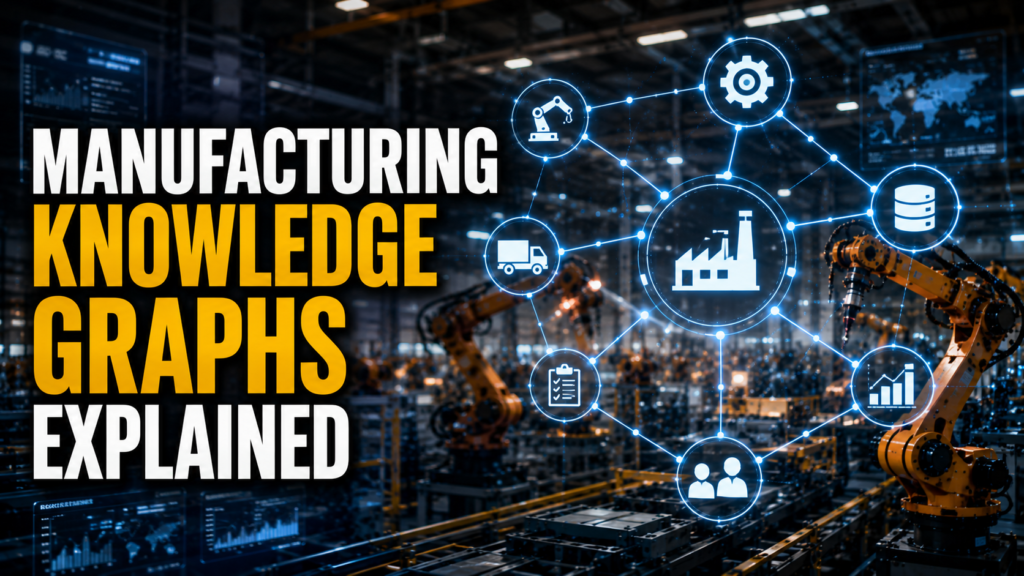
A Manufacturing Knowledge Graph is a structured representation of manufacturing information in which industrial entities and their relationships are connected into a unified network of knowledge.
Unlike traditional databases that organize information into separate tables, a knowledge graph stores both data and the relationships between data.
Each object within the graph represents an industrial entity such as a machine, production line, product, supplier, sensor, maintenance activity, engineering drawing, quality inspection, operator, or manufacturing process.
Relationships describe how these entities interact.
For example, a machine may produce a specific product, consume materials supplied by a particular vendor, generate sensor readings monitored by predictive maintenance software, require maintenance performed by certified technicians, and belong to a production line operating within a specific factory.
By capturing these relationships, Manufacturing Knowledge Graphs provide context that conventional databases often cannot.
Why Manufacturing Needs Knowledge Graphs
Modern manufacturing environments rely on dozens of specialized software systems.
Examples include:
Enterprise Resource Planning systems
Manufacturing Execution Systems
Product Lifecycle Management platforms
Quality Management Systems
Industrial Internet of Things platforms
Warehouse Management Systems
Computerized Maintenance Management Systems
Supply Chain Management software
Labor management systems
Engineering document repositories
Each system stores valuable information, but they often operate independently.
This fragmentation creates data silos that limit operational visibility and reduce AI effectiveness.
Manufacturing Knowledge Graphs eliminate these silos by connecting information into a unified semantic network.
The result is a comprehensive understanding of manufacturing operations across the entire enterprise.
Traditional Databases vs Manufacturing Knowledge Graphs
| Traditional Databases | Manufacturing Knowledge Graphs |
|---|---|
| Store isolated records | Connect data through relationships |
| Structured tables | Flexible graph structures |
| Limited contextual understanding | Rich contextual intelligence |
| Complex joins for analysis | Natural relationship navigation |
| Difficult integration | Unified enterprise knowledge |
| Static relationships | Dynamic and expandable connections |
| Limited AI reasoning | Supports intelligent reasoning and discovery |
Core Components of a Manufacturing Knowledge Graph
Several key components work together to create an effective industrial knowledge graph.
Entities
Entities represent real-world manufacturing objects.
Examples include:
Machines
Production lines
Factories
Products
Raw materials
Suppliers
Employees
Robots
Quality inspections
Maintenance events
Sensors
Engineering documents
Inventory items
Every entity becomes a node within the graph.
Relationships
Relationships define how entities connect.
Examples include:
Machine produces product
Sensor monitors equipment
Supplier delivers material
Technician repairs machine
Product requires component
Factory contains production line
Inspection verifies quality
Maintenance prevents failure
These relationships create meaningful industrial context.
Attributes
Each entity contains descriptive properties.
For a machine, attributes might include:
Serial number
Installation date
Operating hours
Manufacturer
Location
Maintenance status
Energy consumption
Performance metrics
Attributes enrich graph intelligence.
Ontologies
An ontology provides standardized definitions for industrial concepts.
It ensures that different systems interpret manufacturing information consistently.
For example, the graph understands that a robotic arm is a type of industrial equipment while preventive maintenance represents a maintenance activity.
Standardized semantics improve interoperability.
How Manufacturing Knowledge Graphs Work
Manufacturing Knowledge Graphs continuously collect information from multiple enterprise systems.
Data originates from Industrial Internet of Things sensors, Manufacturing Execution Systems, Enterprise Resource Planning software, maintenance applications, engineering databases, quality systems, logistics platforms, digital twins, and external suppliers.
The graph organizes this information into interconnected entities and relationships.
Artificial Intelligence applications then query the graph to answer complex business questions.
For example, instead of searching multiple databases separately, an engineer could ask:
Which machines producing Product A experienced vibration increases after the latest software update and share components supplied by Vendor X?
The knowledge graph automatically navigates connected relationships to generate a contextual answer.
This capability dramatically improves industrial intelligence.
Technologies Behind Manufacturing Knowledge Graphs
Graph Databases
Graph databases store interconnected information efficiently.
Unlike relational databases, graph databases optimize relationship traversal, enabling rapid analysis of highly connected industrial data.
Artificial Intelligence
Artificial Intelligence uses knowledge graphs to improve reasoning, decision support, semantic search, recommendation systems, and industrial automation.
Knowledge graphs provide contextual understanding that significantly enhances AI accuracy.
Industrial Internet of Things
Industrial Internet of Things devices continuously update graph entities using live operational data collected from manufacturing equipment.
Real-time updates keep knowledge current.
Natural Language Processing
Engineers increasingly interact with knowledge graphs through conversational interfaces.
Natural Language Processing translates human questions into graph queries.
This makes industrial knowledge more accessible.
Digital Twins
Knowledge graphs enhance digital twins by organizing engineering information, operational history, maintenance records, and equipment relationships into a unified knowledge structure.
This strengthens simulation accuracy.
Industrial Foundation Models
Industrial Foundation Models use knowledge graphs to improve contextual reasoning.
Rather than relying solely on statistical learning, they access structured manufacturing knowledge during decision-making.
Benefits of Manufacturing Knowledge Graphs
Unified Enterprise Knowledge
Knowledge graphs eliminate information silos by integrating multiple manufacturing systems into a single knowledge network.
Employees gain faster access to reliable information.
Better Decision Making
Decision-makers understand relationships between production, maintenance, quality, inventory, engineering, suppliers, and logistics.
This supports more informed operational decisions.
Enhanced Artificial Intelligence
Artificial Intelligence performs better when provided with contextual knowledge.
Knowledge graphs improve recommendation quality, explainability, reasoning, and predictive accuracy.
Faster Root Cause Analysis
Engineers quickly identify connections contributing to operational problems.
Instead of investigating isolated systems, they analyze interconnected manufacturing relationships.
This reduces troubleshooting time.
Improved Predictive Maintenance
Knowledge graphs connect equipment history, maintenance records, sensor data, spare parts, engineering documentation, and operating conditions.
Maintenance recommendations become more accurate.
Better Knowledge Management
Manufacturing organizations possess valuable institutional knowledge accumulated over decades.
Knowledge graphs preserve this expertise while making it searchable for future employees.
Greater Operational Agility
Manufacturers respond more rapidly to production disruptions because relationships between suppliers, inventory, equipment, customers, and logistics remain continuously visible.
Industrial Applications
Predictive Maintenance
Maintenance teams analyze equipment relationships, historical failures, spare part dependencies, environmental conditions, and maintenance activities to improve failure prediction.
Quality Management
Knowledge graphs connect production parameters, inspection results, material batches, machine settings, operators, and suppliers.
This supports rapid identification of defect sources.
Supply Chain Intelligence
Manufacturers visualize relationships among suppliers, inventory, logistics providers, production schedules, and customer demand.
This improves resilience against supply chain disruptions.
Engineering Knowledge Management
Engineers locate relevant technical documents, equipment manuals, maintenance procedures, design specifications, and historical engineering decisions through connected knowledge.
Product Lifecycle Management
Knowledge graphs connect product design, engineering changes, manufacturing processes, supplier information, customer feedback, and maintenance history throughout the product lifecycle.
Sustainability Reporting
Manufacturers track energy usage, carbon emissions, waste generation, supplier sustainability metrics, and production efficiency through interconnected environmental data.
Manufacturing Knowledge Graphs and Industry 4.0
Industry 4.0 focuses on connected manufacturing through automation, Industrial Internet of Things, cloud computing, robotics, and advanced analytics.
Knowledge graphs serve as the semantic foundation connecting these technologies.
Instead of isolated digital systems exchanging raw data, manufacturing applications share structured industrial knowledge.
This improves interoperability and enterprise-wide intelligence.
Manufacturing Knowledge Graphs and Industry 5.0
Industry 5.0 emphasizes human-centered manufacturing supported by intelligent technologies.
Knowledge graphs strengthen collaboration between humans and Artificial Intelligence by providing transparent, explainable, and context-rich industrial knowledge.
Engineers gain greater confidence in AI recommendations because supporting relationships remain visible.
This improves trust and decision quality.
Challenges of Implementing Manufacturing Knowledge Graphs
Despite their advantages, implementation requires careful planning.
Data Integration
Connecting multiple enterprise systems requires standardized data models and consistent identifiers.
Legacy systems often complicate integration.
Data Quality
Knowledge graphs depend on accurate and complete information.
Poor data quality weakens relationship accuracy.
Strong governance remains essential.
Ontology Development
Developing comprehensive manufacturing ontologies requires collaboration between engineering experts, data architects, and business leaders.
This process takes time.
Organizational Adoption
Employees must understand how knowledge graphs support daily operations.
Training encourages successful adoption.
Scalability
Large manufacturing enterprises may manage millions of interconnected entities.
Scalable graph architectures ensure long-term performance.
Best Practices for Successful Implementation
Organizations should begin with a clearly defined business objective such as predictive maintenance, engineering knowledge management, or quality optimization.
Develop standardized industrial ontologies describing manufacturing concepts consistently across departments.
Integrate high-value systems first before expanding enterprise-wide.
Establish strong data governance policies covering quality, ownership, validation, security, and lifecycle management.
Use Artificial Intelligence to continuously enrich graph relationships through automated entity recognition and semantic analysis.
Monitor graph quality regularly to ensure relationships remain accurate as manufacturing operations evolve.
Promote cross-functional collaboration among engineering, operations, maintenance, information technology, data science, and executive leadership.
Emerging Trends in Manufacturing Knowledge Graphs
Several innovations are expanding the capabilities of industrial knowledge graphs.
Generative AI is increasingly using knowledge graphs to produce more accurate and context-aware engineering recommendations.
Industrial copilots rely on knowledge graphs to answer complex manufacturing questions using conversational interfaces.
Autonomous AI agents access graph relationships when planning production activities, coordinating maintenance, and optimizing logistics.
Digital twins continuously synchronize with knowledge graphs to improve operational simulation.
Physics-Informed AI uses graph relationships to combine engineering knowledge with scientific modeling.
Semantic interoperability standards are enabling manufacturers to exchange industrial knowledge more effectively across global supply chains.
These developments position knowledge graphs as a foundational technology for intelligent manufacturing.
Why Manufacturing Knowledge Graphs Matter for Business Competitiveness
Competitive manufacturing increasingly depends on information rather than machinery alone.
Organizations capable of connecting engineering expertise, production knowledge, supplier relationships, maintenance history, quality data, and operational intelligence gain significant advantages.
Manufacturing Knowledge Graphs transform isolated information into connected enterprise knowledge that supports faster innovation, better decision-making, improved operational efficiency, and stronger organizational resilience.
As Artificial Intelligence becomes more autonomous, knowledge graphs will provide the contextual understanding necessary for trustworthy industrial decision-making.
Businesses investing in knowledge graph technology today are building the digital knowledge infrastructure required for tomorrow’s intelligent factories.
Conclusion
Manufacturing Knowledge Graphs are reshaping how industrial organizations manage, understand, and apply enterprise knowledge. By connecting machines, products, suppliers, engineering documents, maintenance records, quality inspections, production systems, and operational data into a unified network, they provide the contextual intelligence that traditional databases cannot deliver.
This connected knowledge foundation enhances Artificial Intelligence, accelerates decision-making, improves predictive maintenance, strengthens quality management, supports digital twins, and enables more intelligent automation across the factory. It also helps organizations preserve institutional knowledge, reduce information silos, and create a single source of truth for manufacturing operations.
As the manufacturing sector continues its transition toward Industry 5.0, knowledge graphs will play an increasingly important role in enabling trustworthy AI, autonomous systems, industrial copilots, and enterprise-wide collaboration. Manufacturers that invest in this technology today will be better equipped to build resilient, data-driven, and future-ready smart factories capable of competing in an increasingly connected and intelligent global economy.
Also Read: “Education in the Age of Artificial Intelligence“
Author
Frequently Asked Questions
What is a Manufacturing Knowledge Graph?
A Manufacturing Knowledge Graph is a connected network of manufacturing entities and relationships that organizes industrial information into a structured, context-rich knowledge system supporting Artificial Intelligence and operational decision-making.
How is a knowledge graph different from a traditional database?
Traditional databases store isolated records, while knowledge graphs connect information through meaningful relationships, enabling richer analysis and AI reasoning.
Why are Manufacturing Knowledge Graphs important?
They eliminate data silos, improve enterprise visibility, strengthen Artificial Intelligence, accelerate engineering decisions, enhance predictive maintenance, and support digital transformation.