


Modern manufacturing plants generate an enormous volume of data every second. From machine sensors and production lines to supply chains and quality inspection systems, factories today are among the most data-rich environments in the world. Yet, despite this abundance, most of this data remains underutilized, siloed, or entirely inaccessible for meaningful decision-making.
This is where Industrial AI emerges as a transformative force.
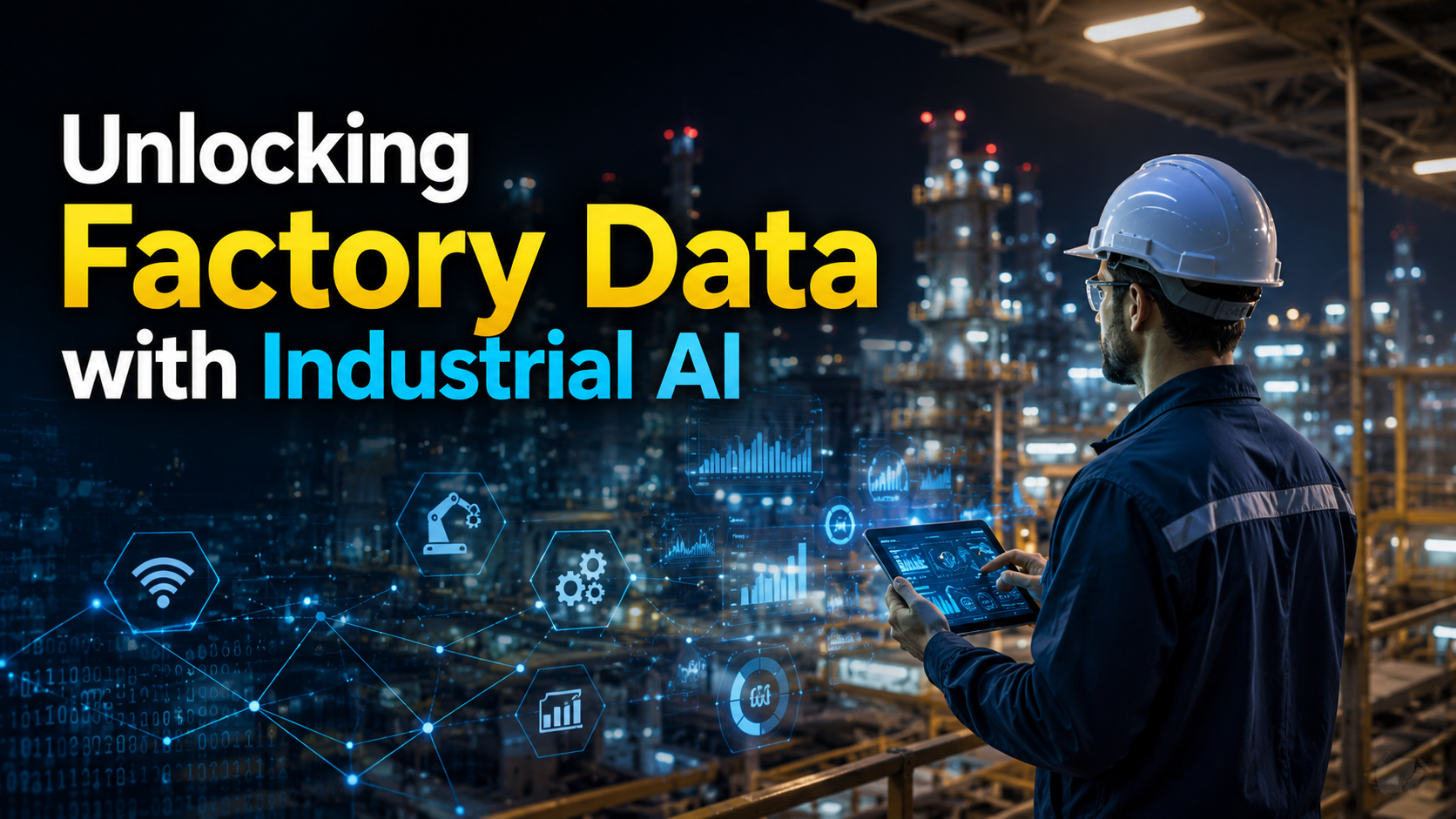
Industrial AI is not just another analytics layer, it is a powerful intelligence system that connects machines, systems, and processes to extract actionable insights from factory data in real time. It enables manufacturers to move from reactive decision-making to predictive and even autonomous operations. Unlocking Factory Data with Industrial AI.
In essence, Industrial AI acts as the bridge between raw industrial data and intelligent action.
The goal is simple but revolutionary: unlock factory data and turn it into operational intelligence that drives efficiency, quality, sustainability, and profitability.
In this in-depth guide, we explore how Industrial AI unlocks hidden value from factory data, the technologies behind it, real-world applications, implementation strategies, challenges, and the future of intelligent manufacturing ecosystems.
Table of Contents
What Is Industrial AI?
Industrial AI refers to the application of artificial intelligence technologies in industrial environments such as manufacturing plants, warehouses, energy systems, and supply chains.
It combines:
- Machine Learning (ML)
- Deep Learning
- Computer Vision
- Industrial IoT (IIoT)
- Edge Computing
- Digital Twins
- Agentic AI systems
Unlike traditional data analytics, Industrial AI continuously learns from live factory environments and improves decision-making over time.
It enables machines and systems to:
- Detect anomalies
- Predict failures
- Optimize production
- Improve quality
- Reduce downtime
- Enhance energy efficiency
At its core, Industrial AI transforms raw data into operational intelligence.
Why Factory Data Is So Valuable
Factories generate data from multiple sources:
- Sensors embedded in machines
- Production control systems (MES)
- Enterprise resource planning (ERP)
- SCADA systems
- Quality inspection cameras
- Robotics and automation systems
- Energy monitoring devices
- Supply chain platforms
However, most of this data remains underused due to fragmentation and complexity.
When properly analyzed, factory data can reveal:
- Equipment health patterns
- Production inefficiencies
- Quality variations
- Supply chain risks
- Energy waste
- Maintenance needs
- Process bottlenecks
Industrial AI makes this transformation possible by converting disconnected data streams into unified intelligence.
The Data Problem in Modern Manufacturing
Despite advanced digital tools, many factories face similar challenges:
1. Data Silos
Different systems operate independently, making it difficult to unify insights.
2. Unstructured Data
A large portion of industrial data is unstructured, including images, logs, and sensor streams.
3. Delayed Insights
Traditional analytics often provide insights after problems occur, not in real time.
4. Legacy Systems
Older equipment lacks connectivity, limiting data accessibility.
5. Data Overload
Factories generate more data than humans can analyze effectively.
Industrial AI addresses these challenges by automating data interpretation and decision-making.
Industrial AI Architecture in Smart Factories
| Layer | Function |
|---|---|
| Data Layer | Sensors, machines, IoT devices |
| Connectivity Layer | Industrial networks, 5G, edge gateways |
| Processing Layer | Edge computing and cloud systems |
| Intelligence Layer | AI, ML, deep learning models |
| Orchestration Layer | Agentic AI systems coordinating actions |
| Application Layer | Dashboards, automation tools, robotics |
This layered architecture ensures seamless data flow from machines to decision-making systems.
How Industrial AI Unlocks Factory Data
Industrial AI transforms raw data into insights through a continuous cycle.
1. Data Collection
Sensors and machines continuously generate operational data such as temperature, vibration, pressure, and output speed.
2. Data Integration
Industrial AI aggregates data from multiple systems into a unified platform.
3. Data Cleaning
AI removes noise, fills missing values, and standardizes formats.
4. Pattern Recognition
Machine learning models identify trends, anomalies, and correlations.
5. Prediction
AI forecasts outcomes such as machine failure, demand fluctuations, or quality defects.
6. Optimization
Systems recommend or execute actions to improve performance.
7. Continuous Learning
Models improve automatically as more data is collected.
Key Use Cases of Industrial AI in Manufacturing
Predictive Maintenance
Industrial AI analyzes machine data to predict failures before they occur.
Benefits include:
- Reduced downtime
- Lower maintenance costs
- Extended equipment lifespan
Quality Control and Inspection
AI-powered vision systems detect defects in real time.
Applications include:
- Surface defect detection
- Dimensional analysis
- Assembly verification
Production Optimization
AI adjusts production schedules dynamically based on demand and machine availability.
Energy Management
Industrial AI identifies energy waste and optimizes consumption across machines and production lines.
Supply Chain Intelligence
AI analyzes supplier performance, inventory levels, and logistics data to improve supply chain resilience.
Process Automation
AI systems automate repetitive decisions in manufacturing workflows.
Digital Twin Integration
Factories use virtual models to simulate operations and test improvements before implementation.
Benefits of Unlocking Factory Data with Industrial AI
Improved Operational Efficiency
AI reduces downtime, bottlenecks, and inefficiencies across production systems.
Better Decision-Making
Real-time insights enable faster and more accurate decisions.
Reduced Operational Costs
Optimized maintenance, energy use, and production planning reduce overall expenses.
Enhanced Product Quality
Continuous monitoring ensures consistent product standards.
Increased Equipment Lifespan
Predictive maintenance prevents premature machine failure.
Greater Flexibility
Manufacturers can quickly adapt to changes in demand or supply chain disruptions.
Sustainability Gains
AI helps reduce waste, energy consumption, and carbon emissions.
Industrial AI vs Traditional Data Analytics
| Feature | Traditional Analytics | Industrial AI |
|---|---|---|
| Data Processing | Batch-based | Real-time |
| Decision Making | Human-driven | AI-assisted or autonomous |
| Data Type | Structured | Structured + unstructured |
| Adaptability | Static models | Self-learning systems |
| Speed | Slow insights | Instant insights |
| Scalability | Limited | Highly scalable |
Industrial AI goes beyond reporting to actively improving operations.
Role of Digital Twins in Industrial AI
Digital twins act as virtual replicas of physical factories.
They allow manufacturers to:
- Simulate production changes
- Predict machine behavior
- Test optimization strategies
- Train AI models safely
When combined with Industrial AI, digital twins create a powerful feedback loop between real and virtual environments.
Role of Agentic AI in Factory Intelligence
Agentic AI enhances Industrial AI by introducing autonomous decision-making capabilities.
Agentic systems can:
- Analyze factory conditions
- Plan operational improvements
- Coordinate systems automatically
- Execute approved actions
This moves manufacturing closer to fully autonomous operations.
Challenges in Unlocking Factory Data
Data Integration Complexity
Combining multiple industrial systems requires advanced integration strategies.
Cybersecurity Risks
Connected factories increase exposure to cyber threats
High Implementation Costs
Industrial AI deployment requires investment in sensors, infrastructure, and platforms.
Workforce Adaptation
Employees need training to work effectively alongside AI systems.
Data Governance
Factories must ensure data quality, consistency, and compliance.
Best Practices for Implementing Industrial AI
Manufacturers should follow a structured approach:
Start with High-Impact Use Cases
Focus on predictive maintenance, quality control, or energy optimization first.
Build Strong Data Infrastructure
Ensure reliable connectivity and standardized data collection.
Integrate Legacy Systems
Use gateways and APIs to connect older machinery.
Adopt Edge + Cloud Architecture
Balance real-time processing with scalable analytics.
Prioritize Cybersecurity
Implement strong OT and IT security frameworks.
Train Workforce
Develop AI literacy and digital skills across teams.
Future of Industrial AI in Manufacturing
Fully Autonomous Factories
Factories will increasingly operate with minimal human intervention.
Multi-Agent AI Systems
Different AI agents will manage production, logistics, quality, and maintenance collaboratively.
Hyper-Personalized Manufacturing
AI will enable production of customized products at scale.
Real-Time Global Supply Chain Intelligence
Factories will coordinate dynamically with global suppliers using AI-driven systems.
Sustainable Smart Manufacturing
AI will optimize every aspect of production for environmental sustainability.
Business Impact of Industrial AI
| Area | Impact |
|---|---|
| Productivity | Higher output with fewer resources |
| Maintenance | Reduced unplanned downtime |
| Quality | Fewer defects and higher consistency |
| Energy | Lower consumption and cost |
| Supply Chain | Improved resilience |
| Decision Speed | Real-time intelligence |
| Profitability | Increased margins |
Industrial AI is becoming a key driver of competitive advantage in manufacturing.
Conclusion
Unlocking factory data with Industrial AI represents one of the most transformative shifts in modern manufacturing. For decades, factories have generated vast amounts of valuable data, but much of it remained unused due to fragmentation, complexity, and limited analytical capability.
Industrial AI changes this by converting raw data into real-time intelligence that drives better decisions, improves efficiency, enhances quality, and enables predictive operations.
When combined with technologies like IoT, digital twins, edge computing, and Agentic AI, Industrial AI becomes the foundation of next-generation smart factories—capable not only of understanding what is happening but also of predicting what will happen and optimizing outcomes automatically.
The future of manufacturing belongs to organizations that can effectively harness their data. Those who successfully unlock factory data with Industrial AI will gain stronger resilience, higher productivity, and a significant competitive advantage in an increasingly intelligent industrial world.
Also Read: “The Competitive Advantage of AI Adoption“
Author
Frequently Asked Questions (FAQs)
1. What is Industrial AI in manufacturing?
Industrial AI refers to the use of artificial intelligence technologies in manufacturing environments to analyze data, optimize processes, predict failures, and improve operational efficiency.
2. How does Industrial AI unlock factory data?
Industrial AI collects data from machines and systems, integrates it, cleans it, analyzes patterns, and generates real-time insights that help improve decision-making and automation.
3. What are the main benefits of Industrial AI?
Key benefits include improved efficiency, reduced downtime, better product quality, predictive maintenance, energy savings, and enhanced supply chain visibility