



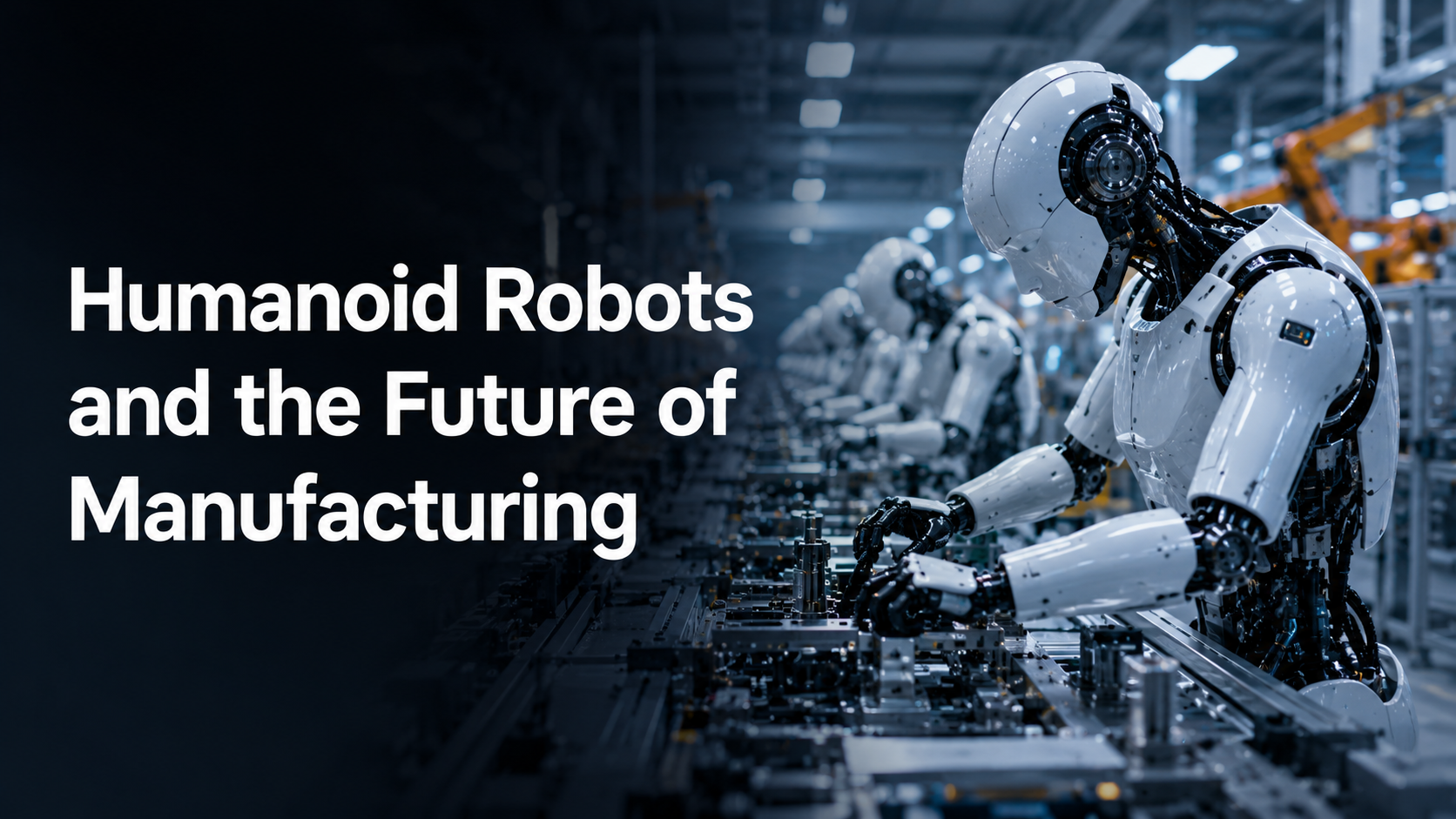
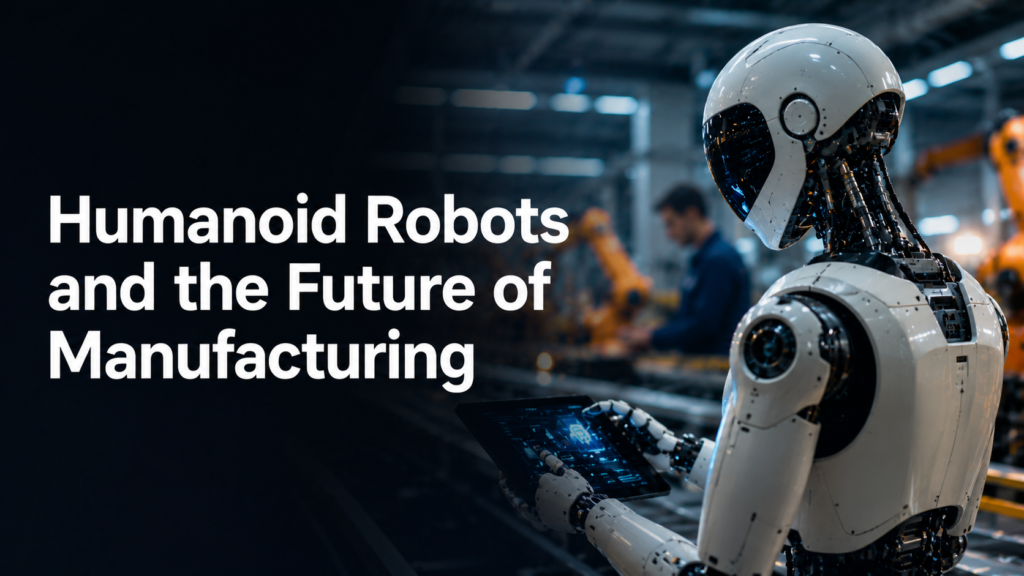
Manufacturing is entering one of the most exciting phases in its history. After decades of industrial automation powered by robotic arms, programmable logic controllers (PLCs), and conveyor systems, a new generation of intelligent machines is beginning to reshape factory operations. These machines are not simply faster industrial robots or more advanced collaborative robots, they are humanoid robots designed to work in environments originally built for people. Humanoid Robots and the Future of Manufacturing.
Unlike conventional industrial robots that remain fixed in one location and perform repetitive tasks, humanoid robots combine artificial intelligence (AI), advanced mobility, computer vision, dexterous hands, force sensing, and real-time decision-making to perform a broad range of activities. Their human-like form allows them to navigate stairs, use standard tools, open doors, carry materials, operate machinery, and collaborate directly with workers in existing manufacturing facilities without requiring factories to be redesigned around automation.
This shift is particularly significant because many factories worldwide still depend on manual labor for assembly, inspection, logistics, packaging, machine tending, and maintenance. As manufacturers face persistent labor shortages, rising production costs, increasing product customization, and higher expectations for operational resilience, humanoid robots are emerging as a promising solution for repetitive, physically demanding, and ergonomically challenging tasks.
However, the future of manufacturing is not about replacing people with humanoid robots. Instead, it is about creating intelligent, collaborative workplaces where humans and robots complement one another. Robots contribute speed, consistency, endurance, and precision, while people provide creativity, engineering expertise, ethical judgment, adaptability, and complex problem-solving.
Supported by advances in Physical AI, machine learning, computer vision, digital twins, edge computing, and Industry 5.0 principles, humanoid robots are becoming an increasingly important part of the next generation of smart factories.
In this comprehensive guide, we explore what humanoid robots are, why they matter for manufacturing, the technologies behind them, practical applications, business benefits, implementation strategies, challenges, and the future trends shaping human-robot collaboration in industrial environments.
Table of Contents
What Are Humanoid Robots?
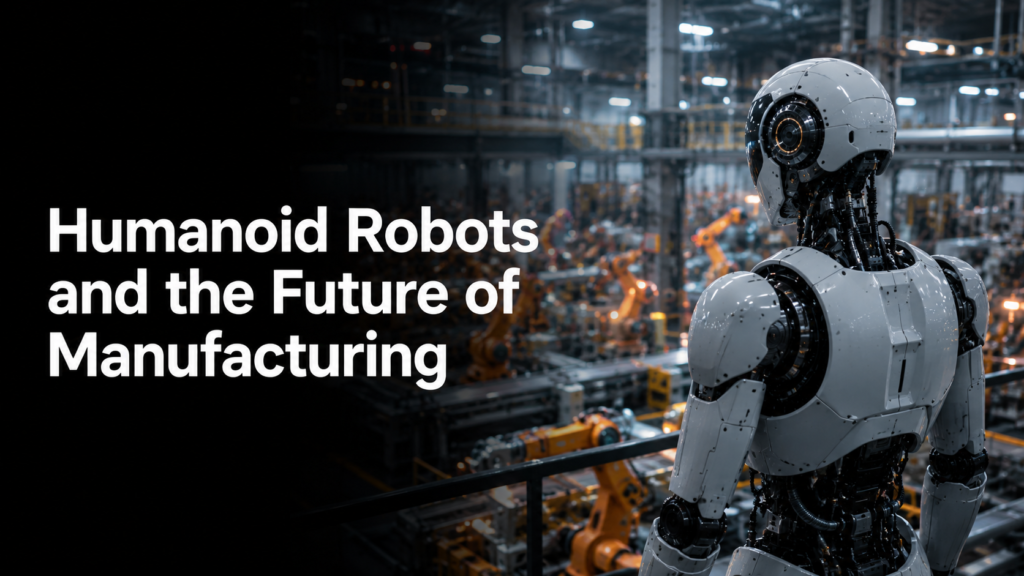
Humanoid robots are intelligent robotic systems designed with a body structure that resembles the human form, typically including:
- A head equipped with cameras and sensors
- Two arms with articulated joints
- Dexterous hands capable of grasping tools and components
- A torso containing computing and power systems
- Two legs for walking and balancing, or in some designs, wheeled mobility
Their human-like design enables them to operate in workplaces built for human workers rather than requiring entirely new robotic infrastructure.
Unlike traditional industrial robots that repeat fixed motions, humanoid robots can perceive their surroundings, adapt to changing environments, interact with equipment, and perform multiple tasks using AI-driven decision-making.
Why Manufacturing Needs Humanoid Robots
Manufacturers around the world face several persistent challenges:
- Skilled labor shortages
- Aging workforces
- Rising labor costs
- Increasing product customization
- Demand for 24/7 operations
- Workplace safety concerns
- Frequent production changes
Traditional automation solves many repetitive tasks but often lacks the flexibility needed for dynamic environments.
Humanoid robots help bridge this gap because they can work in existing facilities, use standard industrial tools, and switch between different tasks with relatively little reconfiguration compared to fixed robotic systems.
This flexibility makes them particularly attractive for modern manufacturing.
Evolution of Industrial Robotics
| Manufacturing Era | Primary Robotics | Characteristics |
|---|---|---|
| Industry 3.0 | Fixed industrial robots | High-speed repetitive automation |
| Industry 4.0 | Smart connected robots | Data-driven automation |
| Industry 5.0 | Collaborative robots (Cobots) | Human-machine collaboration |
| Next-Generation Manufacturing | AI-powered humanoid robots | Adaptive, mobile, multi-purpose assistance |
Humanoid robots build on decades of robotics innovation while introducing unprecedented flexibility and mobility.
Core Technologies Behind Humanoid Robots
Modern humanoid robots combine multiple cutting-edge technologies.
| Technology | Purpose |
|---|---|
| Artificial Intelligence | Decision-making and reasoning |
| Physical AI | Real-world perception and interaction |
| Machine Learning | Continuous improvement through experience |
| Computer Vision | Object recognition and navigation |
| Natural Language Processing (NLP) | Human-robot communication |
| Force and Tactile Sensors | Safe object manipulation |
| Autonomous Navigation | Independent movement inside factories |
| Edge Computing | Real-time processing near the robot |
| Digital Twins | Virtual training and simulation |
| Battery and Power Management | Extended operational runtime |
Together, these technologies enable humanoid robots to function safely and effectively in complex manufacturing environments.
How Humanoid Robots Work
A humanoid robot follows a continuous cycle of perception, reasoning, action, and learning.
1. Perception
Cameras, LiDAR, depth sensors, microphones, and force sensors gather information about the surrounding environment.
2. Understanding
AI processes sensor data to identify people, equipment, tools, obstacles, and workpieces.
3. Planning
The robot evaluates multiple action options while considering production priorities, safety rules, and task objectives.
4. Action
Motors and actuators perform physical movements such as walking, lifting, assembling, inspecting, or transporting materials.
5. Learning
Machine learning algorithms continuously improve performance by analyzing completed tasks and operational feedback.
Benefits of Humanoid Robots in Manufacturing
Greater Workforce Flexibility
Humanoid robots can perform multiple tasks rather than being dedicated to a single production process.
This adaptability supports changing production requirements without extensive reprogramming.
Improved Workplace Safety
Many manufacturing jobs involve repetitive lifting, hazardous environments, or exposure to extreme temperatures.
Humanoid robots can perform these tasks while reducing injury risks for employees.
Addressing Labor Shortages
Many manufacturers struggle to recruit and retain skilled workers.
Humanoid robots help fill workforce gaps by handling repetitive, physically demanding, or less desirable tasks while enabling employees to focus on technical and supervisory roles.
Increased Productivity
Humanoid robots can operate continuously with consistent performance, helping manufacturers improve throughput, reduce downtime, and meet production targets.
Higher Product Quality
AI-powered vision systems and precision manipulation reduce assembly errors, improve inspection accuracy, and support consistent manufacturing quality.
Better Operational Resilience
Flexible robotic systems allow manufacturers to respond more quickly to changes in customer demand, workforce availability, and supply chain conditions.
Real-World Applications
Assembly Operations
Humanoid robots can assemble products using tools and workstations originally designed for people, making them suitable for mixed-model production environments.
Machine Tending
Robots load and unload CNC machines, injection molding equipment, and production systems while maintaining continuous operation.
Material Handling
Humanoid robots transport components between workstations, reducing manual lifting and improving production flow.
Quality Inspection
Computer vision enables robots to inspect products for surface defects, missing components, dimensional variations, and assembly quality.
Warehouse Operations
Humanoid robots assist with inventory movement, picking, packing, and logistics inside manufacturing facilities.
Maintenance Support
AI-powered robots can perform routine inspections, collect sensor data, and assist technicians with preventive maintenance tasks.
Humanoid Robots vs Traditional Industrial Robots
| Traditional Industrial Robots | Humanoid Robots |
|---|---|
| Fixed location | Mobile and adaptable |
| Single-purpose | Multi-purpose |
| Requires dedicated work cells | Operates in human environments |
| Limited environmental awareness | AI-powered perception |
| Repetitive programming | Adaptive decision-making |
| Minimal human interaction | Collaborative operation |
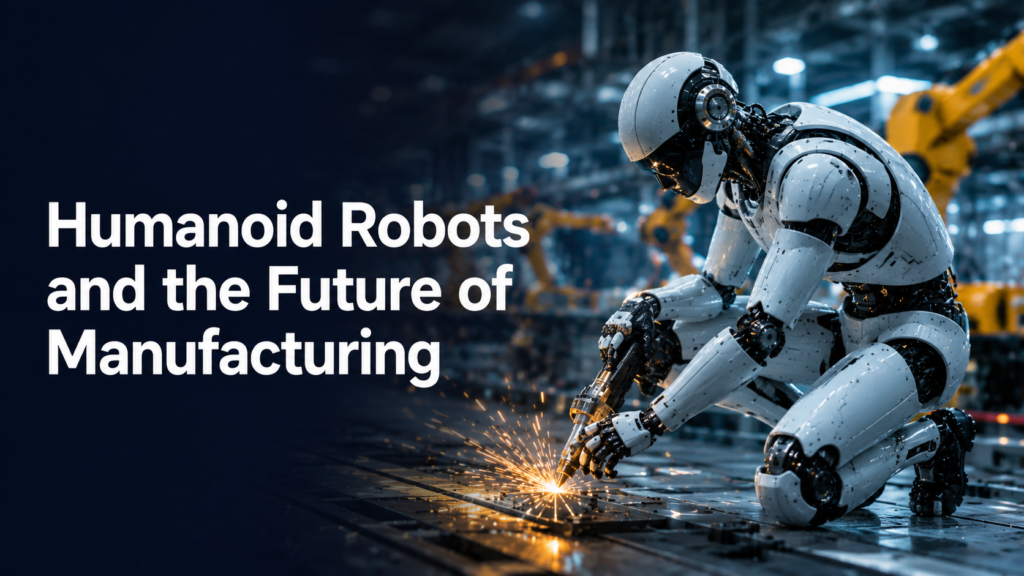
Humanoid robots expand the possibilities of industrial automation by combining mobility, intelligence, and versatility.
Human-Robot Collaboration
The future factory is not human versus robot, it is human with robot.
Workers contribute:
- Engineering knowledge
- Creativity
- Strategic thinking
- Customer understanding
- Process innovation
- Ethical judgment
Humanoid robots contribute:
- Precision
- Endurance
- Consistency
- Data-driven execution
- Hazardous task handling
- Repetitive labor
This collaboration creates more productive and safer manufacturing environments.
The Role of AI and Physical AI
Artificial intelligence provides humanoid robots with reasoning and learning capabilities, while Physical AI enables interaction with the physical world.
Together they support:
- Object recognition
- Navigation
- Motion planning
- Dexterous manipulation
- Human interaction
- Autonomous decision-making
- Adaptive manufacturing
These capabilities distinguish humanoid robots from conventional automation systems.
Digital Twins and Robot Training
Digital twins allow manufacturers to simulate factories and train humanoid robots in virtual environments before physical deployment.
Benefits include:
- Faster implementation
- Reduced operational risk
- Safer testing
- Process optimization
- Continuous performance improvement
Simulation shortens deployment time while improving robot reliability.
Challenges of Humanoid Robot Adoption
High Investment Costs
Although prices are expected to decline over time, humanoid robots currently require substantial investments in hardware, AI software, integration, and maintenance.
Battery Limitations
Long operational shifts require efficient power management, charging infrastructure, or battery-swapping strategies.
Complex Environments
Factories present dynamic conditions involving people, moving equipment, variable lighting, and changing workflows.
Robots must interpret these environments safely and accurately.
Cybersecurity
Connected robots require robust cybersecurity protections to prevent unauthorized access or operational disruption.
Workforce Acceptance
Successful implementation depends on transparent communication, employee involvement, and continuous training to build confidence in human-robot collaboration.
Practices for Implementation
Manufacturers should approach humanoid robot deployment strategically.
Start with Pilot Projects
Introduce robots in high-value applications where safety, productivity, or labor shortages create measurable business benefits.
Prioritize Human-Centric Design
Ensure robots complement rather than disrupt existing workflows.
Build Secure Digital Infrastructure
Reliable networking, edge computing, and cybersecurity are essential.
Train Employees
Develop workforce skills in robotics supervision, AI collaboration, maintenance, and troubleshooting.
Measure Business Outcomes
Track key performance indicators such as:
- Overall Equipment Effectiveness (OEE)
- Product quality
- Downtime
- Worker safety
- Production throughput
- Return on investment (ROI)
Future Trends
General-Purpose Manufacturing Robots
Future humanoid robots will perform a broader range of manufacturing tasks with minimal reprogramming.
Agentic AI Integration
Robots will increasingly plan, coordinate, and execute multi-step workflows using Agentic AI while remaining under human governance.
Robot-as-a-Service (RaaS)
Subscription-based deployment models may reduce upfront investment barriers for manufacturers.
Collaborative Factory Ecosystems
Humanoid robots, autonomous mobile robots, cobots, and industrial AI systems will coordinate seamlessly within unified smart factories.
Sustainable Manufacturing
Humanoid robots will contribute to resource efficiency by optimizing production processes, reducing waste, and supporting energy-conscious operations.
Business Impact
Manufacturers adopting humanoid robotics can experience improvements across several operational areas.
| Business Area | Expected Impact |
|---|---|
| Productivity | Higher throughput and operational efficiency |
| Workforce Safety | Reduced exposure to hazardous tasks |
| Product Quality | Improved consistency and fewer defects |
| Labor Availability | Greater resilience to workforce shortages |
| Operational Flexibility | Faster adaptation to changing production needs |
| Maintenance | Better equipment monitoring and support |
| Sustainability | Reduced waste and optimized resource use |
| Long-Term Competitiveness | Stronger innovation and manufacturing resilience |
While results depend on the maturity of deployment and the specific manufacturing context, humanoid robots have the potential to become an important complement to existing automation strategies.
Conclusion
Humanoid robots represent one of the most promising developments in the future of manufacturing. By combining artificial intelligence, Physical AI, computer vision, robotics, digital twins, and advanced sensing technologies, they introduce a level of mobility, adaptability, and collaboration that traditional industrial automation cannot easily achieve.
Their greatest value lies not in replacing human workers but in expanding what manufacturing teams can accomplish together. Humanoid robots can take on repetitive, physically demanding, or hazardous tasks, allowing employees to focus on innovation, engineering, quality improvement, customer engagement, and strategic decision-making. This human-centric approach aligns closely with the goals of Industry 5.0, where technology is designed to augment people rather than displace them.
As AI models become more capable, robotic hardware becomes more reliable, and simulation technologies continue to advance, humanoid robots are likely to play an increasingly important role across assembly, logistics, quality inspection, maintenance, and flexible production environments. Their adoption will require thoughtful planning, workforce training, strong cybersecurity, and responsible governance, but the long-term opportunities are substantial.
The factories of the future will not be defined solely by smarter machines. They will be distinguished by intelligent collaboration between people and robots, creating manufacturing systems that are more productive, resilient, adaptable, and sustainable than ever before.
Also Read: “Critical Thinking as a Competitive Advantage“
Author
Frequently Asked Questions (FAQs)
1. What are humanoid robots in manufacturing?
Humanoid robots are AI-powered robotic systems with a human-like body structure that enables them to work in environments designed for people. They can perform tasks such as assembly, machine tending, material handling, inspection, and maintenance while collaborating safely with human workers.
2. How are humanoid robots different from traditional industrial robots?
Traditional industrial robots are typically fixed in place and designed for repetitive, single-purpose tasks. Humanoid robots are mobile, adaptable, AI-driven, and capable of performing multiple activities in dynamic manufacturing environments without requiring extensive infrastructure changes.
3. What industries can benefit from humanoid robots?
Automotive, electronics, aerospace, logistics, consumer goods, pharmaceuticals, food and beverage, warehousing, and advanced manufacturing industries can benefit from humanoid robots through improved productivity, workplace safety, operational flexibility, and labor support