

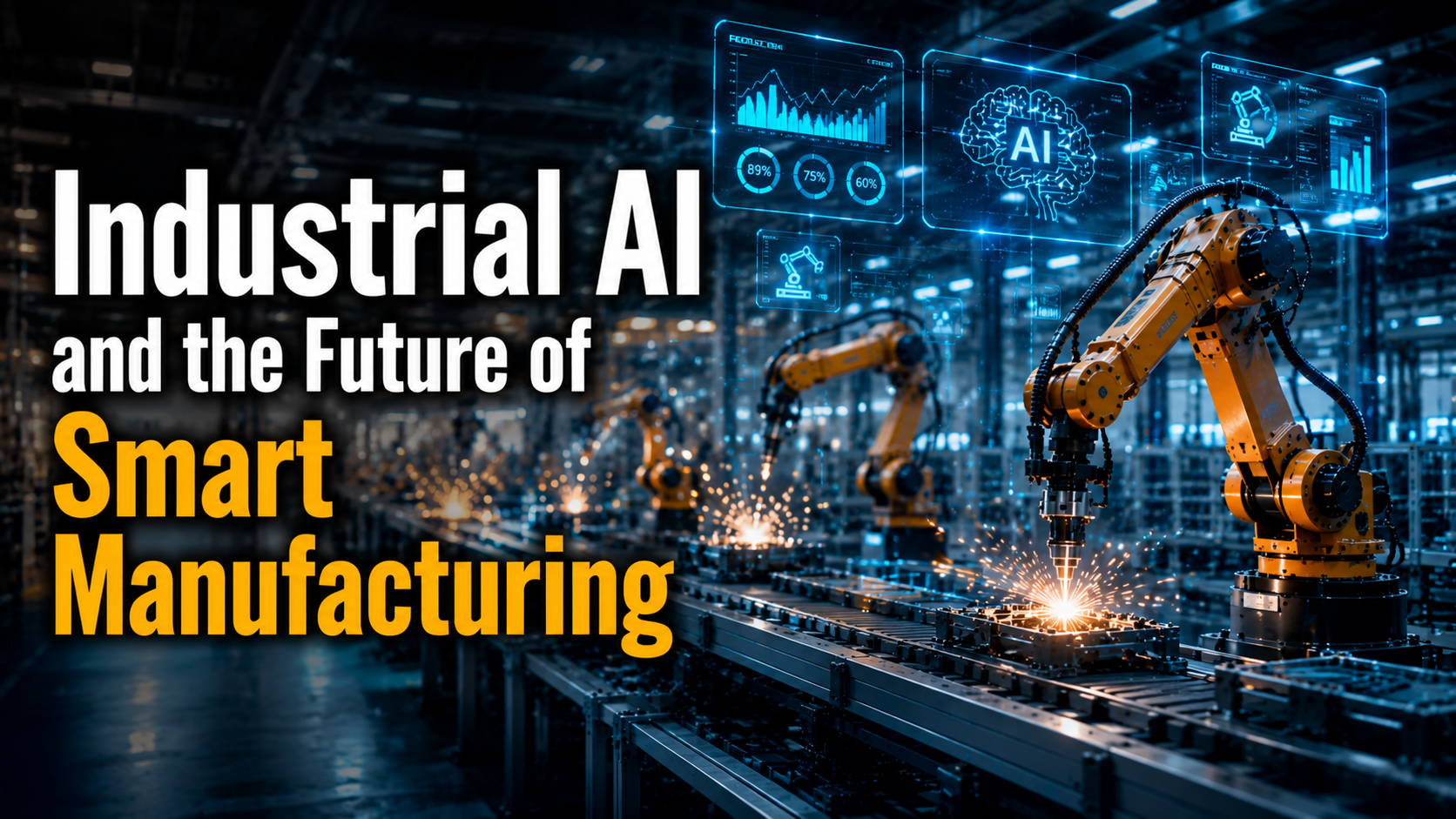
The manufacturing industry is entering one of the most significant transformations since the Industrial Revolution. While automation has improved production for decades, the latest wave of innovation is powered by Industrial Artificial Intelligence (Industrial AI), a technology capable of analyzing massive amounts of operational data, making intelligent decisions, predicting failures, optimizing production schedules, and continuously improving manufacturing efficiency. Industrial AI and the Future of Smart Manufacturing.
Today’s factories are becoming smarter, more connected, and increasingly autonomous. Machines no longer simply execute programmed instructions; they learn from data, identify patterns, detect anomalies, and even recommend improvements before problems occur.
From automotive assembly lines and semiconductor fabrication plants to pharmaceutical production and food processing facilities, Industrial AI is reshaping every aspect of manufacturing.
As businesses face increasing pressure to improve productivity, reduce operational costs, enhance product quality, and meet sustainability goals, Industrial AI has become one of the most valuable technologies driving the next generation of smart manufacturing.
This article explores how Industrial AI works, its core technologies, real-world applications, benefits, implementation challenges, and what the future holds for intelligent factories.
Table of Contents
What is Industrial AI?
Industrial AI refers to the application of Artificial Intelligence technologies within manufacturing and industrial environments.
Unlike traditional automation systems that follow fixed programming rules, Industrial AI continuously learns from production data and adapts to changing manufacturing conditions.
Industrial AI combines:
- Machine Learning
- Deep Learning
- Computer Vision
- Predictive Analytics
- Edge AI
- Robotics
- Industrial Internet of Things (IIoT)
- Digital Twins
- Natural Language Processing
Together, these technologies enable manufacturing systems to make intelligent decisions with minimal human intervention.
Evolution of Manufacturing
| Era | Major Technology | Key Feature |
|---|---|---|
| Industry 1.0 | Steam Power | Mechanization |
| Industry 2.0 | Electricity | Mass Production |
| Industry 3.0 | Computers & PLCs | Automation |
| Industry 4.0 | IoT + Cloud | Connected Factories |
| Industry 5.0 | AI + Human Collaboration | Intelligent Manufacturing |
Industrial AI serves as the intelligence layer that powers Industry 4.0 and Industry 5.0.
Why Industrial AI Matters
Manufacturers today generate enormous amounts of operational data.
This includes:
- Machine sensor data
- Production logs
- Quality inspection reports
- Energy consumption
- Supply chain information
- Inventory data
- Maintenance records
- Worker performance metrics
Traditionally, much of this information remained unused.
Industrial AI transforms this raw data into actionable insights that improve business outcomes.
Core Technologies Behind Industrial AI
1. Machine Learning
Machine learning identifies patterns from historical production data.
Applications include:
- Failure prediction
- Demand forecasting
- Process optimization
- Production planning
The more data available, the smarter these systems become.
2. Computer Vision
AI-powered cameras inspect products faster and more accurately than manual inspection.
Computer vision detects:
- Surface defects
- Assembly errors
- Incorrect packaging
- Missing components
- Dimensional inaccuracies
Manufacturers significantly reduce defective products using automated visual inspection.
3. Predictive Analytics
Traditional maintenance waits until equipment fails.
Industrial AI predicts failures weeks before they happen.
Benefits include:
- Reduced downtime
- Lower repair costs
- Increased equipment lifespan
- Improved operational reliability
4. Digital Twins
A digital twin is a virtual replica of a physical manufacturing asset.
It continuously receives live data from sensors.
Manufacturers can simulate:
- Equipment performance
- Process optimization
- Production changes
- Maintenance scenarios
Without interrupting actual production.
5. Industrial IoT (IIoT)
Smart sensors collect real-time operational data from:
- Motors
- Pumps
- Conveyor belts
- Robotic arms
- CNC machines
- Compressors
Industrial AI analyzes this information instantly.
6. Edge AI
Instead of sending all data to cloud servers, Edge AI processes information directly on factory equipment.
Advantages include:
- Lower latency
- Faster decisions
- Better privacy
- Reduced bandwidth costs
How Industrial AI Transforms Manufacturing
Predictive Maintenance
Unexpected equipment failures cost manufacturers billions every year.
Industrial AI analyzes:
- Temperature
- Pressure
- Vibration
- Noise
- Oil quality
- Electrical current
The system predicts when maintenance is required before breakdown occurs.
Result:
- Less downtime
- Higher production uptime
- Lower maintenance expenses
Intelligent Quality Control
Quality inspection has traditionally relied on human workers.
AI-powered cameras now inspect thousands of products every minute.
Benefits include:
- Higher inspection accuracy
- Consistent quality
- Faster production
- Reduced waste
Production Optimization
Industrial AI continuously monitors production lines.
It recommends:
- Better machine settings
- Improved production speed
- Material optimization
- Reduced bottlenecks
Factories achieve higher throughput without additional equipment.
Supply Chain Optimization
Manufacturing depends heavily on supply chains.
Industrial AI forecasts:
- Raw material demand
- Inventory shortages
- Transportation delays
- Supplier risks
Companies improve planning while reducing inventory costs.
Energy Management
Energy costs represent a major manufacturing expense.
AI identifies:
- Energy waste
- Peak usage periods
- Equipment inefficiencies
Factories reduce electricity consumption while lowering carbon emissions.
Industrial AI Applications Across Industries
| Industry | AI Application |
|---|---|
| Automotive | Robotic Assembly |
| Aerospace | Quality Inspection |
| Electronics | Semiconductor Manufacturing |
| Pharmaceuticals | Drug Production Monitoring |
| Food Processing | Packaging Inspection |
| Oil & Gas | Equipment Monitoring |
| Mining | Predictive Maintenance |
| Steel | Furnace Optimization |
| Chemicals | Process Automation |
| Textiles | Fabric Defect Detection |
Benefits of Industrial AI
Higher Productivity
AI reduces idle machine time while maximizing production efficiency.
Manufacturers produce more using existing infrastructure.
Lower Operating Costs
Industrial AI minimizes:
- Downtime
- Material waste
- Energy consumption
- Maintenance expenses
Resulting in significant cost savings.
Improved Product Quality
Continuous AI inspection reduces defects before products leave the factory.
Customers receive consistently higher-quality products.
Faster Decision Making
Managers gain real-time dashboards showing:
- Equipment health
- Production performance
- Inventory status
- Quality metrics
Decisions become data-driven instead of intuition-based.
Enhanced Worker Safety
Industrial AI monitors dangerous environments.
AI can detect:
- Gas leaks
- Equipment overheating
- Unsafe worker behavior
- Fire risks
Preventing workplace accidents.
Real-World Examples of Industrial AI
Several global manufacturers have already integrated Industrial AI into their production systems.
Automotive Manufacturing
AI-powered robots assemble vehicles with exceptional precision while computer vision systems inspect paint quality, welds, and component alignment.
Electronics Manufacturing
Industrial AI identifies microscopic defects in semiconductor chips that are nearly impossible for human inspectors to detect consistently.
Pharmaceutical Industry
AI continuously monitors production environments to ensure strict compliance with quality standards, reducing contamination risks and improving traceability.
Food Manufacturing
Computer vision systems inspect packaging, detect contamination, verify labels, and ensure products meet food safety requirements.
Industrial AI and Robotics
Modern industrial robots are becoming increasingly intelligent.
Instead of following fixed programming, AI enables robots to:
- Learn new tasks
- Adapt to changing environments
- Collaborate safely with humans
- Improve accuracy over time
Collaborative robots (Cobots) are especially useful for repetitive, precise, or ergonomically challenging tasks.
AI-Powered Smart Factories
A smart factory integrates every manufacturing component into one intelligent ecosystem.
Characteristics include:
- Connected machines
- Autonomous robots
- AI analytics
- Real-time monitoring
- Predictive maintenance
- Automated quality control
- Cloud connectivity
- Edge computing
Smart factories continuously optimize themselves using live operational data.
Challenges of Industrial AI Adoption
Despite its advantages, Industrial AI implementation presents several challenges.
High Initial Investment
Deploying sensors, AI platforms, and cloud infrastructure requires significant capital investment.
However, long-term operational savings often justify the expense.
Data Quality Issues
AI depends on accurate, high-quality data.
Poor sensor calibration or incomplete records can reduce model accuracy.
Cybersecurity Risks
Connected factories increase exposure to cyber threats.
Manufacturers must implement:
- Network segmentation
- Encryption
- Zero-trust security
- Continuous monitoring
Skills Gap
Industrial AI requires expertise in:
- Data Science
- Machine Learning
- Industrial Engineering
- Robotics
- Automation
- Cybersecurity
Organizations must invest in workforce upskilling.
Integration with Legacy Systems
Many factories still operate decades-old machinery.
Integrating AI with existing equipment requires careful planning and specialized interfaces.
Sustainability and Green Manufacturing
Industrial AI contributes significantly to environmental sustainability.
AI reduces:
- Energy consumption
- Material waste
- Carbon emissions
- Water usage
- Equipment failures
This helps organizations meet environmental, social, and governance (ESG) objectives while improving profitability.
Emerging Trends in Industrial AI
Several innovations are shaping the future of manufacturing.
Generative AI for Manufacturing
Generative AI assists engineers by creating optimized component designs, technical documentation, maintenance procedures, and production plans.
Autonomous Factories
Factories will increasingly operate with minimal human intervention while AI coordinates production, logistics, and maintenance.
AI-Powered Digital Twins
Future digital twins will simulate entire manufacturing ecosystems, allowing organizations to test improvements virtually before implementing them.
Human-AI Collaboration
Rather than replacing workers, Industrial AI will augment human capabilities by automating repetitive tasks and supporting complex decision-making.
Explainable AI
Manufacturers increasingly demand AI systems that clearly explain recommendations and decisions, particularly in safety-critical environments.
Best Practices for Implementing Industrial AI
Manufacturers should follow a structured implementation strategy:
- Define measurable business objectives.
- Start with pilot projects.
- Collect high-quality operational data.
- Invest in secure IIoT infrastructure.
- Train employees on AI technologies.
- Integrate AI gradually with existing systems.
- Continuously monitor and improve AI models.
A phased approach minimizes risk while delivering measurable business value.
The Future of Smart Manufacturing
Over the next decade, Industrial AI will become the foundation of nearly every modern manufacturing facility.
Future factories will feature:
- Fully autonomous production lines
- AI-driven logistics
- Self-healing equipment
- Predictive supply chains
- Hyper-personalized manufacturing
- Sustainable production systems
- Real-time global factory coordination
Manufacturers that embrace AI today will be better positioned to compete in an increasingly digital and data-driven global economy.
Conclusion
Industrial AI is no longer an emerging technology, it is becoming a strategic necessity for manufacturers seeking greater efficiency, resilience, and competitiveness.
By combining machine learning, computer vision, predictive analytics, robotics, digital twins, and Industrial IoT, organizations can optimize every stage of the manufacturing lifecycle. The result is higher productivity, lower costs, improved quality, enhanced worker safety, and more sustainable operations.
Although challenges such as implementation costs, cybersecurity, and workforce transformation remain, the long-term advantages far outweigh the initial barriers. Companies that invest thoughtfully in Industrial AI today are laying the foundation for agile, intelligent, and future-ready factories.
As Industry 4.0 evolves toward Industry 5.0, the partnership between human expertise and AI-driven intelligence will define the next era of manufacturing innovation.
Also Read: “Physical AI and the Future of Manufacturing“
Author
Frequently Asked Questions (FAQs)
1. What is Industrial AI?
Industrial AI is the application of artificial intelligence technologies such as machine learning, computer vision, predictive analytics, and robotics to improve manufacturing operations, automate processes, enhance quality, and optimize decision-making.
2. How does Industrial AI improve manufacturing?
Industrial AI improves manufacturing by predicting equipment failures, automating quality inspections, optimizing production schedules, reducing waste, lowering energy consumption, and increasing operational efficiency through data-driven insights.
3. What is the difference between Industrial AI and traditional automation?
Traditional automation follows predefined rules and fixed programming. Industrial AI learns from data, adapts to changing conditions, identifies patterns, and continuously improves its performance without requiring constant manual reprogramming.
4. What is the future of Industrial AI?
The future of Industrial AI includes autonomous factories, AI-powered digital twins, collaborative robots, generative AI-assisted engineering, predictive supply chains, and sustainable smart manufacturing ecosystems that combine human expertise with intelligent automation.