









How Artificial Intelligence Is Transforming Search, Content Discovery, and the Future of the Web
Introduction: The Biggest Shift Since the Birth of Search Engines
For more than two decades, search engines have served as the gateway to the internet. AI Search and the Future of the Open Internet.
Whenever people needed information, they opened a browser, typed a query into a search engine, and received a list of links. Users would then visit websites, compare sources, evaluate information, and discover content across the web.
This model shaped the modern internet.
It created opportunities for publishers, bloggers, businesses, educators, researchers, and creators to reach global audiences. Entire industries were built around search visibility, search engine optimization (SEO), digital advertising, and online publishing.
Today, however, a new technological transformation is underway.
Artificial Intelligence is changing the very nature of search.
Instead of presenting a list of links, AI-powered search systems increasingly provide direct answers, summaries, recommendations, and conversational responses.
Users are moving from “searching the web” to “asking AI.”
This shift may represent the most significant change to the internet since the rise of search engines themselves.
The implications extend far beyond technology.
They affect content creators, publishers, businesses, advertisers, consumers, educators, and the future structure of the open internet.
As AI search becomes mainstream, an important question emerges:
Can the open internet continue to thrive when intelligent systems become the primary gateway to information?
The answer will shape the future of the digital world.
Table of Contents
Understanding the Open Internet
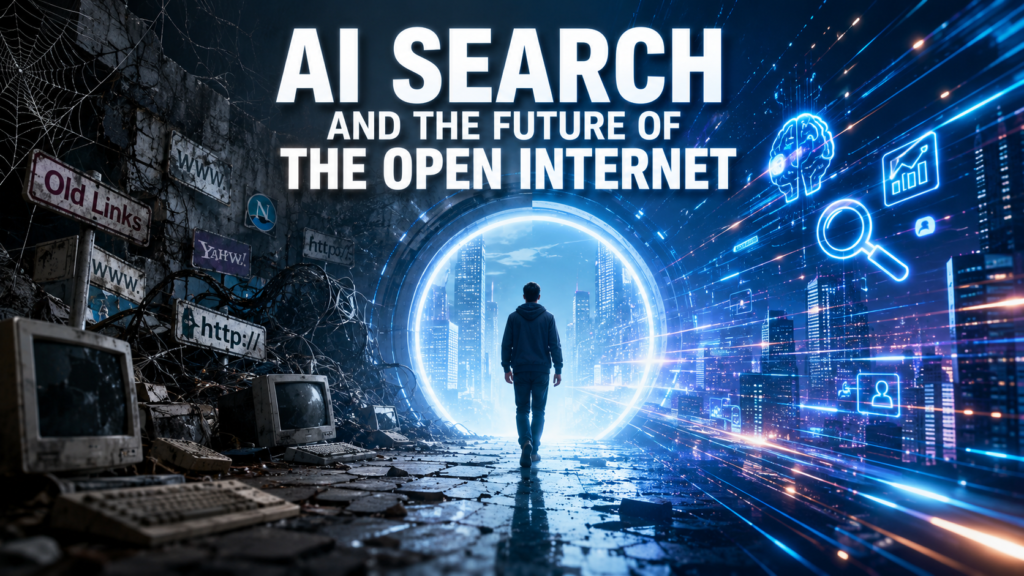
The open internet refers to a decentralized ecosystem where individuals and organizations can freely create, publish, access, and share information.
Key characteristics include:
- Open access to information
- Independent publishing
- Diverse viewpoints
- Competitive discovery
- Free exchange of ideas
- Innovation without gatekeepers
For decades, search engines helped users navigate this vast ecosystem.
Although search platforms influenced visibility, users still visited websites directly to consume content.
Traffic flowed from search engines to publishers.
This relationship formed the economic foundation of much of the modern web.
How Traditional Search Changed the Internet
The rise of search engines fundamentally transformed information discovery.
Before search engines became dominant, users relied on:
- Web directories
- Bookmarks
- Forums
- Recommendations
- Direct navigation
Search engines simplified access to information.
Instead of knowing where information existed, users only needed to know what they wanted.
This created enormous opportunities for website owners.
Businesses and publishers could attract audiences through:
- Quality content
- Search optimization
- Authority building
- Relevance
The result was an internet driven by discoverability.
The Emergence of AI Search
AI search introduces a fundamentally different experience.
Traditional search engines provide:
- Lists of links
- Rankings
- Website previews
AI-powered search systems provide:
- Direct answers
- Summaries
- Personalized explanations
- Conversational interactions
- Context-aware responses
Users increasingly receive information without needing to visit multiple websites.
The search experience becomes more efficient.
However, efficiency creates new challenges for the broader web ecosystem.
What Makes AI Search Different?
The difference between traditional search and AI search is significant.
| Traditional Search | AI Search |
|---|---|
| Returns links | Returns answers |
| User evaluates sources | AI synthesizes information |
| Multiple website visits | Fewer website visits |
| Keyword-driven | Conversational |
| Information retrieval | Information interpretation |
| Search-centric | Assistance-centric |
This shift changes how people interact with online information.
Instead of navigating the web, users increasingly interact with an AI intermediary.
Why Users Are Embracing AI Search
The rapid adoption of AI search is driven by convenience.
Users benefit from:
Faster Answers
Information is delivered immediately.
Reduced Research Time
AI summarizes multiple sources quickly.
Conversational Experience
Questions can be refined naturally.
Personalized Responses
Answers can adapt to user needs.
Improved Accessibility
Complex topics become easier to understand.
For users, AI search often feels more intuitive than traditional search.
This explains its growing popularity.
The Impact on Website Traffic
One of the biggest concerns surrounding AI search involves website traffic.
Historically, search engines sent visitors directly to websites.
Publishers earned value through:
- Advertising revenue
- Subscriptions
- Product sales
- Brand visibility
AI search may reduce direct visits by answering questions before users click.
This phenomenon is sometimes called:
“The Zero-Click Internet.”
If users receive complete answers without leaving the AI interface, many publishers could experience significant traffic declines.
This challenge raises important questions about sustainability.
The Publisher Dilemma
The open internet depends on content creators.
Journalists, bloggers, researchers, educators, and businesses invest time and resources to create valuable information.
AI systems often learn from publicly available content.
If AI search reduces publisher traffic, content creators may struggle to monetize their work.
This creates a potential imbalance.
| Content Creators Produce | AI Systems Consume |
|---|---|
| Articles | Training data |
| Research | Knowledge extraction |
| Reviews | Information synthesis |
| Analysis | Content summarization |
Without sustainable incentives, fewer organizations may invest in creating high-quality content.
This could weaken the information ecosystem over time.
Why Content Quality Matters More Than Ever
Ironically, AI search increases the importance of high-quality content.
AI systems depend on:
- Accurate information
- Expert insights
- Original reporting
- Trusted sources
Poor-quality content reduces answer quality.
Therefore, the future internet may place greater value on:
Expertise
Content created by knowledgeable professionals.
Authority
Trusted and recognized sources.
Experience
First-hand perspectives and real-world insights.
Originality
Unique information unavailable elsewhere.
These principles align closely with Google’s EEAT framework:
- Experience
- Expertise
- Authoritativeness
- Trustworthiness
The Future of SEO in an AI Search Era
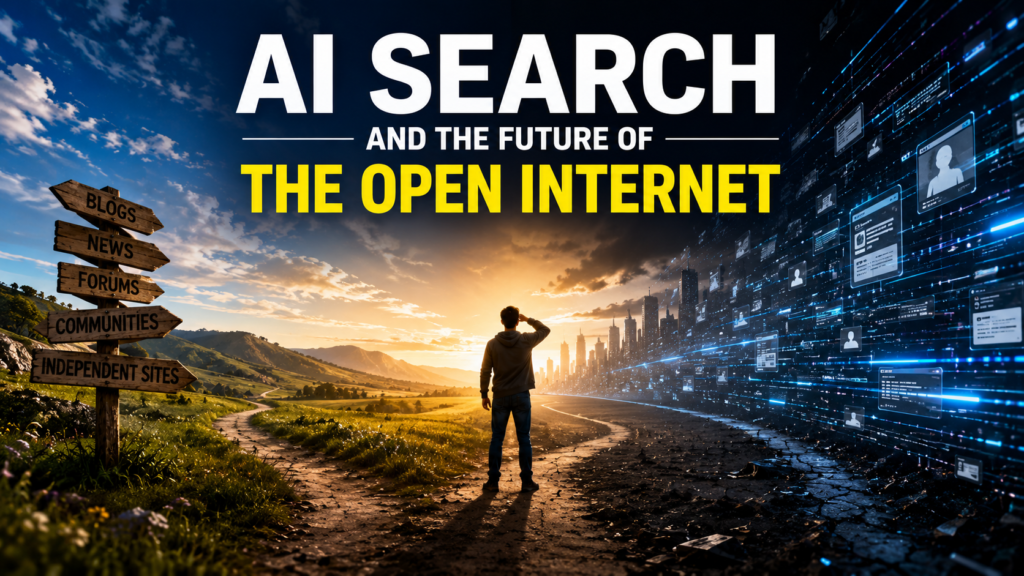
Search Engine Optimization is evolving rapidly.
Traditional SEO focused heavily on:
- Keywords
- Backlinks
- Technical optimization
- Search rankings
AI search introduces new priorities.
Future SEO may focus on:
Entity Authority
Building expertise around topics.
Content Depth
Providing comprehensive information.
Brand Trust
Establishing credibility.
Structured Information
Making content easier for AI systems to understand.
User Intent
Answering questions thoroughly and accurately.
The goal shifts from ranking pages to becoming a trusted source for AI-generated answers.
The Rise of AI-Native Discovery
Search is no longer the only discovery mechanism.
AI systems increasingly recommend:
- Products
- Services
- Educational resources
- News
- Tools
- Businesses
This creates a new visibility challenge.
Organizations must optimize not only for search engines but also for AI recommendation systems.
Being discoverable in AI-generated responses may become as important as traditional rankings.
The Risk of Centralized Knowledge
The open internet thrives because it offers diverse viewpoints.
AI search introduces concerns about centralization.
When users receive answers from a small number of AI platforms, several risks emerge:
Reduced Diversity
Fewer perspectives may be surfaced.
Algorithmic Bias
AI outputs may reflect underlying biases.
Information Gatekeeping
Platforms gain influence over knowledge access.
Reduced Transparency
Users may not always know how answers are generated.
Maintaining openness requires transparency and accountability.
Trust Becomes the New Currency
In an AI-first internet, trust becomes increasingly valuable.
Users need confidence that information is:
- Accurate
- Reliable
- Current
- Fair
- Transparent
Organizations that consistently demonstrate trustworthiness may gain significant advantages.
Future digital success may depend less on visibility and more on credibility.
The Economic Future of the Open Web
A major challenge facing AI search involves economics.
The internet functions because content creators receive value from audiences.
Possible future models include:
| Potential Model | Description |
|---|---|
| Attribution Systems | AI cites content creators |
| Revenue Sharing | Publishers receive compensation |
| Licensing Agreements | Content usage partnerships |
| Subscription Ecosystems | Premium information access |
| Hybrid Search Models | AI answers plus website traffic |
Sustainable solutions are essential for preserving content creation incentives.
How Businesses Must Adapt
Organizations should prepare for AI-driven discovery.
Key strategies include:
Build Strong Brands
Brand recognition improves trust.
Create Original Content
Unique insights remain valuable.
Demonstrate Expertise
Authority matters more than ever.
Focus on EEAT
Trust signals become increasingly important.
Optimize for Conversations
Content should answer questions naturally.
Businesses that adapt early may gain significant advantages.
The Future Relationship Between AI and the Open Internet
The future is unlikely to involve AI replacing the internet.
Instead, AI and the web will become increasingly interconnected.
The internet remains the source.
AI becomes the interpreter.
Content creators remain essential because intelligent systems require fresh, reliable information.
The challenge is creating an ecosystem where:
- Users receive better experiences
- Publishers remain sustainable
- Innovation continues
- Knowledge remains open
Achieving this balance will shape the next generation of the internet.
What the Next Decade May Look Like
Over the next ten years, several trends are likely to emerge:
Conversational Search Dominance
Natural language interactions become standard.
AI-Powered Research Assistants
Complex information gathering becomes easier.
Greater Content Attribution
Publishers demand recognition and compensation.
Hyper-Personalized Discovery
Information adapts to individual needs.
New Web Business Models
Economic structures evolve alongside AI.
The internet will continue changing, but openness and accessibility must remain priorities.
Conclusion
AI search is transforming how people access information, discover content, and interact with the digital world. By providing direct answers, personalized assistance, and conversational experiences, artificial intelligence is making information more accessible than ever before.
At the same time, this transformation raises important questions about website traffic, publisher sustainability, information diversity, transparency, and the future economics of the open internet.
The internet’s success has always depended on a healthy relationship between creators and consumers. As AI becomes the primary gateway to information, maintaining that balance becomes increasingly important.
The future of the web should not be a choice between AI and the open internet.
It should be a partnership.
AI can help people navigate information more effectively, while the open internet continues to provide the knowledge, creativity, expertise, and innovation that make intelligent systems useful in the first place.
The future belongs to an internet that remains open, trustworthy, diverse, and sustainable, even as AI reshapes how the world discovers information.
Also Read: “Humanoid Robots and the Future of Manufacturing“
Author
Frequently Asked Questions (FAQs)
1. What is AI search?
AI search uses artificial intelligence to provide direct answers, summaries, and conversational responses instead of simply displaying a list of website links.
2. How does AI search affect website traffic?
AI search can reduce website visits by answering user questions directly within the search interface, creating concerns about traffic and revenue for publishers.
3. Will AI replace traditional search engines?
Traditional search engines are likely to evolve rather than disappear. Many platforms are integrating AI features alongside conventional search results.