



Introduction: A New Economic Era Is Taking Shape
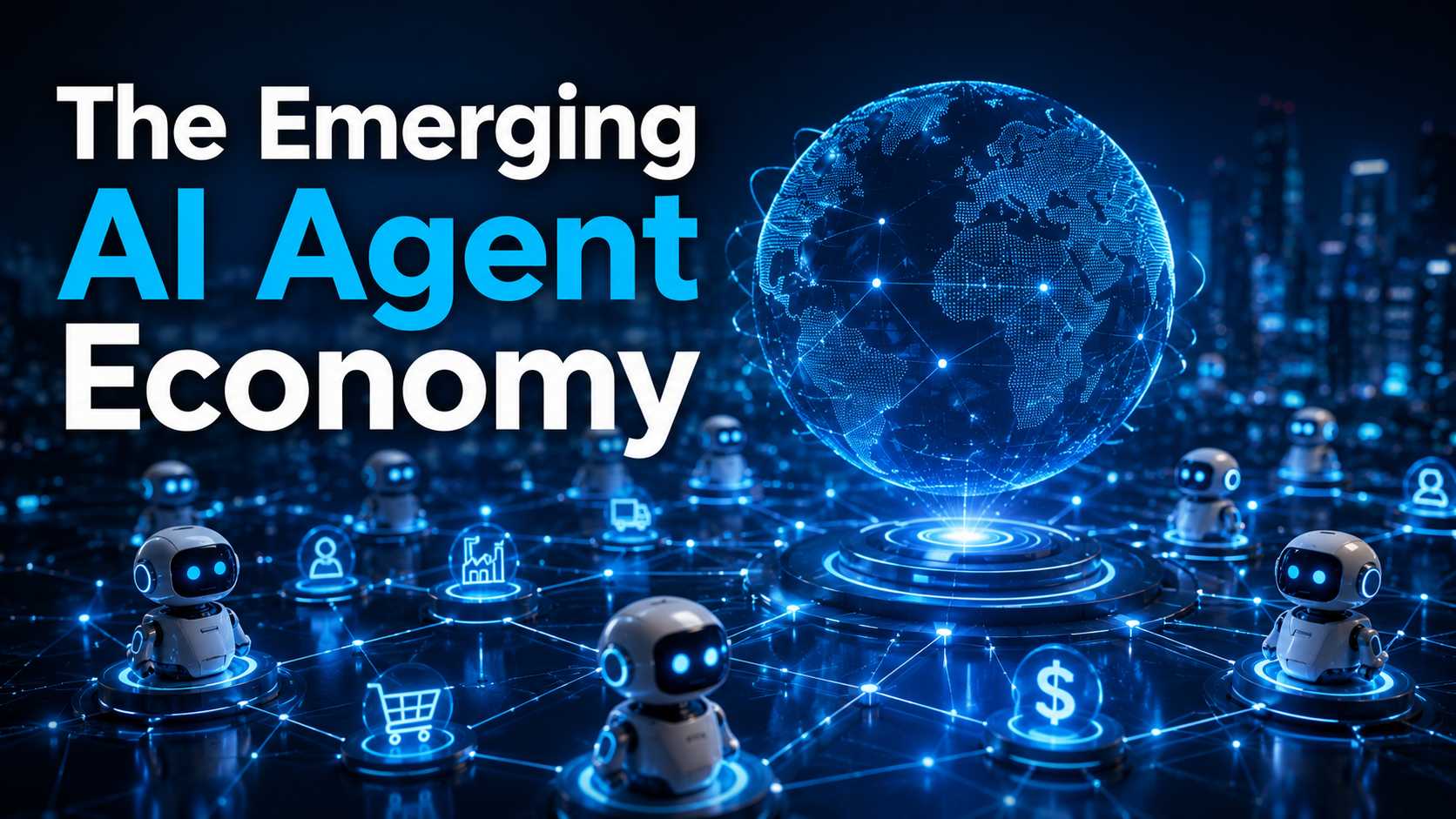
Throughout history, major technological breakthroughs have created entirely new economic systems. The Emerging AI Agent Economy.
The steam engine fueled the Industrial Revolution. Computers powered the Information Age. The internet enabled the Digital Economy. Cloud computing transformed how businesses operate globally.
Today, another shift is unfolding.
Artificial Intelligence is evolving beyond simple automation and content generation. A new class of intelligent systems known as AI agents is emerging, capable of performing tasks, making decisions, coordinating workflows, and pursuing goals with minimal human intervention.
These developments are laying the foundation for what many experts call the AI Agent Economy.
In this new economy, value is increasingly generated not only by humans and traditional software but also by autonomous digital workers capable of executing complex tasks at scale.
Businesses are beginning to deploy AI agents for customer service, marketing, software development, research, finance, operations, and countless other functions. Entrepreneurs are building AI-native startups. Enterprises are redesigning workflows around intelligent automation.
The implications extend far beyond technology.
The AI Agent Economy could reshape labor markets, productivity, entrepreneurship, business models, and the future of work itself.
Understanding this transformation is essential for business leaders, professionals, investors, and organizations seeking to remain competitive in a rapidly changing world.
Table of Contents
What Is the AI Agent Economy?
The AI Agent Economy refers to an emerging economic ecosystem where autonomous AI agents actively participate in creating, delivering, and optimizing value.
Unlike traditional software applications that require direct human control, AI agents can:
- Understand objectives
- Plan actions
- Execute tasks
- Monitor outcomes
- Adapt strategies
- Collaborate with humans and other agents
These capabilities enable agents to function as productive digital workers.
In practical terms, the AI Agent Economy involves:
- AI-powered businesses
- Autonomous digital workflows
- Intelligent service delivery
- Agent-to-agent interactions
- AI-driven marketplaces
The shift is comparable to how the internet transformed commerce and communication.
The Evolution Toward Autonomous Intelligence
The rise of the AI Agent Economy did not happen overnight.
Artificial Intelligence has evolved through several distinct stages.
| AI Evolution Stage | Primary Capability |
|---|---|
| Rule-Based Systems | Following predefined instructions |
| Machine Learning | Pattern recognition |
| Deep Learning | Advanced prediction and classification |
| Generative AI | Content creation and conversation |
| AI Agents | Goal-oriented task execution |
| Multi-Agent Systems | Collaborative autonomous work |
Each stage increased the ability of machines to perform increasingly sophisticated tasks.
AI agents represent a major leap because they combine reasoning, planning, memory, and action.
They do not merely generate information.
They generate outcomes.
Why the AI Agent Economy Matters
The significance of the AI Agent Economy extends beyond technology.
It addresses one of the most important challenges facing modern organizations:
The growing complexity of work.
Businesses today must manage enormous amounts of information, communication, and operational activity.
Human teams often struggle to keep pace.
AI agents help solve this challenge by acting as scalable digital labor.
This creates opportunities for:
- Greater productivity
- Faster execution
- Lower operational costs
- Improved customer experiences
- Enhanced decision-making
Organizations that successfully integrate AI agents may gain substantial competitive advantages.
The Difference Between Traditional Automation and AI Agents
Many people assume AI agents are simply advanced automation tools.
However, there is a significant distinction.
| Traditional Automation | AI Agents |
|---|---|
| Rule-based | Goal-based |
| Fixed workflows | Adaptive workflows |
| Limited flexibility | Dynamic decision-making |
| Requires extensive programming | Operates through natural language instructions |
| Task automation | Process automation |
Traditional automation follows predefined rules.
AI agents can reason through unfamiliar situations and adjust their behavior accordingly.
This flexibility dramatically expands their economic value.
The Rise of Digital Workers
One of the defining characteristics of the AI Agent Economy is the emergence of digital workers.
Digital workers are AI agents capable of performing operational tasks that were previously handled by humans.
Examples include:
Customer Service Agents
Managing support requests around the clock.
Research Agents
Gathering and synthesizing information.
Marketing Agents
Creating campaigns and analyzing performance.
Sales Agents
Identifying prospects and managing outreach.
Finance Agents
Generating reports and monitoring compliance.
These digital workers operate continuously, scale easily, and can often complete tasks in seconds that might take humans hours.
The Economic Drivers Behind the AI Agent Economy
Several forces are accelerating adoption.
Labor Shortages
Many industries face talent shortages and increasing labor costs.
AI agents provide scalable support.
Productivity Pressure
Organizations seek greater efficiency and faster execution.
Data Explosion
Businesses generate more information than humans can process effectively.
Competitive Advantage
Early adopters gain operational and strategic benefits.
Advances in AI Technology
Recent breakthroughs have dramatically improved agent capabilities.
Together, these factors are driving rapid investment in agent-based systems
How Businesses Are Adopting AI Agents
Organizations are integrating AI agents across multiple functions.
Customer Support
AI agents can handle inquiries, resolve issues, and escalate complex cases.
Marketing Operations
Agents conduct research, generate content, and optimize campaigns.
Human Resources
Applications include recruitment support, onboarding, and employee assistance.
Operations Management
Agents monitor workflows and coordinate processes.
Software Development
Developers increasingly use AI agents for coding, testing, and documentation.
The scope of adoption continues to expand.
AI-Native Businesses and New Market Opportunities
Some organizations are going beyond AI adoption.
They are becoming AI-native businesses.
These companies are designed around autonomous intelligence from the beginning.
Characteristics include:
- AI-first operations
- Minimal administrative overhead
- Intelligent workflows
- Digital workforces
- Highly scalable business models
AI-native startups can often achieve levels of efficiency previously available only to much larger organizations.
The Emergence of Agent-to-Agent Commerce
One of the most fascinating developments in the AI Agent Economy is agent-to-agent interaction.
Future economic activity may involve AI agents communicating directly with one another.
Examples include:
- Procurement agents negotiating purchases
- Travel agents booking services automatically
- Financial agents executing transactions
- Customer service agents coordinating solutions
This could create entirely new forms of digital commerce.
The Role of Multi-Agent Systems
The future may not involve isolated agents.
Instead, organizations may deploy teams of specialized agents.
A multi-agent system might include:
| Agent Type | Responsibility |
|---|---|
| Research Agent | Information gathering |
| Analytics Agent | Data interpretation |
| Marketing Agent | Campaign execution |
| Sales Agent | Lead generation |
| Operations Agent | Workflow management |
Together, these agents function as a coordinated digital workforce.
The Impact on Entrepreneurship
The AI Agent Economy is lowering barriers to entrepreneurship.
Historically, building a company required:
- Large teams
- Significant capital
- Extensive operational resources
AI agents reduce many of these requirements.
Entrepreneurs can now leverage:
- AI researchers
- AI marketers
- AI analysts
- AI developers
- AI customer support systems
This enables smaller teams to achieve larger outcomes.
How the AI Agent Economy Will Affect Jobs
Questions about employment are inevitable.
The reality is nuanced.
AI agents will automate many repetitive and routine tasks.
However, they are also creating demand for new skills.
Human strengths become increasingly valuable:
Creativity
Developing novel ideas and solutions.
Strategic Thinking
Making high-level decisions.
Leadership
Guiding organizations through change.
Emotional Intelligence
Managing relationships and collaboration.
Ethical Judgment
Ensuring responsible AI deployment.
The future workforce will likely consist of humans and AI agents working together.
Challenges Facing the AI Agent Economy
Despite enormous potential, challenges remain.
Trust and Reliability
Organizations need confidence in agent outputs.
Security
Autonomous actions create new risks.
Privacy
Sensitive data must be protected.
Governance
Clear accountability frameworks are necessary.
Regulation
Governments are developing AI-related policies.
Addressing these challenges will be essential for long-term growth.
Why Trust Will Become a Competitive Advantage
Trust is emerging as a critical differentiator.
Organizations deploying AI agents must demonstrate:
- Transparency
- Reliability
- Accountability
- Security
- Ethical practices
Businesses that earn trust may gain substantial advantages in the AI Agent Economy.
Industries Most Likely to Be Transformed
Several sectors are particularly well-positioned.
Technology
Software development and IT operations.
Financial Services
Risk management and compliance automation.
Healthcare
Administrative efficiency and workflow coordination.
Marketing
Content generation and campaign optimization.
Customer Service
Autonomous support systems.
Education
Personalized learning assistance.
Virtually every knowledge-intensive industry can benefit.
The Future of the AI Agent Economy
Over the next decade, the AI Agent Economy may evolve dramatically.
Potential developments include:
Autonomous Enterprises
Organizations powered largely by intelligent systems.
Agent Marketplaces
Platforms where specialized agents provide services.
AI Workforce Management
Systems coordinating digital employees.
Personalized Agent Assistants
Individual AI companions for work and life.
Global Agent Networks
Interconnected ecosystems of autonomous systems.
These developments could reshape how economic value is created and exchanged.
How Businesses Can Prepare Today
Organizations seeking to participate in the AI Agent Economy should begin now.
Invest in AI Literacy
Build understanding across teams.
Identify Automation Opportunities
Focus on high-impact workflows.
Improve Data Infrastructure
Quality data drives better outcomes.
Establish Governance Frameworks
Ensure responsible deployment.
Develop Human Skills
Strengthen creativity, leadership, and critical thinking.
Preparation today creates long-term advantages.
Conclusion
The Emerging AI Agent Economy represents one of the most important technological and economic transformations of the twenty-first century. Autonomous AI agents are evolving from experimental tools into productive digital workers capable of generating value across industries, functions, and markets.
As businesses integrate intelligent systems into their operations, entirely new opportunities are emerging for productivity, entrepreneurship, innovation, and economic growth.
At the same time, challenges involving trust, governance, security, and workforce adaptation must be addressed thoughtfully.
The organizations that succeed will be those that combine human ingenuity with autonomous intelligence.
The AI Agent Economy is not simply a future possibility.
It is already beginning to take shape.
And its influence on business, work, and society is likely to grow significantly in the years ahead.
Also Read: “The Next Phase of Digital Transformation“
Frequently Asked Questions (FAQs)
1. What is the AI Agent Economy?
The AI Agent Economy refers to an emerging economic ecosystem where autonomous AI agents perform tasks, create value, automate workflows, and participate in business operations alongside humans.
2. How are AI agents different from traditional software?
Traditional software requires direct user input and follows predefined instructions. AI agents can independently plan, adapt, execute tasks, and pursue goals with minimal supervision.
3. Which industries will benefit most from the AI Agent Economy?
Technology, healthcare, finance, marketing, education, customer service, and professional services are among the industries expected to experience significant transformation.

Great content! Keep up the good work!