



How AI Is Reshaping Search, Digital Advertising, Content Discovery, and the Future of Online Business
Introduction: Search Is Entering a New Economic Era
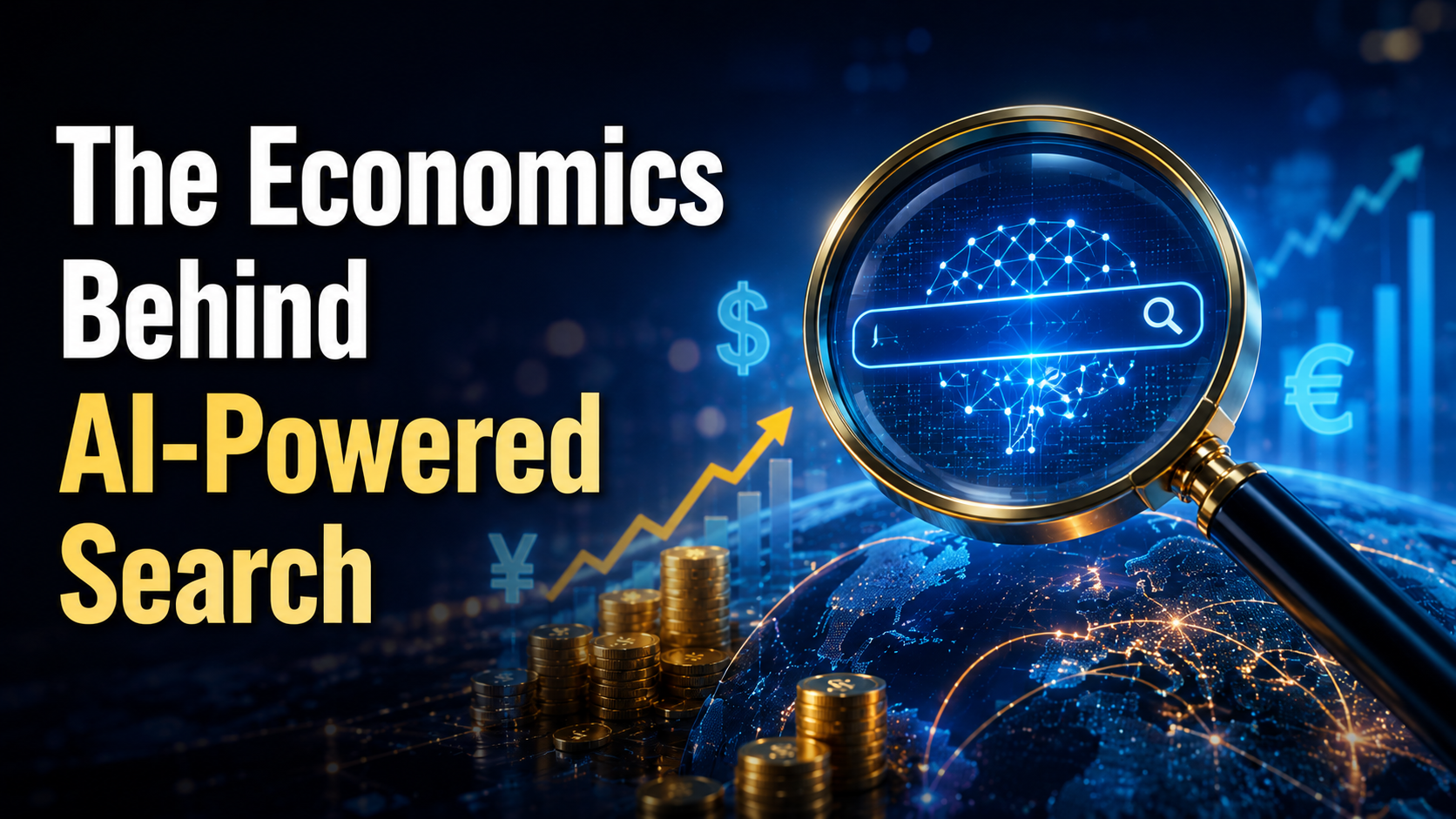
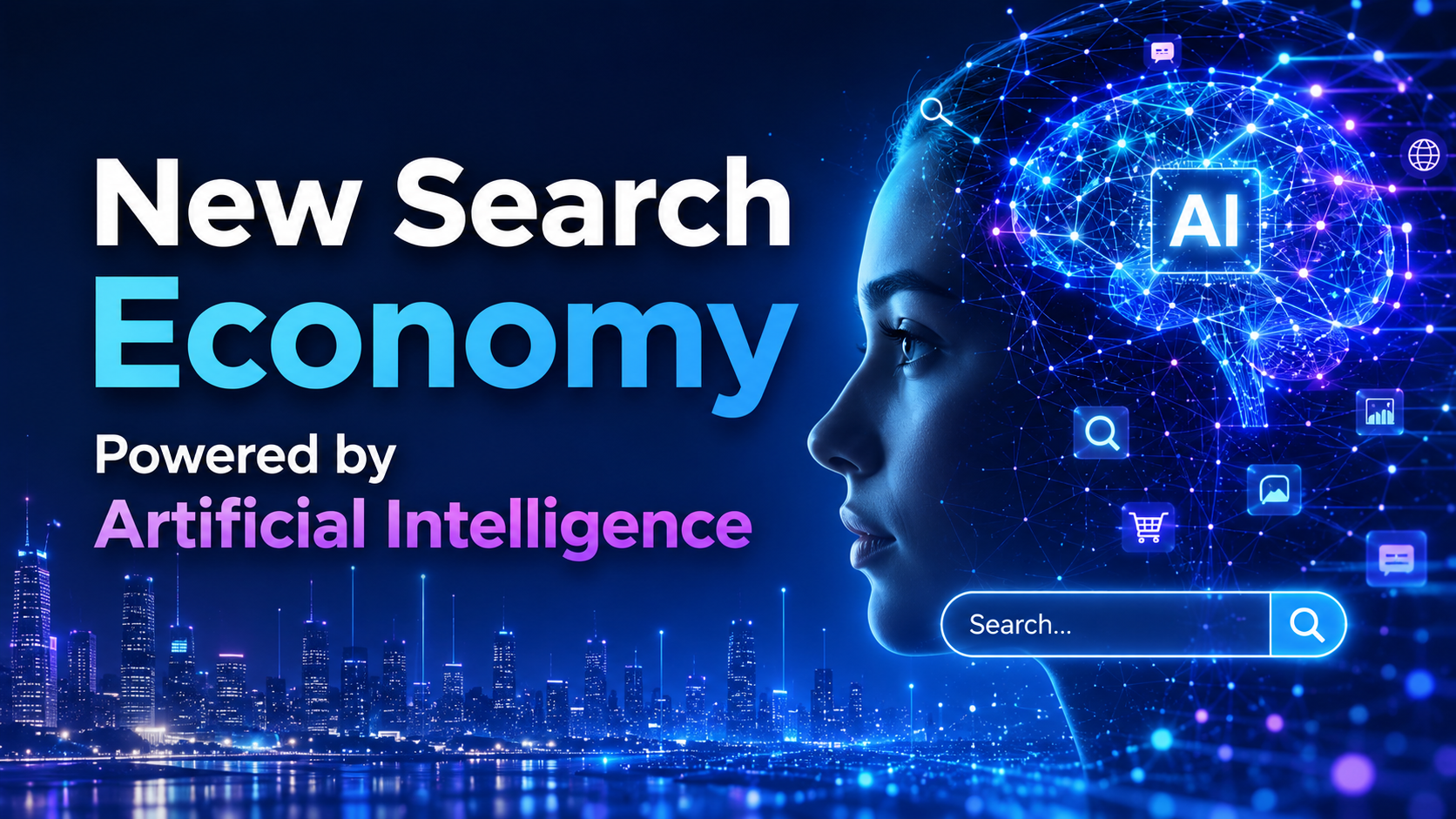
For more than two decades, search engines have been the backbone of the digital economy. The New Search Economy Powered by AI.
They connected people with information, businesses with customers, and advertisers with potential buyers. Search became one of the most successful business models in modern history because it aligned user intent with commercial opportunity.
Whenever someone searched for a product, service, solution, or answer, search engines created value by organizing information and monetizing attention through advertising.
This model transformed the internet.
Entire industries emerged around search engine optimization (SEO), content marketing, pay-per-click advertising, affiliate marketing, and digital publishing.
Today, however, search is undergoing its most significant transformation since its inception.
Artificial Intelligence is fundamentally changing how people find information online.
Instead of displaying a list of links, AI-powered search systems increasingly provide direct answers, personalized recommendations, summaries, and conversational experiences.
This evolution is not simply changing search technology.
It is creating an entirely new search economy.
The shift affects businesses, publishers, advertisers, marketers, creators, and consumers alike. New winners are emerging, traditional models are being challenged, and digital visibility is being redefined.
Understanding the new search economy powered by Artificial Intelligence is becoming essential for anyone who depends on online discoverability.
The future of search will belong not only to those who master technology but also to those who understand the economic forces shaping AI-driven information ecosystems.
Table of Contents
What Is the New Search Economy?
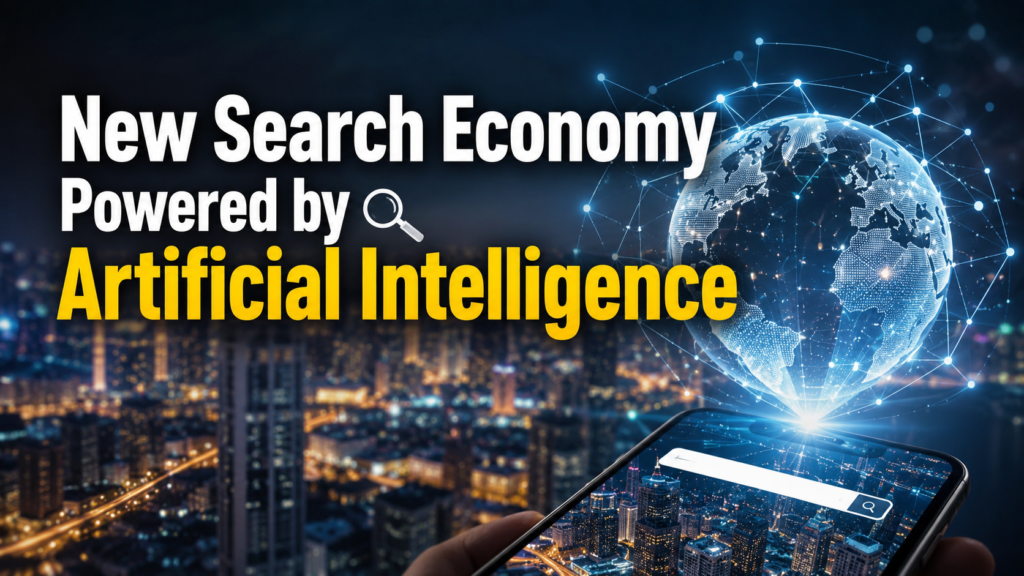
The new search economy refers to the emerging economic system created by AI-powered search experiences.
Traditional search economies were built around:
- Search queries
- Search results pages
- Website clicks
- Advertising impressions
- User traffic
AI-powered search introduces a different model.
Increasingly, users receive:
- Direct answers
- Conversational guidance
- Personalized recommendations
- Content summaries
- Automated decision support
As search evolves from information retrieval to intelligent assistance, the economic relationships between platforms, businesses, publishers, and users also evolve.
This creates a new digital marketplace where visibility, trust, authority, and AI relevance become increasingly valuable assets.
How Traditional Search Built a Digital Empire
The traditional search economy was remarkably efficient.
The process worked like this:
- Users searched for information.
- Search engines displayed results.
- Advertisers competed for visibility.
- Websites earned traffic.
- Platforms generated revenue.
The model succeeded because search queries often reveal intent.
For example:
- “Best smartphone under $500”
- “Hotels in Dubai”
- “Affordable health insurance”
- “Running shoes for beginners”
These searches indicate potential purchasing behavior.
Advertisers willingly paid to appear in front of motivated users.
This created one of the most profitable digital business models ever developed.
Why Artificial Intelligence Is Disrupting Search
AI changes the role of search engines.
Historically, search platforms helped users find information.
Today, AI systems increasingly help users understand information.
This distinction is crucial.
Traditional search:
- Retrieves information
- Displays links
- Requires user evaluation
AI-powered search:
- Interprets intent
- Synthesizes information
- Generates responses
- Provides recommendations
The result is a dramatically different user experience.
Users spend less time searching and more time receiving actionable answers.
The Rise of Generative Search
Generative search represents one of the most significant developments in the modern internet economy.
Unlike traditional search engines, generative systems can:
- Summarize complex topics
- Compare products
- Explain concepts
- Generate recommendations
- Personalize responses
Users increasingly interact with search systems as if they were advisors rather than directories.
This changes how value is created and distributed online.
Traditional Search vs AI Search
| Traditional Search | AI-Powered Search |
|---|---|
| Link-based | Answer-based |
| Click-driven | Conversation-driven |
| Ranking-focused | Authority-focused |
| User navigates websites | AI synthesizes information |
| Traffic-centric | Recommendation-centric |
| Search engine acts as gateway | AI acts as intermediary |
This transition is rewriting the economics of visibility.
The New Currency of Visibility
In traditional search, rankings were the primary currency.
Higher rankings generally meant:
- More traffic
- More leads
- More revenue
In the AI era, visibility increasingly depends on:
Authority
Trusted sources receive greater attention.
Expertise
Subject matter expertise influences recommendations.
Trust
Reliable information becomes more valuable.
Brand Recognition
Strong brands often receive preferential attention.
Original Insights
Unique knowledge attracts citations.
The future economy rewards authority as much as optimization.
The Economics of AI-Powered Answers
Generating AI-powered answers is significantly more expensive than displaying traditional search results.
AI systems require:
- Advanced computing infrastructure
- High-performance processors
- Large-scale data centers
- Continuous model training
- Significant energy consumption
This creates new economic challenges.
Traditional search scaled efficiently because displaying links was relatively inexpensive.
Generating intelligent responses requires substantially more resources.
As a result, AI companies must develop sustainable monetization strategies.
Emerging Revenue Models in AI Search
The new search economy is giving rise to multiple revenue models.
AI Advertising
Sponsored recommendations integrated into conversations.
Premium Subscriptions
Advanced AI capabilities offered through paid plans.
Commerce Integration
AI-assisted purchasing experiences.
Affiliate Partnerships
Revenue generated through product recommendations.
Content Licensing
Compensation for publishers whose content supports AI systems.
The future search economy will likely involve a combination of these models.
The Publisher Traffic Challenge
Publishers are among the groups most affected by AI-powered search.
Historically, publishers relied on:
- Organic traffic
- Search referrals
- Advertising revenue
- Subscriber growth
AI-generated answers can reduce the need for users to visit source websites.
This creates a major economic challenge.
Publishers continue producing valuable content, but users may increasingly consume information directly through AI interfaces.
The industry is actively exploring solutions to maintain a sustainable content ecosystem.
Why Authority Is Becoming the New SEO
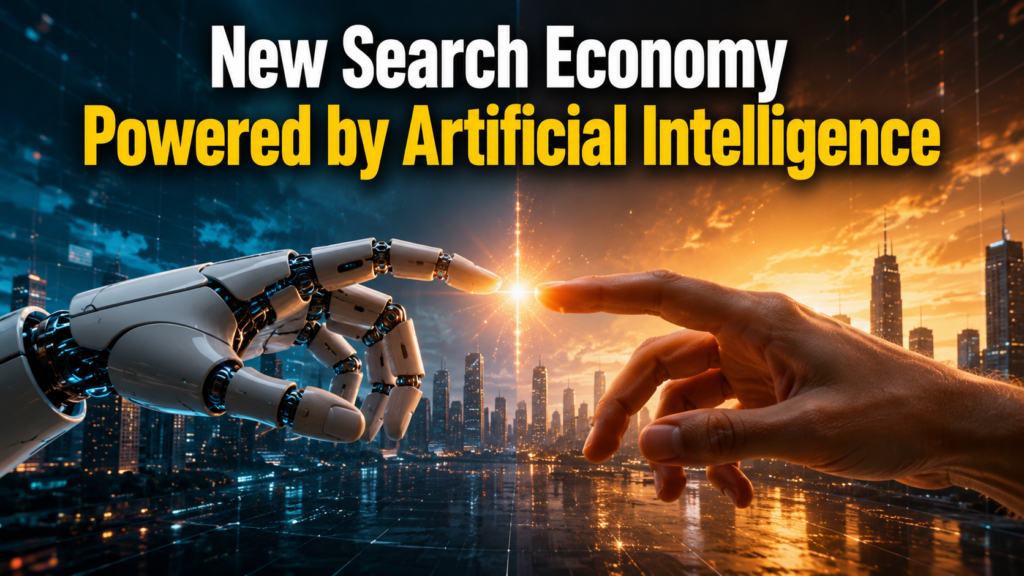
Search Engine Optimization is evolving.
Traditional SEO focused on:
- Keywords
- Backlinks
- Technical optimization
- Search rankings
AI-first visibility increasingly depends on authority.
Organizations must demonstrate:
- Expertise
- Credibility
- Trustworthiness
- Experience
- Original knowledge
This shift aligns closely with Google’s EEAT framework.
The future of SEO may be less about ranking and more about becoming a trusted source.
The Growing Importance of Google’s EEAT Principles
EEAT stands for:
Experience
Real-world involvement and practical knowledge.
Expertise
Deep subject matter understanding.
Authoritativeness
Recognition within an industry.
Trustworthiness
Accuracy, transparency, and reliability.
AI systems increasingly prioritize sources that exhibit these qualities.
As AI-generated answers become more influential, EEAT becomes a critical component of digital visibility.
How Businesses Must Adapt
Businesses operating in the new search economy should focus on several key priorities.
Build Topical Authority
Become a recognized expert in specific subject areas.
Create Original Research
Unique insights are difficult to replicate.
Strengthen Brand Recognition
Trustworthy brands gain visibility advantages.
Focus on User Value
Help users solve real problems.
Optimize for AI Discovery
Structure content for both humans and AI systems.
Adaptability is becoming a competitive advantage.
The Rise of Answer Engine Optimization (AEO)
A new discipline is emerging alongside traditional SEO.
Answer Engine Optimization (AEO) focuses on helping content appear within AI-generated responses.
Key principles include:
- Clear content structure
- Comprehensive topic coverage
- Direct question answering
- Trustworthy sourcing
- Topic authority
AEO may become one of the most important digital marketing disciplines of the next decade.
How AI Is Transforming Digital Advertising
Advertising remains central to the search economy.
However, AI is changing how advertising works.
Future advertising may include:
Conversational Advertising
Sponsored recommendations within AI interactions.
Personalized Promotions
Offers tailored to individual users.
Predictive Commerce
AI anticipating user needs.
Contextual Recommendations
Products suggested based on conversation context.
Advertising becomes more integrated and less disruptive.
Why Trust Has Become an Economic Asset
In the AI era, trust is more than a reputation metric.
It is an economic asset.
Trusted organizations benefit from:
- Greater visibility
- Stronger recommendations
- Higher conversion rates
- Better user engagement
Trust influences both human decisions and AI evaluations.
As misinformation concerns grow, trusted sources become increasingly valuable.
The Future of Content Discovery
Content discovery is evolving rapidly.
Users increasingly rely on:
- AI assistants
- Recommendation engines
- Personalized feeds
- Generative search experiences
Discovery is shifting from active searching to intelligent recommendation.
Content increasingly finds users rather than users finding content.
This changes how businesses approach marketing and visibility.
Winners and Losers in the New Search Economy
Every technological shift creates opportunities and challenges.
Potential Winners
- Trusted brands
- Expert creators
- AI platform providers
- Original content publishers
- Specialized businesses
Potential Challenges
- Low-quality content producers
- Traffic-dependent websites
- Generic affiliate platforms
- Businesses relying solely on rankings
Success increasingly depends on differentiation and trust.
The Future of Search
The next decade may bring:
Conversational Search
Natural language interactions become standard.
Autonomous AI Agents
AI systems perform research and tasks independently.
Hyper-Personalization
Experiences tailored to individual users.
Multimodal Discovery
Voice, text, image, and video converge.
AI-Curated Knowledge Ecosystems
Information becomes increasingly organized through intelligent systems.
Search is evolving into a personalized knowledge layer for the internet.
Conclusion
The new search economy powered by Artificial Intelligence represents one of the most significant transformations in the history of the digital world. Search is no longer simply about finding information. It is increasingly about generating answers, guiding decisions, and delivering personalized experiences.
This shift is reshaping how businesses compete, how publishers earn revenue, how marketers build visibility, and how consumers interact with information.
In the emerging AI-driven economy, authority, trust, expertise, and original knowledge are becoming the new foundations of digital success.
Organizations that adapt to these changes will be better positioned to thrive in an increasingly intelligent internet.
The future of search is not merely technological.
It is economic.
And the businesses that understand this new economy today will help define the digital landscape of tomorrow.
Also Read: “How Technology Is Redefining Human Potential“
Frequently Asked Questions (FAQs)
1. What is the new search economy?
The new search economy refers to the AI-driven ecosystem where search platforms provide answers, recommendations, and personalized guidance rather than simply displaying links, creating new business models and visibility strategies.
2. How is AI changing traditional search?
AI is transforming search from a link-based retrieval system into an answer-driven experience that interprets user intent, synthesizes information, and provides conversational assistance.
3. What is Answer Engine Optimization (AEO)?
Answer Engine Optimization (AEO) is the process of creating and structuring content so it can be understood, referenced, and included in AI-generated responses.
4. Why is authority important in AI-powered search?
AI systems prioritize trustworthy and authoritative sources to provide accurate responses. Businesses with strong expertise, credibility, and trust signals are more likely to gain visibility.