








Search Is No Longer Just About Links
For more than two decades, traditional search engines have served as the gateway to the internet. Users entered keywords, search algorithms ranked billions of webpages, and businesses competed for visibility through search engine optimization and advertising. This model created one of the most successful digital economies in history. The Business of AI Search.
Today, however, search is entering a new era.
Artificial intelligence is fundamentally transforming how information is discovered, consumed, and monetized. Instead of presenting a list of links, modern AI-powered search systems increasingly provide direct answers, summaries, recommendations, and conversational experiences. Search is evolving from information retrieval into information synthesis.
This shift is creating entirely new business models while simultaneously disrupting long-established industries. Publishers, advertisers, software companies, content creators, and search platforms are all adapting to a changing ecosystem where artificial intelligence acts as an intermediary between users and information.
The business of AI search is becoming one of the most important economic stories of the digital age because search itself has always been more than technology. Search represents attention, and attention drives value.
Table of Contents
Understanding AI Search
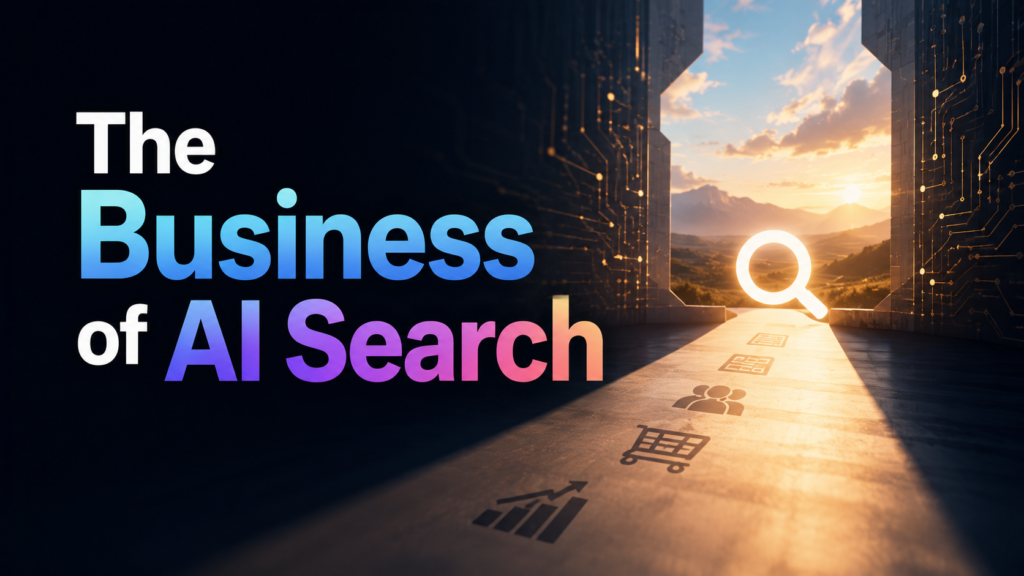
AI search combines traditional search infrastructure with advanced artificial intelligence technologies such as:
- Large language models
- Machine learning
- Natural language understanding
- Semantic search
- Generative AI
- Knowledge graphs
Unlike conventional search engines that primarily rank webpages, AI search systems attempt to understand intent and generate contextual responses.
Modern AI search capabilities include:
- Conversational interactions
- Summarized answers
- Personalized recommendations
- Multi-step reasoning
- Context awareness
- Content synthesis
This changes the relationship between users and information.
Instead of searching websites, users increasingly interact with intelligent assistants.
The Evolution of Search
| Era | Search Experience | Primary Goal |
|---|---|---|
| Directory Era | Categorized websites | Navigation |
| Keyword Search | Ranked webpages | Information retrieval |
| Mobile Search | Instant access | Convenience |
| Semantic Search | Intent understanding | Relevance |
| AI Search | Conversational answers | Intelligence |
| Agentic Search | Autonomous assistance | Action and execution |
Search is gradually moving from finding information to solving problems.
This evolution has profound implications for businesses and publishers.
Why AI Search Is Growing Rapidly
Several technological developments are accelerating this transformation.
Advances in Large Language Models
Modern AI models understand context, language, and relationships between concepts more effectively than earlier systems.
User Preference for Simplicity
Consumers increasingly prefer answers instead of lists of links.
Multimodal Capabilities
AI systems can process text, images, videos, and audio together.
Faster Computing Infrastructure
Cloud computing and specialized chips enable sophisticated AI experiences.
Growing Digital Complexity
The internet contains overwhelming amounts of information. AI helps simplify discovery.
These factors are reshaping the economics of information itself.
Search Has Always Been a Business
Search engines generate revenue primarily through advertising.
Traditional search economics follow a simple model:
- Users perform searches.
- Platforms display ads.
- Businesses pay for clicks.
- Traffic flows to publishers.
- Publishers monetize visitors.
This ecosystem created trillions of dollars in economic activity.
AI search introduces a major disruption.
If users receive complete answers without visiting websites, traffic patterns change dramatically.
This creates opportunities and challenges for everyone involved.
The New Economics of AI Search
AI search operates differently from traditional search engines.
Traditional Search
Revenue Model:
- Pay-per-click advertising
- Sponsored listings
- Display advertising
AI Search
Emerging Revenue Models:
- Premium subscriptions
- AI assistants
- Enterprise solutions
- Transaction commissions
- Sponsored recommendations
- Contextual advertising
This shift may redefine how information businesses generate revenue.
The Publisher Traffic Challenge
Publishers have historically relied on search traffic.
News organizations, blogs, and websites monetize through:
- Display ads
- Affiliate marketing
- Subscriptions
- Sponsored content
AI-generated answers reduce the need for users to click external links.
This phenomenon is often called “zero-click search.”
Consequences include:
- Lower traffic
- Reduced advertising revenue
- Increased competition
- Greater dependence on authority and branding
Publishers are increasingly focusing on:
- Exclusive content
- Community building
- Direct audiences
- Subscription models
Trust and expertise are becoming more valuable than raw page views.
SEO Is Entering a New Era
Search engine optimization is evolving.
Traditional SEO focused on:
- Keywords
- Backlinks
- Meta tags
- Rankings
AI search prioritizes:
- Authority
- Expertise
- Context
- Structured information
- Topical depth
- User intent
Content creators now compete not only for rankings but also for citations inside AI-generated answers.
The rise of Answer Engine Optimization (AEO) and Generative Engine Optimization (GEO) reflects this shift.
AI Search and Digital Advertising
Advertising remains the economic foundation of the internet.
However, AI changes how ads are delivered.
Future AI search advertising may include:
Conversational Ads
Recommendations embedded naturally into conversations.
Intent-Based Advertising
Ads based on user goals rather than keywords.
Personalized Commerce
AI assistants helping users discover products.
Transactional Search
Search systems completing purchases directly.
Advertising is becoming more intelligent, contextual, and outcome-focused.
The Rise of AI Search Platforms
The search landscape is becoming increasingly competitive.
Emerging categories include:
| Platform Type | Primary Function |
|---|---|
| Traditional Search Engines | Web indexing |
| AI Assistants | Conversational answers |
| Enterprise Search | Business intelligence |
| Vertical AI Search | Specialized industries |
| Agentic Systems | Autonomous actions |
| Knowledge Platforms | Information synthesis |
Search is no longer a single product.
It is becoming an ecosystem of intelligent experiences.
AI Search and E-Commerce
Shopping experiences are undergoing transformation.
AI-powered systems can:
- Compare products
- Analyze reviews
- Recommend purchases
- Answer questions
- Personalize experiences
Consumers may increasingly rely on AI agents rather than manually browsing dozens of websites.
This could reshape:
- Retail
- Affiliate marketing
- Product discovery
- Brand competition
Companies may compete to become the preferred recommendation inside AI ecosystems.
Enterprise AI Search Is Booming
Businesses are generating enormous amounts of information.
Employees often struggle to find:
- Documents
- Insights
- Customer data
- Internal knowledge
AI-powered enterprise search enables:
- Faster knowledge retrieval
- Better productivity
- Automated workflows
- Improved decision-making
This segment represents one of the fastest-growing opportunities in enterprise software.
Why Trust Is Becoming the New Currency
Information abundance creates a trust problem.
AI search systems must address:
- Hallucinations
- Bias
- Source quality
- Transparency
- Accuracy
Users increasingly value:
- Credibility
- Expertise
- Verifiable information
Trust is becoming a competitive advantage.
Organizations with strong reputations may benefit disproportionately in AI search ecosystems.
How Businesses Must Adapt
Companies need to rethink digital strategies.
Build Topical Authority
Depth matters more than volume.
Create Unique Content
Commodity content becomes less valuable.
Invest in Brand Recognition
Strong brands attract direct audiences.
Diversify Traffic Sources
Relying solely on search becomes risky.
Optimize for AI Systems
Structured content improves discoverability.
Prioritize Experience
Human expertise remains essential.
Businesses that adapt early may gain significant advantages.
The Emerging AI Search Economy
The AI search economy involves multiple participants.
| Stakeholder | Opportunity |
|---|---|
| Search Platforms | AI subscriptions and advertising |
| Publishers | Premium content and communities |
| Businesses | New customer acquisition models |
| Advertisers | Personalized campaigns |
| Developers | AI applications |
| Consumers | Better information experiences |
Entire industries are being reorganized around intelligent information access.
Challenges Facing AI Search
Despite its promise, AI search faces important challenges.
Computing Costs
AI responses require significant resources.
Copyright Issues
Publishers seek fair compensation.
Misinformation Risks
Accuracy remains essential.
Privacy Concerns
User data protection is critical.
Market Concentration
Large companies possess significant advantages.
Resolving these issues will shape the long-term sustainability of AI search.
The Future of Search
Search is evolving from retrieval toward execution.
Future systems may:
- Research topics autonomously.
- Compare products.
- Book appointments.
- Complete transactions.
- Manage schedules.
- Perform tasks on behalf of users.
Search will become increasingly agentic.
Instead of simply finding answers, AI systems will help users accomplish goals.
This transition could represent one of the biggest shifts since the birth of the web.
Human Expertise Still Matters
Despite technological advances, human expertise remains indispensable.
AI systems require:
- Trusted sources
- Expert knowledge
- Human oversight
- Ethical frameworks
- Original thinking
The internet economy may become more dependent on high-quality information rather than massive quantities of content.
In the age of AI search, authenticity becomes increasingly valuable.
Conclusion

The business of AI search represents far more than a technological upgrade. It is a fundamental reorganization of how information is discovered, monetized, and consumed.
Traditional search created one of history’s largest digital economies. AI search is now redefining that ecosystem by moving from links to answers, from retrieval to synthesis, and eventually from search to autonomous assistance.
Publishers, businesses, advertisers, and creators are entering a new era where visibility depends on authority, trust, and expertise rather than simply ranking for keywords.
The companies that understand this shift early and adapt strategically will be best positioned to thrive in the next generation of the internet economy.
Search itself is changing, but the ultimate objective remains the same: helping people find value. Artificial intelligence is simply transforming how that value is delivered.
Also Read: “The Rise of Personal AI Ecosystems“
Frequently Asked Questions (FAQs)
1. What is AI search?
AI search uses artificial intelligence and large language models to provide conversational answers, summaries, and contextual recommendations rather than simply displaying lists of webpages.
2. How does AI search affect SEO?
AI search shifts SEO toward authority, expertise, topical depth, structured data, and user intent. Businesses are increasingly optimizing for answer engines and AI-generated citations.
3. Why are publishers concerned about AI search?
AI-generated answers often reduce website visits, creating “zero-click searches” that can impact advertising revenue and traffic for publishers.