





Introduction: A New Economic Era Is Emerging
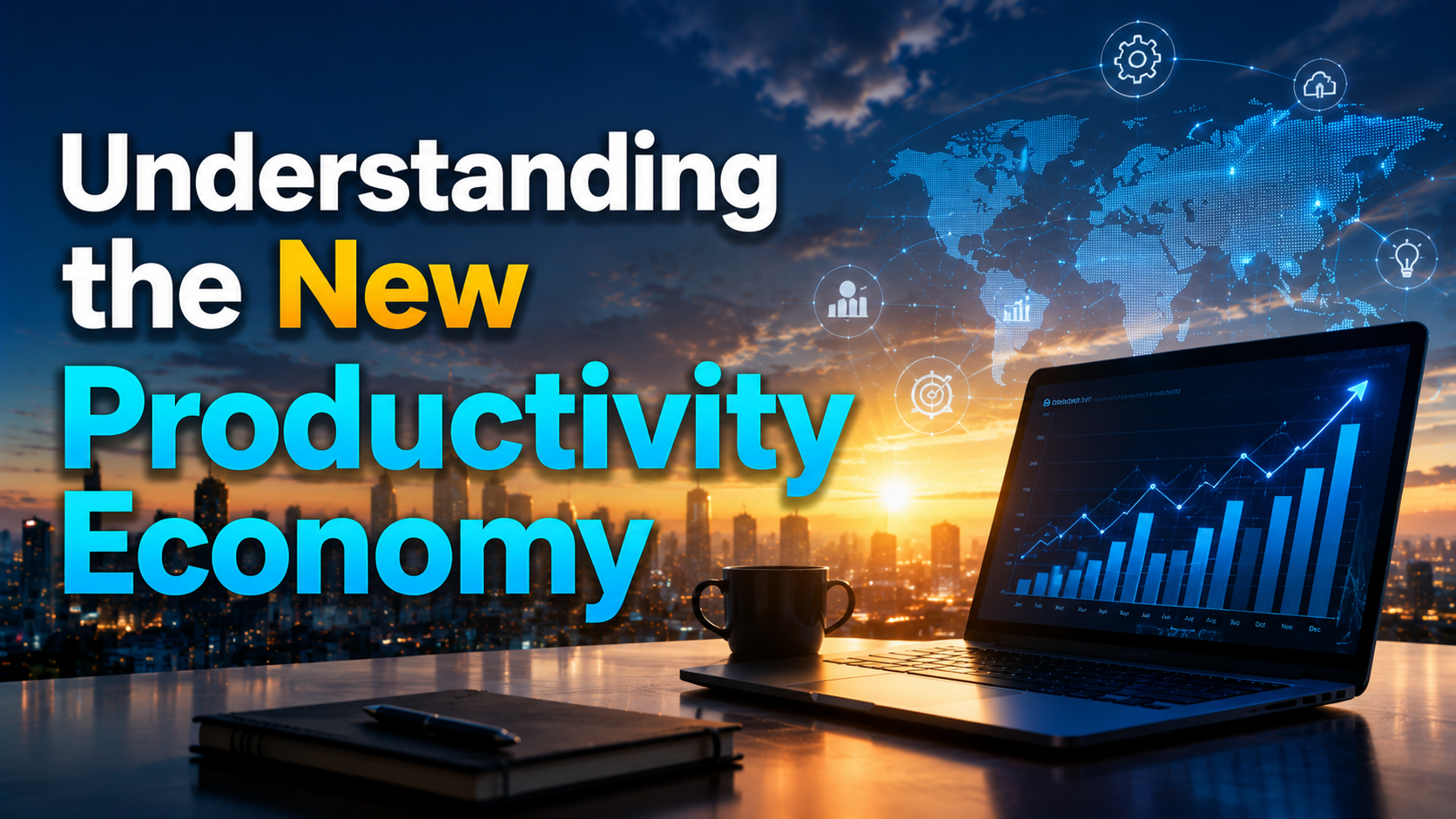
For decades, productivity has been one of the most important drivers of economic growth. Nations, businesses, and workers have continuously sought ways to produce more output with fewer resources. From the Industrial Revolution to the rise of computers and the internet, every major technological breakthrough has transformed how people work and create value. Understanding the New Productivity Economy.
Today, the world is entering another pivotal moment.
Artificial intelligence, intelligent automation, cloud computing, data analytics, and autonomous systems are reshaping the very definition of productivity. Organizations are no longer measuring productivity solely by hours worked or tasks completed. Instead, they are focusing on intelligence, innovation, adaptability, and value creation.
This shift is giving rise to what many experts describe as the New Productivity Economy, an economic environment where technology amplifies human capabilities, accelerates decision-making, and creates entirely new forms of work and business value.
Unlike previous productivity revolutions that focused primarily on mechanization or digitization, this new era combines human intelligence with machine intelligence. The result is a profound transformation affecting every industry, profession, and organization.
Understanding this new productivity economy is essential for business leaders, entrepreneurs, employees, educators, and policymakers who want to remain competitive in a rapidly evolving world.
Table of Contents
What Is the New Productivity Economy?
The New Productivity Economy refers to an economic model where advanced technologies, particularly artificial intelligence, significantly enhance human productivity, decision-making, creativity, and operational efficiency.
Traditional productivity focused on increasing output through labor and capital investments.
The new productivity economy focuses on:
- Intelligence augmentation
- Automation of repetitive work
- Faster decision-making
- Knowledge accessibility
- Continuous innovation
- Human-machine collaboration
In this environment, success depends not only on how hard people work but also on how effectively they leverage intelligent technologies.
The Evolution of Productivity Through History
Understanding the future requires understanding the past.
Human productivity has evolved through several major phases.
| Era | Primary Driver | Productivity Impact |
|---|---|---|
| Agricultural Age | Manual labor | Increased food production |
| Industrial Age | Machinery | Mass production |
| Information Age | Computers | Faster information processing |
| Internet Age | Connectivity | Global collaboration |
| AI Age | Intelligence | Augmented decision-making and automation |
Each era transformed society.
The AI-driven productivity economy may become the most impactful transformation yet because it affects both physical and cognitive work.
Why Productivity Matters More Than Ever
Productivity is often viewed as a business metric, but its influence extends far beyond corporate performance.
Higher productivity contributes to:
- Economic growth
- Increased wages
- Business profitability
- Innovation
- Improved living standards
- National competitiveness
As global competition intensifies, productivity becomes a critical factor for long-term success.
Organizations that improve productivity gain strategic advantages while individuals who develop high-productivity skills become more valuable in the labor market.
The Technology Driving the New Productivity Economy
Several technologies are powering this transformation.
Artificial Intelligence
AI analyzes data, identifies patterns, generates insights, and automates complex tasks.
Machine Learning
Machine learning enables systems to improve performance through experience and data.
Cloud Computing
Cloud platforms provide scalable infrastructure for digital operations and AI deployment.
Intelligent Automation
Automation reduces repetitive work while increasing efficiency and consistency.
Data Analytics
Advanced analytics transform raw information into actionable insights.
Together, these technologies create a foundation for unprecedented productivity improvements.
The Shift from Labor-Based Productivity to Intelligence-Based Productivity
Historically, productivity gains came from working faster or employing more efficient tools.
Today, productivity increasingly depends on intelligence.
Organizations are shifting from:
- Manual processing to automated processing
- Information gathering to insight generation
- Task execution to strategic decision-making
- Labor-intensive operations to knowledge-driven operations
This evolution fundamentally changes how value is created.
Knowledge and intelligence become primary economic assets.
AI as a Productivity Multiplier
Artificial intelligence acts as a productivity multiplier rather than simply a replacement for human workers.
AI can:
- Draft reports
- Analyze data
- Summarize information
- Generate content
- Support customer service
- Optimize workflows
These capabilities free employees from repetitive work and allow them to focus on higher-value activities.
Rather than replacing human expertise, AI often amplifies it.
Human-AI Collaboration: The New Productivity Model
The most productive organizations are not replacing people with machines.
They are creating systems where humans and AI work together.
| Human Strengths | AI Strengths |
|---|---|
| Creativity | Speed |
| Emotional intelligence | Data processing |
| Strategic thinking | Pattern recognition |
| Leadership | Scalability |
| Ethical judgment | Consistency |
When combined effectively, these strengths create exceptional outcomes.
Human-AI collaboration is becoming a cornerstone of the new productivity economy.
The Rise of Knowledge Work
Knowledge work has become increasingly important in modern economies.
Professionals in fields such as:
- Marketing
- Finance
- Consulting
- Engineering
- Healthcare
- Education
spend much of their time processing information and making decisions.
AI dramatically improves productivity in these areas by reducing administrative burdens and accelerating analysis.
This allows knowledge workers to focus on innovation, problem-solving, and strategic thinking.
How Businesses Are Adapting
Forward-thinking organizations are redesigning operations around intelligent productivity.
Key initiatives include:
Workflow Automation
Routine tasks are automated to improve efficiency.
Data-Driven Decision-Making
Leaders use analytics and AI insights to make faster, more informed decisions.
Digital Collaboration
Teams collaborate across locations using advanced digital platforms.
Continuous Learning
Employees receive ongoing training to adapt to technological changes.
Businesses that embrace these practices often outperform competitors.
The Productivity Impact of Generative AI
Generative AI is one of the most significant productivity innovations of the modern era.
Applications include:
- Writing assistance
- Software development
- Research support
- Content creation
- Customer communications
Generative AI reduces time spent on repetitive knowledge tasks while improving speed and scalability.
Many organizations are already experiencing measurable productivity gains from these tools.
The New Metrics of Productivity
Traditional productivity metrics focused on output volume.
Today, organizations are expanding their definitions.
Modern productivity indicators include:
| Metric | Description |
|---|---|
| Innovation Rate | New ideas generated |
| Decision Speed | Time to action |
| Customer Satisfaction | Experience quality |
| Employee Engagement | Workforce effectiveness |
| Revenue per Employee | Value creation |
| Learning Agility | Adaptability to change |
These metrics better reflect the realities of modern knowledge work.
Productivity and Employee Experience
The new productivity economy is not solely about efficiency.
Employee experience also matters.
Workers increasingly seek:
- Flexibility
- Purpose
- Learning opportunities
- Meaningful work
- Technology support
Organizations that improve employee experiences often see higher productivity levels.
Technology should empower employees rather than overwhelm them.
The Future of Remote and Hybrid Work
Remote and hybrid work models have accelerated digital productivity transformation.
AI-powered tools support:
- Virtual collaboration
- Meeting summarization
- Project management
- Knowledge sharing
- Workflow coordination
These capabilities enable distributed teams to remain productive regardless of location.
The future workplace is increasingly digital and intelligent.
The Skills That Matter Most
As productivity evolves, workforce skills must evolve as well.
High-value skills include:
Critical Thinking
The ability to evaluate information and make sound decisions.
AI Literacy
Understanding how to effectively work with intelligent systems.
Adaptability
Responding successfully to rapid change.
Communication
Collaborating effectively across teams and technologies.
Creativity
Developing innovative solutions and ideas.
These skills complement AI capabilities rather than compete with them.
Challenges of the New Productivity Economy
While opportunities are significant, challenges remain.
Digital Overload
Employees may face excessive information and technology complexity.
Skills Gaps
Many workers require additional training.
Data Privacy Concerns
Organizations must protect sensitive information.
Workforce Resistance
Change can create uncertainty and hesitation.
Ethical Considerations
Responsible AI usage remains critical.
Addressing these challenges is essential for sustainable growth.
Industry Transformation Through Productivity Innovation
Every major industry is experiencing change.
Healthcare
AI improves diagnostics, treatment planning, and administrative efficiency.
Financial Services
Automation enhances compliance, risk management, and customer support.
Manufacturing
Smart factories optimize production and maintenance.
Retail
Personalized experiences improve customer engagement.
Education
AI-powered learning platforms support personalized instruction.
Productivity gains are becoming increasingly widespread.
Economic Implications of the Productivity Revolution
The new productivity economy could significantly impact global economic growth.
Potential benefits include:
- Increased GDP growth
- Higher business profitability
- Greater innovation
- Improved workforce efficiency
- Enhanced competitiveness
However, governments and organizations must also address workforce transitions and skills development.
Economic progress depends on ensuring that productivity gains are broadly shared.
Building a Productivity-First Organization
Organizations seeking success should focus on several priorities.
Invest in Technology
Modern infrastructure supports intelligent operations.
Develop Human Talent
Continuous learning drives adaptability.
Encourage Innovation
Experimentation creates competitive advantages.
Prioritize Data Quality
Reliable data improves decision-making.
Foster Human-AI Collaboration
Technology should enhance rather than replace human potential.
These principles form the foundation of long-term productivity success.
What the Workplace Could Look Like by 2035
Imagine a workplace where:
- AI assistants support every employee.
- Routine tasks are largely automated.
- Real-time analytics guide decisions.
- Learning occurs continuously.
- Human creativity drives innovation.
Employees spend less time on administrative work and more time solving meaningful problems.
Organizations become more agile, intelligent, and resilient.
Many of these trends are already underway today.
Why Human Intelligence Remains Essential
Despite rapid advances in AI, human intelligence remains irreplaceable.
Machines excel at:
- Processing data
- Recognizing patterns
- Automating tasks
Humans excel at:
- Empathy
- Leadership
- Creativity
- Ethics
- Vision
The future of productivity lies not in choosing between humans and machines but in combining their strengths effectively.
Organizations that understand this balance will be best positioned for success.
Conclusion
The New Productivity Economy represents one of the most important economic shifts of the 21st century. Driven by artificial intelligence, automation, data analytics, and digital transformation, it is changing how organizations create value and how individuals contribute to the workforce.
Success in this new environment requires more than adopting technology. It requires rethinking workflows, investing in people, fostering innovation, and building systems where human intelligence and machine intelligence work together.
The businesses, workers, and institutions that embrace this transformation will unlock new levels of growth, efficiency, and opportunity.
Productivity is no longer simply about doing more work.
It is about creating more value through intelligence, innovation, and collaboration.
That is the defining characteristic of the new productivity economy.
Also Read: “The Future of Online Trust“
Frequently Asked Questions (FAQs)
1. What is the New Productivity Economy?
The New Productivity Economy is an economic model where AI, automation, data analytics, and digital technologies enhance human productivity, innovation, and decision-making.
2. How does artificial intelligence improve productivity?
AI automates repetitive tasks, analyzes data, generates insights, supports decision-making, and helps employees focus on higher-value work.
3. Will AI replace human workers in the productivity economy?
In most cases, AI will augment human capabilities rather than fully replace workers. Human creativity, leadership, and critical thinking remain essential.