


Introduction: When Answers Arrive Instantly
For most of human history, acquiring knowledge required effort, patience, and persistence.
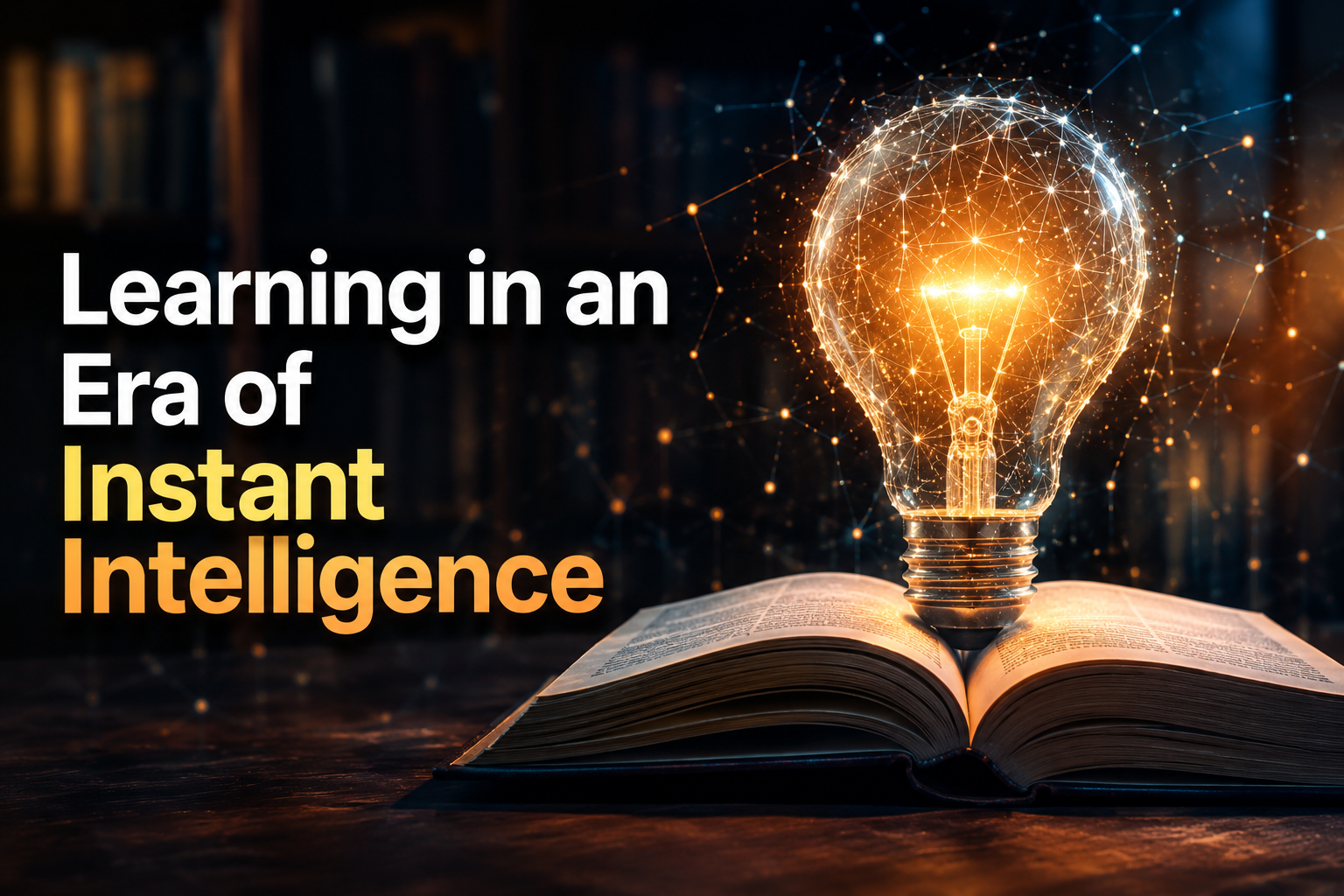
Students spent hours in libraries searching through books. Researchers analyzed countless documents before reaching conclusions. Professionals accumulated expertise through years of study and practical experience. Information was valuable because it was often difficult to access. Learning in an Era of Instant Intelligence.
Today, the situation is radically different.
Within seconds, artificial intelligence systems can summarize complex topics, answer questions, generate reports, explain concepts, create educational materials, and provide insights that once required extensive research. Knowledge has become more accessible than ever before.
We are entering what can be called the Era of Instant Intelligence.
In this new reality, information is available on demand through AI assistants, intelligent search systems, recommendation engines, digital tutors, and autonomous learning platforms. Students can ask questions anytime. Professionals can receive immediate guidance. Organizations can access analytical insights at unprecedented speed.
While this transformation offers extraordinary opportunities, it also raises important questions.
If knowledge becomes instantly accessible, what should people learn?
If AI can answer questions, what role does human intelligence play?
If information is abundant, how do we distinguish understanding from mere access?
These questions sit at the center of modern education and workforce development.
Learning in an era of instant intelligence is no longer simply about acquiring information. It is about developing the ability to think, adapt, evaluate, create, and apply knowledge effectively in partnership with intelligent technologies.
Table of Contents
Understanding Instant Intelligence
Instant intelligence refers to the ability to access relevant information, analysis, and insights immediately through advanced digital systems.
Powered by artificial intelligence, modern platforms can:
- Answer questions in real time
- Summarize complex topics
- Generate explanations
- Create learning materials
- Recommend resources
- Personalize educational experiences
Unlike traditional search engines that present lists of links, AI increasingly provides direct answers and contextual understanding.
This changes how people interact with information.
The challenge is no longer finding knowledge.
The challenge is using it wisely.
The Evolution of Learning Through Technology
Every major technological innovation has transformed education.
| Era | Learning Model | Primary Technology |
|---|---|---|
| Print Age | Book-Centered Learning | Printing Press |
| Industrial Age | Standardized Education | Mass Schooling |
| Computer Age | Digital Learning | Personal Computers |
| Internet Age | Connected Learning | Search Engines |
| AI Age | Intelligent Learning | Artificial Intelligence |
Each stage expanded access to knowledge.
The AI era is different because technology now participates directly in the learning process.
From Information Scarcity to Information Abundance
For centuries, knowledge was scarce.
Books were expensive.
Experts were difficult to access.
Educational opportunities were limited.
Today, information abundance defines the digital world.
Students can access:
- Online courses
- Research databases
- Educational videos
- Interactive simulations
- AI-powered tutors
This democratization of knowledge represents one of the greatest achievements of modern technology.
However, abundance introduces new challenges.
Not all information is accurate.
Not all content is valuable.
Not all answers lead to understanding.
Why Memorization Is Becoming Less Important
Traditional education often emphasized memorization.
Students were expected to remember facts, formulas, dates, and definitions.
In an era of instant intelligence, many of these tasks can be performed by AI systems within seconds.
This does not mean knowledge is unimportant.
Instead, educational priorities are shifting.
Future success depends less on remembering information and more on:
- Understanding concepts
- Applying knowledge
- Solving problems
- Thinking critically
- Making informed decisions
The value of education increasingly lies in interpretation rather than memorization.
Critical Thinking Becomes the Ultimate Learning Skill
As AI-generated information becomes more common, critical thinking becomes increasingly valuable.
Students must learn to ask:
- Is this information accurate?
- What evidence supports it?
- What assumptions are being made?
- Are alternative perspectives available?
- Is the source reliable?
AI can provide answers.
Humans must determine whether those answers are meaningful and trustworthy.
Critical thinking becomes the foundation of modern learning.
The Rise of Personalized Education
One of the most significant benefits of AI is personalization.
Traditional classrooms often struggle to meet individual learning needs.
Students learn at different speeds and in different ways.
AI-powered learning systems can:
- Adapt lesson difficulty
- Identify knowledge gaps
- Recommend learning resources
- Track progress
- Personalize instruction
This creates educational experiences tailored to each learner.
The result is more effective and engaging education.
AI Tutors and Learning Assistants
The concept of having a personal tutor was once a luxury available to a small number of learners.
Modern AI tutors can:
- Explain concepts
- Answer questions
- Generate practice exercises
- Provide feedback
- Support independent learning
Students can receive assistance whenever they need it.
This expands educational access on a global scale.
Learning How to Learn
Perhaps the most important skill in an era of instant intelligence is learning how to learn.
Because knowledge evolves rapidly, students cannot rely solely on what they learn in school.
Instead, they must develop the ability to:
- Acquire new skills
- Adapt to change
- Evaluate information
- Learn independently
- Continuously improve
Lifelong learning becomes essential.
The future belongs to adaptable learners.
The Difference Between Information and Understanding
One of the greatest misconceptions about instant intelligence is that access to information automatically creates understanding.
Information answers questions.
Understanding explains why those answers matter.
Consider the difference:
| Information | Understanding |
|---|---|
| Facts | Context |
| Data | Meaning |
| Answers | Insight |
| Knowledge Access | Knowledge Application |
AI excels at providing information.
Human intelligence excels at building understanding.
Education must continue emphasizing this distinction.
Creativity in the Age of AI
Artificial intelligence can generate text, images, music, and code.
Yet creativity remains deeply human.
True creativity involves:
- Imagination
- Original thinking
- Emotional expression
- Innovation
- Cultural understanding
As routine tasks become automated, creative capabilities become increasingly valuable.
Educational systems should encourage exploration, experimentation, and innovation.
Emotional Intelligence Matters More Than Ever
Technology can process information.
Humans connect with people.
Emotional intelligence includes:
- Empathy
- Communication
- Self-awareness
- Relationship building
- Leadership
These capabilities remain difficult to automate.
In a future where AI handles more technical tasks, human-centered skills become even more important.
Digital Literacy Beyond Search Engines
The concept of digital literacy has evolved.
Modern learners must understand:
- AI systems
- Information verification
- Media literacy
- Data privacy
- Cybersecurity
- Algorithmic influence
The ability to navigate digital environments responsibly is becoming a foundational life skill.
Preparing Students for Jobs That Do Not Yet Exist
Many future careers have not been created yet.
Examples may include:
- AI workflow designers
- Human-AI collaboration specialists
- Digital trust advisors
- AI ethics consultants
- Autonomous systems managers
Educational institutions cannot predict every future profession.
Instead, they must prepare students with adaptable skills that remain valuable regardless of technological change.
The Changing Role of Teachers
Teachers remain essential in the era of instant intelligence.
Their role is evolving rather than disappearing.
Future educators will increasingly focus on:
- Mentorship
- Critical thinking
- Creativity
- Collaboration
- Ethical reasoning
Technology delivers information.
Teachers develop wisdom.
This distinction becomes increasingly important.
Lifelong Learning in the AI Economy
The traditional model of education followed by decades of work is becoming obsolete.
Skills evolve rapidly.
Industries change frequently.
Professionals must continually learn.
AI-powered learning systems support lifelong education through:
- Personalized recommendations
- Adaptive learning pathways
- Skill assessments
- Continuous feedback
Learning becomes a permanent part of professional life.
Challenges of Instant Intelligence
While AI offers remarkable benefits, challenges remain.
Information Overload
Too much information can overwhelm learners.
Misinformation
Not all AI-generated content is accurate.
Reduced Deep Learning
Instant answers may discourage deeper exploration.
Over-Reliance on Technology
Students must avoid becoming dependent on AI.
Ethical Concerns
Responsible technology use remains critical.
Addressing these challenges requires thoughtful educational strategies.
Human Intelligence in an AI World
The rise of AI does not reduce the value of human intelligence.
It increases it.
Machines contribute:
- Speed
- Scale
- Automation
- Pattern recognition
Humans contribute:
- Creativity
- Ethics
- Judgment
- Empathy
- Purpose
The future belongs not to AI alone, but to effective collaboration between humans and intelligent systems.
What Learning Might Look Like in 2035
Imagine a student beginning a lesson in 2035.
AI systems analyze learning preferences.
Content adapts dynamically.
Interactive simulations enhance understanding.
Virtual tutors provide support.
Teachers guide discussions and encourage creativity.
Assessment becomes continuous rather than episodic.
Learning becomes more personalized, engaging, and effective.
Many of these developments are already emerging today.
How Educational Institutions Can Adapt
Schools and universities should prioritize:
AI Literacy
Teaching students how AI works.
Critical Thinking
Encouraging analysis and evaluation.
Future Skills
Focusing on creativity and adaptability.
Digital Responsibility
Promoting ethical technology use.
Lifelong Learning Habits
Preparing students for continuous growth.
Institutions that adapt successfully will better serve future generations.
Conclusion
Learning in an era of instant intelligence represents one of the most profound educational transformations in human history. Artificial intelligence is making information more accessible, learning more personalized, and education more scalable than ever before.
Yet the true purpose of education remains unchanged.
Education is not simply about acquiring answers.
It is about developing the ability to understand, evaluate, create, and apply knowledge meaningfully.
As AI increasingly provides instant access to information, human skills such as critical thinking, creativity, emotional intelligence, adaptability, and ethical judgment become even more valuable.
The future learner will not compete with artificial intelligence.
They will collaborate with it.
Those who develop both technological fluency and human-centered capabilities will be best positioned to thrive in an increasingly intelligent world.
The era of instant intelligence has arrived.
The opportunity now is to learn how to learn within it.
Also Read: “The Silent Transformation of Human Behavior Through AI“
Frequently Asked Questions (FAQs)
1. What is instant intelligence?
Instant intelligence refers to the ability to access information, insights, and knowledge immediately through AI-powered systems and intelligent digital platforms.
2. How is AI changing learning?
AI is enabling personalized education, adaptive learning, intelligent tutoring, automated feedback, and improved access to educational resources.
3. What skills are most important in the age of instant intelligence?
Critical thinking, creativity, adaptability, emotional intelligence, communication, AI literacy, and lifelong learning skills are increasingly important.