





Introduction: The Next Phase of Business Transformation
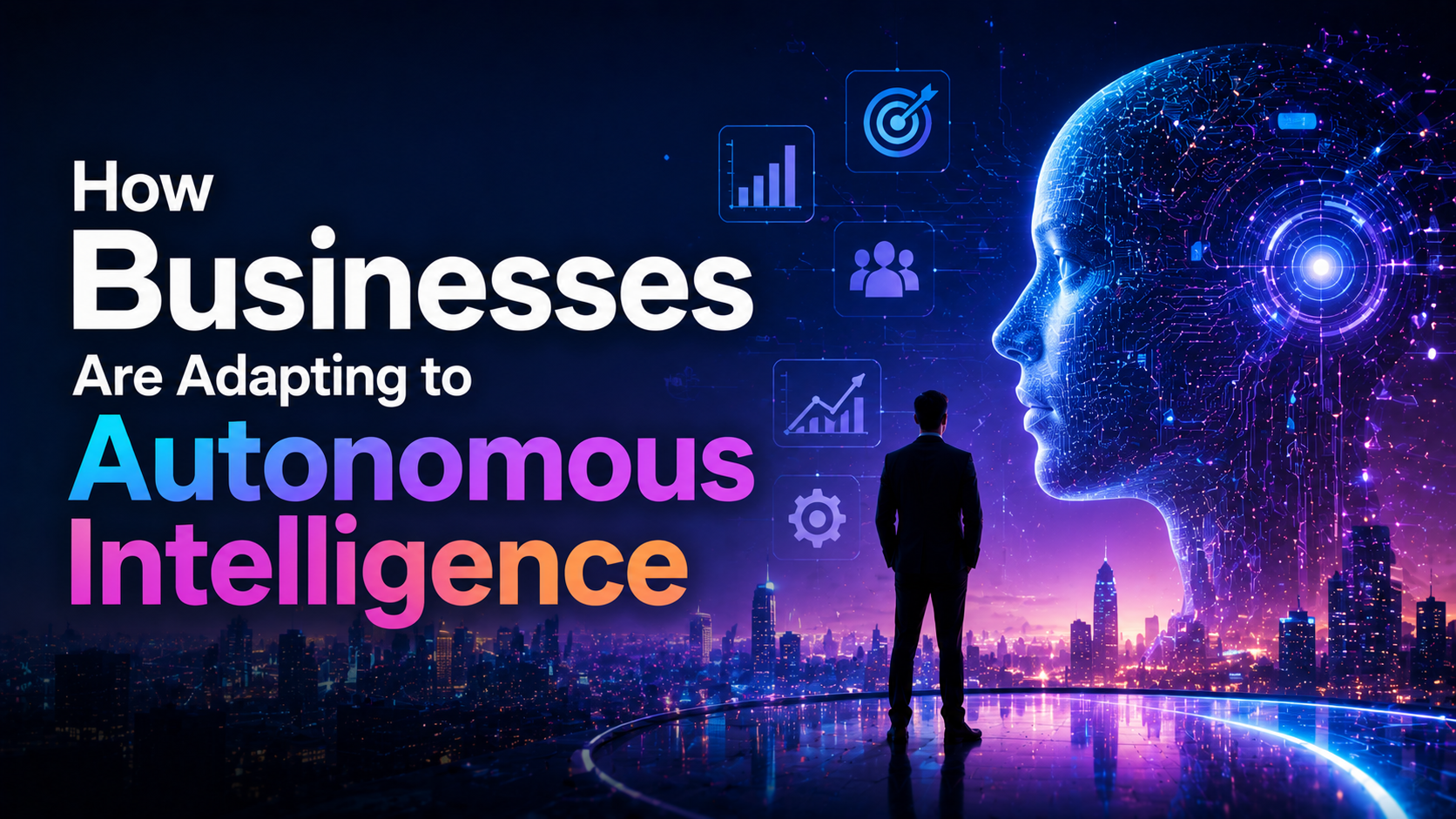
Every major technological revolution changes how businesses operate. The industrial revolution transformed manufacturing. The internet revolutionized communication and commerce. Cloud computing reshaped digital infrastructure. How Businesses Are Adapting to Autonomous Intelligence.
Today, organizations are entering another transformative era driven by autonomous intelligence.
Unlike traditional software systems that require constant human direction, autonomous intelligence refers to artificial intelligence systems capable of performing tasks, making recommendations, learning from data, and executing workflows with minimal human intervention.
This shift is redefining how businesses make decisions, manage operations, serve customers, and compete in global markets.
Across industries, organizations are deploying AI-powered systems that can analyze information, automate complex processes, optimize workflows, predict outcomes, and support strategic planning. What once required teams of employees and weeks of effort can now often be accomplished in minutes through intelligent automation.
The rise of autonomous intelligence is not simply a technology trend. It represents a fundamental transformation in the relationship between humans, software, and business operations.
Companies that adapt successfully stand to gain significant advantages in productivity, efficiency, innovation, and customer experience. Those that fail to evolve may struggle to remain competitive in increasingly intelligent markets.
Understanding how businesses are adapting to autonomous intelligence provides valuable insight into the future of work, enterprise transformation, and digital innovation.
Table of Contents
Understanding Autonomous Intelligence
Autonomous intelligence refers to AI systems capable of independently performing tasks, analyzing situations, learning from outcomes, and making decisions within defined parameters.
Unlike traditional automation, which follows rigid rules, autonomous intelligence can adapt to changing circumstances.
These systems can:
- Interpret complex data
- Identify patterns
- Predict outcomes
- Automate decisions
- Execute workflows
- Continuously improve performance
The result is a more dynamic and intelligent approach to business operations.
Why Autonomous Intelligence Matters
Modern businesses operate in environments characterized by:
- Massive data volumes
- Rapid market changes
- Increasing customer expectations
- Global competition
- Complex operational demands
Human teams alone often struggle to process information quickly enough.
Autonomous intelligence helps organizations:
- Respond faster
- Improve accuracy
- Reduce costs
- Scale operations efficiently
- Enhance decision-making
This capability is becoming a strategic necessity rather than a competitive luxury.
The Evolution of Business Intelligence
Business intelligence has evolved significantly over time.
| Era | Primary Capability | Business Impact |
|---|---|---|
| Manual Analysis | Human reporting | Limited scalability |
| Digital Analytics | Data visualization | Better insights |
| Predictive Analytics | Forecasting trends | Improved planning |
| AI Intelligence | Pattern recognition | Faster decisions |
| Autonomous Intelligence | Independent action | Intelligent execution |
Autonomous intelligence represents the next stage in enterprise evolution.
From Automation to Autonomy
Traditional automation focuses on repetitive tasks.
Examples include:
- Payroll processing
- Invoice generation
- Email routing
- Data entry
Autonomous intelligence extends beyond task automation.
It can:
- Prioritize actions
- Allocate resources
- Recommend strategies
- Monitor performance
- Trigger responses automatically
This shift transforms software from a passive tool into an active participant in business operations.
How Businesses Are Using Autonomous Intelligence
Organizations are implementing autonomous intelligence across multiple functions.
Customer Service
AI-powered systems handle customer inquiries, resolve issues, and provide personalized support.
Marketing
Intelligent platforms optimize campaigns, analyze audience behavior, and generate content recommendations.
Finance
AI assists with fraud detection, forecasting, risk assessment, and financial planning.
Human Resources
Recruitment, onboarding, workforce analytics, and employee engagement increasingly benefit from intelligent automation.
Operations
Autonomous systems improve supply chain management, inventory optimization, and workflow coordination.
The Rise of AI Agents in Business
One of the most significant developments in autonomous intelligence is the emergence of AI agents.
AI agents can:
- Perform multi-step tasks
- Interact with systems
- Execute workflows
- Make recommendations
- Adapt based on results
Businesses are beginning to use AI agents as digital coworkers capable of supporting complex operational activities.
This trend is accelerating enterprise transformation.
Enhancing Decision-Making Through Autonomous Intelligence
Decision-making is one of the most valuable business activities.
AI-powered systems improve decisions by:
- Analyzing large datasets
- Identifying hidden trends
- Forecasting outcomes
- Evaluating scenarios
- Providing actionable recommendations
Executives gain access to insights that would be difficult or impossible to uncover manually.
This enables more informed strategic planning.
Autonomous Intelligence and Customer Experience
Customer expectations continue to rise.
Consumers expect:
- Faster responses
- Personalized interactions
- Consistent service
- Convenient experiences
Autonomous intelligence helps businesses meet these expectations.
Examples include:
- Personalized recommendations
- Intelligent chat support
- Predictive service solutions
- Automated customer engagement
Enhanced customer experiences often translate into stronger loyalty and revenue growth.
Workforce Transformation in the Age of Autonomous Intelligence
Autonomous intelligence is changing how employees work.
Contrary to popular fears, most organizations are not replacing entire workforces.
Instead, they are redesigning roles.
Employees increasingly focus on:
- Creativity
- Strategy
- Relationship building
- Innovation
- Problem-solving
Routine administrative work is increasingly automated.
This creates opportunities for higher-value contributions.
Building an AI-Ready Workforce
Organizations recognize that successful adaptation requires workforce development.
Employees need:
- AI literacy
- Digital skills
- Data literacy
- Critical thinking
- Adaptability
Companies are investing heavily in upskilling and reskilling programs to prepare employees for AI-enhanced workplaces.
Human capital remains central to business success.
Industry Applications of Autonomous Intelligence
Healthcare
Healthcare organizations use autonomous intelligence for:
- Clinical decision support
- Medical imaging analysis
- Patient management
- Administrative automation
Financial Services
Financial institutions deploy AI for:
- Fraud detection
- Credit analysis
- Portfolio management
- Compliance monitoring
Retail
Retailers leverage autonomous intelligence for:
- Demand forecasting
- Personalization
- Inventory optimization
- Customer engagement
Manufacturing
Manufacturers utilize AI-powered systems for:
- Predictive maintenance
- Quality assurance
- Supply chain management
- Production optimization
The Productivity Revolution
Autonomous intelligence significantly improves productivity.
Benefits include:
| Traditional Workflow | Autonomous Workflow |
|---|---|
| Manual processing | Automated execution |
| Reactive decisions | Predictive insights |
| Repetitive tasks | Intelligent automation |
| Human-only analysis | AI-assisted intelligence |
| Fixed processes | Adaptive optimization |
Organizations achieve greater efficiency without proportional increases in workforce size.
Challenges Businesses Must Address
Despite its potential, autonomous intelligence presents challenges.
Data Quality
AI performance depends heavily on data accuracy.
Governance
Organizations need oversight frameworks.
Security
Protecting sensitive information remains essential.
Trust
Employees and customers must trust AI-driven systems.
Ethical Concerns
Bias, transparency, and accountability require ongoing attention.
Responsible implementation is critical.
Building Trust in Autonomous Systems
Trust is a key factor in AI adoption.
Businesses can build trust by:
- Explaining AI decisions
- Maintaining transparency
- Providing human oversight
- Establishing accountability
- Prioritizing ethical practices
Trust encourages adoption and reduces resistance.
The Importance of Human Oversight
While autonomous intelligence can perform many tasks independently, human oversight remains essential.
Humans provide:
- Strategic direction
- Ethical judgment
- Contextual understanding
- Risk assessment
- Final accountability
The future is not about eliminating human involvement.
It is about enhancing human capabilities.
Competitive Advantage Through Autonomous Intelligence
Organizations that effectively implement autonomous intelligence gain advantages in:
- Speed
- Innovation
- Customer satisfaction
- Cost efficiency
- Decision quality
These advantages compound over time.
As AI capabilities improve, the performance gap between adopters and non-adopters may widen significantly.
The Economic Impact of Autonomous Intelligence
Autonomous intelligence has the potential to reshape entire economies.
Potential benefits include:
- Increased productivity
- Higher economic output
- Faster innovation cycles
- New business models
- Enhanced global competitiveness
Businesses that embrace intelligent technologies contribute to broader economic transformation.
What Business May Look Like in 2035
Imagine a typical enterprise in 2035.
AI agents manage administrative workflows.
Customer service systems resolve most routine inquiries independently.
Supply chains continuously optimize themselves.
Predictive analytics guide strategic decisions in real time.
Employees focus on innovation, leadership, and relationship building.
Organizations operate with unprecedented efficiency and agility.
Many aspects of this future are already emerging today.
Strategic Steps for Businesses
Organizations seeking to adapt successfully should:
- Assess current AI readiness.
- Invest in workforce development.
- Establish ethical AI governance.
- Modernize data infrastructure.
- Identify automation opportunities.
- Encourage experimentation.
- Measure business outcomes continuously.
These steps support sustainable transformation.
Why Adaptation Is No Longer Optional
Autonomous intelligence is becoming embedded across industries.
Businesses that delay adoption may face:
- Reduced competitiveness
- Slower innovation
- Higher operating costs
- Talent challenges
- Lower customer satisfaction
Adaptation is increasingly a requirement for long-term success.
Conclusion
The rise of autonomous intelligence marks a defining moment in business evolution. Organizations are moving beyond traditional automation toward intelligent systems capable of learning, adapting, and supporting decision-making at unprecedented scale.
From customer service and marketing to operations and strategic planning, autonomous intelligence is transforming how work gets done. Yet the most successful businesses recognize that technology alone is not enough.
Human intelligence remains essential.
Creativity, leadership, ethical judgment, communication, and innovation continue to differentiate organizations in an increasingly automated world.
The future belongs to businesses that successfully combine human expertise with autonomous intelligence. Those that embrace this transformation thoughtfully will be better positioned to thrive in a rapidly changing digital economy.
Autonomous intelligence is not replacing business leadership.
It is redefining what effective leadership and organizational excellence look like in the age of AI.
Also Read: “A World Increasingly Guided by AI“
Frequently Asked Questions (FAQs)
1. What is autonomous intelligence in business?
Autonomous intelligence refers to AI systems capable of performing tasks, analyzing data, making recommendations, and executing workflows with minimal human intervention.
2. How are businesses using autonomous intelligence today?
Businesses use autonomous intelligence for customer service, marketing optimization, workforce management, fraud detection, supply chain optimization, and strategic decision-making.
3. Will autonomous intelligence replace employees?
Most organizations use autonomous intelligence to augment human capabilities rather than replace employees entirely. Human skills such as creativity, leadership, and critical thinking remain highly valuable.