

Introduction: The Workforce Transformation Has Already Begun
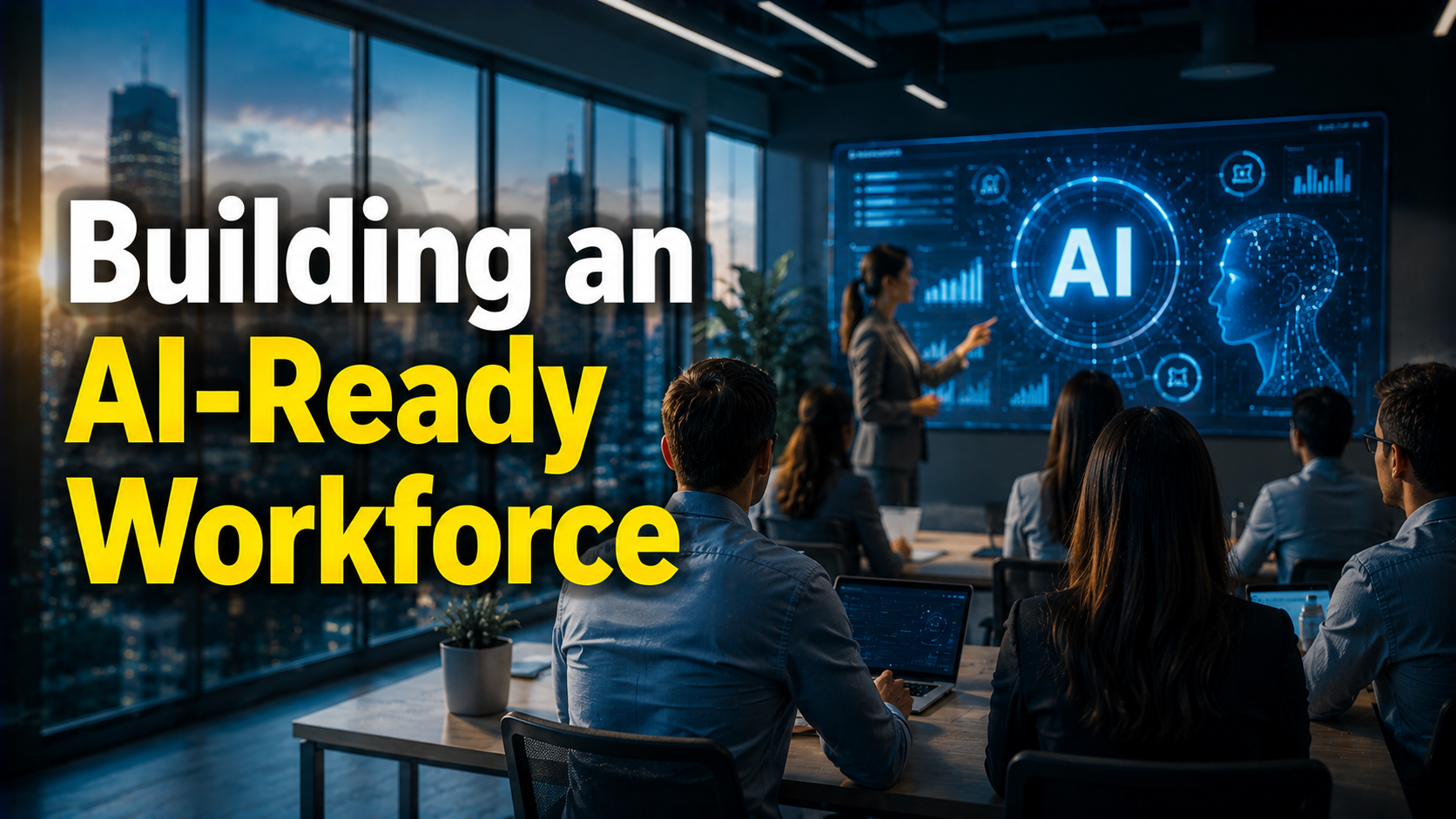
Artificial intelligence is no longer a future technology. It is a present-day business reality. Building an AI-Ready Workforce.
Across industries, organizations are integrating AI into operations, customer service, marketing, software development, finance, healthcare, manufacturing, logistics, and human resources. From intelligent assistants and predictive analytics to autonomous systems and generative AI platforms, businesses are rapidly discovering new ways to improve efficiency and productivity.
However, while companies continue investing heavily in AI technologies, many face a significant challenge:
The workforce is often not prepared for the transformation.
Technology adoption alone does not guarantee success. Organizations must ensure that employees possess the knowledge, skills, and mindset required to work effectively alongside intelligent systems.
This challenge has given rise to a new business priority: building an AI-ready workforce.
An AI-ready workforce is not simply a workforce that understands technology. It is a workforce capable of adapting to continuous change, collaborating with intelligent systems, applying critical thinking, and leveraging AI to create value.
The organizations that succeed in the coming decade will not necessarily be those with the most advanced AI tools. They will be those that successfully combine human intelligence and artificial intelligence to achieve better outcomes.
Building an AI-ready workforce has become a strategic imperative for business growth, innovation, competitiveness, and long-term resilience.
Table of Contents
Understanding the AI Workforce Revolution
Every major technological shift changes how work is performed.
The Industrial Revolution transformed physical labor.
The Digital Revolution transformed information work.
The AI Revolution is transforming decision-making, problem-solving, creativity, and knowledge work.
Artificial intelligence now supports tasks such as:
- Research
- Data analysis
- Content creation
- Customer interactions
- Workflow automation
- Business forecasting
- Process optimization
As AI capabilities expand, workforce expectations evolve.
Employees increasingly need skills that complement rather than compete with intelligent systems.
What Does an AI-Ready Workforce Mean?
An AI-ready workforce is composed of employees who can confidently use AI technologies while applying uniquely human strengths that machines cannot easily replicate.
Key characteristics include:
- AI literacy
- Digital literacy
- Critical thinking
- Adaptability
- Problem-solving
- Collaboration
- Continuous learning
AI readiness is not limited to technical teams.
Every department can benefit from AI-related competencies.
Why Organizations Must Act Now
The pace of AI adoption continues accelerating.
Businesses that delay workforce preparation face risks such as:
- Reduced competitiveness
- Skill shortages
- Lower productivity
- Employee resistance
- Innovation challenges
Organizations that invest early in workforce development are better positioned to capitalize on AI opportunities.
The transition is already underway.
Waiting is no longer a viable strategy.
The Growing AI Skills Gap
One of the most significant workforce challenges today is the AI skills gap.
Many employers struggle to find talent with expertise in:
- AI tools
- Data analysis
- Digital technologies
- Automation systems
- AI governance
At the same time, many employees feel uncertain about how AI may affect their careers.
This mismatch creates urgency for workforce development initiatives.
AI Literacy: The Foundation of Workforce Readiness
AI literacy serves as the cornerstone of AI readiness.
Employees do not need to become machine learning engineers.
However, they should understand:
- What AI is
- How AI systems operate
- AI strengths and limitations
- Ethical considerations
- Practical workplace applications
AI literacy reduces fear, increases confidence, and encourages responsible adoption.
The Shift From Technical Skills Alone to Hybrid Skills
Success in the AI economy increasingly depends on hybrid skill sets.
| Technical Skills | Human Skills |
|---|---|
| AI Literacy | Critical Thinking |
| Data Analysis | Creativity |
| Automation Knowledge | Communication |
| Digital Fluency | Emotional Intelligence |
| Technology Adoption | Leadership |
| Process Optimization | Adaptability |
The most valuable employees combine technological understanding with human-centered capabilities.
Why Human Skills Matter More Than Ever
A common misconception is that AI reduces the importance of human skills.
The opposite is often true.
As routine tasks become automated, demand grows for capabilities such as:
Critical Thinking
Evaluating information and making judgments.
Creativity
Generating innovative ideas and solutions.
Communication
Collaborating effectively across teams.
Emotional Intelligence
Building trust and relationships.
Leadership
Guiding organizations through change.
These skills become increasingly valuable in AI-enhanced workplaces.
Building a Culture of Continuous Learning
AI technologies evolve rapidly.
Knowledge acquired today may become outdated within a few years.
Organizations must foster cultures that encourage:
- Lifelong learning
- Skill development
- Curiosity
- Experimentation
- Adaptability
Continuous learning is no longer optional.
It is a strategic necessity.
Reskilling and Upskilling Employees
Many workforce development strategies focus on two critical approaches:
Reskilling
Training employees for new roles.
Upskilling
Enhancing capabilities within existing roles.
Both strategies help organizations adapt to technological change without relying solely on external recruitment.
Investing in employee development often improves retention and engagement.
The Role of Leadership in AI Readiness
Leadership plays a crucial role in workforce transformation.
Leaders must:
- Communicate vision clearly
- Address employee concerns
- Promote innovation
- Encourage experimentation
- Support learning initiatives
Successful AI adoption requires organizational trust and strong leadership.
Employees are more likely to embrace change when leaders provide guidance and transparency.
Creating AI Literacy Programs
Effective AI literacy programs should cover:
AI Fundamentals
Basic concepts and terminology.
Practical Applications
Real-world business use cases.
Ethical AI
Responsible and transparent usage.
Data Literacy
Understanding data-driven systems.
Human-AI Collaboration
Working effectively alongside intelligent technologies.
These programs create a strong foundation for broader transformation efforts.
Human-AI Collaboration: The New Workplace Model
The future workplace is not about humans versus machines.
It is about humans working with machines.
AI excels at:
- Processing information
- Identifying patterns
- Automating repetitive tasks
Humans excel at:
- Strategic thinking
- Ethical judgment
- Creativity
- Relationship building
- Contextual understanding
Organizations that combine these strengths achieve superior outcomes.
The Importance of Digital Literacy
AI readiness depends on strong digital literacy.
Employees must understand:
- Digital platforms
- Online collaboration tools
- Cybersecurity basics
- Data management practices
- Information evaluation
Digital literacy serves as a foundation upon which AI literacy is built.
Ethical Considerations in Workforce Development
AI implementation introduces important ethical questions.
Organizations should address:
- Bias in AI systems
- Transparency
- Accountability
- Data privacy
- Responsible automation
Employees must understand these considerations to ensure responsible technology usage.
Ethics should be integrated into workforce training programs.
Industry-Specific AI Workforce Needs
Different sectors require different AI competencies.
| Industry | Key AI Workforce Skills |
|---|---|
| Healthcare | AI-assisted diagnostics, data interpretation |
| Finance | Predictive analytics, automation |
| Manufacturing | Smart systems management |
| Marketing | AI content tools, customer insights |
| Education | AI-enhanced learning strategies |
| Retail | Personalization and analytics |
Customized training strategies often produce better results.
Overcoming Employee Resistance to AI
Workforce transformation often generates uncertainty.
Employees may fear:
- Job displacement
- Increased complexity
- Skill obsolescence
Organizations can address concerns by:
- Providing education
- Encouraging participation
- Demonstrating benefits
- Offering career development pathways
Transparency helps build trust.
Measuring AI Readiness
Organizations should evaluate readiness through:
Skill Assessments
Measuring employee capabilities.
Training Participation
Tracking workforce engagement.
Technology Adoption Rates
Understanding usage patterns.
Productivity Improvements
Measuring business impact.
Innovation Metrics
Assessing new opportunities created.
Measurement supports continuous improvement.
The Economic Impact of an AI-Ready Workforce
Organizations with AI-ready employees often experience:
- Increased productivity
- Faster innovation
- Better decision-making
- Improved customer experiences
- Greater competitiveness
Workforce readiness becomes a strategic business asset.
The economic benefits extend beyond individual organizations to entire industries and national economies.
What the AI-Ready Workforce May Look Like in 2035
Imagine a workplace in 2035.
Employees collaborate seamlessly with intelligent assistants.
Routine administrative tasks are automated.
AI systems provide real-time insights.
Workers focus on strategy, creativity, relationship building, and innovation.
Learning is continuous and personalized.
Technology amplifies human capabilities rather than replacing them.
This future is already beginning to emerge.
Building an AI-Ready Workforce: A Strategic Framework
Organizations can follow a structured approach:
- Assess current workforce capabilities.
- Establish AI literacy initiatives.
- Invest in upskilling and reskilling programs.
- Promote continuous learning cultures.
- Encourage human-AI collaboration.
- Integrate ethical AI education.
- Measure progress consistently.
This framework supports sustainable workforce transformation.
Conclusion
Building an AI-ready workforce is one of the most important priorities facing modern organizations. Artificial intelligence is reshaping industries, changing job requirements, and creating new opportunities for innovation and growth.
However, technology alone does not create transformation.
People do.
Organizations that invest in AI literacy, digital skills, continuous learning, and human-centered capabilities position themselves for long-term success. The future workforce will not be defined by technology expertise alone. It will be defined by the ability to combine human intelligence with artificial intelligence effectively.
Critical thinking, creativity, communication, adaptability, and ethical judgment remain essential strengths in the AI economy.
The future belongs to organizations that empower employees to work confidently alongside intelligent systems.
Building an AI-ready workforce today is not simply preparation for tomorrow.
It is a competitive advantage that begins creating value immediately.
Also Read: “The Hidden Impact of Artificial Intelligence on Society“
Frequently Asked Questions (FAQs)
1. What is an AI-ready workforce?
An AI-ready workforce consists of employees who understand AI technologies, can work effectively with intelligent systems, and possess the skills needed to adapt to AI-driven workplaces.
2. Why is AI literacy important for employees?
AI literacy helps employees understand AI capabilities, evaluate AI-generated outputs, use AI responsibly, and collaborate effectively with intelligent technologies.
3. Which skills are most important in an AI-ready workforce?
Critical thinking, AI literacy, digital literacy, adaptability, communication, creativity, emotional intelligence, and continuous learning are among the most valuable skills.