










Introduction: The Internet Is Growing Faster Than Its Foundations
The internet has become the backbone of modern civilization. It powers communication, commerce, education, entertainment, governance, and artificial intelligence itself. Yet behind this digital convenience lies a rapidly expanding infrastructure that consumes massive amounts of energy, generates electronic waste, and depends on complex global supply chains. Building a Sustainable Internet in the Age of AI.
As artificial intelligence accelerates digital growth, the internet is entering a new phase, one where sustainability is no longer optional. It is essential.
Every AI model trained, every cloud service deployed, and every search query processed requires computational power. As usage scales globally, the environmental footprint of the digital world is becoming increasingly significant.
This is why the concept of building a sustainable internet in the age of AI is gaining urgency. The challenge is not just to make the internet faster or smarter, but to make it more efficient, ethical, and environmentally responsible.
A sustainable internet is one that balances innovation with responsibility, ensuring that digital progress does not come at the cost of planetary health or social stability.
Table of Contents
What Is a Sustainable Internet?

A sustainable internet refers to a digital ecosystem designed to minimize environmental impact while maximizing efficiency, accessibility, and long-term usability.
It focuses on:
- Reducing energy consumption
- Optimizing computing resources
- Minimizing electronic waste
- Improving data efficiency
- Promoting ethical AI usage
- Supporting green infrastructure
Sustainability in the digital world is not limited to environmental concerns. It also includes:
- Ethical design
- Responsible AI development
- Fair access to technology
- Long-term scalability
- Reduced digital inequality
In simple terms, a sustainable internet ensures that technological progress does not compromise future generations.
Why Sustainability Matters More in the AI Era
Artificial intelligence is dramatically increasing the demand for computational power.
Modern AI systems require:
- Large-scale data processing
- High-performance GPUs
- Continuous model training
- Cloud infrastructure
- Real-time inference systems
Each of these processes consumes significant energy.
As AI becomes more integrated into daily life, from search engines to healthcare systems, the environmental cost of digital operations is rising rapidly.
This makes sustainability a critical design requirement rather than an optional consideration.
The Hidden Environmental Cost of the Internet
Most users do not realize the environmental impact of their online activities.
Every digital interaction involves:
- Data centers processing requests
- Network infrastructure transmitting information
- Devices consuming power
- Cloud systems storing and retrieving data
Key contributors to digital carbon footprint:
| Component | Impact |
|---|---|
| Data Centers | High electricity usage |
| AI Training | Extremely energy-intensive |
| Video Streaming | Large bandwidth consumption |
| Blockchain Systems | High computational demand |
| Cloud Storage | Continuous energy usage |
| End Devices | Battery and hardware waste |
As global internet usage increases, these factors accumulate into a significant environmental footprint.
Artificial Intelligence and Energy Consumption
AI is both a solution and a challenge for sustainability.
AI as a challenge:
Training large models requires enormous computational resources. Some models consume as much energy as hundreds of households during training phases.
AI as a solution:
AI can optimize energy grids, reduce waste, and improve efficiency in industries such as transportation, manufacturing, and agriculture.
This dual role makes AI a central factor in shaping a sustainable internet.
The Role of Green Data Centers
Data centers are the physical backbone of the internet.
To build a sustainable internet, companies are investing in:
- Renewable energy sources
- Efficient cooling systems
- Low-energy hardware
- Carbon-neutral operations
- Smart workload distribution
Emerging innovations include:
- Liquid cooling systems
- AI-driven energy optimization
- Edge computing to reduce latency and load
- Modular data center design
These advancements aim to reduce the environmental impact of global digital infrastructure.
Edge Computing: Reducing Digital Waste
Edge computing brings data processing closer to the user.
Instead of sending all data to centralized servers, edge devices process information locally.
Benefits include:
- Reduced latency
- Lower bandwidth usage
- Reduced energy consumption
- Improved privacy
Edge computing plays a major role in making the internet more efficient and sustainable.
The Problem of Digital Waste
Just like physical waste, the digital world generates its own form of waste.
This includes:
- Unused data storage
- Redundant files
- Inefficient code
- Overloaded servers
- Excessive AI model training cycles
Digital waste contributes to unnecessary energy consumption.
Optimizing software and eliminating inefficiencies is becoming a key part of sustainability efforts.
Sustainable AI Development Practices
Developing sustainable AI requires rethinking how models are built and deployed.
Key practices include:
- Efficient model architecture design
- Reduced training cycles
- Model compression techniques
- Reusable pre-trained models
- Energy-aware computing strategies
Table: Traditional AI vs Sustainable AI
| Traditional AI | Sustainable AI |
|---|---|
| Large-scale training | Optimized training |
| High energy usage | Energy-efficient models |
| Frequent retraining | Transfer learning |
| Centralized computing | Edge + cloud hybrid |
| Resource-heavy systems | Lightweight architectures |
Sustainable AI focuses on doing more with less.
The Role of Renewable Energy in the Internet
Renewable energy is essential for a sustainable internet.
Data centers and cloud infrastructure are increasingly powered by:
- Solar energy
- Wind energy
- Hydroelectric power
- Geothermal energy
Tech companies are investing heavily in carbon-neutral goals.
The transition to renewable energy is one of the most important steps toward reducing the internet’s environmental footprint.
Digital Minimalism and User Behavior
Sustainability is not only a technological issue, it is also a behavioral one.
Users contribute to digital consumption through:
- Excessive streaming
- Unnecessary data storage
- App overuse
- High-resolution defaults
Digital minimalism encourages:
- Efficient usage habits
- Reduced unnecessary data consumption
- Conscious technology use
- Long-term sustainability awareness
User behavior plays a significant role in shaping digital sustainability.
The Future of Sustainable Internet Architecture
The internet of the future will likely include:
1. Decentralized systems
Reducing reliance on large centralized servers.
2. AI-optimized infrastructure
Automatically managing energy and resources.
3. Carbon-aware computing
Systems that adjust operations based on energy availability.
4. Ultra-efficient hardware
Designed specifically for low energy consumption.
5. Adaptive networks
Dynamic routing to reduce congestion and waste.
These innovations will redefine how the internet operates at a global scale.
Ethical AI and Sustainability
Ethical considerations are deeply connected to sustainability.
Key concerns include:
- Fair access to technology
- Environmental responsibility
- Transparency in AI systems
- Accountability in digital infrastructure
Sustainable internet development must ensure that progress benefits society as a whole
The Business Case for a Sustainable Internet
Sustainability is not just ethical, it is economically beneficial.
Companies investing in sustainable infrastructure benefit from:
- Lower operational costs
- Increased efficiency
- Stronger brand reputation
- Regulatory compliance
- Long-term scalability
Sustainability is becoming a competitive advantage in the digital economy.
Challenges in Building a Sustainable Internet
Despite progress, several challenges remain:
| Challenge | Description |
|---|---|
| High AI energy demand | Large-scale models require heavy computation |
| Infrastructure costs | Green upgrades are expensive |
| Global inequality | Not all regions have equal access |
| Rapid data growth | Increasing digital consumption |
| Legacy systems | Older infrastructure is inefficient |
Overcoming these challenges requires global collaboration.
The Role of Policy and Regulation
Governments and institutions are increasingly involved in shaping sustainable digital practices.
Policies may include:
- Carbon emission standards for data centers
- Incentives for renewable energy adoption
- Data efficiency regulations
- AI sustainability guidelines
Regulation will play a key role in shaping the future of the internet.
Human Responsibility in Digital Sustainability
Ultimately, sustainability depends on human decisions.
Developers, companies, policymakers, and users all play a role.
Key responsibilities include:
- Designing efficient systems
- Reducing unnecessary digital consumption
- Supporting green technologies
- Prioritizing long-term impact over short-term gains
The future internet will reflect the values of its creators and users.
Conclusion
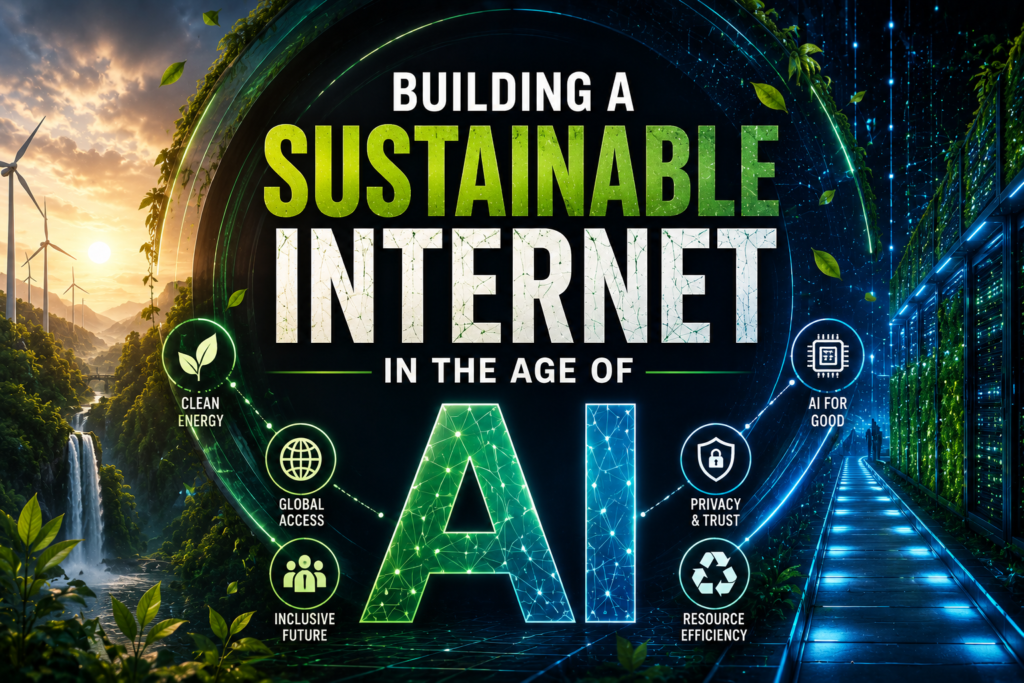
Building a sustainable internet in the age of AI is one of the most important technological challenges of our time. As artificial intelligence continues to expand its role in society, the demand for computing power, data storage, and digital infrastructure will only increase.
However, this growth does not have to come at the expense of the environment. Through green data centers, efficient AI systems, renewable energy, edge computing, and responsible user behavior, it is possible to create a digital ecosystem that is both powerful and sustainable.
The future of the internet will not be defined solely by speed or intelligence. It will be defined by balance, between innovation and responsibility, between progress and preservation, and between technological advancement and environmental care.
A truly sustainable internet ensures that digital progress benefits not only the present generation but also those to come.
Also Read: “The Sovereign Cloud Shift“
Frequently Asked Questions (FAQs)
1. What does a sustainable internet mean?
A sustainable internet is a digital ecosystem designed to reduce environmental impact while improving efficiency, accessibility, and long-term scalability.
2. How does AI affect internet sustainability?
AI increases computational demand and energy consumption but also helps optimize systems, reduce waste, and improve efficiency across industries.
3. What are green data centers?
Green data centers use renewable energy, efficient cooling systems, and optimized hardware to reduce their environmental footprint.