








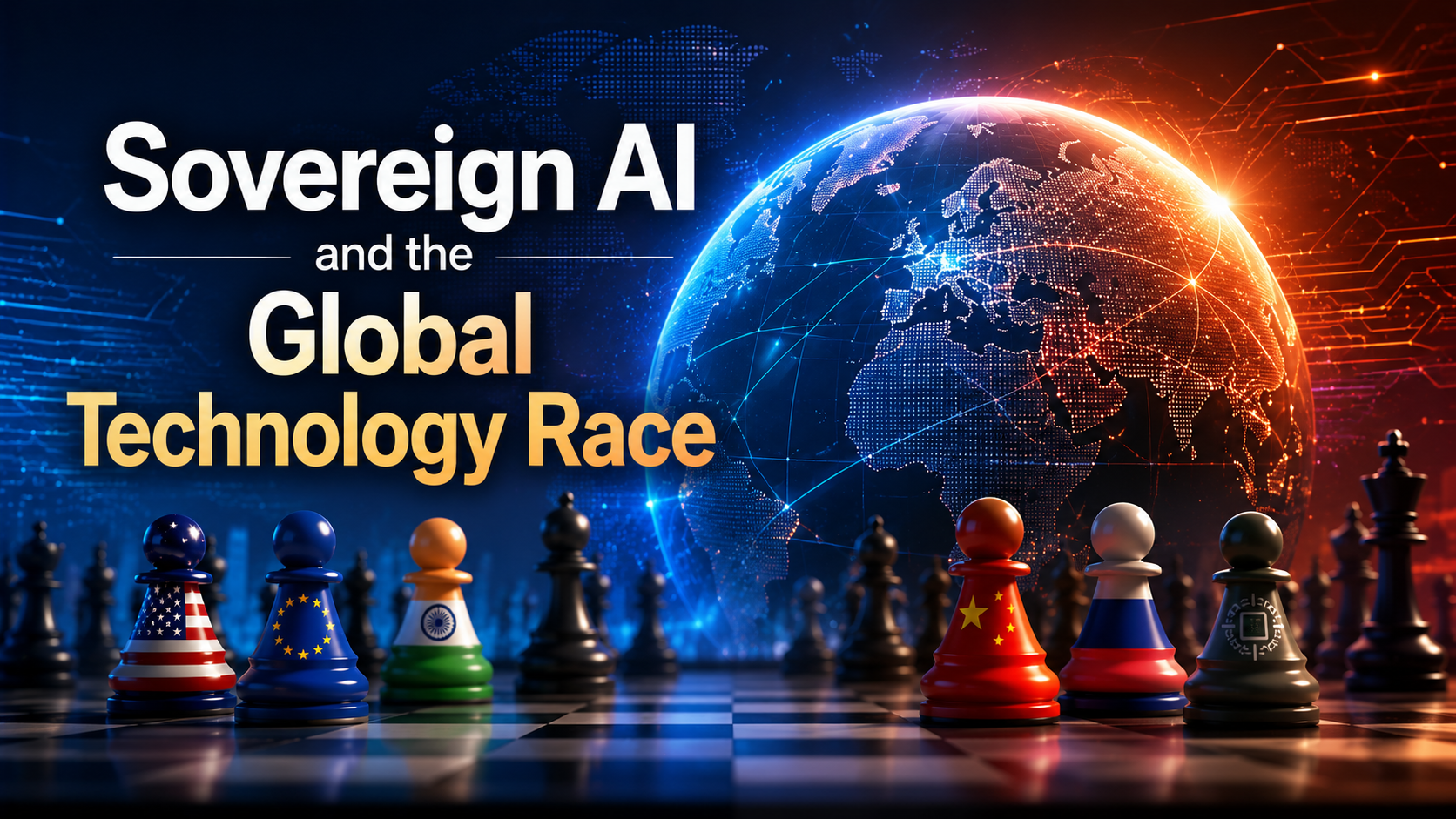
Artificial intelligence is no longer just a business revolution. It has become a matter of economic security, geopolitical influence, technological independence, and national competitiveness. Countries around the world are investing billions of dollars into AI infrastructure, semiconductor manufacturing, supercomputing capabilities, and local AI ecosystems in an effort to secure their place in the next technological era. Sovereign AI and the Global Technology Race: Why Nations Are Competing for Artificial Intelligence Independence
At the center of this transformation lies a new concept that is rapidly reshaping global strategies: Sovereign AI.
Much like energy independence or food security, nations increasingly view artificial intelligence as a strategic asset that should be developed, controlled, and governed domestically. Governments are seeking to reduce dependence on foreign technology providers and ensure that AI systems reflect their languages, cultures, values, and security priorities.
As the race for AI supremacy intensifies, another profound change is unfolding in education. The future classroom is already here, and digital literacy beyond search engines is becoming one of the most important skills for future generations.
The global technology race is no longer just about who invents the next device. It is about who owns the data, controls the infrastructure, trains the most advanced models, and prepares citizens for an AI-first world.
Table of Contents
Understanding Sovereign AI
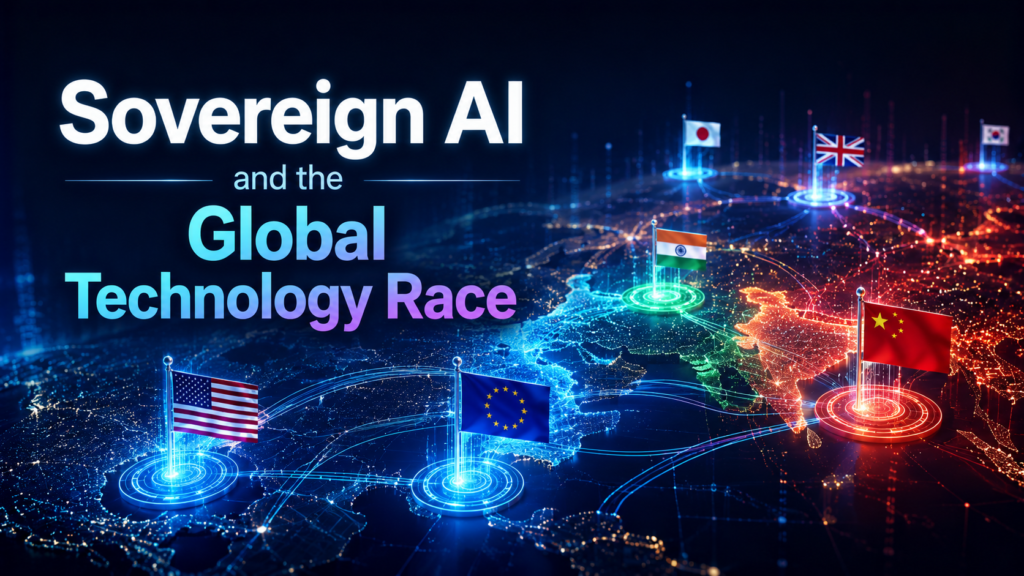
Sovereign AI refers to a nation’s ability to develop, deploy, and govern artificial intelligence systems using its own:
- Data resources
- Computing infrastructure
- Semiconductor supply chains
- Language models
- Regulatory frameworks
- Research ecosystems
- Skilled workforce
The objective is simple:
Ensure that critical AI capabilities remain under national control rather than relying entirely on foreign technology companies or governments.
Sovereign AI enables countries to maintain:
- Economic independence
- Cybersecurity resilience
- Cultural representation
- Data privacy
- National security
In many ways, Sovereign AI is becoming the digital equivalent of energy sovereignty.
Why Sovereign AI Matters
Artificial intelligence is expected to become a foundational layer for almost every industry.
These include:
- Healthcare
- Defense
- Banking
- Manufacturing
- Agriculture
- Education
- Transportation
- Telecommunications
Dependence on external AI providers creates several risks:
Data Exposure
Sensitive information may be processed outside national borders.
Strategic Vulnerability
Foreign governments or corporations may control critical AI infrastructure.
Cultural Bias
Global AI systems may not understand local languages, traditions, or contexts.
Economic Dependency
Nations risk becoming consumers instead of creators of AI technologies.
Consequently, governments are increasingly pursuing domestic AI ecosystems.
The Global Technology Race Has Begun
The world is witnessing an AI race comparable to the space race of the twentieth century.
However, today’s competition involves:
- Semiconductors
- Large language models
- Supercomputers
- Data centers
- Talent acquisition
- AI startups
- Quantum computing
- Cloud infrastructure
Countries leading the AI race understand that technological leadership often translates into economic and geopolitical power.
Major Players in the Sovereign AI Race
United States
The United States remains the global leader in AI innovation.
Its advantages include:
- Leading technology companies
- World-class universities
- Venture capital ecosystems
- Advanced semiconductor design
- Extensive cloud infrastructure
Companies like OpenAI, Google, Microsoft, NVIDIA, Anthropic, and Meta continue to drive AI breakthroughs.
America’s strategy focuses on maintaining leadership through innovation and private-sector partnerships.
China
China views AI as a national priority.
Its strengths include:
- Massive data resources
- State-backed investments
- Large domestic markets
- Strong manufacturing capabilities
China aims to achieve technological self-sufficiency while reducing dependence on Western technology.
The country’s AI development strategy integrates:
- Smart cities
- Manufacturing
- Healthcare
- Military applications
China’s approach demonstrates how AI has become part of long-term geopolitical planning.
European Union
Europe emphasizes:
- Ethical AI
- Privacy protection
- Regulatory leadership
- Digital sovereignty
Rather than competing solely on scale, Europe seeks to build trustworthy AI ecosystems aligned with democratic values.
European investments focus on:
- AI research
- Green computing
- Open-source initiatives
- Human-centered AI
India
India is emerging as a major player in the AI landscape.
Its advantages include:
- A large technology workforce
- Growing startup ecosystems
- Strong software expertise
- Multilingual diversity
India’s Sovereign AI ambitions involve:
- Indigenous language models
- Public digital infrastructure
- AI applications in agriculture and healthcare
- Semiconductor manufacturing initiatives
India’s demographic advantage positions it as a critical participant in the global technology race.
Middle East
Countries such as:
- United Arab Emirates
- Saudi Arabia
are investing heavily in:
- AI research centers
- Data infrastructure
- Smart city projects
Oil-rich nations are diversifying their economies and positioning themselves for an AI-driven future.
Why Chips Have Become Strategic Assets
Artificial intelligence depends heavily on semiconductors.
Without advanced chips, even the best algorithms cannot function efficiently.
Modern AI systems require:
- GPUs
- High-bandwidth memory
- Supercomputers
- Specialized processors
This explains why semiconductor supply chains have become geopolitical concerns.
Countries are investing billions to strengthen domestic chip manufacturing.
| Critical Resource | Importance |
|---|---|
| Semiconductors | AI computation |
| Data Centers | Model training |
| Cloud Infrastructure | Deployment |
| Skilled Talent | Innovation |
| Data | AI accuracy |
| Energy | Computational power |
Control over these resources increasingly determines AI competitiveness.
Data Sovereignty: The New Oil Economy
For decades, oil shaped global geopolitics.
In the AI era, data is emerging as the most valuable resource.
Governments want sensitive information stored within their borders.
Data sovereignty ensures:
- Privacy protection
- National security
- Compliance with regulations
- Reduced dependence on foreign clouds
Countries are establishing:
- Local cloud infrastructure
- National data centers
- Domestic AI ecosystems
This trend reflects a broader shift toward digital independence.
The Economics of Sovereign AI
Building national AI capabilities requires enormous investment.
These costs include:
Supercomputing Infrastructure
Training advanced models demands massive computing power.
Semiconductor Ecosystems
Manufacturing chips requires sophisticated supply chains.
Talent Development
AI researchers and engineers remain scarce resources.
Energy Consumption
Large-scale AI systems consume vast amounts of electricity.
Despite these costs, governments view AI investment as essential for future economic growth.
According to industry projections, AI could contribute trillions of dollars to the global economy over the coming decades.
AI Talent: The New Strategic Resource
The competition for AI talent has become global.
Countries are competing to attract:
- Data scientists
- AI researchers
- Machine learning engineers
- Semiconductor experts
- Robotics specialists
Universities are expanding AI programs while governments introduce initiatives to retain skilled professionals.
Human capital may become more valuable than physical infrastructure.
Open Source Versus Closed AI Models
One major debate in Sovereign AI concerns model accessibility.
Closed Models
Advantages:
- Higher performance
- Greater commercial support
- Better optimization
Disadvantages:
- Dependence on external providers
- Licensing limitations
Open-Source Models
Advantages:
- Greater transparency
- Local customization
- Reduced dependency
Disadvantages:
- Security concerns
- Resource-intensive deployment
Many countries are supporting open-source AI ecosystems to enhance sovereignty.
AI and National Security
Artificial intelligence increasingly affects defense systems.
Applications include:
- Cybersecurity
- Intelligence analysis
- Autonomous systems
- Battlefield simulations
- Threat detection
Military organizations recognize that AI superiority can influence strategic advantages.
Consequently, AI development has become intertwined with national security policies.
The Future Classroom Is Already Here
The global AI race is not only about governments and corporations.
Education itself is transforming.
Students today learn through:
- AI tutors
- Adaptive learning platforms
- Virtual classrooms
- Personalized learning systems
Traditional education focused heavily on memorization.
Modern classrooms emphasize:
- Creativity
- Collaboration
- Problem-solving
- Analytical thinking
- AI literacy
The classroom of tomorrow already exists.
The challenge is ensuring equal access to these opportunities.
Digital Literacy Beyond Search Engines
For years, digital literacy meant knowing how to browse the internet.
That definition is rapidly becoming outdated.
Tomorrow’s workforce must understand:
AI Collaboration
People must learn how to work effectively alongside intelligent systems.
Prompt Engineering
Communicating with AI is becoming an essential skill.
Information Verification
AI-generated content requires human oversight.
Individuals must evaluate:
- Accuracy
- Bias
- Reliability
Data Awareness
Understanding:
- Privacy
- Security
- Ownership
has become increasingly important.
Critical Thinking
As AI systems become more powerful, human judgment becomes even more valuable.
Digital literacy is evolving beyond search engines toward intelligent interaction.
The Rise of AI Alliances
No country can achieve complete AI independence.
International cooperation remains essential.
Strategic alliances are forming around:
- Semiconductor manufacturing
- Research collaboration
- Cybersecurity
- Cloud infrastructure
- Supply chains
These partnerships will shape the future global order.
Challenges Facing Sovereign AI
High Costs
Building AI infrastructure requires billions of dollars.
Talent Shortages
Demand for AI experts exceeds supply.
Energy Constraints
Training large models consumes significant electricity.
Regulatory Complexity
Balancing innovation and safety remains difficult.
Ethical Concerns
Issues involving:
- Bias
- Transparency
- Accountability
require careful governance.
Industries Most Influenced by Sovereign AI
| Industry | AI Applications |
|---|---|
| Healthcare | Diagnostics and medical research |
| Agriculture | Precision farming |
| Finance | Fraud detection |
| Manufacturing | Automation |
| Education | Personalized learning |
| Transportation | Autonomous systems |
| Defense | Intelligence and security |
| Energy | Grid optimization |
Virtually every sector depends on AI capabilities.
What Businesses Should Do
Organizations should prepare by:
Investing in AI Skills
Upskilling employees creates long-term advantages.
Building Data Strategies
High-quality data improves competitiveness.
Embracing Responsible AI
Trust and transparency matter.
Partnering with Local Ecosystems
Domestic innovation strengthens resilience.
Prioritizing Cybersecurity
Protecting AI infrastructure is essential.
The Future of the Global Technology Race
The competition for AI leadership is likely to intensify.
Future battles may revolve around:
- Quantum computing
- AI chips
- Robotics
- Synthetic biology
- Edge AI
- Space technologies
Countries that combine:
- Innovation
- Education
- Talent
- Infrastructure
will shape the next era of human progress.
The winners of the AI race may define the global economic landscape for decades.
Conclusion
Sovereign AI represents far more than technological independence. It reflects a new understanding that artificial intelligence has become critical infrastructure, similar to electricity, telecommunications, and energy.
The global technology race is accelerating, with nations investing heavily in chips, data centers, AI models, and talent development. Economic competitiveness, national security, and geopolitical influence increasingly depend on AI capabilities.
Meanwhile, the future classroom is already here. Digital literacy beyond search engines is becoming one of the most important competencies for the next generation. Success in the AI age will depend not only on access to technology but also on the ability to collaborate with intelligent systems, think critically, and innovate responsibly.
The nations, institutions, and individuals that embrace these changes today will be best positioned to thrive in tomorrow’s AI-driven world.
Also Read: “The Rise of Personal AI Ecosystems“
Frequently Asked Questions (FAQs)
1. What is Sovereign AI?
Sovereign AI refers to a country’s ability to develop, control, and govern artificial intelligence technologies using domestic data, infrastructure, and regulatory frameworks.
2. Why is Sovereign AI important?
Sovereign AI helps protect national security, data privacy, economic independence, and cultural representation while reducing reliance on foreign technology providers.
3. Which countries are leading the AI race?
The United States, China, European Union members, India, and several Middle Eastern nations are investing heavily in AI infrastructure and innovation.