

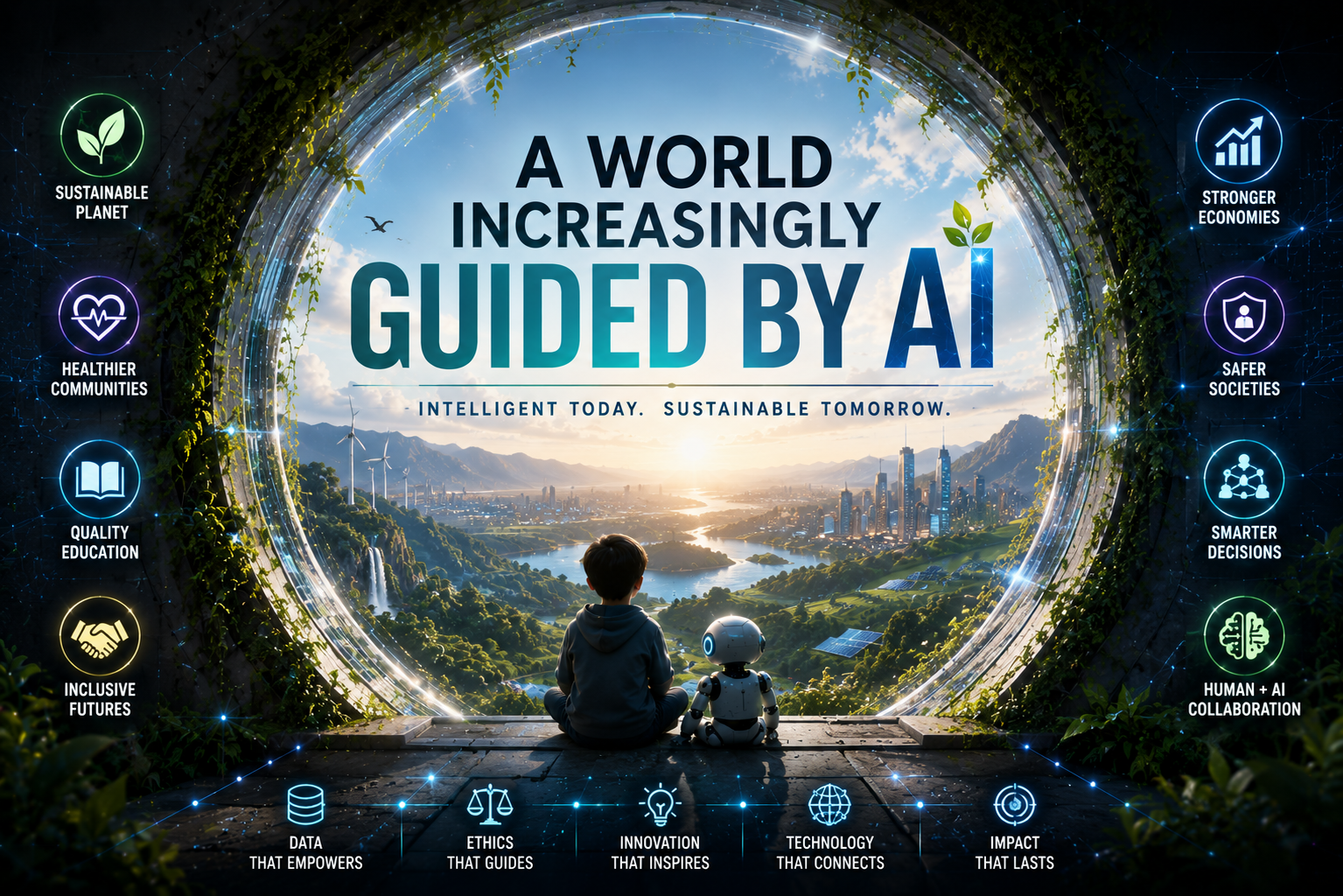
Introduction: The Invisible Intelligence Behind Modern Life
Artificial intelligence is no longer a futuristic concept discussed only by scientists and technology experts. It has become a powerful force embedded within everyday life, influencing decisions, shaping experiences, and transforming industries in ways many people barely notice. A World Increasingly Guided by AI.
Every day, billions of individuals interact with AI without consciously realizing it. From personalized recommendations on streaming platforms to navigation systems that optimize travel routes, from fraud detection in banking to intelligent assistants that answer questions, artificial intelligence is becoming deeply woven into the fabric of modern society.
What makes this transformation remarkable is its subtlety. Unlike previous technological revolutions that introduced visible machines and infrastructure, AI often operates behind the scenes. It works silently, processing data, identifying patterns, predicting outcomes, and offering guidance that influences countless decisions.
The world is entering an era where artificial intelligence is no longer simply a tool. It is becoming a guide.
This does not mean machines are taking control of society. Rather, AI is increasingly acting as a decision-support system that helps individuals, businesses, governments, and institutions navigate growing complexity. As data volumes expand and digital interactions multiply, AI provides the analytical power necessary to make sense of an increasingly connected world.
The rise of AI-guided systems marks one of the most important transformations of the digital age. Understanding this shift is essential for anyone seeking to thrive in the decades ahead.
Table of Contents
The Evolution of Artificial Intelligence in Society
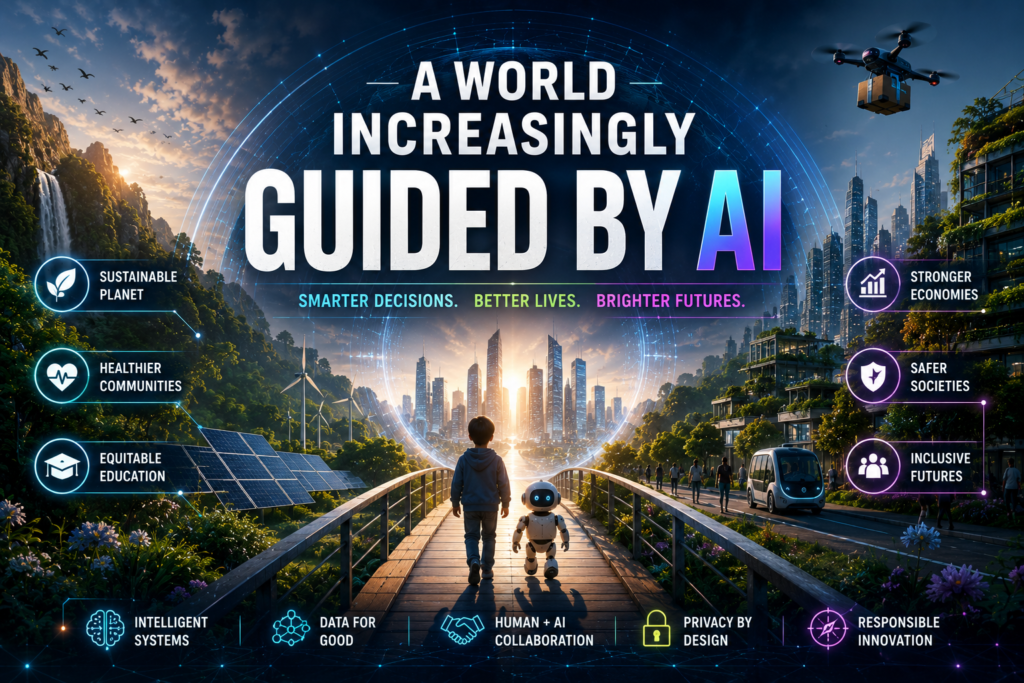
The journey toward an AI-guided world did not happen overnight.
Artificial intelligence has evolved through several stages.
| Era | AI Capability | Primary Impact |
|---|---|---|
| Early Computing | Rule-Based Systems | Basic automation |
| Internet Age | Data Collection | Personalized services |
| Machine Learning Era | Pattern Recognition | Predictive insights |
| Generative AI Era | Content Creation | Cognitive assistance |
| AI Agent Era | Autonomous Support | Intelligent decision-making |
Each stage expanded AI’s role in society.
Today, AI is transitioning from a passive analytical tool into an active participant in workflows, communications, and decision processes.
Why AI Is Becoming a Guide Rather Than Just a Tool
Traditional software required explicit instructions.
Artificial intelligence works differently.
Modern AI systems can:
- Analyze massive datasets
- Identify trends
- Generate recommendations
- Predict outcomes
- Personalize experiences
- Automate decisions
These capabilities allow AI to function as a guide rather than merely an instrument.
Instead of asking software to perform a task, users increasingly ask AI systems for advice, insights, and recommendations.
This subtle shift represents a major change in how humans interact with technology.
The Rise of AI-Guided Decision-Making
One of the most significant developments in modern society is AI-assisted decision-making.
Every day, AI influences decisions related to:
- Shopping
- Transportation
- Education
- Healthcare
- Entertainment
- Finance
- Business operations
For example:
A navigation application recommends the fastest route.
A streaming platform suggests content.
A bank identifies suspicious transactions.
An online retailer recommends products.
An AI assistant summarizes information before a meeting.
In each case, AI provides guidance that shapes human choices.
While people retain ultimate control, AI increasingly influences the decision-making process.
Artificial Intelligence in Everyday Life
Many people underestimate how frequently they interact with AI.
Modern life includes AI-powered systems such as:
Search and Information Discovery
AI helps users find relevant information faster.
Digital Assistants
Voice assistants answer questions and perform tasks.
Recommendation Engines
Algorithms personalize content and products.
Smart Devices
Connected technologies adapt to user preferences.
Language Translation
AI enables global communication across languages.
Collectively, these technologies are changing daily habits and expectations.
The Growing Influence of AI on Human Behavior
Technology has always influenced behavior.
Artificial intelligence takes this influence to a new level.
AI systems shape:
- What people read
- What they watch
- What they buy
- How they travel
- How they communicate
- How they learn
Because recommendations are personalized, individuals increasingly experience customized digital environments.
These environments can significantly influence preferences, habits, and perceptions.
As AI becomes more sophisticated, understanding its influence becomes increasingly important.
AI and the Future of Work
The workplace is one of the areas experiencing the most significant transformation.
AI is helping professionals:
- Conduct research
- Analyze data
- Write reports
- Generate ideas
- Automate repetitive tasks
- Improve customer service
Rather than eliminating all human roles, AI is reshaping workflows.
Workers increasingly collaborate with intelligent systems that enhance productivity and efficiency.
The future workforce will likely be defined by successful human-AI partnerships.
Human Intelligence and Machine Intelligence
The relationship between humans and AI is often misunderstood.
Human intelligence and machine intelligence excel at different tasks.
| Human Strengths | AI Strengths |
|---|---|
| Creativity | Speed |
| Empathy | Data Processing |
| Ethics | Automation |
| Leadership | Pattern Recognition |
| Strategic Thinking | Scalability |
| Contextual Understanding | Continuous Analysis |
The most successful organizations combine these strengths rather than viewing them as competitors.
The future belongs to collaboration, not replacement.
AI in Education and Learning
Artificial intelligence is transforming education worldwide.
AI-powered systems can:
- Personalize learning experiences
- Adapt educational content
- Identify knowledge gaps
- Provide instant feedback
- Support lifelong learning
Students gain access to customized educational pathways that were previously impossible at scale.
Teachers remain critical because they provide mentorship, motivation, and human connection.
AI enhances educational effectiveness rather than replacing educators.
Healthcare in an AI-Guided World
Healthcare illustrates the potential of AI particularly well.
Modern AI systems assist with:
- Medical imaging analysis
- Disease prediction
- Treatment recommendations
- Administrative automation
- Patient monitoring
Healthcare professionals use these insights to make more informed decisions.
The combination of human expertise and machine intelligence can improve outcomes while reducing inefficiencies.
The Emergence of AI Agents
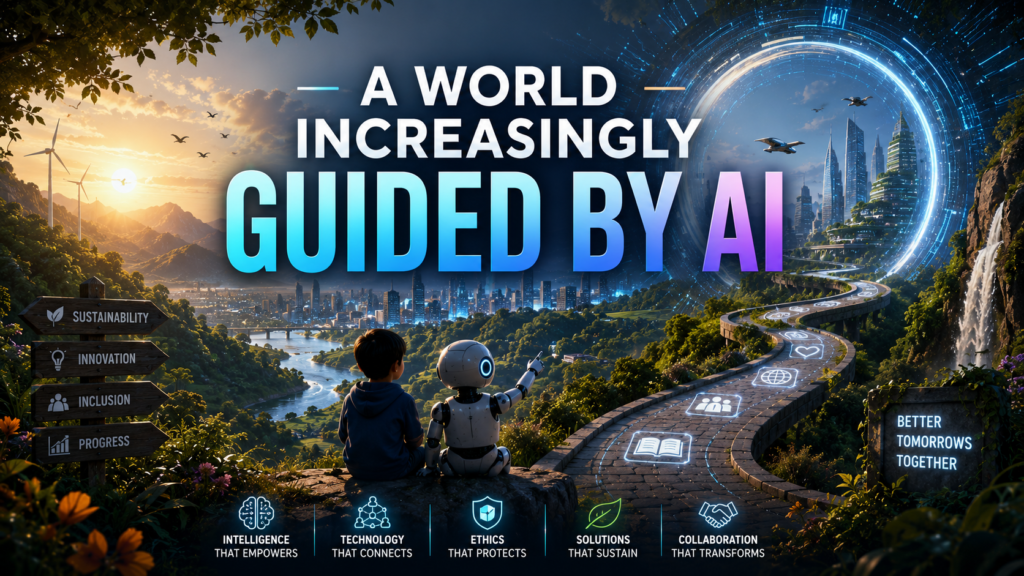
The next stage of AI development involves autonomous agents.
Unlike traditional applications, AI agents can:
- Understand objectives
- Plan actions
- Execute tasks
- Learn from feedback
- Coordinate workflows
These systems may soon assist with:
- Business operations
- Research projects
- Customer support
- Scheduling
- Personal productivity
AI agents represent a significant step toward a world where technology actively participates in achieving goals.
Economic Implications of an AI-Guided Society
Artificial intelligence is becoming a major economic force.
Benefits include:
Increased Productivity
Organizations can accomplish more with fewer resources.
Faster Innovation
AI accelerates idea generation and problem-solving.
Improved Efficiency
Automation reduces repetitive work.
New Industries
AI creates entirely new markets and opportunities.
Enhanced Decision Quality
Organizations gain deeper insights from data.
These factors contribute to long-term economic growth and competitiveness.
Challenges of Living in an AI-Guided World
Despite its benefits, AI introduces important challenges.
Algorithmic Bias
AI systems may reflect biases present in training data.
Privacy Concerns
Data collection raises questions about user protection.
Transparency
Some AI decisions are difficult to explain.
Digital Dependency
Excessive reliance on AI may reduce independent thinking.
Security Risks
Intelligent systems require strong safeguards.
Responsible AI development must address these concerns to ensure public trust.
Building AI Literacy for the Future
As AI becomes more influential, understanding how it works becomes increasingly important.
AI literacy includes:
- Understanding AI capabilities
- Recognizing limitations
- Evaluating outputs critically
- Protecting privacy
- Using AI responsibly
Just as digital literacy became essential during the internet age, AI literacy is becoming a critical skill for the future.
The Ethical Dimension of AI Guidance
When AI influences decisions, ethical questions naturally emerge.
Important considerations include:
- Fairness
- Accountability
- Transparency
- Privacy
- Human oversight
Organizations developing AI systems must prioritize responsible practices.
Public trust will depend on ensuring that AI serves human interests while respecting societal values.
What the Next Decade May Look Like
The coming decade may bring even deeper integration between humans and intelligent systems.
Possible developments include:
- AI-powered personal assistants
- Autonomous workplace agents
- Personalized education systems
- Predictive healthcare platforms
- Intelligent government services
- Enhanced scientific research tools
AI will likely become increasingly proactive, helping individuals navigate complexity before challenges arise.
The future may involve technology that not only responds to requests but actively supports human goals.
Human Agency in an AI-Driven Future
Despite rapid advancements, humans remain central to the future of AI.
Artificial intelligence can process information.
Humans define purpose.
AI can identify opportunities.
Humans establish priorities.
AI can generate recommendations.
Humans make final judgments.
The most important principle of an AI-guided world is that technology should enhance human agency rather than diminish it.
When designed responsibly, AI becomes a powerful partner in achieving human aspirations.
Conclusion
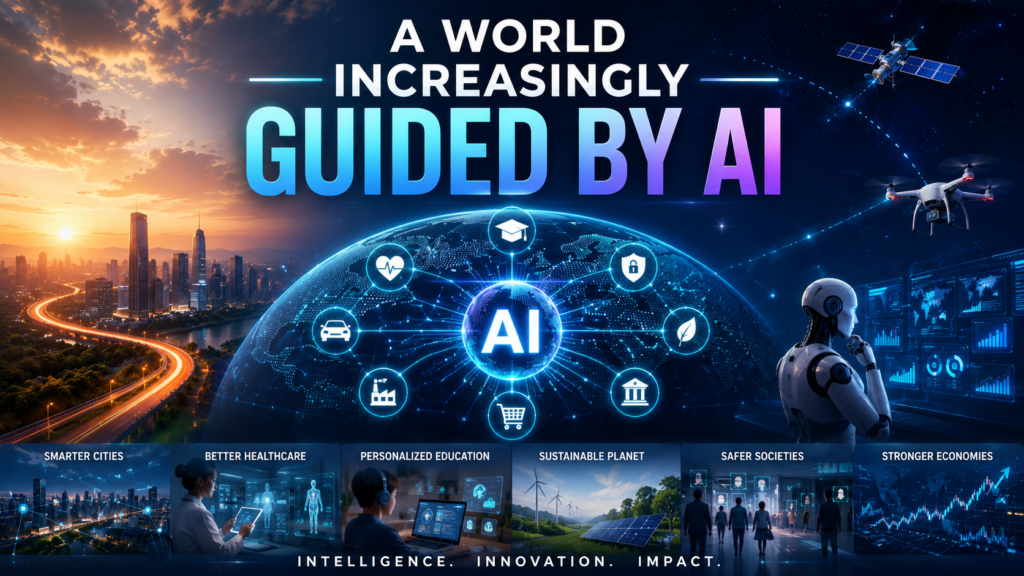
A world increasingly guided by AI is not a distant possibility, it is the reality emerging around us today. Artificial intelligence is influencing decisions, powering services, enhancing productivity, and helping individuals navigate an increasingly complex digital environment.
From healthcare and education to business and personal productivity, AI is becoming a trusted source of insight and support. Its role continues to expand as organizations seek smarter ways to solve problems, improve efficiency, and create value.
However, the future of AI is not solely about technology. It is about how humanity chooses to use that technology. Success will depend on balancing innovation with responsibility, automation with human oversight, and intelligence with ethics.
The most powerful future is not one where machines replace people. It is one where artificial intelligence helps people become more informed, more productive, and more capable than ever before.
As society moves deeper into the AI era, understanding and shaping this relationship will become one of the defining challenges, and opportunities, of our time.
Also Read: “Why We Switched to AI Agents“
Frequently Asked Questions (FAQs)
1. What does it mean to live in a world guided by AI?
It means that artificial intelligence increasingly influences decisions, recommendations, services, and experiences across daily life, business, education, healthcare, and other sectors.
2. Is AI replacing human decision-making?
No. AI primarily supports decision-making by providing insights, recommendations, and analysis, while humans retain responsibility for final judgments and actions.
3. What industries are most affected by AI?
Healthcare, finance, education, retail, manufacturing, media, logistics, and technology are among the sectors experiencing significant AI-driven transformation.