



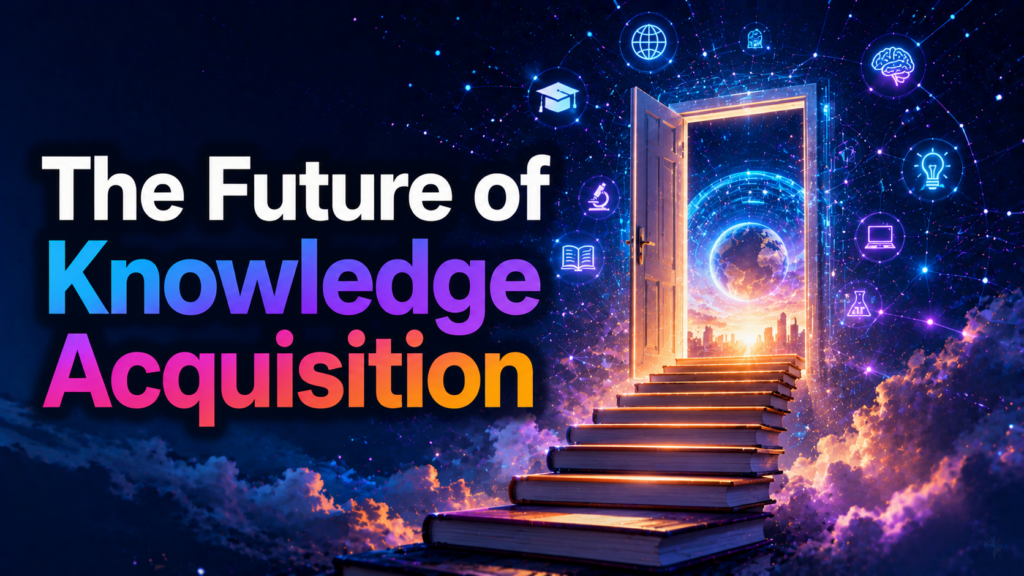
For thousands of years, acquiring knowledge was one of humanity’s greatest challenges. Information was scarce, difficult to access, and often limited to privileged groups. Ancient scholars spent decades collecting manuscripts. Students relied on libraries containing only a fraction of the world’s knowledge. Researchers dedicated years to finding answers that today can be discovered within seconds. The Future of Knowledge Acquisition.
The internet fundamentally changed this reality. Search engines transformed information discovery, giving billions of people unprecedented access to knowledge. Today, artificial intelligence is initiating another profound shift, one that may be even more transformative than the rise of the internet itself.
We are entering an era where knowledge is not simply stored online waiting to be found. Instead, intelligent systems can understand questions, synthesize information, personalize explanations, and assist learners in real time. This evolution is reshaping how humans acquire knowledge, develop skills, and interact with information.
The future of knowledge acquisition is no longer defined solely by access. It is increasingly defined by personalization, context, intelligence, and continuous learning.
Understanding this transformation is essential for students, professionals, educators, businesses, and policymakers seeking to thrive in an AI-driven world.
Table of Contents
The Historical Evolution of Knowledge Acquisition
Every major advancement in civilization has been accompanied by innovations in knowledge sharing.
Human learning has evolved through several significant stages:
| Era | Primary Knowledge Source | Limitation |
|---|---|---|
| Oral Civilization | Storytelling | Limited scalability |
| Writing Age | Manuscripts | Restricted access |
| Printing Era | Books | Distribution constraints |
| Industrial Education | Schools & Universities | Standardized learning |
| Internet Era | Search Engines | Information overload |
| AI Era | Intelligent Systems | Information verification challenges |
Each stage expanded humanity’s ability to learn.
The AI era represents the next major leap.
From Information Scarcity to Information Abundance
For most of history, information scarcity was the dominant challenge.
Today, the challenge is information abundance.
Modern learners face:
- Millions of websites
- Endless social media content
- Video platforms
- Online courses
- Research databases
- AI-generated information
The problem is no longer finding information.
The problem is identifying what matters.
This shift is changing the very nature of knowledge acquisition.
Artificial Intelligence and the New Learning Paradigm
Artificial intelligence is redefining how knowledge is discovered and understood.
Unlike traditional search engines that provide lists of links, AI systems can:
- Answer questions directly
- Summarize complex topics
- Explain concepts in simple language
- Generate personalized learning paths
- Adapt explanations to individual needs
This creates a fundamentally different learning experience.
Knowledge becomes conversational rather than purely navigational.
The Rise of Personalized Learning
Traditional education often follows a standardized approach.
Every learner receives similar content regardless of:
- Learning style
- Prior knowledge
- Interests
- Pace of learning
AI enables personalized education at scale.
Modern learning systems can:
- Analyze learning behavior
- Identify weaknesses
- Recommend resources
- Adjust content difficulty
- Provide targeted feedback
As a result, knowledge acquisition becomes more effective and engaging.
Why Search Is No Longer Enough
Search engines revolutionized access to information.
However, searching requires users to:
- Formulate queries
- Evaluate sources
- Compare results
- Synthesize information
AI systems increasingly perform many of these tasks automatically.
Instead of searching for information, users engage in conversations with intelligent assistants that provide contextual responses.
This evolution changes how knowledge is consumed and understood.
The Shift From Memorization to Understanding
Traditional education often emphasized memorization.
Students were expected to remember:
- Facts
- Dates
- Formulas
- Definitions
In the age of AI, information retrieval becomes effortless.
Consequently, educational priorities are shifting toward:
- Critical thinking
- Problem-solving
- Creativity
- Analysis
- Application
Future success depends less on what individuals know and more on how effectively they use knowledge.
Knowledge Acquisition Becomes Continuous
Historically, education followed a predictable structure:
- Formal schooling
- Higher education
- Professional career
Today’s economy operates differently.
Technology evolves rapidly.
Industries transform continuously.
New skills emerge frequently.
Knowledge acquisition increasingly becomes a lifelong process.
Professionals must continuously learn, adapt, and evolve.
AI-powered learning tools support this ongoing development.
The Growing Importance of AI Literacy
As AI becomes embedded in daily life, understanding intelligent systems becomes essential.
AI literacy includes:
- Understanding AI capabilities
- Recognizing AI limitations
- Evaluating AI-generated information
- Using AI responsibly
- Collaborating effectively with AI systems
Future knowledge acquisition depends not only on consuming information but also on understanding how intelligent technologies generate and present it.
Human Intelligence and Artificial Intelligence
The future of learning is not a competition between humans and machines.
It is a partnership.
AI contributes:
- Speed
- Pattern recognition
- Information processing
- Personalization
Humans contribute:
- Creativity
- Judgment
- Ethics
- Emotional intelligence
- Contextual understanding
The most effective learners will combine both strengths.
Knowledge acquisition becomes a collaborative process between human intelligence and artificial intelligence.
The Future Role of Search Engines
Search engines remain important, but their role is evolving.
Traditional search focuses on finding information.
Future search experiences increasingly focus on:
- Understanding intent
- Delivering synthesized insights
- Providing recommendations
- Supporting decision-making
Search is becoming more conversational, intelligent, and personalized.
This evolution reflects broader changes in how humans interact with knowledge.
Knowledge Acquisition Through AI Assistants
AI assistants are rapidly becoming educational companions.
These systems can:
- Answer questions instantly
- Generate explanations
- Create study plans
- Offer feedback
- Support research
Unlike traditional resources, AI assistants are interactive.
They respond dynamically to learner needs.
This creates a more engaging educational experience.
The Rise of Multimodal Learning
Future knowledge acquisition extends beyond text.
Modern AI systems increasingly support:
- Voice interaction
- Images
- Videos
- Simulations
- Interactive environments
Multimodal learning improves comprehension by engaging multiple senses and learning styles.
Educational experiences become richer and more immersive.
Critical Thinking in the Age of Instant Answers
One of the most important future skills is critical thinking.
AI can generate answers rapidly.
However, not all outputs are accurate.
Learners must evaluate:
- Source reliability
- Evidence quality
- Contextual relevance
- Potential bias
Critical thinking transforms information into understanding.
Without it, information abundance can become overwhelming.
Digital Literacy Beyond Search Engines
The future learner requires more than technical skills.
Digital literacy now includes:
- Information evaluation
- AI literacy
- Media literacy
- Data literacy
- Cybersecurity awareness
These competencies help individuals navigate increasingly complex digital environments.
Knowledge acquisition depends on understanding both information and the systems that deliver it.
Education Systems Must Adapt
Many educational institutions were designed for a different era.
Traditional models often prioritize:
- Memorization
- Standardization
- Fixed curricula
Future-ready education emphasizes:
- Adaptability
- Critical thinking
- Collaboration
- Creativity
- Lifelong learning
Schools and universities must evolve to prepare learners for AI-driven realities.
The Impact on Professional Development
Knowledge acquisition is becoming central to career success.
Modern professionals must continuously develop expertise.
Industries increasingly value:
| Traditional Skill Model | Future Skill Model |
|---|---|
| Static Knowledge | Continuous Learning |
| Technical Expertise Alone | Human + AI Collaboration |
| Degree-Based Validation | Skill-Based Validation |
| Fixed Career Paths | Adaptive Career Growth |
Professional learning becomes more dynamic and personalized.
Challenges Facing the Future of Knowledge Acquisition
Despite tremendous opportunities, several challenges remain.
Information Accuracy
AI-generated content may contain errors.
Misinformation
False information continues to spread rapidly.
Digital Inequality
Not everyone has equal access to advanced learning technologies.
Privacy Concerns
Educational data requires responsible protection.
Over-Reliance on Technology
Human reasoning remains essential.
Addressing these challenges is critical for responsible innovation.
The Future Classroom and Beyond
The future classroom extends beyond physical walls.
Learning increasingly occurs through:
- Virtual environments
- AI tutors
- Mobile devices
- Collaborative platforms
- Personalized digital ecosystems
Education becomes more flexible, accessible, and learner-centered.
Knowledge acquisition adapts to individual needs rather than forcing individuals into standardized systems.
How Businesses Benefit From Better Knowledge Acquisition
Organizations thrive when employees learn efficiently.
AI-powered learning supports:
- Faster onboarding
- Continuous training
- Skill development
- Workforce adaptability
- Innovation
Companies that invest in learning ecosystems gain competitive advantages in rapidly changing markets.
What Knowledge Acquisition May Look Like in 2035
Imagine a learner in 2035.
An AI assistant understands goals, learning preferences, and current skill levels.
Lessons adapt automatically.
Real-time feedback accelerates improvement.
Complex concepts are explained using personalized examples.
Knowledge becomes available instantly and contextually.
Learning is no longer constrained by location, schedules, or traditional educational structures.
Many aspects of this future are already emerging today.
Conclusion
The future of knowledge acquisition represents one of the most important transformations of the digital age. Artificial intelligence is changing how people access information, develop expertise, and engage with learning throughout their lives.
As information becomes increasingly abundant, the value of critical thinking, adaptability, digital literacy, and AI literacy continues to grow. The future is not about memorizing more information. It is about understanding, evaluating, and applying knowledge effectively.
Artificial intelligence offers powerful new tools for learning, but human intelligence remains central to meaningful understanding. The most successful learners will be those who combine technological capabilities with curiosity, creativity, judgment, and lifelong learning habits.
The evolution of knowledge acquisition is far from complete.
Yet one reality is already clear:
The future belongs not to those who simply access information, but to those who know how to transform information into insight, understanding, and action.
Also Read: “Building a Sustainable Internet in the Age of AI“
Frequently Asked Questions (FAQs)
1. What is knowledge acquisition?
Knowledge acquisition refers to the process of obtaining, understanding, and applying information through learning, experience, research, and education.
2. How is AI changing knowledge acquisition?
AI enables personalized learning, intelligent tutoring, real-time information access, adaptive education, and conversational knowledge discovery.
3. Will AI replace traditional learning methods?
AI will enhance many traditional methods but is unlikely to replace human educators, critical thinking, and experiential learning entirely.