


Introduction: Education Is Entering a New Economic Era
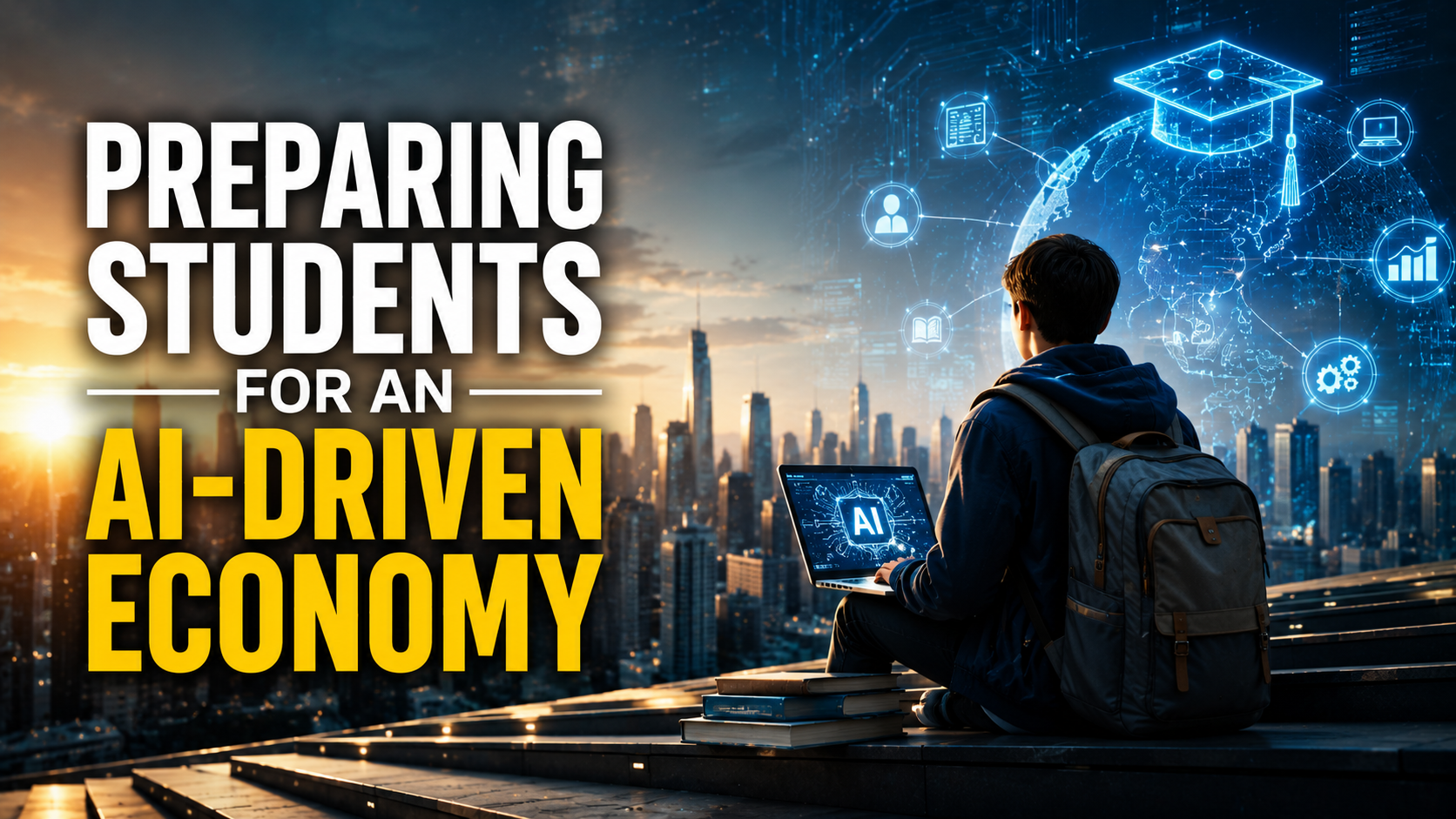
Every generation faces a defining technological shift that reshapes society, business, and employment. For previous generations, it was industrialization, electricity, computers, and the internet. For today’s students, that defining transformation is Artificial Intelligence (AI). Preparing Students for an AI-Driven Economy.
AI is no longer a futuristic concept discussed only in research laboratories. It is rapidly becoming part of everyday life. From recommendation algorithms and virtual assistants to autonomous systems and AI-powered business platforms, intelligent technologies are changing how people work, communicate, learn, and make decisions.
As AI continues to transform industries, a critical question emerges:
Are educational systems preparing students for an AI-driven economy?
The answer remains uncertain.
Many schools still operate using models designed for an industrial-age workforce. Yet the economy students will enter is dramatically different. Future careers will require adaptability, digital fluency, critical thinking, creativity, and the ability to collaborate with intelligent machines.
Preparing students for an AI-driven economy is not simply about teaching coding or introducing AI tools into classrooms. It is about helping learners develop the human and technological capabilities needed to thrive in a world where artificial intelligence becomes a core component of economic activity.
The challenge is significant, but so is the opportunity.
Educational institutions that embrace this transformation can empower the next generation to become innovators, leaders, entrepreneurs, and responsible participants in an increasingly intelligent world.
Table of Contents
Understanding the AI-Driven Economy
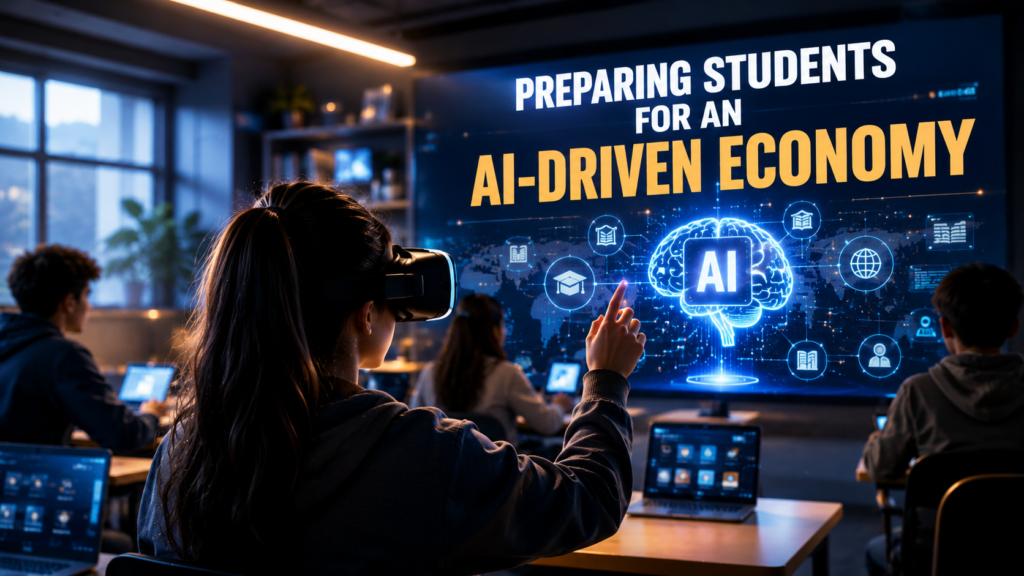
An AI-driven economy is one in which artificial intelligence significantly influences productivity, decision-making, innovation, and economic growth.
Across industries, AI is being used to:
- Automate repetitive tasks
- Analyze large datasets
- Improve customer experiences
- Enhance business operations
- Accelerate research and development
- Support strategic decision-making
The result is a new economic landscape where technology and human intelligence work together.
Unlike previous technological revolutions that primarily replaced physical labor, AI increasingly affects knowledge work, administrative tasks, and decision-based processes.
This means future workers will need a different skill set than previous generations.
Why Traditional Education Models Need to Evolve
For decades, educational systems were designed to prepare students for predictable careers and standardized workplace environments.
Traditional education emphasized:
- Memorization
- Standardized testing
- Fixed curricula
- Repetitive learning exercises
While these approaches still have value, they are no longer sufficient.
AI systems can now retrieve information, generate content, perform calculations, and automate routine tasks faster than humans.
As a result, educational priorities must shift.
Students need to learn how to:
- Solve complex problems
- Think critically
- Evaluate information
- Adapt to change
- Work alongside AI systems
The focus must move from knowledge acquisition alone to knowledge application.
The Skills Gap Emerging in the AI Era
One of the biggest challenges facing employers is the growing gap between existing educational outcomes and workforce requirements.
Many organizations report difficulty finding talent with the right combination of technical and human skills.
Emerging Workforce Expectations
| Traditional Skills | Future AI-Era Skills |
|---|---|
| Memorization | Critical Thinking |
| Routine Analysis | Creative Problem Solving |
| Manual Processes | AI Collaboration |
| Fixed Expertise | Continuous Learning |
| Individual Work | Human-AI Teamwork |
| Task Execution | Strategic Thinking |
This shift highlights the need for educational transformation.
AI Literacy: The New Foundational Skill
Just as computer literacy became essential during the digital revolution, AI literacy is becoming essential during the intelligence revolution.
Students do not necessarily need to become AI engineers.
However, they should understand:
- What AI is
- How AI systems work
- AI limitations
- Ethical considerations
- Responsible usage
- Real-world applications
AI literacy helps students become informed users rather than passive consumers of technology.
Understanding AI will soon be as important as understanding the internet.
Critical Thinking Becomes More Valuable Than Ever
The rise of generative AI has made information more accessible than at any point in history.
However, accessibility does not guarantee accuracy.
Students increasingly encounter:
- AI-generated content
- Automated recommendations
- Personalized information feeds
- Synthetic media
- Deepfakes
This makes critical thinking one of the most important future skills.
Students must learn to:
- Verify information
- Evaluate sources
- Identify bias
- Analyze evidence
- Challenge assumptions
In an AI-driven economy, the ability to think independently becomes a competitive advantage.
Creativity as a Competitive Human Advantage
Artificial intelligence can generate text, images, music, and code.
Yet true creativity remains deeply human.
Creativity involves:
- Original thinking
- Imagination
- Innovation
- Contextual understanding
- Emotional expression
As AI automates routine tasks, creative capabilities become increasingly valuable.
Future educational systems should prioritize:
- Design thinking
- Project-based learning
- Innovation challenges
- Creative exploration
The future workforce will reward people who can create, not just consume.
Communication Skills in an AI World
Technology continues to improve communication efficiency, but human communication remains irreplaceable.
Students need strong skills in:
- Writing
- Public speaking
- Collaboration
- Negotiation
- Storytelling
Organizations increasingly value employees who can communicate complex ideas clearly.
Effective communication becomes even more important when working with AI systems and multidisciplinary teams.
Emotional Intelligence and Human-Centered Skills
AI excels at processing data.
Humans excel at understanding people.
Emotional intelligence includes:
- Empathy
- Self-awareness
- Relationship building
- Conflict resolution
- Leadership
These capabilities remain difficult to automate.
In sectors such as healthcare, education, management, and customer service, emotional intelligence will continue to differentiate exceptional professionals.
Educational institutions should actively cultivate these skills.
The Importance of Digital Literacy Beyond Technology
Digital literacy is no longer limited to using software applications.
Modern digital literacy includes:
- Information evaluation
- Media literacy
- Privacy awareness
- Cybersecurity understanding
- Algorithm awareness
- AI literacy
Students must learn how digital systems influence information, behavior, and decision-making.
These skills support responsible participation in the digital economy.
Preparing Students for Jobs That Do Not Yet Exist
One of the most challenging aspects of educational planning is uncertainty.
Many future jobs have not been invented yet.
Historically, technological revolutions create new industries and occupations.
The AI era is likely to generate careers such as:
- AI trainers
- AI ethicists
- Human-AI workflow designers
- Digital trust specialists
- AI policy analysts
- Autonomous systems managers
Rather than training students for specific job titles, education should focus on transferable skills that remain valuable across changing industries.
Project-Based Learning and Real-World Problem Solving
Traditional instruction often emphasizes theoretical knowledge.
Future-ready education requires practical application.
Project-based learning allows students to:
- Solve real-world problems
- Collaborate with peers
- Develop creativity
- Practice communication
- Build resilience
These experiences mirror workplace realities more closely than standardized assessments alone.
Employers increasingly value demonstrated capabilities over memorized information.
The Growing Role of STEM and Beyond
Science, Technology, Engineering, and Mathematics (STEM) remain critically important.
However, AI-driven economies also require expertise in:
- Ethics
- Psychology
- Design
- Communication
- Business
- Social sciences
The future belongs to interdisciplinary thinkers who can connect technology with human needs.
Education should encourage both technical and humanistic perspectives.
Lifelong Learning Becomes Essential
In the past, education often ended after graduation.
Today, learning continues throughout life.
Technological change is accelerating rapidly.
Workers must continuously update their skills.
Educational systems should teach students how to learn independently.
Key lifelong learning habits include:
- Curiosity
- Adaptability
- Self-directed learning
- Continuous skill development
The most successful professionals will be lifelong learners.
The Role of Teachers in an AI-Driven Economy
AI will not replace educators.
Instead, teachers will become more important in new ways.
Future teachers will focus on:
- Mentorship
- Coaching
- Critical thinking development
- Ethical guidance
- Creativity facilitation
Technology can deliver information.
Teachers help students develop wisdom.
That distinction remains invaluable.
Challenges in Preparing Students for the AI Economy
Despite tremendous opportunities, several obstacles remain.
Unequal Access to Technology
Not all students have access to digital resources.
Curriculum Limitations
Many educational programs evolve slowly.
Teacher Training Gaps
Educators require support and professional development.
Ethical Concerns
AI usage must be guided responsibly.
Rapid Technological Change
Keeping educational systems current is challenging.
Addressing these issues requires collaboration among educators, policymakers, businesses, and technology providers.
What Schools and Universities Should Do Now
Educational institutions can begin preparing immediately by:
Integrating AI Literacy
Teaching AI fundamentals and responsible usage.
Modernizing Curricula
Aligning education with future workforce needs.
Encouraging Critical Thinking
Moving beyond memorization-based learning.
Supporting Creativity
Providing opportunities for innovation.
Promoting Digital Responsibility
Teaching ethical technology practices.
Strengthening Industry Partnerships
Connecting education with real-world experiences.
These actions help bridge the gap between education and future employment.
The Economic Benefits of Future-Ready Education
Countries that successfully prepare students for AI-driven economies may benefit from:
- Increased productivity
- Greater innovation
- Stronger entrepreneurship
- Higher workforce competitiveness
- Improved economic resilience
Education remains one of the most important drivers of long-term economic growth.
Investing in future-ready learning is investing in national prosperity.
Conclusion
Preparing students for an AI-driven economy is one of the most important educational challenges of the twenty-first century. Artificial intelligence is transforming industries, redefining work, and reshaping the skills required for success.
The future workforce will need more than technical knowledge. Students must develop critical thinking, creativity, communication, emotional intelligence, digital literacy, and adaptability. They must learn how to work with intelligent technologies while strengthening the uniquely human capabilities that machines cannot easily replicate.
The goal of education is no longer simply to prepare students for existing jobs.
It is to prepare them for continuous change.
Schools, universities, educators, businesses, and policymakers all have a role to play in this transformation.
The students who thrive in the AI-driven economy will not necessarily be those who know the most.
They will be those who can learn, adapt, innovate, and lead in a world where human intelligence and artificial intelligence work together.
The future economy is already taking shape.
Education must evolve to meet it.
Also Read: “AI Transformation Beyond Automation“
Frequently Asked Questions (FAQs)
1. What does an AI-driven economy mean?
An AI-driven economy is one where artificial intelligence significantly influences productivity, business operations, decision-making, innovation, and workforce requirements across industries.
2. What skills are most important for students in the AI era?
Critical thinking, creativity, communication, emotional intelligence, digital literacy, adaptability, problem-solving, and AI literacy are among the most valuable future skills.
3. Will AI replace many jobs in the future?
AI will automate certain tasks and transform some roles, but it will also create new opportunities and increase demand for uniquely human skills such as leadership, creativity, and strategic thinking.