





Why Trust, Expertise, and Credibility Are Becoming the New Currency of Digital Visibility
Introduction: The Search Landscape Has Changed Forever
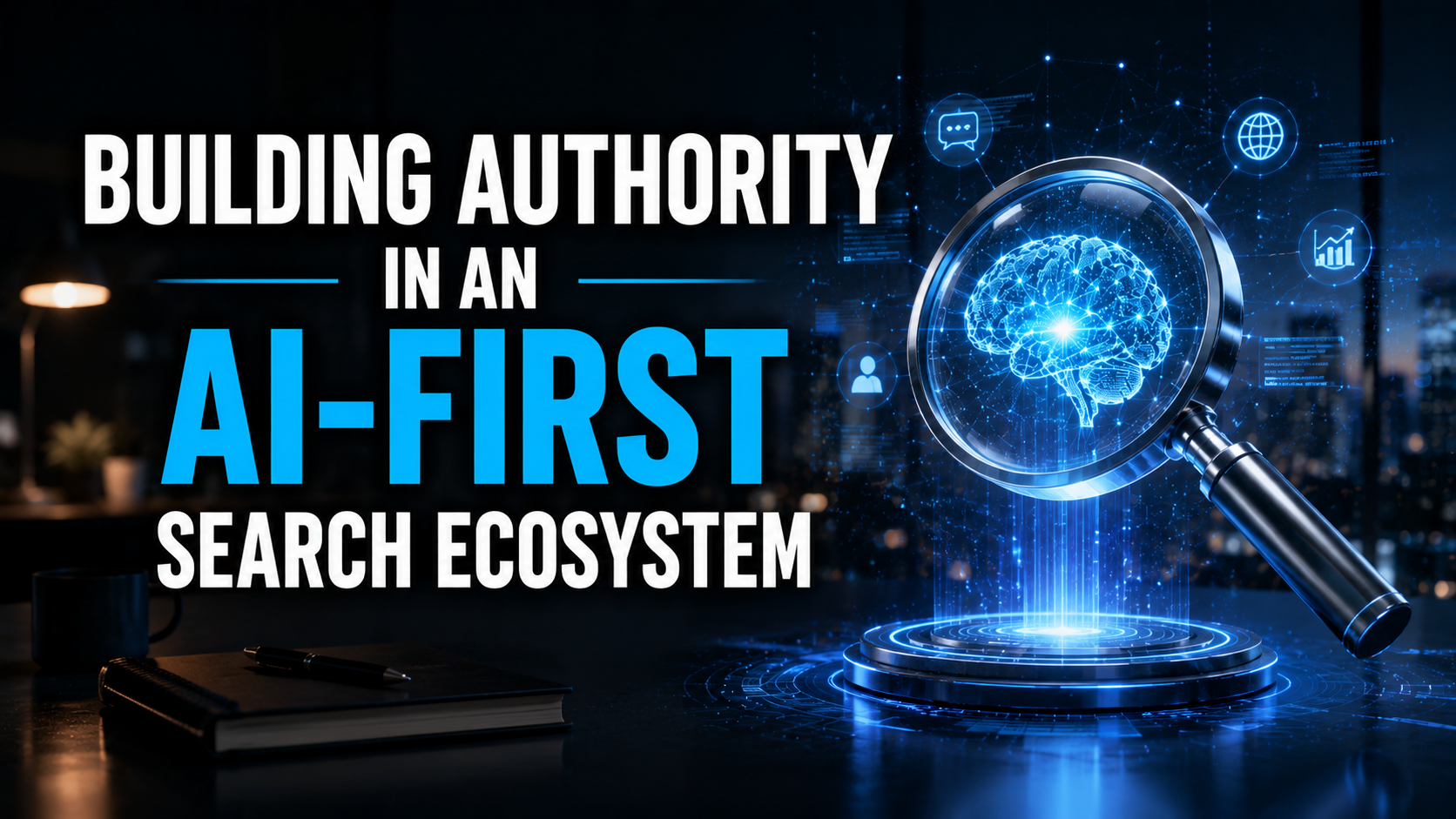
For more than two decades, digital visibility was largely determined by rankings. Building Authority in an AI-First Search Ecosystem.
Businesses invested heavily in Search Engine Optimization (SEO), keyword research, backlinks, technical optimization, and content marketing to secure top positions on search engine results pages. The logic was simple: higher rankings generated more traffic, and more traffic created more opportunities for growth.
Today, that formula is undergoing a dramatic transformation.
Artificial Intelligence is fundamentally changing how people discover information online. AI-powered search experiences, generative search engines, intelligent assistants, and conversational interfaces are increasingly replacing the traditional model of searching through pages of links.
Users now expect immediate answers rather than lists of websites.
Instead of asking, “Which website should I visit?” users are asking, “What is the answer?”
This shift has profound implications for businesses, publishers, marketers, and content creators.
In an AI-first search ecosystem, visibility is no longer determined solely by rankings.
It is increasingly determined by authority.
The organizations that consistently demonstrate expertise, trustworthiness, credibility, and original insight are becoming the sources that AI systems reference, summarize, recommend, and prioritize.
Authority is no longer a competitive advantage.
It is becoming a survival requirement.
As AI continues to reshape search, building authority may become the single most important strategy for long-term digital success.
Table of Contents
Understanding the AI-First Search Ecosystem
To understand why authority matters, it is important to understand how AI-first search differs from traditional search.
Historically, search engines operated as retrieval systems.
Users entered keywords.
Search engines returned links.
Users evaluated sources themselves.
The responsibility for determining credibility rested primarily with the user.
AI-powered search changes this process.
Modern AI systems increasingly:
- Interpret user intent
- Synthesize information
- Generate answers
- Recommend sources
- Personalize responses
The AI acts as an intermediary between users and information.
This means AI systems must determine which sources deserve trust.
As a result, authority becomes a central factor in visibility.
What Authority Means in the AI Era
Authority is often misunderstood.
Many people associate authority solely with popularity.
In reality, authority is built through multiple factors.
These include:
Expertise
Demonstrated knowledge within a specific subject area.
Experience
First-hand insights and practical understanding.
Trustworthiness
Accuracy, transparency, and reliability.
Recognition
Industry acknowledgment and reputation.
Consistency
Delivering high-quality information over time.
AI systems increasingly evaluate these signals when selecting information sources.
Authority is not something that can be manufactured overnight.
It is earned through sustained value creation.
Why AI Systems Depend on Authority
Artificial Intelligence faces a significant challenge.
The internet contains enormous amounts of information, but not all information is reliable.
AI systems must determine:
- Which sources are credible
- Which facts are trustworthy
- Which opinions deserve weight
- Which content provides genuine expertise
Without authority signals, AI-generated responses risk becoming inaccurate, misleading, or untrustworthy.
As a result, AI platforms increasingly prioritize content from authoritative sources.
This trend is likely to accelerate in the coming years.
Google’s EEAT Framework and AI Search
One of the most important frameworks influencing authority is Google’s EEAT model.
EEAT stands for:
Experience
Content created by individuals with direct experience.
Expertise
Demonstrated subject matter knowledge.
Authoritativeness
Recognition within a specific field.
Trustworthiness
Accuracy, transparency, and reliability.
Originally designed as a quality evaluation framework, EEAT has become increasingly relevant in AI-powered search environments.
AI systems require trusted sources to generate trustworthy answers.
EEAT provides a useful framework for identifying those sources.
The Shift From Rankings to Recommendations
Traditional SEO focused heavily on rankings.
Businesses competed for positions on search results pages.
Success was measured through:
- Keyword rankings
- Organic traffic
- Click-through rates
AI-first search introduces a new visibility model.
Success increasingly depends on:
- Recommendations
- Citations
- References
- Mentions
- Inclusion in generated answers
The question is no longer:
“Can my website rank?”
The question is:
“Will AI systems trust my content enough to include it?”
This shift changes the nature of digital competition.
Authority as a Visibility Signal
In the AI era, authority functions as a visibility signal.
Consider two organizations publishing similar information.
One is widely recognized, consistently accurate, and respected within its field.
The other is relatively unknown and lacks credibility signals.
Which source is more likely to be referenced by AI systems?
The answer is obvious.
Authority increases discoverability.
As AI search grows, authority may become one of the most powerful ranking factors ever created.
Building Topical Authority
One of the most effective strategies for AI-era visibility is topical authority.
Topical authority refers to deep expertise within a specific subject area.
Rather than publishing broadly on countless topics, organizations increasingly benefit from becoming definitive sources within focused domains.
Examples include:
- Cybersecurity
- Digital marketing
- Artificial intelligence
- Healthcare technology
- Financial planning
Topical authority helps AI systems understand:
- What your organization knows
- Which topics you specialize in
- Why your content deserves trust
Specialization often creates stronger authority than generalization.
Why Original Research Matters
AI systems can easily generate generic information.
What they cannot easily replicate is original knowledge.
Original research includes:
- Surveys
- Industry reports
- Proprietary data
- Case studies
- Experiments
- First-hand analysis
Organizations that produce original research create information that others reference.
This naturally strengthens authority.
In many industries, original insights have become one of the strongest competitive advantages available.
The Growing Importance of Author Credibility
People trust people.
AI systems increasingly recognize this reality.
Content associated with credible authors often performs better because it demonstrates:
- Expertise
- Experience
- Accountability
- Professional qualifications
Organizations should showcase:
- Author bios
- Credentials
- Experience
- Professional achievements
Authority is often strengthened when expertise is clearly visible.
Brand Authority and AI Visibility
Strong brands enjoy significant advantages in AI-first environments.
Recognized brands often possess:
- Greater trust
- More citations
- Better reputation signals
- Stronger audience loyalty
Brand authority influences both human perception and algorithmic evaluation.
Organizations that invest in brand-building often strengthen their search visibility simultaneously.
The future of SEO and branding may become increasingly interconnected.
The Role of Trust in AI Search
Trust is emerging as one of the most valuable digital assets.
Users increasingly rely on AI-generated answers.
This creates pressure on AI systems to prioritize trustworthy information.
Trust signals include:
Transparent Sources
Clear attribution and sourcing.
Accurate Information
Factually reliable content.
Consistent Publishing Standards
Maintaining quality over time.
Ethical Practices
Avoiding misleading content.
Trust takes years to build and moments to lose.
In the AI era, it may become an organization’s most valuable asset.
Why Content Quality Is No Longer Optional
For years, some websites achieved visibility through content volume.
AI-first search changes this equation.
Content quality increasingly matters more than content quantity.
High-quality content typically demonstrates:
- Depth
- Accuracy
- Relevance
- Originality
- User value
AI systems seek information that genuinely helps users.
Low-value content becomes increasingly difficult to justify.
Authority-Building Strategies for Businesses
Organizations seeking long-term visibility should focus on several key strategies.
Create Comprehensive Content
Cover topics thoroughly and accurately.
Publish Original Insights
Provide information unavailable elsewhere.
Demonstrate Expertise
Showcase real-world knowledge and experience.
Build Industry Recognition
Participate in conferences, publications, and professional communities.
Strengthen Brand Identity
Trustworthy brands often become authoritative brands.
Focus on User Value
Help people solve problems effectively.
Authority grows through contribution rather than promotion.
Measuring Authority in an AI-First World
Traditional SEO metrics remain useful, but new indicators are emerging.
| Traditional Metrics | AI-Era Authority Metrics |
|---|---|
| Rankings | Citations |
| Traffic | Recommendations |
| Backlinks | Brand Mentions |
| Clicks | Source Inclusion |
| Impressions | Trust Signals |
The future may involve measuring influence rather than simply measuring traffic.
Common Mistakes That Undermine Authority
Many organizations unintentionally weaken their authority.
Common mistakes include:
- Publishing inaccurate information
- Chasing trends without expertise
- Creating generic content
- Neglecting author credibility
- Prioritizing quantity over quality
- Ignoring trust signals
Authority requires discipline and consistency.
Shortcuts rarely work.
The Future of Authority in Search
As AI systems become more sophisticated, authority will likely grow in importance.
Future search ecosystems may increasingly prioritize:
Verified Expertise
Proof of knowledge and credentials.
Authentic Experience
First-hand insights and practical understanding.
Trusted Brands
Recognized and respected organizations.
Original Knowledge
Unique information and research.
Reliable Sources
Consistently accurate content creators.
Authority may become the primary determinant of visibility.
Conclusion
The transition to an AI-first search ecosystem represents one of the most significant shifts in digital history. Search is evolving from a system focused on retrieving information to one focused on generating answers.
In this new environment, authority becomes the foundation of visibility.
Organizations that demonstrate expertise, experience, trustworthiness, and credibility are increasingly positioned to become the sources that AI systems reference, recommend, and prioritize.
The future of digital success will not belong solely to those who master technical SEO.
It will belong to those who earn trust.
Building authority requires patience, expertise, consistency, and genuine value creation. It cannot be achieved through shortcuts or manipulation.
As AI continues reshaping how information is discovered, one reality is becoming clear:
The most visible organizations of the future will be the most trusted organizations of the future.
Authority is no longer just a ranking factor.
It is becoming the cornerstone of digital relevance in the age of AI.
Also Read: “The New Skills Gap Emerging in the AI Age“
Frequently Asked Questions (FAQs)
What does authority mean in an AI-first search ecosystem?
Authority refers to the combination of expertise, experience, trustworthiness, credibility, and recognition that makes a source reliable enough for AI systems to reference and recommend.
Why is authority becoming more important than rankings?
AI-powered search systems increasingly provide direct answers rather than lists of links. To generate reliable responses, they prioritize authoritative sources over purely ranking-based signals.
How can businesses build topical authority?
Businesses can build topical authority by publishing comprehensive content, conducting original research, demonstrating expertise, focusing on niche topics, and consistently providing valuable information.