
Information Has Become the World’s Most Valuable Resource
For centuries, economic power revolved around land, labor, and physical resources. Nations built wealth through agriculture, manufacturing, industrial production, and natural assets. During the twentieth century, oil became one of the most valuable commodities, fueling global growth and geopolitical influence. Today, however, another resource is rapidly surpassing traditional assets in importance, information. The New Information Economy.
The world is entering a new economic era where knowledge, data, intelligence, and digital networks are becoming the primary drivers of value creation. This transformation is commonly referred to as the new information economy, a system in which information itself acts as a strategic asset and digital intelligence powers innovation across industries.
Unlike previous economic revolutions, the information economy is built on intangible assets rather than physical goods. Companies now derive competitive advantages from data, algorithms, software, digital platforms, and intellectual property. Businesses capable of collecting, analyzing, and utilizing information effectively are increasingly dominating global markets.
Artificial intelligence, cloud computing, big data analytics, and interconnected digital ecosystems have accelerated this shift. Consumers, businesses, governments, and institutions are all participating in a world where information flows instantly across borders, creating new opportunities and new challenges.
Understanding the new information economy is essential because it is fundamentally changing how wealth is created, how businesses compete, and how societies evolve.
Table of Contents
From Industrial Economy to Information Economy
Human civilization has experienced several economic transformations throughout history.
| Economic Era | Primary Resource | Value Creation |
|---|---|---|
| Agricultural Economy | Land | Farming and food production |
| Industrial Economy | Machines and labor | Manufacturing |
| Service Economy | Human expertise | Professional services |
| Digital Economy | Connectivity and software | Online platforms |
| Information Economy | Data and intelligence | Knowledge-driven innovation |
The industrial era emphasized physical production. The information economy emphasizes knowledge and insights.
Today, businesses are competing not only based on products but also based on their ability to process information faster and make better decisions.
Why Information Has Become a Strategic Asset
Information possesses unique characteristics that distinguish it from traditional resources.
Unlike oil or raw materials, information:
- Can be copied without depletion.
- Increases in value when combined with other information.
- Travels globally in seconds.
- Enables continuous innovation.
- Supports automation and intelligent decision-making.
These qualities make information one of the most scalable resources in human history.
Modern organizations increasingly view data as a form of capital.
In many cases, the most valuable assets owned by companies are not factories or buildings but customer insights, software platforms, algorithms, and intellectual property.
The Rise of Data as the New Currency
Data is often called the “new oil,” but in reality, it may be even more valuable.
Every interaction generates data:
- Online searches
- Social media activity
- Mobile applications
- Wearable devices
- E-commerce transactions
- Streaming platforms
- Smart devices
Businesses analyze these signals to understand behavior, predict trends, and optimize experiences.
This capability enables:
- Personalized recommendations
- Improved products
- Better customer service
- More efficient operations
- Faster innovation
Data-driven companies can adapt rapidly to changing markets, giving them a significant competitive advantage.
Artificial Intelligence Is Accelerating the Information Economy
Artificial intelligence has become one of the most powerful forces driving this transformation.
AI systems can process enormous amounts of information and identify patterns beyond human capability.
Applications include:
Predictive Analytics
Businesses forecast demand and customer behavior more accurately.
Intelligent Automation
Organizations automate repetitive tasks and optimize workflows.
Personalized Experiences
Streaming services, shopping platforms, and digital products deliver customized recommendations.
Healthcare Insights
AI helps identify diseases and improve diagnostics.
Financial Analysis
Algorithms process market trends and detect risks.
Artificial intelligence transforms raw information into actionable intelligence, making data increasingly valuable.
The Platform Economy and Information Networks
Modern technology giants have built ecosystems based on information.
Digital platforms create value by connecting users, businesses, and services.
Examples include:
- Search engines
- Social media networks
- Streaming services
- Online marketplaces
- Cloud computing providers
These platforms benefit from network effects.
As more users participate, more information is generated, improving products and attracting additional users.
This cycle creates powerful competitive advantages.
Knowledge Workers Are Becoming Central to Economic Growth
The information economy places increasing importance on knowledge workers.
These professionals create value through expertise, analysis, creativity, and innovation rather than physical labor.
Examples include:
- Software developers
- Data analysts
- Designers
- Researchers
- Engineers
- Consultants
- Educators
- Content creators
Their work relies heavily on information and intellectual capital.
As automation handles repetitive tasks, human creativity and problem-solving become even more valuable.
How Businesses Are Adapting to the Information Economy
Organizations across industries are undergoing digital transformation.
Modern businesses focus on:
- Data analytics
- Customer intelligence
- AI integration
- Cloud infrastructure
- Cybersecurity
- Digital collaboration
Companies increasingly compete based on their ability to generate insights rather than simply manufacture products.
Traditional vs Information-Economy Businesses
| Traditional Business Model | Information-Economy Model |
|---|---|
| Physical assets | Digital assets |
| Mass production | Personalization |
| Linear supply chains | Platform ecosystems |
| Historical analysis | Predictive analytics |
| Manual processes | Intelligent automation |
| Local markets | Global digital reach |
This shift is redefining competitive strategy across virtually every sector.
The Role of Artificial Intelligence in Decision-Making
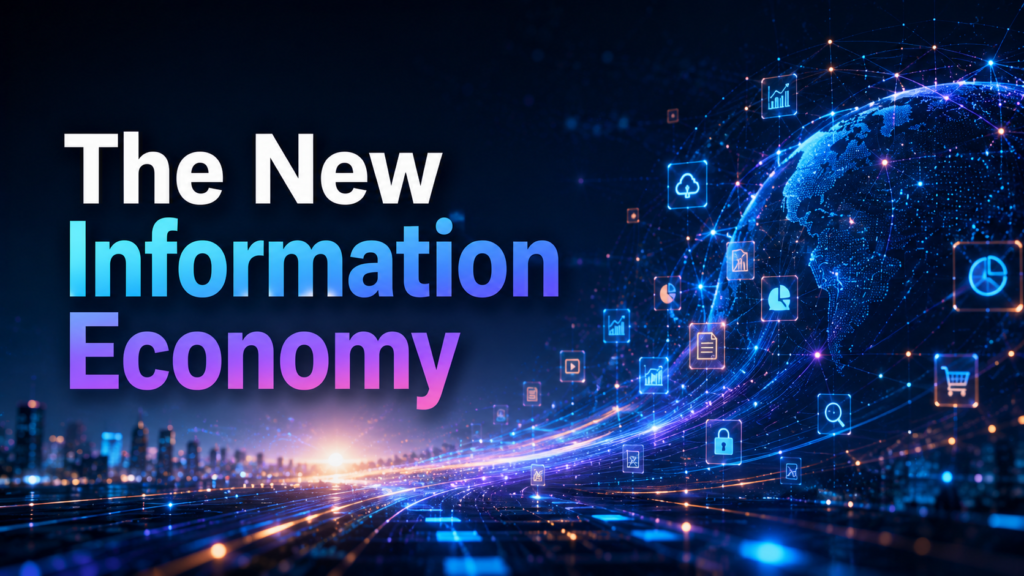
Decision-making has become increasingly data-driven.
AI-powered systems help organizations:
- Forecast demand
- Optimize pricing
- Identify risks
- Analyze customer preferences
- Improve efficiency
However, successful organizations combine machine intelligence with human judgment.
Artificial intelligence provides speed and scale, while humans contribute context, ethics, and strategic thinking.
The future belongs to collaborative intelligence rather than machine-only intelligence.
The Creator Economy and Digital Entrepreneurship
The information economy has enabled entirely new forms of entrepreneurship.
Individuals can now build businesses through:
- Online education
- Content creation
- Freelancing
- Software products
- Newsletters
- Podcasts
- Consulting services
Knowledge itself has become a monetizable asset.
Creators are transforming expertise into income streams through digital platforms and global audiences.
This democratization of opportunity is one of the most significant consequences of the information economy.
Education in the Information Economy
Traditional education models were designed for industrial societies.
Today’s economy requires different capabilities.
Future-ready skills include:
- Critical thinking
- Digital literacy
- AI literacy
- Communication
- Problem-solving
- Creativity
- Adaptability
Learning is increasingly continuous rather than confined to formal institutions.
Individuals who continuously acquire new knowledge will remain competitive in rapidly changing environments.
The Importance of Trust
Information has tremendous power, but trust determines its value.
Challenges include:
- Misinformation
- Deepfakes
- Privacy concerns
- Cybersecurity threats
- Algorithmic bias
Trust has become one of the most valuable assets in the digital world.
Organizations that prioritize transparency, ethics, and responsible AI are likely to build stronger relationships with customers and communities.
Cybersecurity: Protecting Digital Assets
As information becomes more valuable, cyber threats become more significant.
Businesses must protect:
- Customer data
- Intellectual property
- Financial records
- AI models
- Digital infrastructure
Cybersecurity is no longer simply an IT concern.
It is becoming a fundamental economic priority.
In the information economy, security equals resilience.
Global Competition Is Being Redefined
Economic leadership increasingly depends on technological capabilities.
Countries investing heavily in:
- Artificial intelligence
- Semiconductor technologies
- Research and development
- Education
- Cloud infrastructure
are positioning themselves for long-term competitiveness.
Information has become a geopolitical asset as well as an economic one.
Nations capable of leveraging knowledge effectively may shape the next century of innovation.
Human Skills Matter More Than Ever
Ironically, the rise of AI increases the importance of uniquely human abilities.
These include:
Creativity
Innovation starts with imagination.
Emotional Intelligence
Relationships remain fundamentally human.
Critical Thinking
People must evaluate information and make ethical decisions.
Leadership
Vision and trust cannot be automated.
Adaptability
Change is becoming continuous.
Technology amplifies human potential, but human qualities remain indispensable.
Challenges Facing the Information Economy
Despite its enormous potential, several risks must be addressed.
| Challenge | Impact |
|---|---|
| Information Overload | Reduced productivity |
| Privacy Concerns | Loss of trust |
| Cyberattacks | Economic disruption |
| Digital Divide | Unequal access |
| Misinformation | Social instability |
| Algorithmic Bias | Unfair outcomes |
| AI Dependence | Overreliance on technology |
Addressing these issues requires collaboration among governments, businesses, and society.
The Future of the Information Economy
The next decade will likely see even deeper integration between data, artificial intelligence, and human decision-making.
Emerging trends include:
- Autonomous AI agents
- Personalized digital assistants
- Quantum computing
- Intelligent workplaces
- Real-time predictive systems
- Human-AI collaboration
Information will increasingly become dynamic rather than static.
Instead of merely storing knowledge, systems will continuously interpret and apply intelligence to solve problems.
This evolution could fundamentally redefine productivity and innovation.
Building a Responsible Information Economy
The success of the new information economy depends on balancing innovation with responsibility.
Key principles include:
- Transparency
- Privacy protection
- Ethical AI
- Security
- Accessibility
- Human oversight
Technology should enhance human well-being rather than undermine trust or social stability.
Responsible innovation is essential for sustainable growth.
Conclusion
The new information economy represents one of the most profound shifts in modern history. Data, knowledge, and artificial intelligence are rapidly becoming the foundations of economic value, transforming industries, businesses, and societies.
Unlike previous economic systems centered around physical resources, this new era is driven by intelligence, connectivity, and innovation. Organizations that successfully harness information will gain enormous advantages, while individuals who continuously develop knowledge and digital skills will thrive in a rapidly evolving world.
Yet despite technological advances, the information economy remains fundamentally human. Trust, creativity, ethics, and critical thinking will determine how effectively societies use these powerful tools.
Information may be the currency of the future, but human wisdom will remain its most valuable asset.
Also Read: “Digital Ownership in the AI Era“
Frequently Asked Questions (FAQs)
1. What is the new information economy?
The new information economy is an economic system where data, knowledge, digital technologies, and artificial intelligence become primary sources of value creation and competitive advantage.
2. Why is data considered valuable?
Data helps businesses understand customers, optimize operations, predict trends, and make better decisions, making it one of the most important assets in the digital era.
3. How does artificial intelligence contribute to the information economy?
AI transforms raw data into actionable insights, enabling automation, predictive analytics, personalization, and intelligent decision-making across industries.