








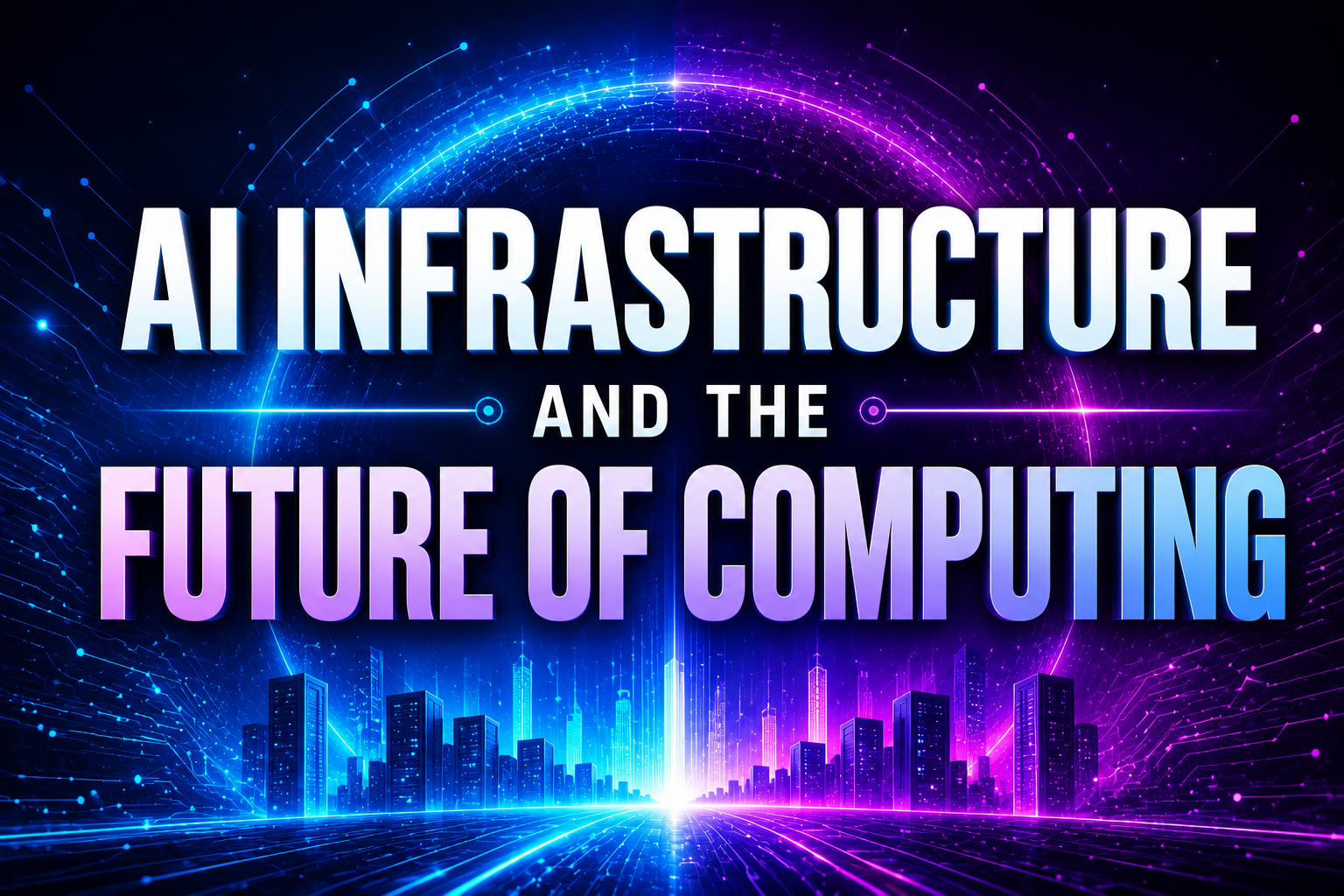
Artificial intelligence is transforming industries, economies, and societies at an unprecedented pace. While most discussions focus on AI applications such as chatbots, autonomous agents, robotics, and generative AI, a far more important story is unfolding behind the scenes. The remarkable capabilities of modern artificial intelligence are only possible because of a powerful and rapidly evolving ecosystem known as AI infrastructure. AI Infrastructure and the Future of Computing: Building the Foundation of the Intelligent Age.
From advanced semiconductors and hyperscale data centers to cloud computing, edge devices, and next-generation networking, AI infrastructure is becoming the backbone of the digital economy. In many ways, it represents the new industrial foundation of the twenty-first century.
The future of computing will not simply be faster computers or more powerful software. It will be defined by intelligent infrastructure capable of processing enormous amounts of data, supporting autonomous systems, and enabling real-time decision-making across every industry.
At the same time, the transformation extends beyond business and technology. The future classroom is already here, and digital literacy beyond search engines is becoming essential for preparing individuals to thrive in an AI-driven world.
As governments, corporations, and research institutions invest billions into AI capabilities, understanding AI infrastructure and its implications is becoming increasingly important for businesses, students, professionals, and policymakers.
Table of Contents
What Is AI Infrastructure?
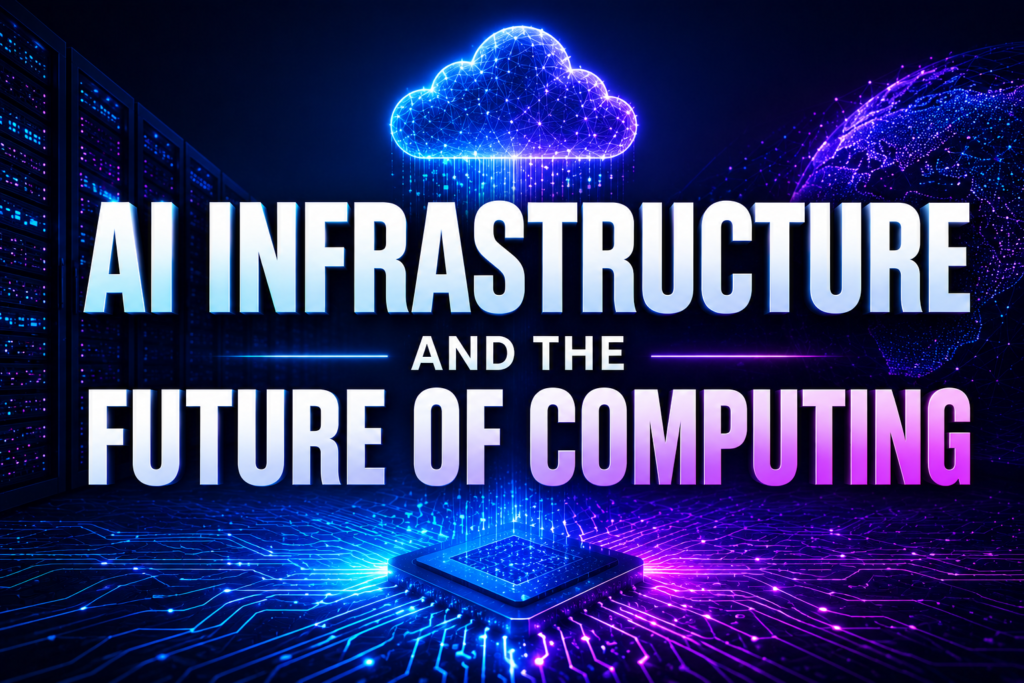
AI infrastructure refers to the collection of technologies, hardware, software, networks, and computing resources that enable artificial intelligence systems to operate efficiently.
It includes:
- Data centers
- Graphics Processing Units (GPUs)
- Central Processing Units (CPUs)
- Specialized AI chips
- Cloud computing platforms
- Networking technologies
- Storage systems
- Machine learning frameworks
- Edge computing devices
Simply put, AI infrastructure provides the computational power required to train, deploy, and scale artificial intelligence models.
Without robust infrastructure, even the most advanced algorithms remain unusable.
Why AI Infrastructure Matters
Artificial intelligence systems process enormous amounts of information.
Modern large language models and generative AI systems require:
- Massive datasets
- High-performance processors
- Fast networking
- Efficient storage
- Significant energy resources
AI infrastructure serves as the engine that powers these capabilities.
Its importance can be compared to:
- Electricity during the industrial revolution.
- Telecommunications during the internet age.
- Cloud computing during the digital transformation era.
Today, AI infrastructure is becoming critical national and economic infrastructure.
Components of AI Infrastructure
Advanced Semiconductors
Semiconductors are at the heart of artificial intelligence.
Traditional CPUs are increasingly complemented by:
- GPUs
- Tensor Processing Units (TPUs)
- AI accelerators
- Neuromorphic chips
These specialized processors enable parallel computation required for machine learning workloads.
Why GPUs Matter
AI training involves billions or even trillions of calculations.
GPUs excel because they can perform multiple computations simultaneously.
This capability dramatically accelerates:
- Model training
- Data processing
- Real-time inference
Consequently, advanced chip manufacturing has become a strategic priority for nations worldwide.
Data Centers
Data centers serve as the factories of the AI age.
These facilities contain thousands of servers working together to process information.
Modern AI data centers require:
- High-speed networking
- Cooling systems
- Massive storage
- Energy-efficient architectures
Hyperscale data centers operated by major cloud providers are becoming essential infrastructure for AI innovation.
Cloud Computing
Cloud computing democratized access to computing resources.
Organizations no longer need to build expensive infrastructure from scratch.
Cloud platforms provide:
- On-demand processing power
- Storage solutions
- AI development tools
- Scalable resources
This accessibility has enabled startups and researchers to compete with larger organizations.
Networking Technologies
Artificial intelligence systems rely heavily on communication between servers.
High-speed networks enable:
- Distributed training
- Real-time processing
- Data synchronization
Emerging technologies such as:
- 5G
- Optical networking
- High-bandwidth memory systems
are improving AI performance and scalability.
The Evolution of Computing
Computing has evolved through several stages.
| Era | Dominant Technology | Focus |
|---|---|---|
| Mainframe Era | Centralized Systems | Enterprise Processing |
| Personal Computer Era | Desktop Computing | Individual Productivity |
| Internet Era | Web Infrastructure | Connectivity |
| Cloud Era | Distributed Computing | Scalability |
| AI Era | Intelligent Infrastructure | Cognitive Computing |
The next phase involves systems capable of understanding, reasoning, and acting autonomously.
AI Workloads Demand New Architectures
Traditional computing architectures were not designed for AI.
Modern AI workloads require:
Parallel Processing
Millions of calculations occur simultaneously.
High Memory Bandwidth
Large models need rapid access to data.
Low Latency
Applications demand near-instant responses.
Energy Efficiency
Power consumption must remain manageable.
These requirements are driving innovation in hardware design.
Edge Computing and the AI Revolution
Not all AI processing occurs inside centralized data centers.
Edge computing brings intelligence closer to devices.
Examples include:
- Smartphones
- Autonomous vehicles
- Industrial sensors
- Smart homes
- Medical devices
Benefits include:
Faster Response Times
Real-time decisions become possible.
Lower Network Dependence
Devices function even with limited connectivity.
Enhanced Privacy
Sensitive data remains local.
Edge AI will play a major role in future intelligent ecosystems.
The Economics of AI Infrastructure
AI infrastructure represents one of the largest investment opportunities of the decade.
Governments and corporations are spending billions on:
- Semiconductor manufacturing
- Data centers
- Renewable energy
- Networking systems
These investments aim to secure competitive advantages.
Infrastructure as Competitive Advantage
Organizations with superior infrastructure can:
- Train better models
- Deliver faster services
- Scale efficiently
Infrastructure increasingly determines AI leadership.
Energy: The Hidden Challenge
Artificial intelligence consumes vast amounts of electricity.
Training large models requires:
- High-performance chips
- Cooling systems
- Continuous operations
Energy availability is becoming a critical factor.
Countries with abundant energy resources may gain advantages in AI development.
This explains the growing focus on:
- Solar energy
- Nuclear power
- Hydroelectric systems
- Green computing initiatives
Sustainable AI infrastructure is becoming essential.
AI Infrastructure and National Security
Artificial intelligence is now considered strategic infrastructure.
Governments view AI capabilities as vital for:
- Cybersecurity
- Defense systems
- Intelligence analysis
- Economic resilience
Consequently, nations are investing heavily in:
- Semiconductor manufacturing
- Sovereign cloud platforms
- AI supercomputers
The competition for AI infrastructure has become a geopolitical issue.
Quantum Computing: The Next Frontier
Quantum computing represents one of the most exciting developments in computing.
Unlike classical computers, quantum systems use:
- Qubits
- Superposition
- Quantum entanglement
Potential applications include:
- Drug discovery
- Optimization problems
- Financial modeling
- Climate simulations
Although still emerging, quantum computing could dramatically accelerate AI capabilities
Neuromorphic Computing
Researchers are exploring hardware inspired by the human brain.
Neuromorphic chips aim to:
- Mimic neural structures
- Reduce energy consumption
- Enable adaptive learning
These architectures may power future generations of intelligent machines.
AI Infrastructure and Industry Transformation
Healthcare
AI infrastructure enables:
- Medical imaging
- Genomic analysis
- Drug discovery
- Personalized treatment
Healthcare becomes faster and more accurate.
Manufacturing
Factories utilize intelligent systems for:
- Predictive maintenance
- Quality control
- Automation
Smart manufacturing increases productivity.
Finance
Financial institutions leverage AI infrastructure for:
- Fraud detection
- Risk analysis
- High-frequency trading
Computational power enhances decision-making.
Transportation
Autonomous systems rely heavily on:
- Edge computing
- Sensors
- Real-time AI processing
The future of mobility depends on advanced infrastructure.
AI Infrastructure and the Rise of Autonomous Agents
AI agents are becoming digital workers.
They require infrastructure capable of supporting:
- Continuous reasoning
- Tool usage
- Memory systems
- Multi-agent collaboration
Future businesses may employ thousands of AI agents operating around the clock.
Reliable infrastructure will become indispensable.
The Future Classroom Is Already Here
Artificial intelligence is transforming education itself.
Modern classrooms increasingly incorporate:
- AI tutors
- Adaptive learning platforms
- Virtual simulations
- Personalized education systems
Students receive customized learning experiences tailored to their strengths and weaknesses.
Education is moving away from memorization toward:
- Creativity
- Collaboration
- Problem-solving
- AI literacy
The future classroom is already becoming reality.
Digital Literacy Beyond Search Engines
For decades, digital literacy meant knowing how to use search engines and office software.
Today, digital literacy extends much further.
Individuals must understand:
AI Collaboration
Working effectively with intelligent systems.
Prompt Engineering
Communicating clearly with AI tools.
Information Verification
Evaluating:
- Accuracy
- Bias
- Reliability
Human oversight remains essential.
Data Awareness
Understanding:
- Privacy
- Ownership
- Security
is increasingly important.
Critical Thinking
As AI-generated content grows, analytical thinking becomes even more valuable.
Digital literacy beyond search engines will define success in future economies.
Challenges Facing AI Infrastructure
High Costs
Building data centers and chip factories requires billions of dollars.
Talent Shortages
Demand for AI engineers and semiconductor experts exceeds supply.
Supply Chain Risks
Geopolitical tensions affect chip manufacturing and availability.
Energy Consumption
Sustainable solutions remain necessary.
Cybersecurity Threats
AI infrastructure must remain secure against attacks.
The Future of Computing
Over the next decade, computing will become increasingly:
Intelligent
AI will be embedded everywhere.
Distributed
Edge devices and cloud systems will work together.
Autonomous
AI agents will perform complex tasks independently.
Energy-Efficient
New architectures will optimize power consumption.
Personalized
Systems will adapt to individual users.
Computers will evolve from tools into intelligent collaborators.
Human Skills in the Age of Intelligent Computing
Despite technological advances, uniquely human skills remain indispensable.
These include:
Creativity
Innovation drives progress.
Emotional Intelligence
Relationships and empathy matter.
Leadership
Vision and strategy remain human strengths.
Critical Thinking
Humans provide judgment and context.
Adaptability
Continuous learning becomes essential.
The future belongs to individuals who combine these qualities with AI capabilities.
What Organizations Should Do Today
Businesses preparing for the AI era should:
Invest in AI Infrastructure
Modern computing capabilities create competitive advantages.
Prioritize Data Quality
AI depends on reliable information.
Upskill Employees
AI literacy is becoming essential.
Strengthen Cybersecurity
Protecting infrastructure is critical.
Embrace Sustainable Computing
Energy efficiency matters.
Organizations that prepare early will thrive in the intelligent economy.
Conclusion
AI infrastructure represents the foundation of the next computing revolution. From advanced semiconductors and cloud platforms to edge computing and quantum technologies, the future of computing is being shaped by intelligent systems capable of processing unprecedented amounts of information.
As industries become increasingly AI-driven, infrastructure will determine competitiveness, innovation, and economic growth. At the same time, the future classroom is already here, and digital literacy beyond search engines is becoming essential for individuals navigating this new world.
Success in the intelligent age will depend not only on access to technology but also on the ability to understand, collaborate with, and responsibly harness its power.
The future of computing is no longer about machines alone, it is about creating an ecosystem where human intelligence and artificial intelligence work together to solve humanity’s greatest challenges.
Also Read: “The Race for Quantum Chips in 2026“
Frequently Asked Questions (FAQs)
1. What is AI infrastructure?
AI infrastructure includes the hardware, software, networks, and computing resources required to train, deploy, and scale artificial intelligence systems.
2. Why are GPUs important for AI?
GPUs enable parallel processing, allowing AI models to perform billions of calculations efficiently and significantly reducing training times.
3. How does edge computing support AI?
Edge computing processes data closer to devices, reducing latency, improving privacy, and enabling real-time decision-making