








Introduction: The Rise of an Invisible Companion
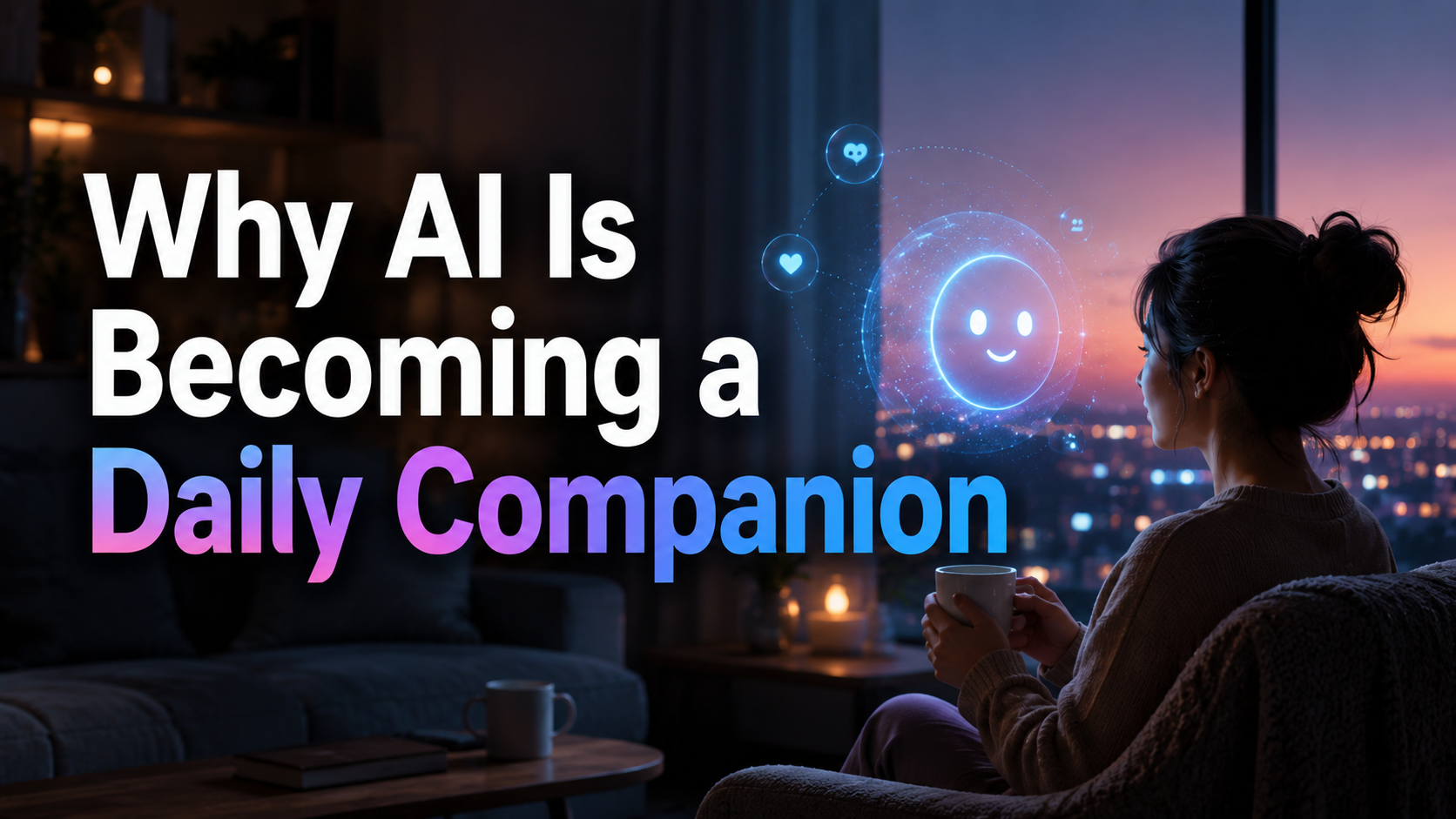
Not long ago, artificial intelligence seemed like a futuristic concept reserved for research laboratories, science fiction movies, and technology conferences. Most people viewed AI as a distant innovation that might someday change the world. Why AI Is Becoming a Daily Companion.
That future has arrived.
Today, artificial intelligence is no longer confined to specialized industries or technology companies. It has become deeply embedded in everyday life. Millions of people interact with AI multiple times each day, often without even realizing it.
Whether someone is asking a voice assistant for weather updates, receiving personalized recommendations from a streaming platform, navigating traffic with a GPS application, using AI-powered writing tools, or interacting with a customer service chatbot, artificial intelligence has become a constant presence.
What makes this transformation remarkable is its subtlety.
Unlike previous technological revolutions that introduced highly visible machines and devices, AI often works silently in the background. It assists, predicts, recommends, and automates without demanding attention. Over time, these interactions create a relationship between humans and intelligent systems that resembles companionship more than simple tool usage.
This emerging dynamic is reshaping how people work, learn, communicate, make decisions, and manage daily life.
As AI becomes increasingly capable, personalized, and accessible, it is evolving from a technology people occasionally use into a digital companion they rely on every day.
Table of Contents
Understanding the Concept of an AI Companion
When people hear the phrase “AI companion,” they often imagine humanoid robots or advanced virtual assistants from science fiction films.
The reality is much broader.
An AI companion can be any intelligent system that consistently supports users in their daily activities.
Examples include:
- Virtual assistants
- AI chatbots
- Recommendation engines
- Navigation systems
- Smart home devices
- AI productivity tools
- Personalized learning platforms
- Digital wellness applications
These systems help people solve problems, answer questions, organize tasks, and access information more efficiently.
Unlike traditional software, AI companions learn from interactions and adapt to user preferences over time.
This adaptability creates a more personal and engaging experience.
The Evolution from Tools to Intelligent Partners
Technology has evolved significantly over the past few decades.
Traditional software required users to learn commands and navigate interfaces manually.
AI changes this relationship.
Instead of forcing humans to adapt to machines, AI increasingly adapts to humans.
This shift represents a major milestone in technological development.
| Traditional Software | AI-Powered Systems |
|---|---|
| Fixed functionality | Adaptive functionality |
| Manual operation | Intelligent assistance |
| Limited personalization | Highly personalized |
| Reactive responses | Predictive support |
| Task-oriented | Relationship-oriented |
The result is a more natural interaction model that feels increasingly conversational and intuitive.
Why People Are Turning to AI Every Day
The rapid adoption of AI is not accidental.
Several factors explain why AI is becoming an everyday companion.
Convenience
People value solutions that simplify life.
AI reduces effort by:
- Answering questions instantly
- Automating repetitive tasks
- Organizing schedules
- Providing recommendations
Convenience remains one of the strongest drivers of AI adoption.
Accessibility
AI tools are available through:
- Smartphones
- Computers
- Smart speakers
- Wearable devices
This accessibility makes AI available almost anywhere and at any time.
Speed
AI delivers information and assistance within seconds.
In a world where time is increasingly valuable, speed matters.
Personalization
AI learns preferences and adapts experiences accordingly.
Personalized support creates greater relevance and engagement.
AI as a Personal Knowledge Assistant
One of the most significant roles AI plays today is serving as a knowledge companion.
Historically, finding information required:
- Searching websites
- Reading books
- Consulting experts
- Conducting research
Today, AI can provide:
- Explanations
- Summaries
- Recommendations
- Tutorials
- Research assistance
This dramatically reduces the time needed to access knowledge.
For students, professionals, and lifelong learners, AI has become an always-available learning partner.
How AI Is Transforming Communication
Communication is another area where AI companionship is becoming increasingly evident.
AI tools assist with:
- Writing emails
- Translating languages
- Drafting content
- Correcting grammar
- Summarizing conversations
These capabilities improve efficiency and reduce communication barriers.
For global teams and multicultural communities, AI-powered communication tools make collaboration easier than ever.
As AI becomes more conversational, interactions feel increasingly natural.
AI in Everyday Decision-Making
People make hundreds of decisions every day.
Many of these decisions are now influenced by AI.
Examples include:
- Choosing travel routes
- Selecting products
- Finding restaurants
- Managing finances
- Planning schedules
AI analyzes vast amounts of information and presents relevant options.
This helps users make informed choices while saving time.
Over time, AI becomes a trusted advisor for routine decisions.
The Role of AI in Productivity
Modern professionals face growing demands and information overload.
AI helps address these challenges by acting as a productivity companion.
Applications include:
Task Management
AI organizes priorities and schedules.
Content Creation
AI assists with writing, editing, and brainstorming.
Research
AI accelerates information gathering and analysis.
Meeting Support
AI summarizes discussions and identifies action items.
Workflow Automation
Routine processes become more efficient.
These capabilities allow individuals to focus on higher-value activities.
AI and Personalized Learning
Education is experiencing one of the most significant AI transformations.
Traditional education often follows standardized approaches.
AI enables personalized learning experiences tailored to individual needs.
Benefits include:
- Customized learning paths
- Adaptive assessments
- Instant feedback
- Skill recommendations
- Learning analytics
Students can receive support whenever they need it.
This accessibility makes AI an effective educational companion.
Healthcare and Wellness Support
AI is increasingly supporting personal health and wellness.
Applications include:
- Fitness tracking
- Symptom monitoring
- Mental wellness tools
- Medication reminders
- Personalized health recommendations
While AI cannot replace healthcare professionals, it can complement medical care by helping individuals maintain healthier lifestyles.
For many users, AI serves as a daily wellness assistant.
Smart Homes and Everyday Convenience
Smart home technologies demonstrate how AI companionship extends into physical environments.
AI-powered systems can:
- Control lighting
- Manage temperatures
- Monitor security
- Automate routines
- Optimize energy usage
These capabilities create living environments that respond intelligently to user needs.
As smart home adoption grows, AI becomes increasingly integrated into daily routines.
The Emotional Dimension of AI Companionship
One reason AI is becoming a daily companion is its ability to engage in conversation.
Many users appreciate:
- Immediate responses
- Consistent availability
- Nonjudgmental interactions
- Personalized support
While AI does not possess genuine emotions, it can simulate conversational behaviors that feel supportive.
This creates a sense of engagement that traditional software lacks.
The emotional aspect of AI companionship continues to evolve as conversational systems become more sophisticated.
AI and the Future of Work-Life Balance
Work-life balance has become a major concern in modern society.
AI can help individuals manage competing responsibilities by:
- Organizing schedules
- Automating routine tasks
- Reducing administrative workloads
- Supporting productivity
These capabilities allow people to allocate more time to family, hobbies, learning, and personal development.
In this sense, AI acts as a lifestyle companion rather than merely a work tool.
The Psychology Behind AI Adoption
Human beings naturally seek tools that reduce effort and improve outcomes.
AI aligns with several psychological preferences:
- Desire for convenience
- Need for information
- Preference for personalization
- Appreciation for efficiency
As AI continues to meet these needs, adoption rates are likely to increase.
The more useful AI becomes, the more integrated it becomes into daily habits.
Potential Challenges of AI Companionship
Despite its benefits, AI companionship presents important challenges.
Privacy Concerns
AI systems often require data to deliver personalized experiences.
Protecting user information remains critical.
Overdependence
Excessive reliance on AI may reduce independent problem-solving skills.
Bias and Accuracy
AI-generated information may occasionally contain inaccuracies.
Ethical Questions
Society must establish responsible guidelines for AI development and use.
Addressing these challenges is essential for maintaining trust.
The Human Side of the AI Relationship
Although AI is becoming increasingly capable, human qualities remain irreplaceable.
Humans provide:
- Empathy
- Ethics
- Creativity
- Leadership
- Emotional intelligence
AI complements these strengths but does not replace them.
The most successful future will involve collaboration between human intelligence and artificial intelligence.
Rather than viewing AI as a substitute for people, it is more accurate to see it as a partner that enhances human capabilities.
How AI Companions Will Evolve in the Future
The next decade is likely to bring major advancements.
Future AI companions may offer:
- Greater contextual understanding
- Improved personalization
- Enhanced conversational abilities
- Multimodal interactions
- Seamless integration across devices
AI will likely become increasingly proactive, anticipating needs before users explicitly request assistance.
This evolution could fundamentally change how people interact with technology.
Why AI Companionship Matters for Society
The growing presence of AI companions represents more than a technological trend.
It reflects a broader transformation in how humans access information, make decisions, and navigate daily life.
AI has the potential to:
- Expand knowledge access
- Improve productivity
- Support education
- Enhance healthcare
- Increase convenience
When developed responsibly, AI companions can contribute positively to individual well-being and societal progress.
Conclusion
Artificial intelligence is quietly becoming one of the most influential companions in modern life.
From answering questions and managing schedules to supporting learning, productivity, communication, and wellness, AI has evolved far beyond its origins as a specialized technology.
Its growing presence reflects a fundamental shift in the relationship between humans and machines.
The reason AI is becoming a daily companion is simple: it provides value.
It saves time, simplifies complexity, personalizes experiences, and offers support whenever needed.
However, the future of AI companionship should not focus solely on technological advancement. It must also prioritize trust, transparency, privacy, and human empowerment.
The ultimate goal is not to replace human intelligence but to enhance it.
As AI continues to evolve, it will likely become one of the most important tools, and companions, that people use to navigate an increasingly complex world.
Also Read: “A World Increasingly Guided by AI“
Frequently Asked Questions (FAQs)
1. Why is AI becoming a daily companion?
AI is becoming a daily companion because it provides personalized assistance, improves productivity, offers instant access to information, and simplifies everyday tasks.
2. How do people interact with AI daily?
People interact with AI through virtual assistants, recommendation systems, navigation apps, smart home devices, chatbots, productivity tools, and learning platforms.
3. Can AI replace human relationships?
No. AI can provide support and conversation, but it cannot replace genuine human relationships, empathy, and emotional connections.