



Introduction: The Most Valuable Skill in an Age of Infinite Information
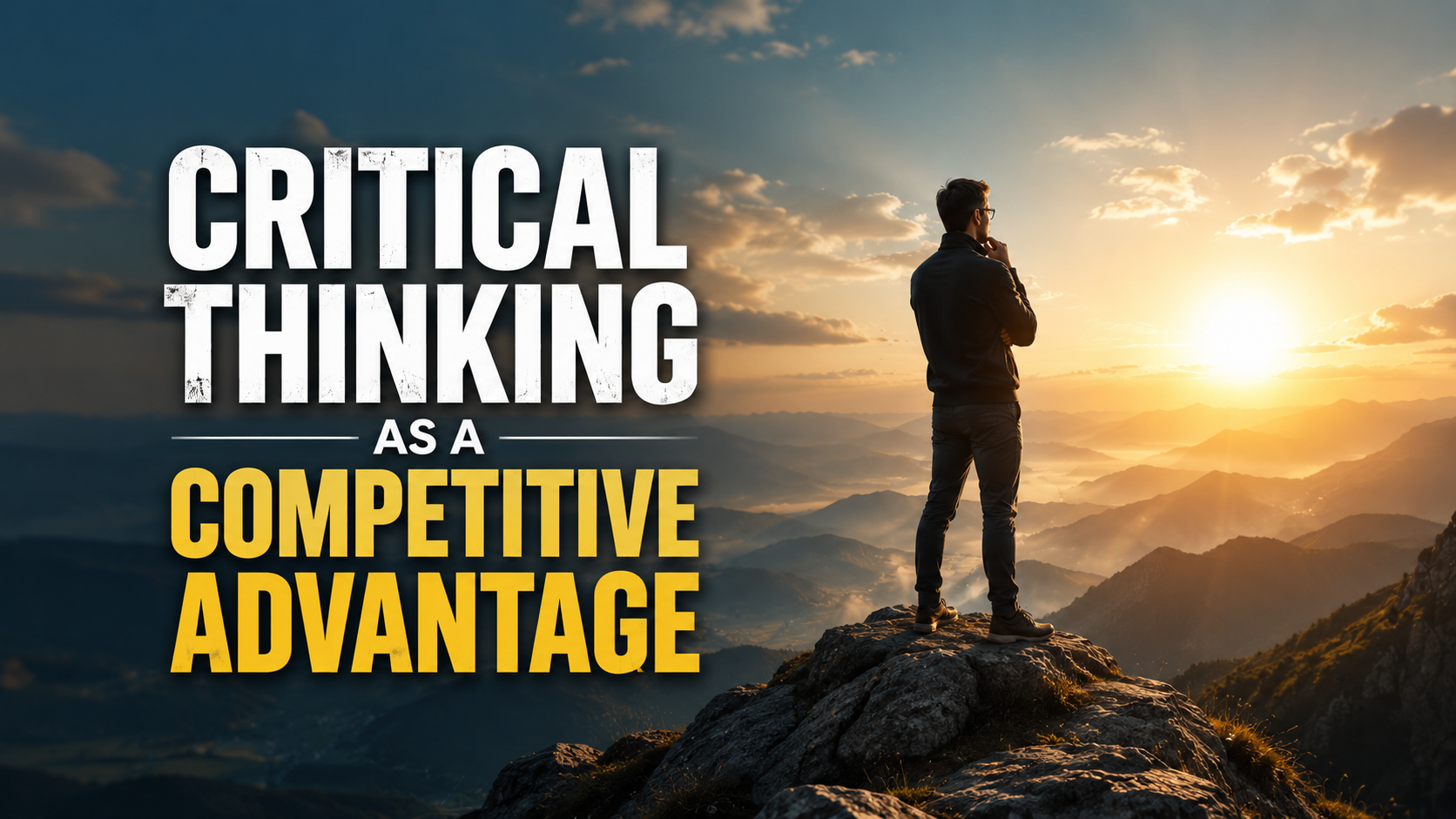
We live in an era where information has become abundant, accessible, and nearly instantaneous. Critical Thinking as a Competitive Advantage.
With a few clicks, or increasingly, a simple question to an AI assistant, people can access answers, generate reports, summarize research, create content, and solve problems that once required hours of effort. Artificial intelligence is transforming how individuals learn, work, communicate, and make decisions.
At first glance, this seems like a future where knowledge itself becomes the ultimate advantage.
But a closer look reveals something different.
As information becomes easier to obtain, the ability to think critically becomes increasingly valuable.
The modern challenge is no longer finding information. The challenge is evaluating it, understanding it, questioning it, and applying it effectively.
In a world flooded with data, opinions, algorithms, recommendations, and AI-generated content, critical thinking has emerged as one of the most important skills for personal success, professional growth, and organizational competitiveness.
The individuals and businesses that thrive in the coming decades will not necessarily be those with the most information. They will be those who can interpret information better than others.
Critical thinking is no longer simply an educational objective.
It is becoming a powerful competitive advantage.
Table of Contents
What Is Critical Thinking?
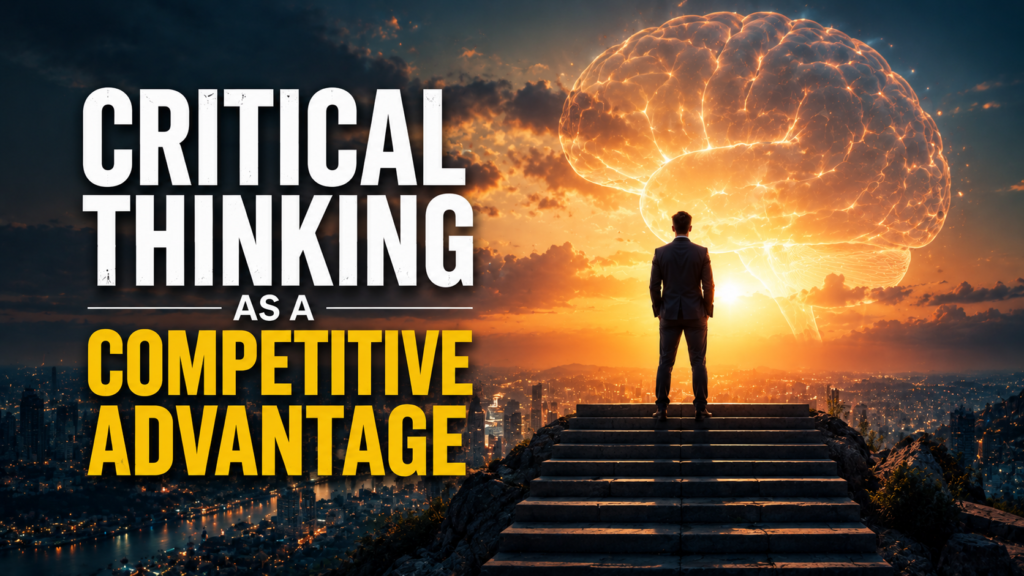
Critical thinking is the ability to objectively analyze information, evaluate evidence, identify assumptions, question conclusions, and make reasoned judgments.
It involves more than intelligence or knowledge.
Critical thinkers actively engage with information instead of accepting it at face value.
Key components of critical thinking include:
- Analytical reasoning
- Logical evaluation
- Evidence-based decision-making
- Problem-solving
- Independent judgment
- Intellectual curiosity
- Open-mindedness
Critical thinking helps individuals move beyond surface-level understanding and develop deeper insights.
Why Critical Thinking Matters More Than Ever
Historically, access to information was limited.
Today, the problem is the opposite.
The digital world produces enormous amounts of information every day.
People encounter:
- News articles
- Social media content
- AI-generated responses
- Marketing messages
- Research studies
- Expert opinions
Not all information is accurate.
Not all information is relevant.
Not all information is trustworthy.
Critical thinking enables individuals to separate valuable insights from noise.
In many ways, information abundance increases the importance of critical thinking.
The Rise of AI and the Need for Human Judgment
Artificial intelligence can process vast amounts of information at incredible speed.
AI can:
- Generate content
- Summarize research
- Analyze data
- Answer questions
- Recommend actions
However, AI does not replace human judgment.
AI systems may:
- Produce inaccurate outputs
- Reflect biases in training data
- Lack contextual understanding
- Generate convincing but incorrect information
This creates a new reality.
The more people rely on AI-generated insights, the more important critical thinking becomes.
Human oversight remains essential.
Information Is No Longer the Advantage
For much of modern history, possessing information created a competitive edge.
Today, information is widely available.
Competitive advantage increasingly comes from:
| Traditional Advantage | Modern Advantage |
|---|---|
| Access to Information | Interpretation of Information |
| Memorization | Critical Analysis |
| Data Collection | Insight Generation |
| Knowledge Storage | Knowledge Application |
| Information Ownership | Decision Quality |
The ability to think critically transforms information into meaningful action.
Critical Thinking in Business Decision-Making
Business leaders operate in environments filled with uncertainty.
Every day, organizations make decisions involving:
- Investments
- Hiring
- Product development
- Market expansion
- Technology adoption
Poor decisions can be costly.
Critical thinking enables leaders to:
- Evaluate risks
- Assess opportunities
- Challenge assumptions
- Analyze evidence
- Make informed choices
Organizations that cultivate critical thinking often make better strategic decisions.
Why Employers Value Critical Thinkers
Modern employers increasingly prioritize critical thinking over routine task execution.
Many repetitive tasks can now be automated.
What organizations need are people who can:
- Solve unfamiliar problems
- Adapt to change
- Evaluate information
- Make sound judgments
- Innovate effectively
Critical thinkers contribute value that technology alone cannot easily replicate.
This makes them highly sought-after professionals.
Critical Thinking and Problem-Solving
Every meaningful achievement begins with solving a problem.
Critical thinking improves problem-solving by helping individuals:
- Define challenges clearly
- Identify root causes
- Evaluate alternatives
- Consider consequences
- Develop effective solutions
Rather than reacting impulsively, critical thinkers approach problems systematically.
This leads to better outcomes.
The Role of Critical Thinking in Innovation

Innovation requires more than creativity.
It requires the ability to challenge existing assumptions.
Many groundbreaking ideas emerge because someone asks:
- Why do we do it this way?
- Is there a better solution?
- What are we overlooking?
- What assumptions are limiting us?
Critical thinking fuels innovation by encouraging deeper exploration and questioning.
Organizations that encourage critical thinking often become more innovative.
How Critical Thinking Strengthens Leadership
Leadership is fundamentally about decision-making.
Strong leaders:
- Analyze situations objectively
- Evaluate competing viewpoints
- Consider long-term consequences
- Make informed judgments
Critical thinking enables leaders to remain effective during uncertainty and complexity.
As technological disruption accelerates, thoughtful leadership becomes increasingly important.
Critical Thinking in the Age of Misinformation
One of the defining challenges of the digital era is misinformation.
False information can spread rapidly through:
- Social media
- Online communities
- AI-generated content
- Manipulated media
- Deepfake technologies
Critical thinkers ask important questions:
- What is the source?
- Is the evidence credible?
- Are there alternative viewpoints?
- What motivations may exist?
These habits help individuals navigate information responsibly.
Education and the Critical Thinking Gap
Many traditional educational systems emphasize memorization and standardized testing.
While knowledge remains important, future success increasingly depends on analytical capabilities.
Educational institutions must focus on:
- Inquiry-based learning
- Problem-solving
- Debate and discussion
- Evidence evaluation
- Independent research
Students need opportunities to practice thinking, not simply remembering.
Critical Thinking as a Future Workforce Skill
According to workforce and economic trends, critical thinking consistently ranks among the most valuable future skills.
Reasons include:
AI Automation
Routine tasks are increasingly automated.
Complex Work Environments
Business challenges are becoming more sophisticated.
Rapid Change
Industries evolve quickly.
Information Overload
Workers must evaluate large volumes of information.
Critical thinking supports success across all these areas.
Human Intelligence vs Artificial Intelligence
Artificial intelligence excels at:
- Processing data
- Recognizing patterns
- Automating workflows
- Generating outputs
Human intelligence excels at:
- Contextual understanding
- Ethical reasoning
- Creativity
- Strategic thinking
- Judgment
The future workplace is not a competition between humans and AI.
It is a collaboration.
Critical thinking helps humans maximize the value of AI-generated insights.
Building Critical Thinking Skills
Fortunately, critical thinking can be developed.
Effective strategies include:
Ask Better Questions
Curiosity drives deeper understanding.
Seek Diverse Perspectives
Different viewpoints challenge assumptions.
Evaluate Evidence Carefully
Focus on facts rather than opinions.
Practice Reflective Thinking
Consider why conclusions are reached.
Challenge Personal Biases
Recognize cognitive blind spots.
Consistent practice strengthens analytical abilities.
Critical Thinking in Everyday Life
Critical thinking is not limited to business or education.
It influences:
- Financial decisions
- Career choices
- Health decisions
- Technology adoption
- Civic participation
Individuals who think critically often make more informed decisions across all areas of life.
Why Critical Thinking Creates a Competitive Advantage
Competitive advantages emerge when a capability is valuable, difficult to replicate, and broadly applicable.
Critical thinking meets all three criteria.
Valuable
It improves decision quality.
Difficult to Automate
Human judgment remains essential.
Universally Relevant
It applies across industries and professions.
As AI democratizes access to information, critical thinking becomes increasingly rare and valuable.
The Future Belongs to Thoughtful Thinkers
Technology will continue evolving.
AI systems will become more powerful.
Information will become even more accessible.
Yet the need for human judgment will remain.
The future economy will reward individuals who can:
- Think independently
- Analyze deeply
- Learn continuously
- Evaluate evidence
- Make responsible decisions
These capabilities define critical thinking.
And they represent one of the strongest competitive advantages available in the modern world.
How Organizations Can Develop a Critical Thinking Culture
Businesses seeking long-term success should encourage:
| Organizational Practice | Benefit |
|---|---|
| Open Discussion | Better Ideas |
| Diverse Perspectives | Reduced Bias |
| Evidence-Based Decisions | Higher Accuracy |
| Continuous Learning | Greater Adaptability |
| Constructive Questioning | Stronger Innovation |
Organizations that value thoughtful analysis often outperform those that prioritize speed alone.
Conclusion
Critical thinking as a competitive advantage is becoming one of the defining realities of the AI age. As information becomes increasingly abundant and artificial intelligence becomes more capable, the ability to analyze, evaluate, question, and interpret information grows more valuable.
Success in the modern economy is no longer determined by who has access to information. It is determined by who can use information most effectively.
Critical thinking empowers individuals to make better decisions, solve complex problems, lead effectively, innovate consistently, and navigate uncertainty with confidence.
For students, it represents a future-ready skill.
For professionals, it provides career resilience.
For organizations, it drives better outcomes and sustainable growth.
Technology will continue transforming the world.
But thoughtful human judgment remains irreplaceable.
In an age of instant answers, the ability to ask the right questions may be the greatest advantage of all.
Also Read: “Digital Literacy Beyond Search Engines“
Frequently Asked Questions (FAQs)
1. Why is critical thinking important in the AI era?
Critical thinking helps individuals evaluate AI-generated information, identify inaccuracies, assess evidence, and make informed decisions rather than blindly accepting automated outputs.
2. How does critical thinking create a competitive advantage?
Critical thinking improves decision-making, problem-solving, innovation, leadership, and adaptability—skills that remain highly valuable and difficult to automate.
3. Can critical thinking be learned?
Yes. Critical thinking can be developed through questioning assumptions, evaluating evidence, seeking diverse perspectives, practicing reflection, and engaging in analytical problem-solving.