


Introduction: A Workforce Transformation Unlike Any Before
Throughout history, technological revolutions have reshaped the workforce.
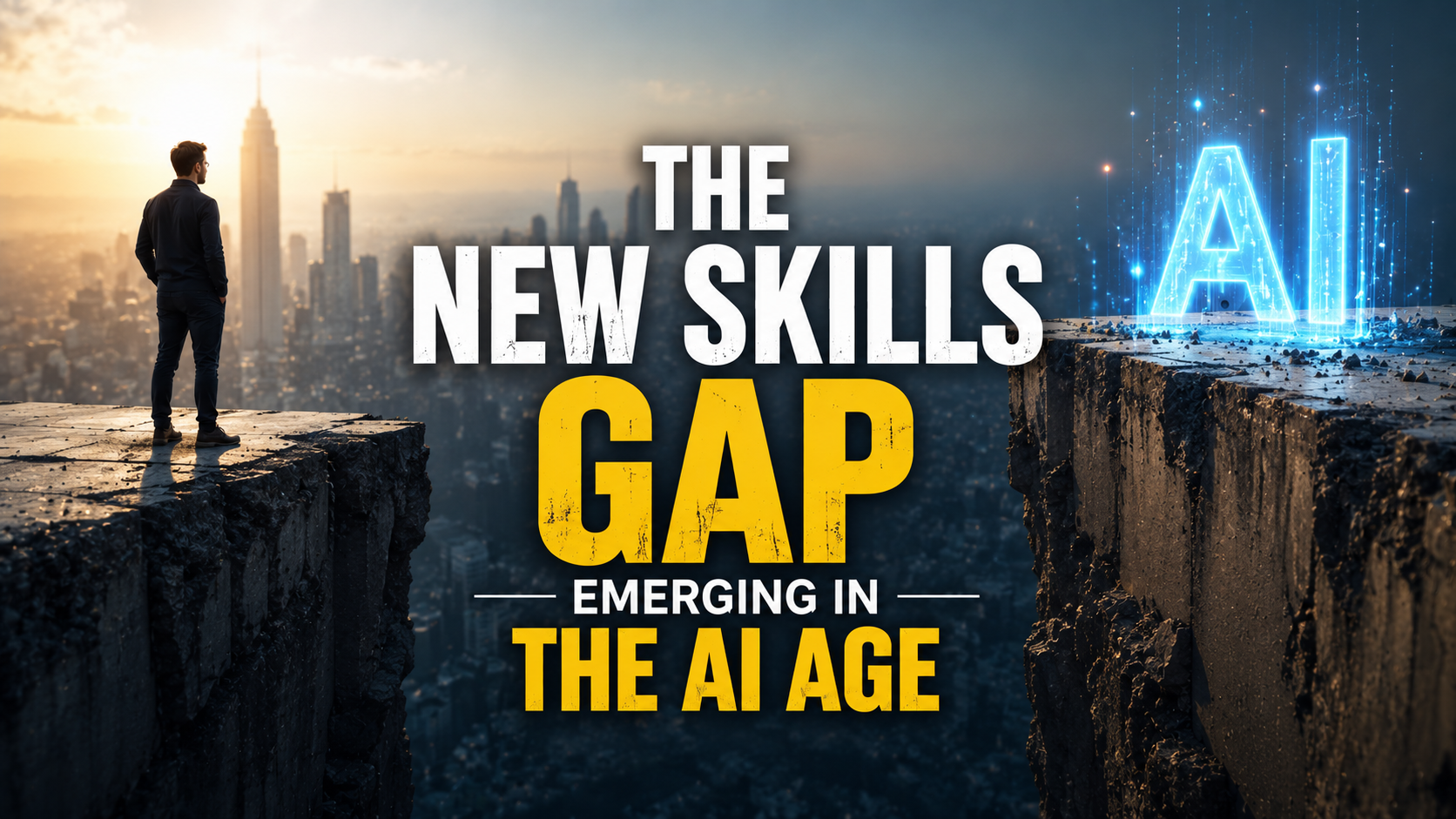
The Industrial Revolution changed manufacturing. The computer revolution transformed office work. The internet revolution connected global economies and created entirely new industries. The New Skills Gap Emerging in the AI Age.
Today, artificial intelligence is driving another major transformation.
However, unlike previous technological shifts, AI is affecting not only manual labor but also knowledge work, decision-making, communication, content creation, research, and problem-solving. Tasks that once required highly educated professionals can now be completed, assisted, or accelerated by intelligent systems.
This evolution is creating what many experts call a new skills gap.
Organizations are rapidly adopting AI technologies, yet many workers lack the skills required to thrive in AI-enhanced environments. Educational institutions are struggling to update curricula quickly enough. Businesses are finding it difficult to recruit talent that combines technical proficiency with human-centered capabilities.
The result is a growing mismatch between workforce needs and workforce readiness.
Understanding the new skills gap emerging in the AI age is essential for students, professionals, employers, educators, and policymakers seeking to remain competitive in an increasingly intelligent economy.
The future of work is not simply about learning new technologies.
It is about learning how humans and artificial intelligence can work together effectively.
Table of Contents
Understanding the AI Skills Gap
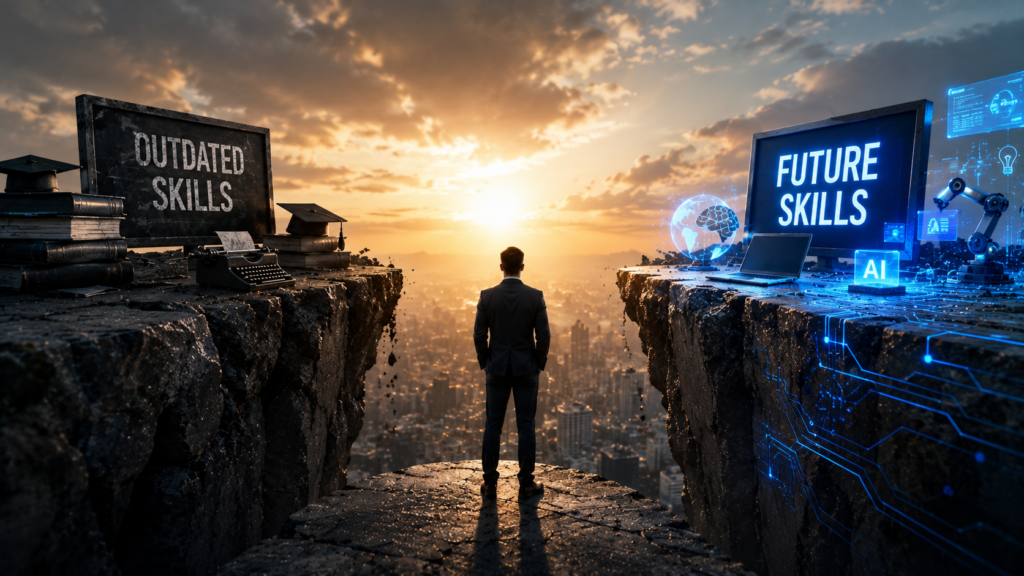
A skills gap occurs when workforce capabilities do not align with labor market demands.
In the AI era, this gap is expanding because technological advancement is accelerating faster than traditional education and workforce development systems can adapt.
Organizations increasingly need employees who can:
- Work with AI systems
- Interpret data
- Think critically
- Solve complex problems
- Adapt to change
- Make ethical decisions
Yet many workers were educated for an economy that prioritized routine processes and predictable workflows.
The difference between these realities creates a significant challenge.
Why AI Is Creating a Different Kind of Skills Gap
Previous technological disruptions often focused on automation of physical tasks.
AI affects cognitive work.
This distinction is important.
Artificial intelligence can now support activities such as:
- Writing
- Research
- Customer service
- Programming
- Data analysis
- Content creation
- Administrative operations
As AI assumes more routine cognitive tasks, the value of uniquely human capabilities increases.
The skills gap is no longer simply technical.
It is increasingly human.
The Evolution of Workforce Requirements
Workforce priorities have changed dramatically over the past several decades.
| Traditional Economy Skills | AI Economy Skills |
|---|---|
| Routine execution | Complex problem-solving |
| Memorization | Critical thinking |
| Fixed expertise | Continuous learning |
| Task completion | Strategic thinking |
| Individual productivity | Human-AI collaboration |
| Process compliance | Adaptability |
The modern workforce requires a broader and more dynamic skill set.
The Growing Demand for AI Literacy
AI literacy is rapidly becoming a foundational professional competency.
Employees do not need to become AI engineers to benefit from AI.
However, they increasingly need to understand:
- What AI can do
- What AI cannot do
- How AI systems generate outputs
- Potential biases and limitations
- Responsible AI usage
AI literacy enables individuals to collaborate effectively with intelligent systems.
Much like computer literacy became essential during the digital revolution, AI literacy is becoming essential in the intelligence revolution.
Critical Thinking: The Most Valuable Skill in the AI Era
Artificial intelligence can generate answers quickly.
What it cannot fully replace is human judgment.
Critical thinking allows individuals to:
- Evaluate information quality
- Challenge assumptions
- Assess risks
- Interpret context
- Make informed decisions
As AI-generated content becomes more widespread, the ability to think independently becomes increasingly important.
Organizations value employees who can determine whether an answer is correct, relevant, and actionable.
Why Creativity Is Becoming More Important
Many people assume AI will reduce the importance of creativity.
The opposite may be true.
AI can generate content based on patterns.
Human creativity involves:
- Original ideas
- Innovation
- Imagination
- Cultural understanding
- Emotional expression
Creative professionals increasingly use AI as a collaborative tool rather than a replacement.
The most successful workers may be those who combine human creativity with AI-powered productivity.
Communication Skills in an Automated World
Communication remains one of the most valuable workplace competencies.
AI can generate text and presentations.
However, effective communication requires:
- Persuasion
- Empathy
- Storytelling
- Relationship building
- Contextual understanding
Organizations continue to prioritize employees who can communicate complex ideas clearly and effectively.
The AI age amplifies rather than diminishes the importance of communication.
Emotional Intelligence: The Human Advantage
One of the largest emerging gaps involves emotional intelligence.
While AI can analyze sentiment and generate conversational responses, it does not genuinely experience emotions.
Human strengths include:
- Empathy
- Trust-building
- Leadership
- Conflict resolution
- Collaboration
These capabilities remain essential across industries.
As routine work becomes automated, interpersonal skills become increasingly valuable.
Adaptability and Continuous Learning
Perhaps no skill is more important than adaptability.
Technological change is accelerating.
Skills that are valuable today may become outdated within a few years.
Professionals must embrace continuous learning.
Adaptability includes:
- Learning new technologies
- Acquiring new competencies
- Responding to change
- Remaining curious
- Embracing innovation
Organizations increasingly seek employees who can evolve alongside technology.
Data Literacy in an AI-Powered Economy
Data is the foundation of modern AI systems.
Employees across industries increasingly work with data-driven insights.
Data literacy includes:
- Understanding metrics
- Interpreting trends
- Evaluating evidence
- Making data-informed decisions
Even non-technical roles benefit from basic data literacy.
The ability to understand information is becoming a competitive advantage.
Human-AI Collaboration: A New Workplace Skill
The future workforce will not compete against AI alone.
It will work alongside AI.
Human-AI collaboration involves:
- Using AI tools effectively
- Providing oversight
- Verifying outputs
- Enhancing productivity
- Combining machine efficiency with human judgment
This emerging capability may become one of the defining professional skills of the next decade.
Industries Most Affected by the Skills Gap
Nearly every sector is experiencing change.
Technology
Demand for AI literacy and technical expertise continues growing.
Healthcare
Professionals increasingly work with AI-supported diagnostics and analytics.
Finance
Automation and predictive intelligence are transforming operations.
Education
Teachers require new digital and AI competencies.
Marketing
AI-powered content creation and analytics are becoming standard.
Manufacturing
Smart automation is reshaping production processes.
The skills gap affects virtually every industry.
Why Educational Institutions Are Under Pressure
Schools and universities face increasing pressure to modernize.
Traditional curricula often lag behind technological change.
Educational institutions must prepare students for:
- AI-driven workplaces
- Digital collaboration
- Lifelong learning
- Emerging industries
- Future technologies
This requires a shift away from purely memorization-based education toward capability development.
The New Skills Students Need
Future-ready students should develop a balanced skill portfolio.
| Technical Skills | Human Skills |
|---|---|
| AI Literacy | Critical Thinking |
| Digital Literacy | Creativity |
| Data Literacy | Communication |
| Technology Fluency | Emotional Intelligence |
| Information Evaluation | Leadership |
| Cybersecurity Awareness | Adaptability |
Success increasingly depends on combining both categories.
The Employer Perspective
Organizations are encountering significant hiring challenges.
Many employers report shortages in:
- AI-related capabilities
- Digital skills
- Problem-solving abilities
- Strategic thinking
- Communication competencies
Recruiting future-ready talent is becoming a major business priority.
Companies increasingly invest in internal upskilling programs to address these gaps.
The Rise of Lifelong Learning
The concept of completing education early in life and relying on those skills indefinitely is becoming outdated.
The AI economy rewards continuous development.
Lifelong learning may include:
- Online courses
- Professional certifications
- Workplace training
- Self-directed learning
- AI-assisted education
Continuous growth becomes a professional necessity.
Challenges in Closing the Skills Gap
Despite growing awareness, several obstacles remain.
Unequal Access
Not everyone has equal access to educational opportunities.
Curriculum Lag
Educational systems evolve slowly.
Rapid Technological Change
Technology advances faster than many training programs.
Resource Limitations
Organizations and institutions may lack necessary resources.
Resistance to Change
Adapting to new realities can be difficult.
Addressing these challenges requires collaboration across sectors.
Strategies for Individuals
Professionals can prepare by:
Learning AI Fundamentals
Understanding emerging technologies.
Developing Critical Thinking
Strengthening analytical capabilities.
Building Digital Literacy
Improving technological fluency.
Enhancing Communication Skills
Becoming a more effective collaborator.
Embracing Lifelong Learning
Continuously updating knowledge and skills.
The most resilient workers are proactive learners.
What the Future Workforce May Look Like
By 2035, many workplaces may operate through close collaboration between humans and intelligent systems.
Employees may rely on AI for:
- Research
- Data analysis
- Administrative tasks
- Workflow automation
Human workers will focus on:
- Strategy
- Creativity
- Leadership
- Ethics
- Innovation
The workforce becomes increasingly hybrid, combining human intelligence with machine intelligence.
Conclusion
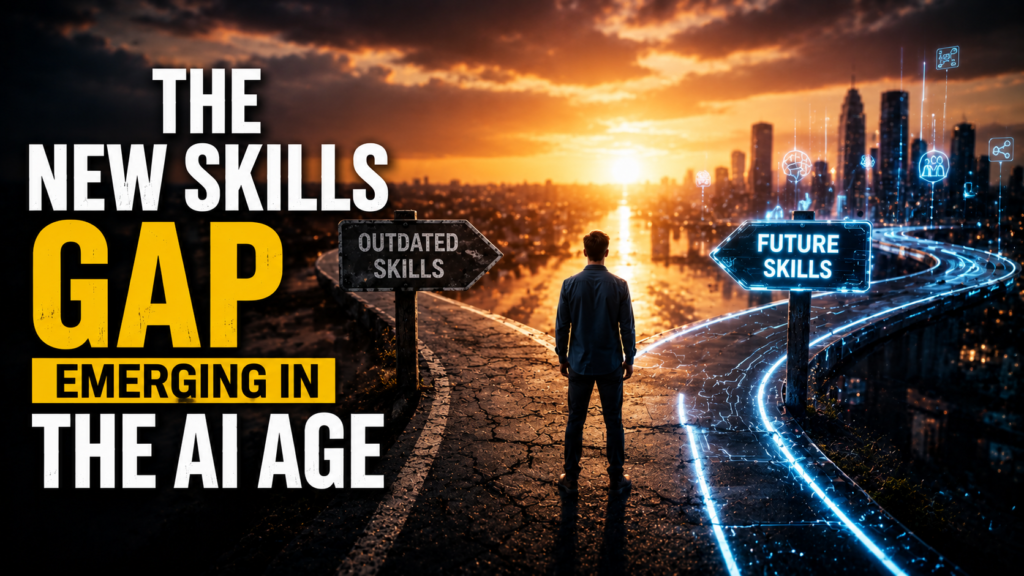
The new skills gap emerging in the AI age is one of the defining workforce challenges of our time. Artificial intelligence is transforming industries, reshaping job requirements, and creating demand for capabilities that traditional education systems were not originally designed to develop.
The future belongs to individuals who can combine technological fluency with uniquely human strengths. AI literacy, digital literacy, data literacy, critical thinking, creativity, communication, emotional intelligence, and adaptability are becoming essential components of career success.
Organizations, educational institutions, governments, and individuals all share responsibility for addressing this gap.
The objective is not simply to keep pace with technological change.
It is to build a workforce capable of thriving alongside intelligent technologies.
The AI revolution is already underway.
Those who invest in future-ready skills today will be best positioned to succeed in tomorrow’s economy.
Also Read: “Inside the Future Workplace Driven by AI Agents“
Frequently Asked Questions (FAQs)
1. What is the AI skills gap?
The AI skills gap refers to the difference between the skills employers need in an AI-driven economy and the capabilities currently available in the workforce.
2. Which skills are most important in the AI age?
Critical thinking, AI literacy, creativity, communication, emotional intelligence, adaptability, data literacy, and digital literacy are among the most valuable future skills.
3. Will AI eliminate the need for human workers?
AI will automate certain tasks, but human capabilities such as leadership, empathy, creativity, ethical judgment, and strategic thinking remain highly valuable.