



Introduction: A New Definition of Digital Literacy
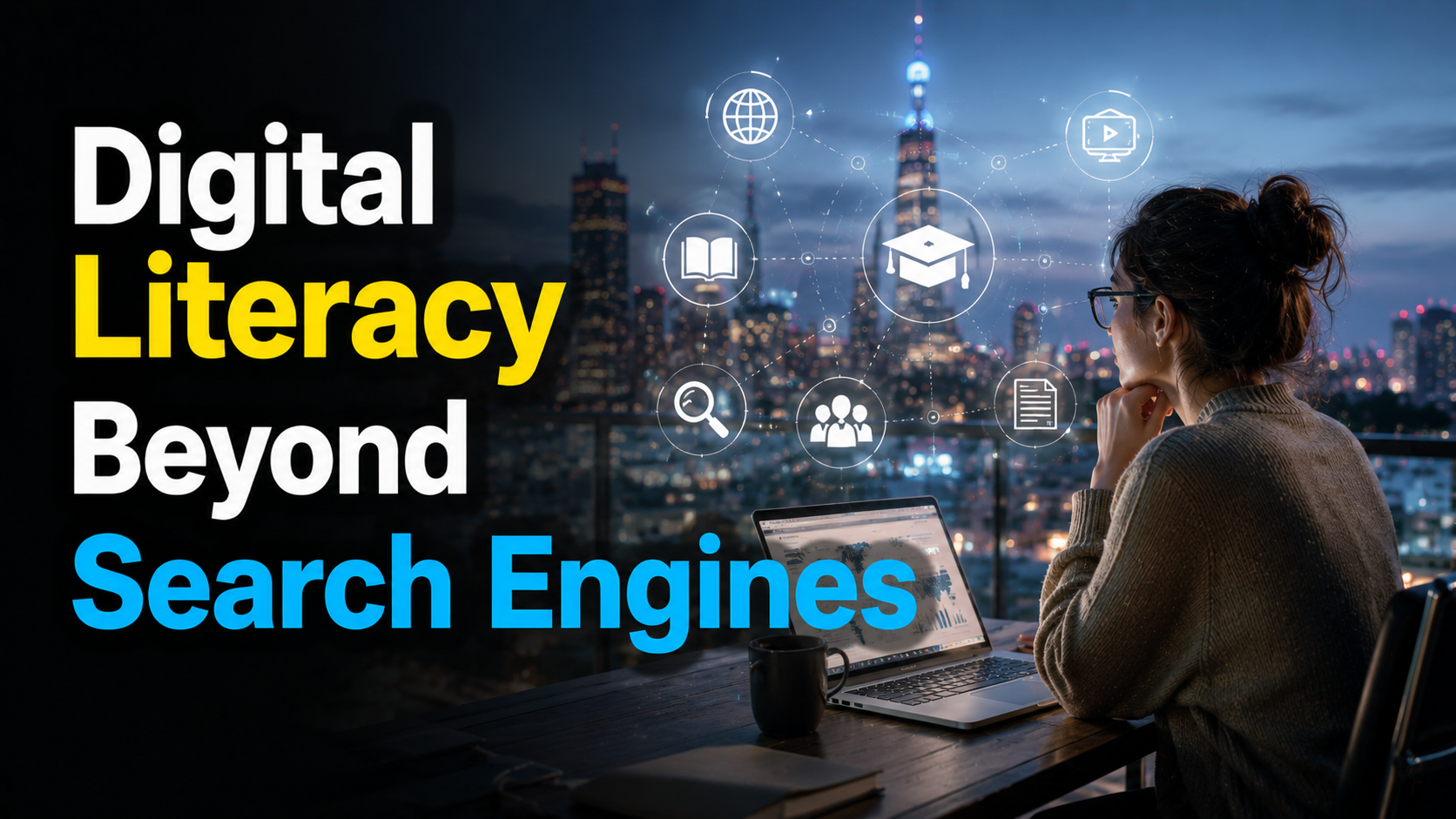
For more than two decades, digital literacy was often associated with a simple ability: knowing how to use a search engine. Digital Literacy Beyond Search Engines.
People learned how to type queries into search bars, evaluate website results, and find information online. These skills became essential as the internet evolved into the world’s largest knowledge repository.
Today, however, the digital landscape looks dramatically different.
Search engines are no longer the sole gateway to information. Artificial Intelligence assistants, recommendation algorithms, social media platforms, voice interfaces, digital agents, online communities, and personalized content feeds increasingly shape how people discover knowledge.
As a result, traditional digital literacy is no longer enough.
The modern internet demands a broader set of competencies that go beyond searching and clicking. Individuals must learn how to evaluate AI-generated content, identify misinformation, protect personal data, understand algorithmic influence, manage digital identities, and think critically about the information they consume.
In many ways, digital literacy has become one of the most important life skills of the twenty-first century.
The challenge is no longer finding information.
The challenge is understanding, evaluating, and using information responsibly in an increasingly intelligent digital world.
This is why digital literacy beyond search engines matters more than ever.
Table of Contents
The Evolution of Digital Literacy
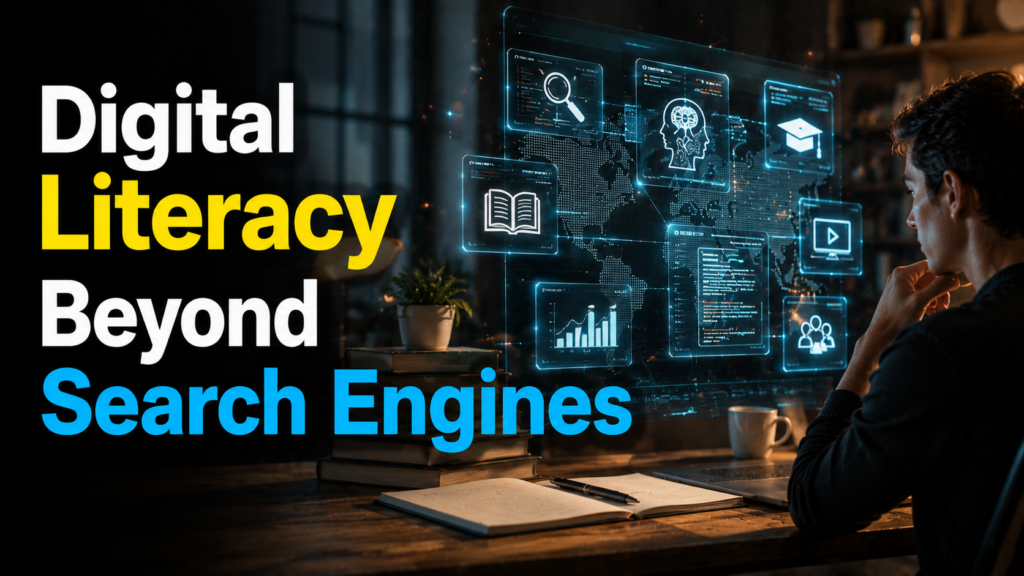
Digital literacy has continuously evolved alongside technology.
Each era introduced new challenges and required new skills.
| Era | Primary Digital Skill |
|---|---|
| Early Internet | Basic computer usage |
| Search Engine Era | Information retrieval |
| Social Media Era | Content sharing and communication |
| Mobile Era | Digital accessibility |
| AI Era | Critical evaluation and intelligent interaction |
In the early days of the internet, simply knowing how to access information was a valuable skill.
Today, information is abundant.
The real challenge lies in understanding which information deserves trust.
Why Search Engines Are No Longer the Center of Digital Discovery
For years, search engines served as the primary method for finding information online.
Users entered keywords and received a list of websites.
Today, content discovery occurs through multiple channels:
- AI assistants
- Social media feeds
- Recommendation systems
- Voice assistants
- Video platforms
- Messaging communities
- Personalized content streams
Many younger users increasingly discover information through platforms rather than traditional search engines.
This shift fundamentally changes how people interact with information.
The Rise of AI-Powered Information Access
Artificial Intelligence is transforming information discovery.
Modern AI systems can:
- Summarize complex topics
- Answer questions directly
- Generate explanations
- Recommend resources
- Personalize content
These capabilities create convenience.
However, they also introduce new responsibilities.
Users must understand that AI-generated information may contain:
- Errors
- Biases
- Missing context
- Outdated information
- Oversimplifications
Digital literacy now requires understanding how AI systems operate and recognizing their limitations.
Critical Thinking Becomes the Most Important Digital Skill
The internet provides access to more information than any generation in human history has ever experienced.
Unfortunately, access does not guarantee accuracy.
Critical thinking helps individuals:
- Evaluate claims
- Identify misinformation
- Verify sources
- Detect manipulation
- Assess credibility
Without critical thinking, users become vulnerable to false information regardless of the technology they use.
In the AI era, critical thinking is no longer optional.
It is essential.
Understanding Information Credibility
One of the most important aspects of modern digital literacy involves evaluating credibility.
Questions users should ask include:
Who Created the Content?
Understanding authorship matters.
What Evidence Supports the Claim?
Reliable information should be supported by evidence.
Is the Source Reputable?
Established expertise increases trustworthiness.
Is the Information Current?
Outdated information may be misleading.
Are Multiple Sources Confirming It?
Verification reduces the risk of misinformation.
These habits help users navigate an increasingly complex information environment.
The Challenge of AI-Generated Content
AI-generated content is becoming more common across the internet.
Articles, videos, images, and social media posts can now be produced rapidly at scale.
This creates opportunities but also challenges.
Benefits include:
- Increased accessibility
- Faster content creation
- Enhanced productivity
Risks include:
- Misinformation
- Low-quality content
- Deepfakes
- Content manipulation
- Reduced transparency
Digital literacy now includes the ability to recognize and evaluate AI-generated information.
Algorithm Awareness: Understanding What You See
Many online experiences are shaped by algorithms.
Algorithms influence:
- News feeds
- Search results
- Video recommendations
- Social media content
- Online advertisements
Most users interact with algorithms every day without fully understanding their influence.
Algorithm awareness helps individuals recognize that what they see online is often curated rather than neutral.
Understanding this reality is an important part of modern digital literacy.
The Role of Media Literacy in the Digital Age
Media literacy and digital literacy are increasingly interconnected.
Media literacy involves understanding:
- How content is produced
- How narratives are constructed
- How information influences perception
- How media organizations operate
These skills help users become informed consumers rather than passive audiences.
In a world filled with digital content, media literacy supports responsible decision-making.
Privacy Literacy: Protecting Personal Information
Digital literacy extends beyond information consumption.
It also involves understanding privacy.
Many digital platforms collect extensive user data.
Individuals should understand:
- What data is collected
- How data is used
- Privacy settings
- Security practices
- Digital tracking mechanisms
Protecting personal information is becoming a critical life skill.
As digital ecosystems expand, privacy awareness becomes increasingly important.
Cybersecurity Awareness for Everyday Users
Cybersecurity is no longer only an IT concern.
Everyone faces digital security risks.
Common threats include:
- Phishing attacks
- Identity theft
- Malware
- Fraudulent websites
- Social engineering scams
Basic cybersecurity knowledge helps individuals:
- Protect accounts
- Secure devices
- Avoid scams
- Safeguard personal data
Digital literacy now includes security literacy.
The Growing Importance of AI Literacy
AI literacy is rapidly emerging as a core competency.
Individuals should understand:
| AI Literacy Area | Why It Matters |
|---|---|
| How AI Works | Understanding system capabilities |
| AI Limitations | Recognizing potential errors |
| Bias Awareness | Identifying unfair outcomes |
| Ethical Implications | Evaluating societal impact |
| Responsible Use | Applying AI effectively |
AI literacy helps people interact more effectively with intelligent systems.
Digital Identity and Online Reputation
Every online interaction contributes to a digital footprint.
Digital literacy includes understanding:
- Personal branding
- Online reputation management
- Professional visibility
- Social media behavior
- Content permanence
Students and professionals increasingly need to manage their digital identities carefully.
Online actions can have long-term consequences.
Digital Literacy in Education
Educational institutions are adapting to these changes.
Modern digital literacy education increasingly includes:
- Information evaluation
- AI literacy
- Media literacy
- Privacy awareness
- Cybersecurity fundamentals
- Ethical technology use
Schools are recognizing that digital literacy extends far beyond technical skills.
It involves critical judgment and responsible participation.
Why Businesses Need Digitally Literate Employees
Organizations increasingly depend on digital tools and platforms.
Employers value workers who can:
- Evaluate information critically
- Use AI responsibly
- Protect sensitive data
- Adapt to emerging technologies
- Communicate effectively online
Digital literacy has become a workplace competency.
Employees who possess strong digital literacy skills often contribute more effectively to modern organizations.
The Future of Digital Literacy
The next decade will likely introduce even more technological complexity.
Emerging technologies include:
- Autonomous AI agents
- Immersive virtual environments
- Advanced recommendation systems
- Intelligent personal assistants
- Synthetic media
As these technologies become mainstream, digital literacy requirements will continue evolving.
The ability to learn and adapt may become the most valuable skill of all.
Building a Digitally Literate Society
Governments, educational institutions, businesses, and communities all have roles to play.
Strategies include:
Updating Educational Curricula
Reflecting modern technological realities.
Promoting Media Literacy
Helping individuals evaluate information.
Expanding AI Education
Preparing people for intelligent technologies.
Improving Privacy Awareness
Encouraging responsible digital behavior.
Supporting Lifelong Learning
Recognizing that digital skills require continuous development.
Building a digitally literate society benefits everyone.
Human Judgment Remains Essential
Despite technological advances, human judgment remains irreplaceable.
Technology can provide information.
Humans provide meaning.
Technology can generate answers.
Humans determine relevance.
Technology can automate processes.
Humans make ethical decisions.
Digital literacy ultimately involves understanding how to combine technological capabilities with human intelligence.
Conclusion
Digital literacy beyond search engines is becoming one of the defining skills of the modern era. The internet is no longer a simple collection of websites accessed through search queries. It is a dynamic ecosystem shaped by artificial intelligence, algorithms, social platforms, recommendation systems, and intelligent digital assistants.
As technology evolves, individuals must develop new competencies that go far beyond finding information online. Critical thinking, AI literacy, media literacy, privacy awareness, cybersecurity knowledge, and digital responsibility are becoming essential for success in education, work, and everyday life.
The future belongs not simply to those who can access information.
It belongs to those who can evaluate it, understand it, question it, and use it wisely.
Digital literacy is no longer about searching.
It is about thinking.
And in the age of artificial intelligence, that distinction matters more than ever.
Also Read: “Understanding the Human Side of Artificial Intelligence“
Frequently Asked Questions (FAQs)
1. What does digital literacy beyond search engines mean?
It refers to the broader set of skills needed to navigate the modern internet, including AI literacy, critical thinking, media literacy, privacy awareness, cybersecurity knowledge, and information evaluation.
2. Why is digital literacy important in the AI era?
AI systems increasingly influence how information is created and consumed. Digital literacy helps individuals understand AI outputs, identify misinformation, and use technology responsibly.
3. What are the key components of modern digital literacy?
Key components include critical thinking, media literacy, AI literacy, cybersecurity awareness, privacy protection, information evaluation, and digital communication skills.