




Introduction: A New Chapter in the History of Artificial Intelligence
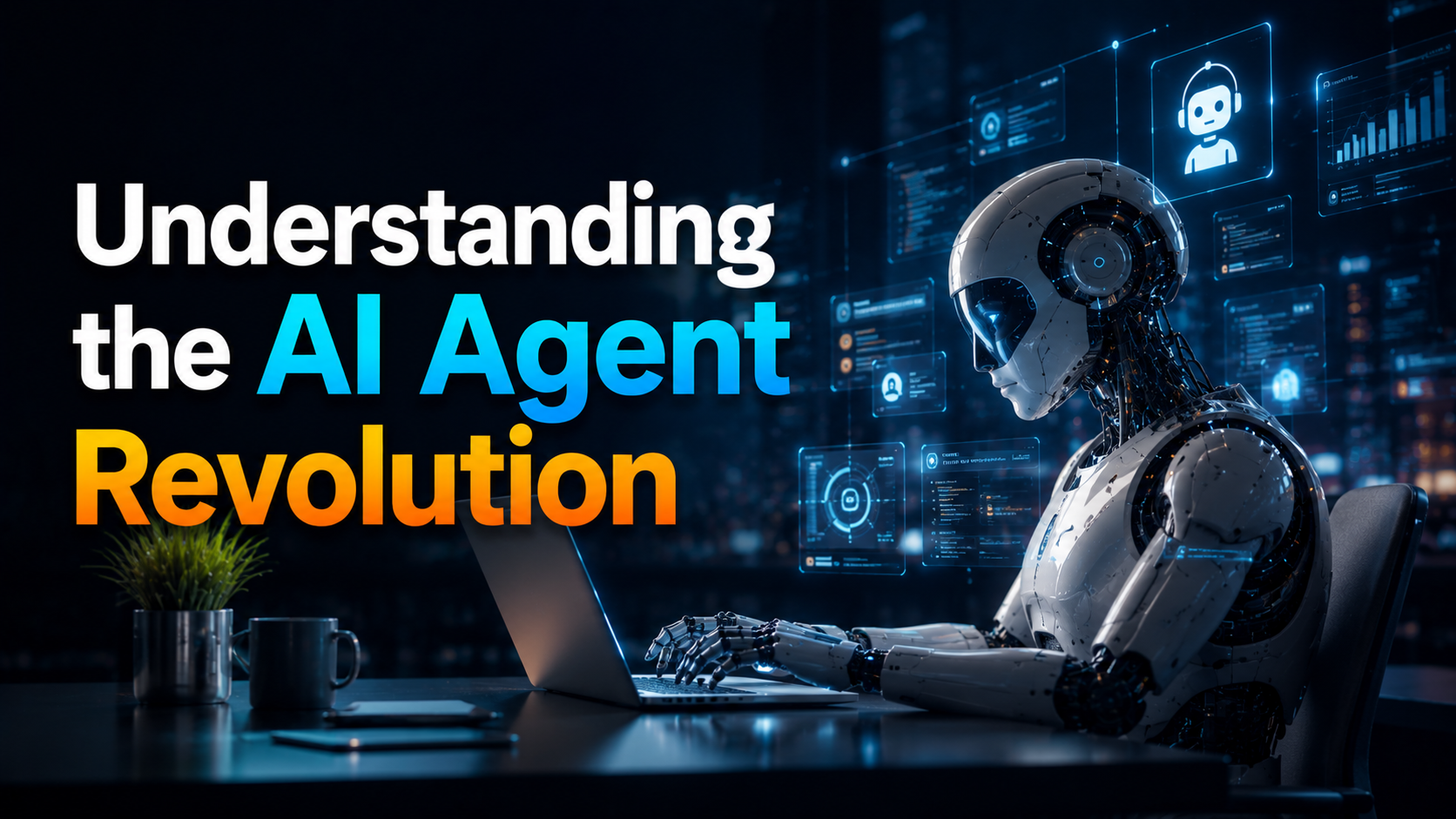
Technology has always evolved through transformative breakthroughs. Understanding the AI Agent Revolution.
The personal computer brought computing into homes and offices. The internet connected the world. Smartphones placed digital power into people’s pockets. Cloud computing made technology scalable and accessible.
Today, another revolution is unfolding, one that may be even more significant than those that came before it.
Artificial Intelligence is entering a new phase characterized by the emergence of AI agents. Unlike traditional software applications that simply respond to user commands, AI agents can understand objectives, make decisions, execute tasks, and adapt to changing circumstances with minimal human intervention.
This shift is creating what many experts describe as the AI Agent Revolution.
Organizations across industries are exploring how AI agents can automate workflows, improve productivity, enhance customer experiences, and support decision-making. Entrepreneurs are building AI-native companies. Technology providers are redesigning software around autonomous intelligence. Employees are beginning to work alongside digital coworkers capable of handling routine operational tasks.
The implications extend far beyond technology.
The AI Agent Revolution is changing how businesses operate, how software is designed, how work gets done, and how economic value is created.
Understanding this transformation is essential for anyone seeking to thrive in the next generation of the digital economy.
Table of Contents
What Is an AI Agent?
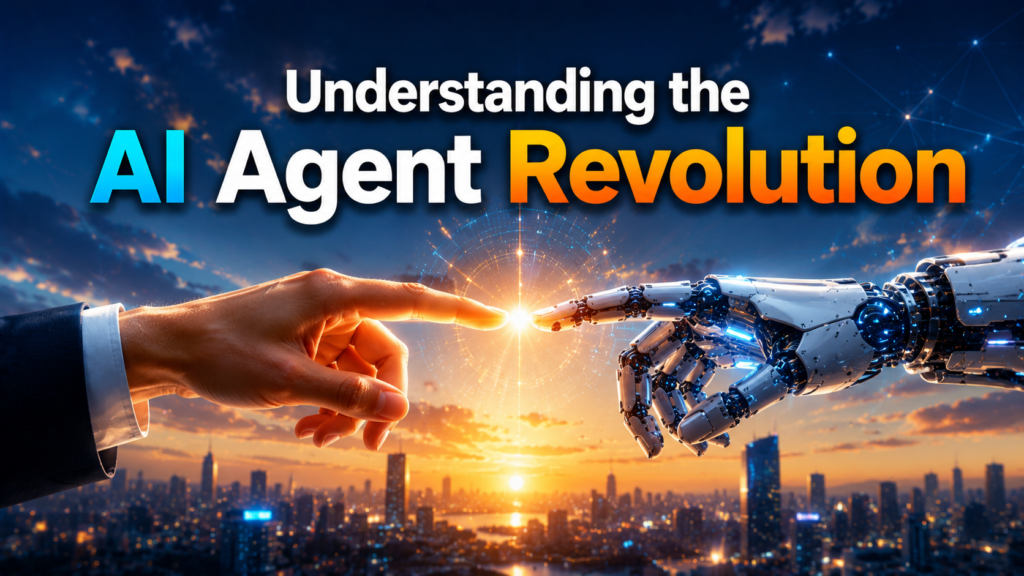
Before exploring the broader revolution, it is important to understand what AI agents are.
An AI agent is an intelligent software system designed to pursue goals autonomously.
Unlike traditional applications, AI agents can:
- Understand instructions
- Interpret context
- Create plans
- Use tools
- Execute actions
- Learn from outcomes
- Adapt to changing situations
Traditional software performs functions.
AI agents pursue objectives.
For example, a conventional analytics platform might display sales data. An AI agent can analyze that data, identify trends, generate insights, and recommend actions.
This distinction is what makes AI agents revolutionary.
The Evolution of Artificial Intelligence
The AI Agent Revolution is the result of decades of technological progress.
| AI Era | Primary Capability |
|---|---|
| Rule-Based Systems | Following predefined instructions |
| Machine Learning | Pattern recognition |
| Deep Learning | Prediction and classification |
| Generative AI | Content creation and conversation |
| AI Agents | Autonomous task execution |
| Multi-Agent Systems | Collaborative intelligence |
Each stage expanded what machines could accomplish.
AI agents represent a major leap because they move beyond generating information and begin generating outcomes.
Why the AI Agent Revolution Matters
Many technology trends generate excitement.
Few fundamentally alter the relationship between humans and machines.
AI agents do exactly that.
For decades, people have used software as a tool.
Now software is becoming an active participant in work.
This matters because organizations face increasing complexity.
Businesses must manage:
- More data
- More communication
- More workflows
- More customer interactions
- More operational challenges
Human attention is limited.
AI agents provide scalable intelligence that helps organizations operate more efficiently.
The Difference Between Traditional Software and AI Agents
To appreciate the significance of the AI Agent Revolution, it is useful to compare traditional software with AI agents.
| Traditional Software | AI Agents |
|---|---|
| Tool-based | Goal-based |
| User-driven | Outcome-driven |
| Requires constant input | Operates autonomously |
| Static workflows | Adaptive workflows |
| Limited flexibility | Dynamic decision-making |
| Task execution | Objective completion |
Traditional software waits for instructions.
AI agents proactively pursue goals.
This changes how technology creates value.
The Rise of Autonomous Digital Workers
One of the most important developments within the AI Agent Revolution is the emergence of digital workers.
Digital workers are AI agents capable of performing operational tasks traditionally handled by humans.
Examples include:
Customer Support Agents
Responding to inquiries and resolving issues.
Research Agents
Gathering and summarizing information.
Marketing Agents
Managing campaigns and generating insights.
Finance Agents
Producing reports and monitoring performance.
Operations Agents
Coordinating workflows across departments.
These systems function as scalable digital labor.
How AI Agents Are Transforming Business Operations
Organizations are already deploying AI agents across numerous business functions.
Customer Service
AI agents provide instant responses, automate support workflows, and improve service availability.
Marketing
Businesses use AI agents to create content, analyze audiences, and optimize campaigns.
Human Resources
Recruitment, onboarding, and employee support increasingly benefit from intelligent automation.
Finance
AI agents assist with forecasting, compliance monitoring, and performance analysis.
Operations
Organizations use agents to coordinate workflows and improve efficiency.
The result is a more agile and productive enterprise.
The Shift From Tools to Teammates
Historically, software functioned as a tool.
The AI Agent Revolution introduces a new paradigm.
Software becomes a teammate.
Consider how work traditionally occurs.
A manager opens multiple applications, gathers information, analyzes data, and prepares recommendations.
An AI agent can perform many of these activities independently.
The human role shifts from execution to oversight and strategy.
This transition fundamentally changes workplace dynamics
The Emergence of Agentic AI
The term Agentic AI refers to AI systems capable of independently pursuing goals.
Agentic AI combines:
- Reasoning
- Planning
- Memory
- Tool usage
- Decision-making
These capabilities enable systems to operate with increasing autonomy.
Agentic AI represents one of the fastest-growing areas within artificial intelligence.
Many experts believe it will define the next decade of AI innovation.
AI Agents and the Future of Software
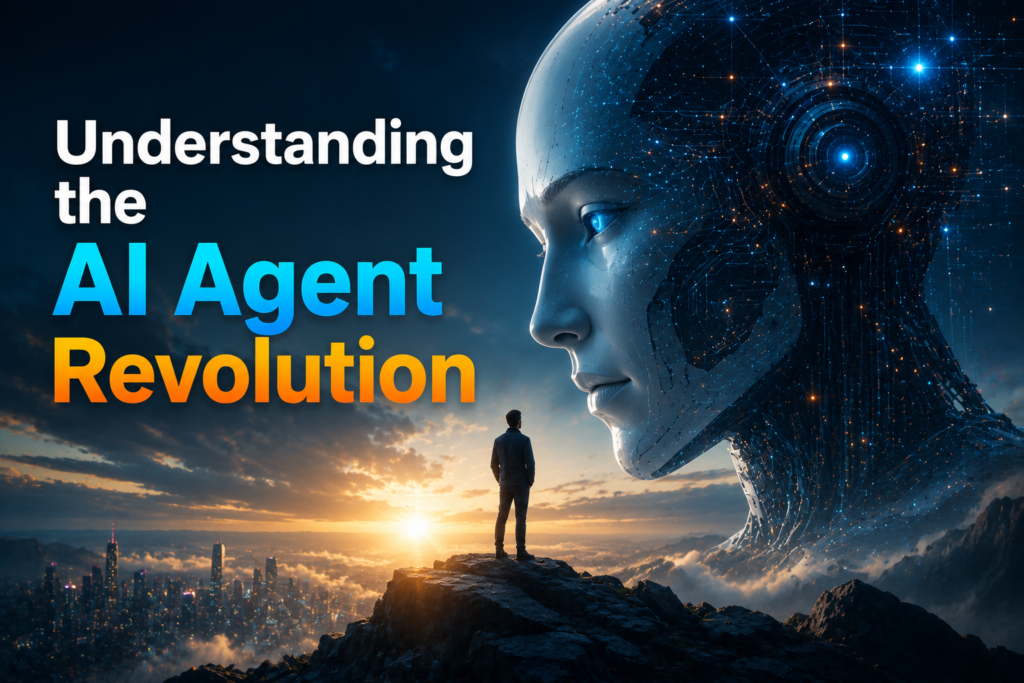
The AI Agent Revolution is forcing software companies to rethink product design.
Traditional software relies on interfaces, menus, and workflows.
Future software may focus more on:
- Natural language interaction
- Goal-based computing
- Autonomous execution
- Personalized assistance
Users increasingly communicate intentions rather than navigate interfaces.
This creates a more intuitive experience.
Multi-Agent Systems: The Next Evolution
The future may not involve a single AI agent.
Instead, organizations may deploy teams of specialized agents.
For example:
| Agent Type | Responsibility |
|---|---|
| Research Agent | Information gathering |
| Analytics Agent | Data interpretation |
| Communication Agent | Internal coordination |
| Marketing Agent | Campaign execution |
| Operations Agent | Workflow management |
Together, these agents create a collaborative digital workforce.
The Impact on Productivity
Productivity gains are one of the primary drivers behind AI adoption.
AI agents can:
- Operate continuously
- Process large datasets
- Execute repetitive tasks
- Reduce administrative burdens
- Accelerate decision-making
This allows employees to focus on higher-value activities.
Organizations gain:
- Faster execution
- Greater efficiency
- Improved scalability
- Reduced costs
The productivity implications are substantial.
Human Skills Become More Valuable
Contrary to fears of complete automation, the AI Agent Revolution increases demand for uniquely human abilities.
These include:
Creativity
Generating original ideas and solutions.
Critical Thinking
Evaluating complex information.
Leadership
Providing direction and vision.
Emotional Intelligence
Building trust and relationships.
Ethical Judgment
Making responsible decisions.
AI agents complement these skills rather than replace them.
The Economic Impact of the AI Agent Revolution
The economic consequences could be enormous.
Potential benefits include:
- Higher productivity growth
- Increased business efficiency
- Faster innovation cycles
- Lower operational costs
- New entrepreneurial opportunities
The AI Agent Revolution may create entirely new markets and industries.
Just as the internet created the digital economy, AI agents may create a new agent economy.
Challenges Facing the AI Agent Revolution
Despite tremendous promise, significant challenges remain.
Trust and Reliability
Organizations must trust agent outputs.
Security Risks
Autonomous systems require safeguards.
Data Privacy
Sensitive information must remain protected.
Governance
Clear accountability frameworks are essential.
Regulatory Compliance
Governments continue developing AI policies.
Responsible adoption will determine long-term success.
Why Trust Is the Foundation of AI Adoption
Trust may become one of the most important competitive differentiators.
Organizations deploying AI agents must prioritize:
- Transparency
- Accountability
- Reliability
- Security
- Ethical practices
Without trust, adoption will slow.
With trust, AI agents can become powerful business assets.
Industries Most Likely to Be Transformed
Virtually every sector will experience change.
Technology
Software development and IT operations.
Healthcare
Administrative support and workflow coordination.
Finance
Risk management and intelligent automation.
Education
Personalized learning experiences.
Retail
Customer engagement and operational efficiency.
Professional Services
Research, analysis, and advisory support.
The transformation is broad and accelerating.
The Rise of AI-Native Organizations
Some companies are moving beyond AI adoption.
They are becoming AI-native.
Characteristics include:
- AI-first workflows
- Intelligent decision support
- Autonomous operations
- Digital workforces
- Continuous optimization
These organizations may gain significant competitive advantages.
What the Future Could Look Like
Over the next decade, workplaces may increasingly include AI agents as standard team members.
Employees could begin each day with:
- AI-generated briefings
- Automated task prioritization
- Intelligent workflow recommendations
- Real-time decision support
Organizations may deploy dozens or even hundreds of specialized agents.
Work becomes more outcome-focused and less process-driven.
The future workplace becomes a collaborative ecosystem of humans and intelligent systems.
How Businesses Can Prepare for the AI Agent Revolution
Organizations should begin preparing now.
Invest in AI Literacy
Educate leaders and employees.
Modernize Infrastructure
Enable integration with intelligent systems.
Improve Data Quality
Reliable data improves AI performance.
Pilot Agent-Based Workflows
Identify practical use cases.
Establish Governance Frameworks
Ensure responsible deployment.
Preparation today creates future advantages.
Conclusion
The AI Agent Revolution represents one of the most significant technological transformations of the twenty-first century. By moving beyond passive software and toward autonomous intelligence, AI agents are changing how businesses operate, how employees work, and how value is created.
These systems are not simply improving existing workflows.
They are redefining the nature of digital work itself.
Organizations that embrace AI agents responsibly can achieve greater productivity, innovation, and competitiveness. At the same time, success will require balancing technological capabilities with human judgment, ethical governance, and organizational trust.
The future is unlikely to be fully automated.
Instead, it will be collaborative.
Humans will provide creativity, leadership, empathy, and strategic thinking.
AI agents will contribute speed, scale, automation, and intelligence.
Together, they will shape the next chapter of the digital economy.
The AI Agent Revolution is no longer a future possibility.
It is already underway.
And its impact is only beginning to be understood.
Also Read: “The New Digital Habits Shaping Modern Life“
Frequently Asked Questions (FAQs)
1. What is the AI Agent Revolution?
The AI Agent Revolution refers to the growing adoption of autonomous AI systems capable of planning, reasoning, and executing tasks independently, transforming business operations and digital workflows.
2. How are AI agents different from traditional AI tools?
Traditional AI tools assist users with specific tasks, while AI agents can pursue goals, make decisions, coordinate workflows, and operate with greater autonomy.
3. Which industries will benefit most from AI agents?
Technology, healthcare, finance, education, retail, customer service, and professional services are expected to experience significant benefits from AI agent adoption.