
Introduction: Welcome to the Workplace of the AI Era
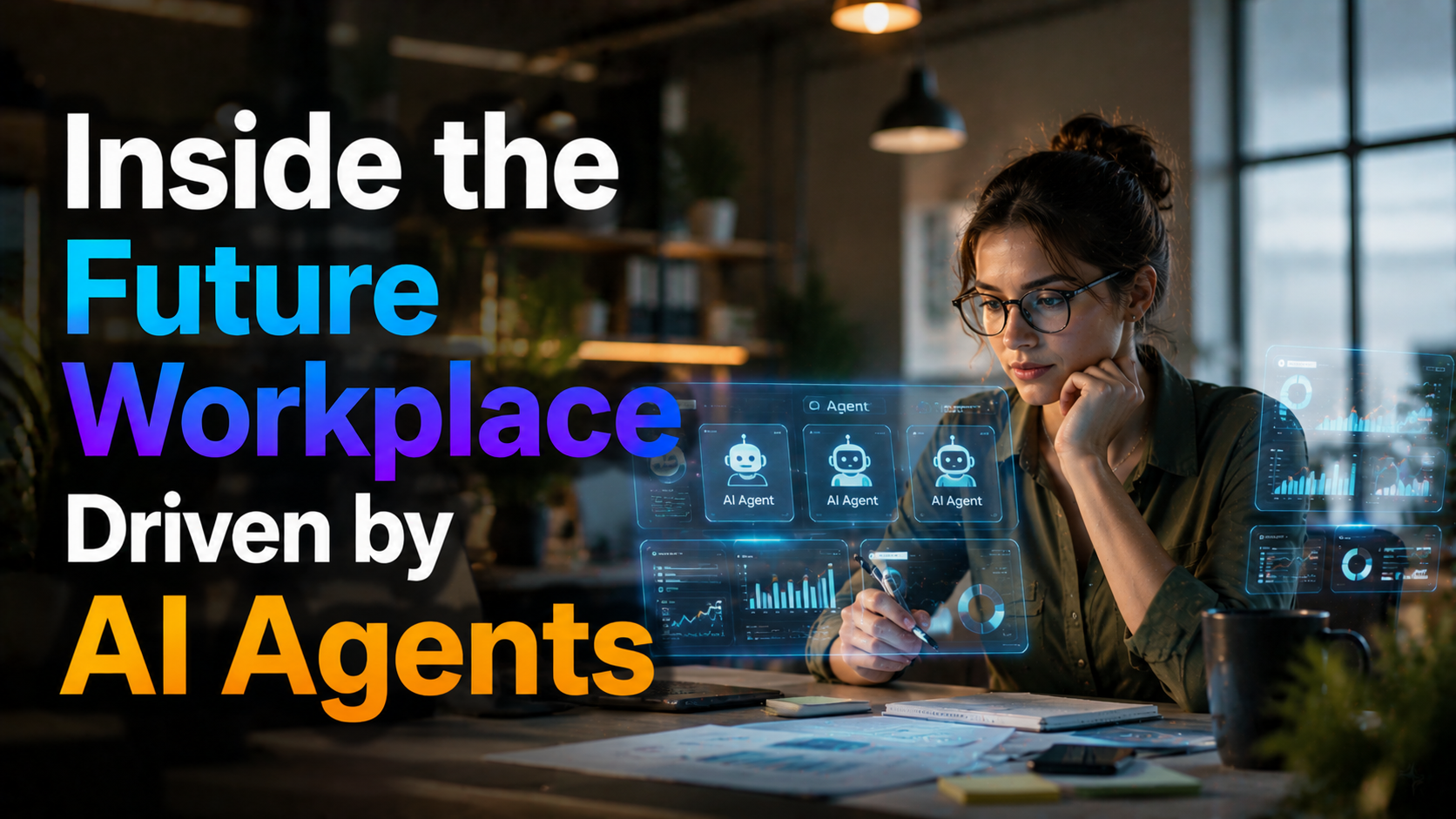
For more than a century, workplaces have evolved alongside technology. Inside the Future Workplace Driven by AI Agents.
Factories transformed physical labor. Computers digitized information. The internet connected global teams. Cloud computing enabled remote work. Mobile technology created always-on productivity.
Now, another workplace revolution is underway.
Artificial Intelligence is no longer limited to generating text, answering questions, or analyzing data. A new generation of autonomous AI agents is emerging, systems capable of planning, reasoning, executing tasks, coordinating workflows, and supporting business operations with minimal human intervention.
These AI agents are beginning to reshape how organizations function.
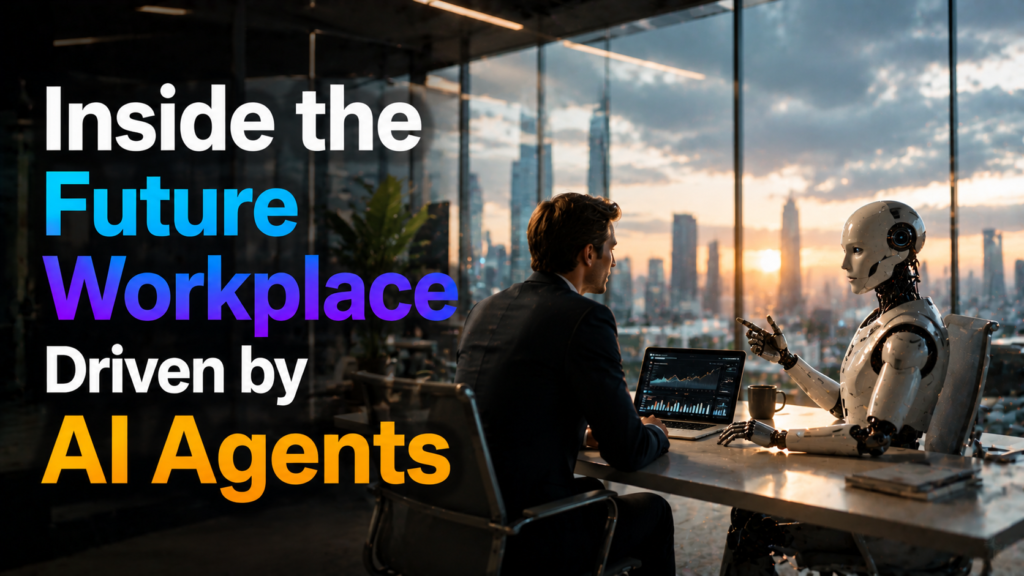
The future workplace will not simply consist of employees using AI tools. Instead, it will increasingly involve humans working alongside intelligent digital colleagues capable of handling routine tasks, processing information, and executing workflows at unprecedented speed and scale.
This transformation has profound implications for productivity, leadership, hiring, workplace culture, organizational design, and economic growth.
Businesses that understand these changes today will be better positioned to thrive in tomorrow’s increasingly AI-driven economy.
The future workplace is already taking shape.
And AI agents are becoming one of its defining features.
Table of Contents
Understanding AI Agents in the Workplace
Before exploring the future workplace, it is important to understand what AI agents actually are.
AI agents are intelligent software systems designed to pursue objectives autonomously.
Unlike traditional software, AI agents can:
- Understand goals
- Create plans
- Analyze information
- Make recommendations
- Execute tasks
- Learn from outcomes
- Adapt to changing conditions
Instead of merely assisting workers, they increasingly act as productive participants in workflows.
In practical terms, an AI agent may:
- Schedule meetings
- Generate reports
- Conduct research
- Analyze customer data
- Monitor projects
- Coordinate workflows
- Draft communications
This capability fundamentally changes how work gets done.
The Evolution of the Workplace
The future workplace can be better understood by examining the progression of work environments.
| Era | Primary Workforce Model |
|---|---|
| Industrial Age | Manual Labor |
| Information Age | Knowledge Workers |
| Internet Era | Connected Workforce |
| Cloud Era | Distributed Teams |
| AI Era | Human-AI Collaboration |
Each transition increased productivity and expanded organizational capabilities.
The AI era introduces a new workforce category:
Digital workers.
The Rise of Digital Workers
Digital workers are AI agents that perform operational tasks traditionally handled by humans.
Unlike conventional software, digital workers can manage complete workflows.
Examples include:
Customer Service Agents
Handling inquiries and resolving issues.
Research Agents
Gathering and synthesizing information.
Marketing Agents
Managing campaigns and performance analysis.
HR Agents
Supporting recruitment and onboarding.
Operations Agents
Coordinating internal processes.
These agents can work continuously without fatigue, creating new levels of organizational efficiency.
How AI Agents Are Transforming Daily Work
The future workplace will look significantly different from today’s environment.
Many routine responsibilities may be delegated to AI agents.
Employees will spend less time on:
- Administrative tasks
- Data entry
- Scheduling
- Reporting
- Information retrieval
And more time on:
- Strategic planning
- Innovation
- Leadership
- Problem-solving
- Relationship building
This shift allows organizations to focus human talent on higher-value activities.
From Task Management to Outcome Management
Traditional workplaces often focus on task completion.
Employees manually execute individual activities throughout the day.
AI agents enable a transition toward outcome management.
Instead of assigning tasks, managers increasingly define objectives.
For example:
Traditional approach:
- Gather sales data
- Build report
- Analyze performance
- Prepare presentation
AI-agent approach:
“Provide a weekly sales performance summary with recommendations.”
The AI executes the workflow.
Employees focus on interpreting results and making decisions.
Intelligent Workflows Become the New Standard
One of the most significant changes involves workflow automation.
Traditional workflows often require multiple human interactions.
AI agents can:
- Collect information
- Process data
- Generate outputs
- Coordinate systems
- Monitor progress
Workflows become increasingly autonomous.
Organizations gain:
- Faster execution
- Greater consistency
- Reduced errors
- Improved scalability
This represents a major productivity breakthrough.
The AI-Powered Employee Experience
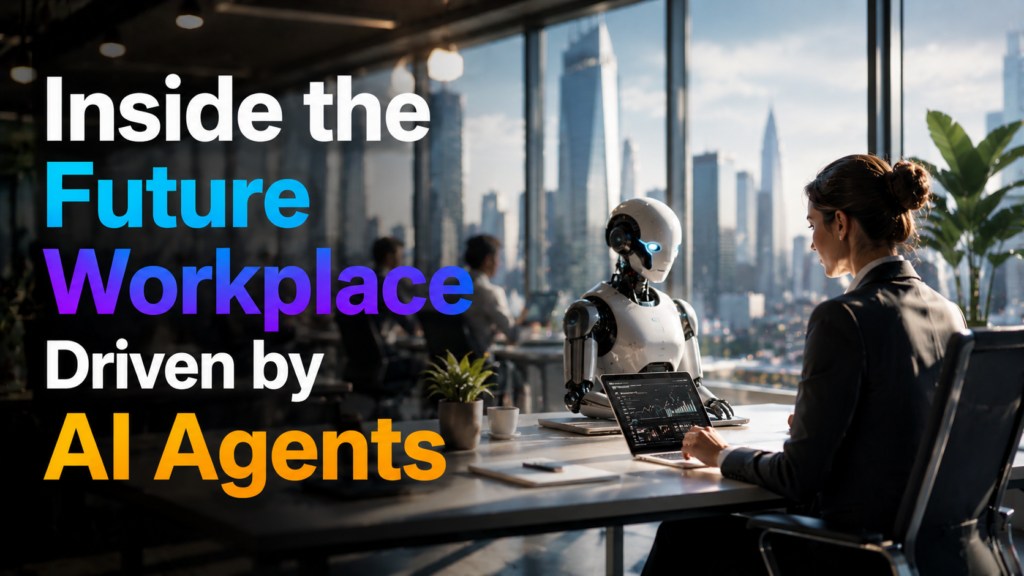
Employees will increasingly interact with AI throughout the workday.
Future workplace experiences may include:
Personalized AI Assistants
Helping employees manage responsibilities.
Intelligent Knowledge Systems
Providing instant access to organizational information.
Automated Administrative Support
Handling repetitive operational work.
Continuous Learning Assistance
Supporting skill development.
The workplace becomes more responsive and adaptive.
AI Agents and Team Collaboration
Collaboration is also evolving.
AI agents can function as active team participants.
They may:
- Attend meetings
- Take notes
- Summarize discussions
- Assign action items
- Track project progress
This reduces administrative overhead while improving coordination.
Future teams may consist of both human members and AI contributors.
The Emergence of Multi-Agent Workforces
The future workplace may involve entire ecosystems of specialized AI agents.
Consider a marketing department:
| AI Agent | Responsibility |
|---|---|
| Research Agent | Market analysis |
| Content Agent | Content creation |
| Analytics Agent | Performance tracking |
| Advertising Agent | Campaign management |
| Reporting Agent | Executive summaries |
Together, these agents form a digital workforce supporting human teams.
How Leadership Will Change
Leadership in the AI era requires new skills.
Managers will increasingly oversee:
- Human employees
- AI systems
- Hybrid workflows
Leadership responsibilities may include:
Defining Objectives
Providing strategic direction.
Managing Human-AI Collaboration
Ensuring effective teamwork.
Evaluating Outcomes
Focusing on results rather than activity.
Maintaining Accountability
Ensuring responsible AI use.
The role of leadership becomes more strategic and less operational.
Why Human Skills Become More Valuable
As AI agents automate routine work, uniquely human abilities gain importance.
Creativity
Generating original ideas.
Emotional Intelligence
Building relationships and trust.
Critical Thinking
Evaluating complex situations.
Strategic Vision
Planning long-term initiatives.
Ethical Judgment
Making responsible decisions.
These capabilities remain difficult for AI systems to replicate.
The future workplace rewards human strengths rather than replacing them.
The Economic Benefits of AI-Driven Workplaces
Organizations adopting AI agents may experience significant advantages.
| Benefit | Organizational Impact |
|---|---|
| Productivity Growth | Faster execution |
| Cost Efficiency | Lower operational expenses |
| Better Decision-Making | Improved business outcomes |
| Scalability | Growth without proportional staffing increases |
| Employee Satisfaction | Reduced repetitive work |
These benefits explain why AI investment continues accelerating globally.
The Future of Hiring and Workforce Development
Hiring practices will evolve significantly.
Future employers may prioritize:
Adaptability
Ability to work with emerging technologies.
AI Literacy
Understanding AI capabilities and limitations.
Collaboration Skills
Working effectively alongside intelligent systems.
Problem-Solving
Managing complex challenges.
Communication
Coordinating people and technology.
The most valuable employees may be those who effectively leverage AI agents rather than compete with them.
Challenges Facing the AI-Powered Workplace
Despite significant opportunities, challenges remain.
Trust
Employees must trust AI-generated outputs.
Security
Autonomous systems require safeguards.
Privacy
Sensitive organizational data must remain protected.
Governance
Clear accountability frameworks are essential.
Workforce Adaptation
Organizations must manage change effectively.
Addressing these challenges will be critical for successful adoption.
Why Workplace Culture Still Matters
Technology alone does not create successful organizations.
Culture remains essential.
Future workplace cultures must emphasize:
- Continuous learning
- Innovation
- Transparency
- Collaboration
- Responsible AI use
Strong culture helps organizations maximize the benefits of intelligent systems.
The Rise of AI-Native Organizations
Some companies are moving beyond AI adoption.
They are becoming AI-native organizations.
Characteristics include:
- AI-first workflows
- Intelligent operations
- Autonomous decision support
- Digital workforces
- Continuous optimization
These organizations may gain substantial competitive advantages over traditional businesses.
What the Workplace of 2035 Might Look Like
By 2035, workplaces may operate very differently.
Employees may begin each day by interacting with AI assistants that:
- Prioritize tasks
- Summarize key developments
- Recommend actions
- Coordinate schedules
- Manage workflows
Departments may include dozens of specialized AI agents supporting operations.
Routine work becomes increasingly automated.
Human effort focuses on creativity, innovation, leadership, and strategy.
The workplace becomes more intelligent, responsive, and productive.
How Businesses Can Prepare Today
Organizations seeking to prepare for this future should:
Build AI Literacy
Educate employees and leaders.
Modernize Infrastructure
Enable AI integration across systems.
Improve Data Quality
Reliable data improves AI performance.
Pilot AI Workflows
Identify high-value use cases.
Establish Governance Policies
Ensure responsible deployment.
Preparation today creates future advantages.
Conclusion
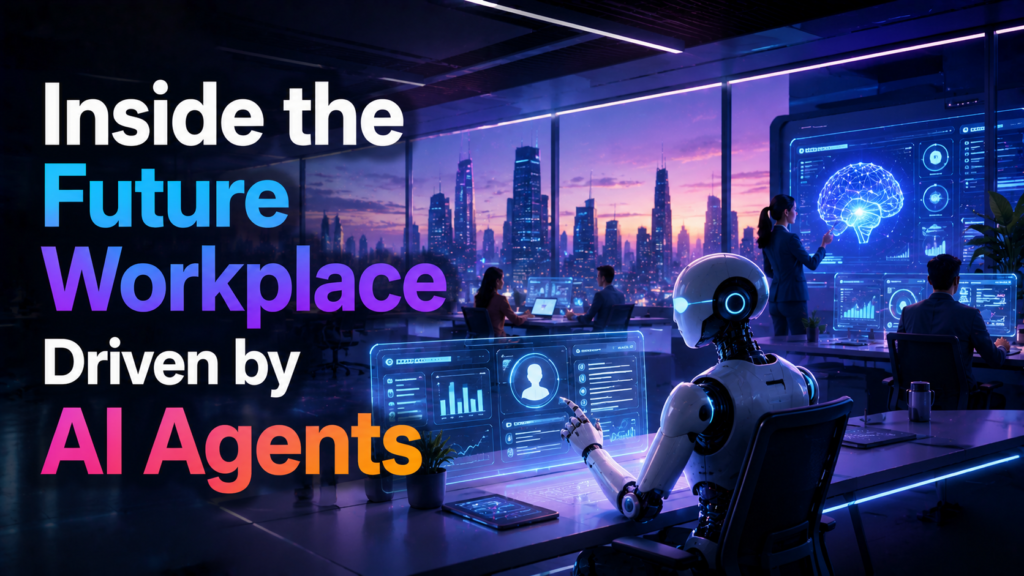
The future workplace driven by AI agents represents one of the most significant transformations in modern business history. As autonomous AI systems become more capable, organizations gain access to intelligent digital workers that can automate workflows, improve decision-making, enhance productivity, and support business growth.
Rather than replacing human employees, AI agents are likely to become collaborative partners that handle routine operational tasks while humans focus on creativity, leadership, innovation, and strategic thinking.
The most successful organizations will not simply deploy AI technology.
They will redesign how work is performed, how teams collaborate, and how value is created.
The future workplace will be defined by human-AI collaboration.
Employees will work alongside intelligent systems.
Leaders will manage hybrid workforces.
Organizations will operate with unprecedented efficiency and agility.
The workplace of tomorrow is not a distant vision.
It is already beginning to emerge today.
And AI agents are helping build it.
Also Read: “Why AI Is Becoming a Daily Companion“
Frequently Asked Questions (FAQs)
1. What are AI agents in the workplace?
AI agents are intelligent software systems capable of autonomously performing tasks, coordinating workflows, analyzing information, and supporting business operations.
2. Will AI agents replace human employees?
AI agents are more likely to automate repetitive tasks rather than replace entire jobs. Human skills such as creativity, leadership, emotional intelligence, and strategic thinking remain highly valuable.
3. What industries will benefit most from AI-driven workplaces?
Technology, finance, healthcare, retail, customer service, education, marketing, and professional services are among the industries expected to see significant benefits.