

Introduction: The Next Evolution of Work Has Already Begun
Every major technological era has transformed how people work.
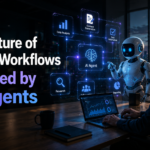
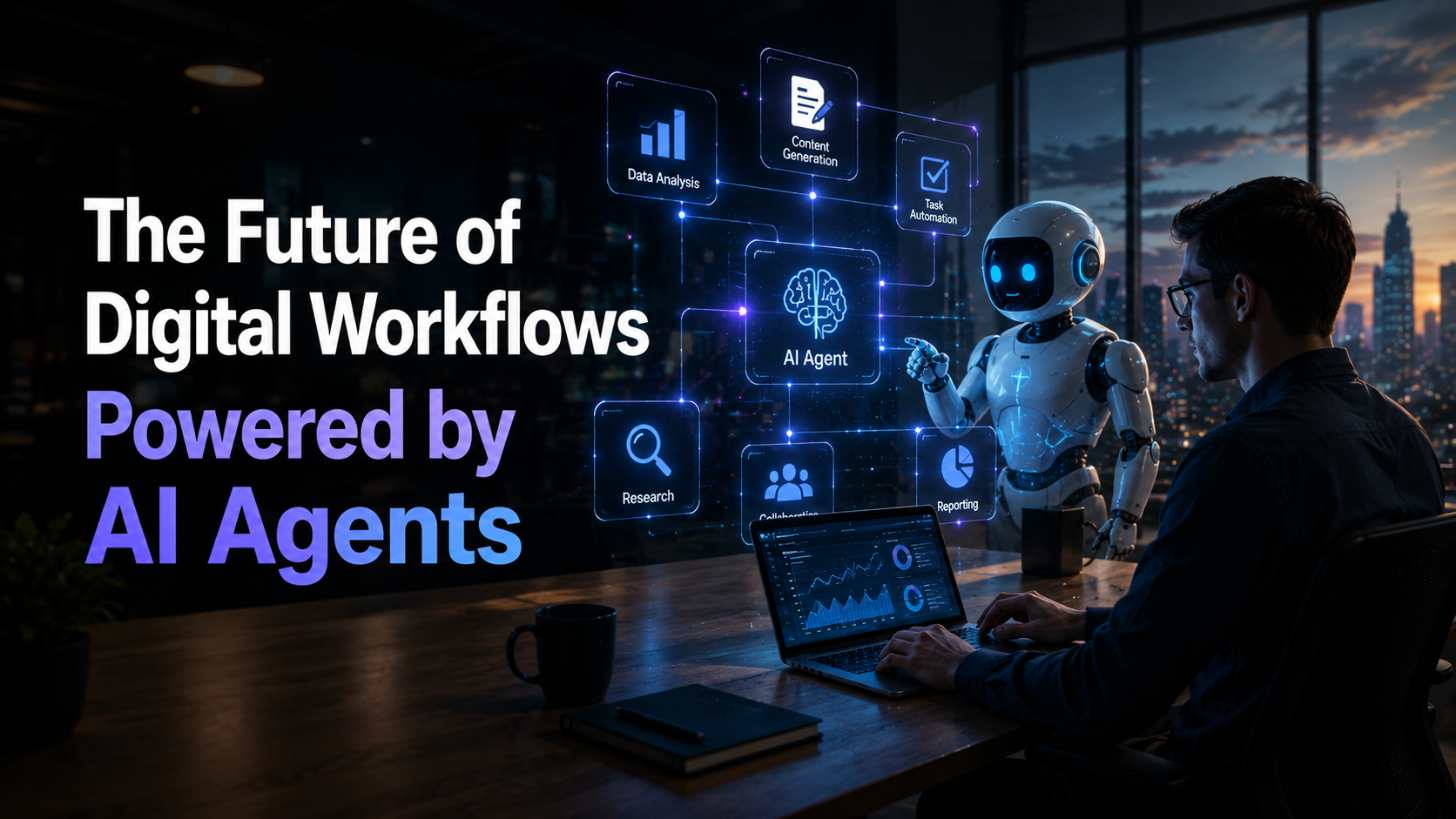
The industrial revolution mechanized physical labor. The computer revolution digitized information. The internet connected businesses globally. Cloud computing enabled work from anywhere. The Future of Digital Workflows Powered by AI Agents.
Today, another transformation is unfolding.
Artificial Intelligence is redefining how digital work gets done.
However, the most significant shift is not simply AI-powered tools. It is the emergence of AI agents, intelligent systems capable of planning, reasoning, executing tasks, and coordinating workflows with minimal human supervision.
For decades, digital workflows required humans to move information between systems, monitor processes, make routine decisions, and manually manage countless operational tasks.
AI agents are changing that reality.
Instead of employees spending hours updating spreadsheets, generating reports, coordinating communications, or processing repetitive requests, AI agents can increasingly perform these activities autonomously.
This marks the beginning of a new era where workflows become intelligent, adaptive, and self-managing.
The future of digital workflows powered by AI agents is not about replacing humans. It is about augmenting human capabilities, eliminating operational friction, and creating organizations that can operate faster, smarter, and more efficiently than ever before.
As businesses race toward digital transformation, AI agents are becoming one of the most important technologies shaping the future of work.
Table of Contents
Understanding Digital Workflows
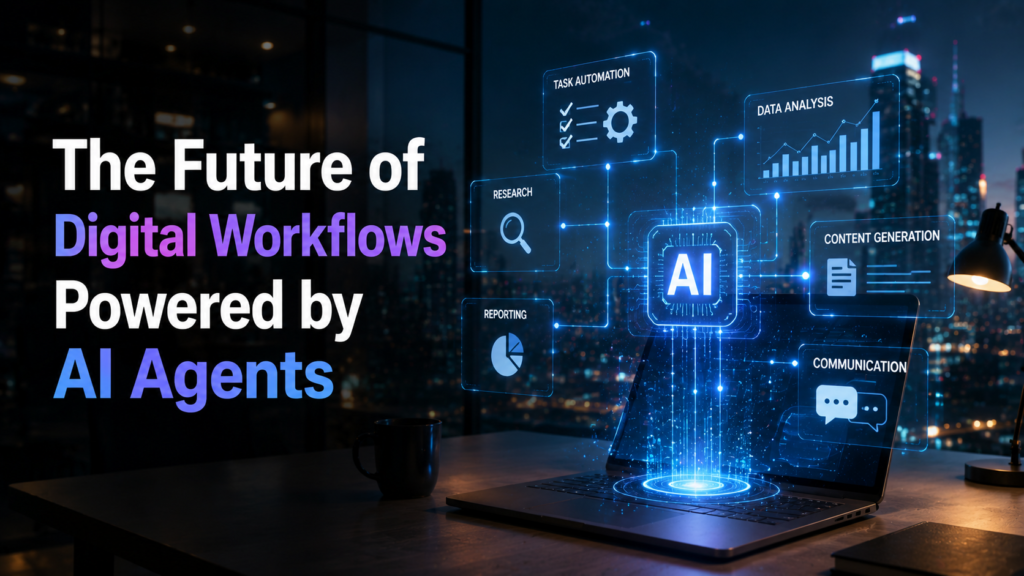
Before exploring the impact of AI agents, it is important to understand what digital workflows actually are.
A digital workflow is a sequence of tasks, processes, and decisions that enable work to move through an organization.
Examples include:
- Employee onboarding
- Customer support
- Marketing campaigns
- Financial reporting
- Software development
- Sales operations
- Human resource management
Traditionally, these workflows rely heavily on human coordination.
Employees gather information, transfer data, make decisions, and ensure processes move forward.
While software has improved efficiency, humans often remain the primary operators.
AI agents are beginning to change this model.
What Are AI Agents?
AI agents are intelligent software systems capable of independently pursuing goals and executing tasks.
Unlike traditional automation tools that follow predefined rules, AI agents can:
- Understand objectives
- Create plans
- Analyze information
- Make decisions
- Adapt to changing circumstances
- Interact with software systems
- Complete multi-step workflows
In simple terms, traditional software executes commands.
AI agents execute outcomes.
For example:
Instead of asking an employee to manually prepare a quarterly performance report, an AI agent can:
- Collect data
- Analyze trends
- Generate insights
- Create visualizations
- Deliver a completed report
The workflow becomes largely autonomous.
Why AI Agents Represent a Workflow Revolution
Organizations have long sought to automate repetitive work.
Traditional automation achieved this through rule-based systems.
However, conventional automation struggles when workflows involve:
- Ambiguity
- Unstructured data
- Human language
- Dynamic decision-making
AI agents overcome many of these limitations.
Their ability to reason and adapt allows them to manage significantly more complex processes.
This transforms workflows from static systems into intelligent operational networks.
Traditional Automation vs AI-Powered Workflows
| Traditional Automation | AI Agent Workflows |
|---|---|
| Rule-based | Goal-based |
| Fixed processes | Adaptive processes |
| Structured inputs | Structured and unstructured inputs |
| Limited flexibility | Dynamic decision-making |
| Task automation | Workflow automation |
| Human supervision required | Reduced supervision |
This distinction explains why AI agents are attracting enormous attention across industries.
How AI Agents Transform Digital Workflows
The impact of AI agents extends across nearly every business function.
Intelligent Task Coordination
Agents can manage multiple tasks simultaneously.
Instead of employees manually coordinating activities, agents can prioritize and allocate resources automatically.
Automated Decision Support
AI agents can evaluate information and recommend actions.
This accelerates decision-making while reducing operational delays.
Continuous Monitoring
Agents can monitor workflows 24/7.
Issues are identified and addressed in real time.
Adaptive Execution
When conditions change, agents can adjust workflows without requiring extensive reprogramming.
This flexibility is one of their most powerful advantages.
The Rise of Autonomous Business Processes
Historically, automation focused on individual tasks.
AI agents enable automation at the process level.
Entire workflows can become autonomous.
Examples include:
Customer Service
AI agents can:
- Receive inquiries
- Analyze requests
- Access customer information
- Resolve issues
- Escalate complex cases
Marketing Operations
Agents can:
- Conduct audience research
- Generate content
- Launch campaigns
- Monitor performance
- Recommend optimizations
Human Resources
Agents can:
- Screen applications
- Schedule interviews
- Coordinate onboarding
- Answer employee questions
The result is faster and more efficient operations.
AI Agents and Enterprise Productivity
Productivity remains one of the strongest business arguments for AI agents.
Knowledge workers often spend substantial time on repetitive activities.
Research, reporting, scheduling, documentation, and administrative coordination consume significant resources.
AI agents can automate many of these responsibilities.
Benefits include:
- Faster task completion
- Reduced operational costs
- Improved employee satisfaction
- Greater organizational scalability
Employees gain more time to focus on strategic and creative work.
The Future of Knowledge Work
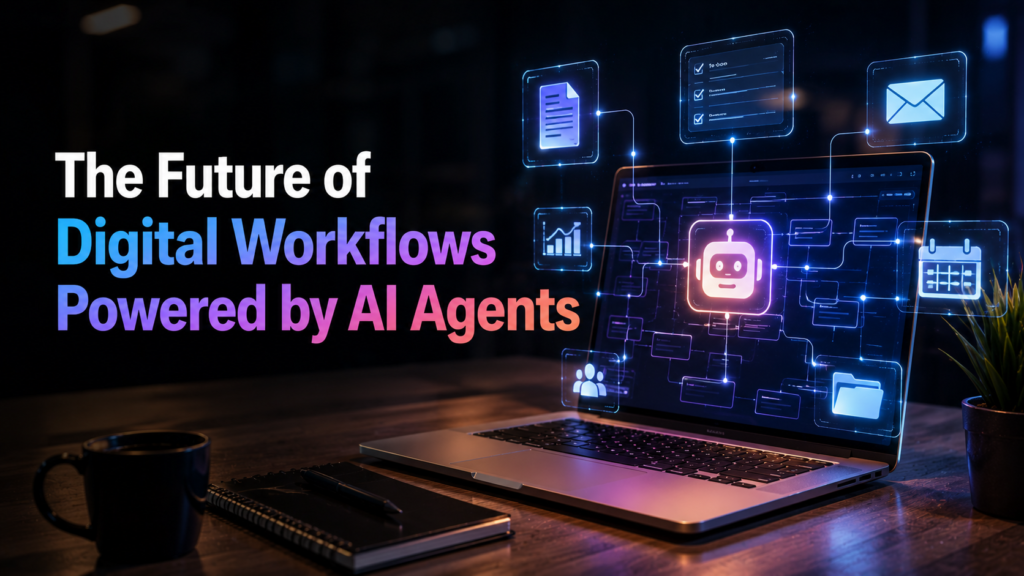
Knowledge work has traditionally been difficult to automate because it requires reasoning and decision-making.
AI agents are changing this assumption.
Modern agents can assist with:
- Research
- Analysis
- Writing
- Data interpretation
- Workflow coordination
This does not eliminate human expertise.
Instead, it amplifies it.
Professionals become supervisors, strategists, and decision-makers while AI agents handle operational execution.
Industry Applications of AI-Powered Workflows
The impact of AI agents extends across sectors.
Healthcare
Applications include:
- Patient scheduling
- Documentation
- Insurance processing
- Administrative coordination
Finance
AI-powered workflows can support:
- Compliance monitoring
- Risk assessment
- Reporting
- Fraud detection
Retail
Agents help manage:
- Inventory optimization
- Customer support
- Product recommendations
- Supply chain coordination
Manufacturing
Applications include:
- Predictive maintenance
- Production scheduling
- Quality assurance
- Resource allocation
Virtually every industry can benefit from workflow automation.
The Rise of Multi-Agent Systems
The future may involve not just individual agents but entire teams of AI agents.
A multi-agent system consists of specialized agents collaborating toward shared objectives.
For example:
A marketing department might utilize:
- Research agents
- Content agents
- Analytics agents
- Advertising agents
- Reporting agents
Together, these systems create highly efficient operational ecosystems.
AI Agents and the Modern Digital Workplace
The workplace itself is evolving.
Digital employees powered by AI may become standard organizational assets.
These agents can:
- Attend meetings
- Summarize discussions
- Track action items
- Coordinate projects
- Monitor deadlines
Organizations gain an intelligent support layer that operates continuously.
This transforms workplace productivity.
Challenges and Risks of AI-Powered Workflows
Despite their promise, AI agents introduce important challenges.
Reliability
AI systems can occasionally generate incorrect outputs.
Security
Autonomous actions require robust safeguards.
Privacy
Sensitive information must be protected.
Compliance
Regulatory requirements vary across industries.
Accountability
Organizations must determine responsibility for AI-driven decisions.
Effective governance frameworks are essential.
Why Human Oversight Remains Critical
AI agents are powerful tools.
They are not replacements for human judgment.
Humans provide:
- Strategic thinking
- Ethical reasoning
- Contextual understanding
- Creativity
- Leadership
The most successful organizations will combine AI efficiency with human expertise.
The future is collaborative rather than fully autonomous.
Human Skills That Become More Valuable
As workflows become automated, certain human skills increase in importance.
Critical Thinking
Evaluating complex situations.
Creativity
Generating innovative solutions.
Emotional Intelligence
Managing relationships and teams.
Leadership
Guiding organizational direction.
Strategic Planning
Making long-term decisions.
These capabilities complement AI rather than compete with it.
The Economics of AI-Powered Workflows
The business case for AI agents is compelling.
Organizations may achieve:
| Benefit | Impact |
|---|---|
| Productivity Growth | Higher output per employee |
| Cost Reduction | Lower operational expenses |
| Faster Decision-Making | Improved responsiveness |
| Better Customer Experiences | Increased satisfaction |
| Scalability | Growth without proportional staffing increases |
These benefits explain why investment in AI agent technologies continues accelerating.
What Businesses Should Do Today
Organizations preparing for the future should take several steps.
Invest in AI Education
Build organizational understanding.
Identify Workflow Bottlenecks
Focus automation efforts where value is greatest.
Modernize Infrastructure
Prepare systems for AI integration.
Establish Governance Policies
Ensure responsible AI usage.
Strengthen Data Quality
High-quality data improves outcomes.
Preparation today creates long-term competitive advantages.
The Future of Digital Workflows
Over the next decade, digital workflows may become increasingly autonomous.
Future workflows could:
Self-Optimize
Continuously improve performance.
Self-Monitor
Identify issues automatically.
Self-Heal
Resolve operational problems independently.
Collaborate Across Systems
Coordinate actions across multiple platforms.
Personalize Experiences
Adapt to individual users and teams.
The result is a more intelligent and responsive operational environment.
Conclusion
The future of digital workflows powered by AI agents represents one of the most important developments in modern business technology. These systems are transforming workflows from static, human-dependent processes into intelligent operational networks capable of planning, executing, and optimizing work at unprecedented scale.
Organizations that embrace AI-powered workflows stand to gain significant advantages in productivity, efficiency, customer experience, and innovation.
However, success will depend not only on technology adoption but also on responsible governance, strong data foundations, and thoughtful integration with human expertise.
The future workplace will not be powered by humans alone or AI alone.
It will be powered by collaboration between both.
As AI agents become increasingly capable, they will redefine how work flows through organizations and how value is created in the digital economy.
The next generation of business operations is already emerging.
And AI agents are at the center of that transformation.
Also Read: “The Next Digital Revolution Is Already Underway“
Frequently Asked Questions (FAQs)
1. What are AI-powered digital workflows?
AI-powered digital workflows use intelligent AI agents to automate, coordinate, and optimize business processes with minimal human intervention.
2. How do AI agents improve workflow efficiency?
AI agents can handle repetitive tasks, analyze information, make decisions, coordinate activities, and continuously monitor operations, reducing manual effort and increasing productivity.
3. Will AI agents replace employees?
AI agents are more likely to automate tasks rather than entire jobs. Human skills such as creativity, leadership, critical thinking, and strategic decision-making remain essential.