







How AI-Powered Search Is Reshaping Digital Publishing, Website Traffic, and the Economics of the Open Web
Introduction: A Crisis Few Publishers Saw Coming
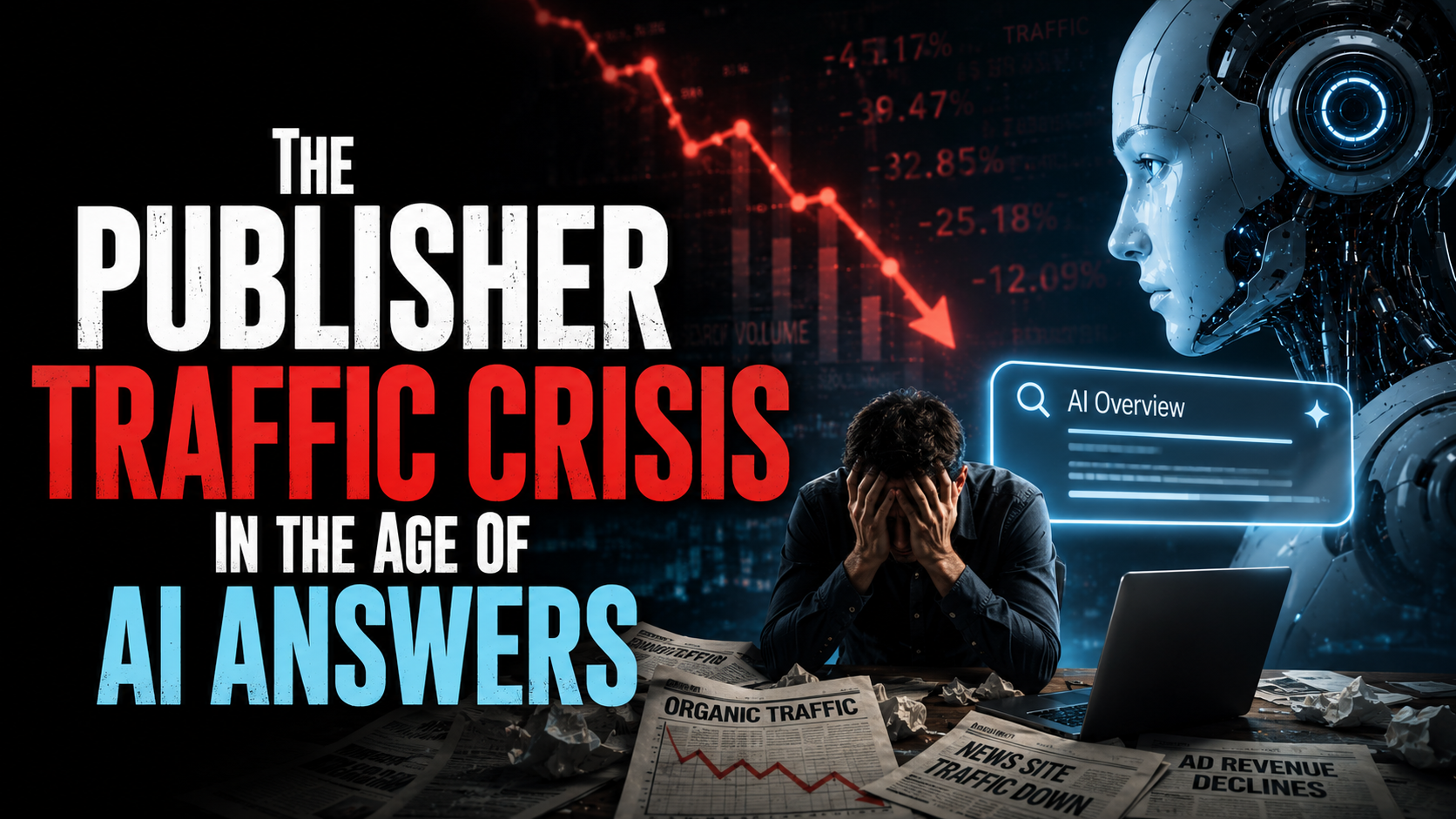
For more than twenty years, the internet operated on a relatively simple agreement. The Publisher Traffic Crisis in the Age of AI Answers.
Publishers created content.
Search engines helped users discover it.
Users clicked links, visited websites, consumed content, and publishers earned revenue through advertising, subscriptions, sponsorships, affiliate partnerships, and product sales.
This system powered the modern digital economy.
News organizations, blogs, niche websites, educational platforms, independent creators, and businesses all benefited from the flow of search traffic.
Today, however, that model is facing its biggest disruption since the birth of search engines.
Artificial Intelligence is changing how people find information.
Instead of clicking through multiple websites to find answers, users increasingly receive direct responses from AI-powered search engines, chatbots, and intelligent assistants.
The shift appears small on the surface.
Yet beneath it lies a profound transformation.
Every answer generated by AI may represent a website visit that never happens.
Every summarized article may represent page views that disappear.
Every AI-generated response potentially reduces the economic value of the content ecosystem that made the answer possible in the first place.
This growing challenge is becoming known as the Publisher Traffic Crisis.
For publishers, creators, journalists, marketers, and businesses that rely on organic traffic, the rise of AI answers may fundamentally reshape the future of online publishing.
The question is no longer whether AI will change digital media.
The question is whether publishers can survive the transition.
Table of Contents
Understanding the Traditional Publisher Ecosystem
To understand the crisis, it is important to understand how digital publishing has worked for decades.
The traditional model followed a predictable path:
Step 1: Publishers Create Content
Examples include:
- News articles
- Blog posts
- Product reviews
- Tutorials
- Research reports
- Educational resources
Step 2: Search Engines Index Content
Search platforms discover and rank pages.
Step 3: Users Search for Information
People enter queries and receive relevant links.
Step 4: Traffic Flows to Publishers
Visitors arrive on websites.
Step 5: Publishers Monetize Attention
Revenue comes through:
- Display advertising
- Subscriptions
- Affiliate marketing
- Lead generation
- Product sales
This ecosystem rewarded content creation.
The more useful the content, the more visibility and traffic a publisher could earn.
The Rise of AI Answers
Artificial Intelligence is introducing a fundamentally different information model.
Traditional search results typically provide:
- Website links
- Page titles
- Meta descriptions
AI-powered systems increasingly provide:
- Direct answers
- Summaries
- Comparisons
- Recommendations
- Explanations
Instead of directing users to sources, AI often delivers the information immediately.
For users, this is convenient.
For publishers, it can be devastating.
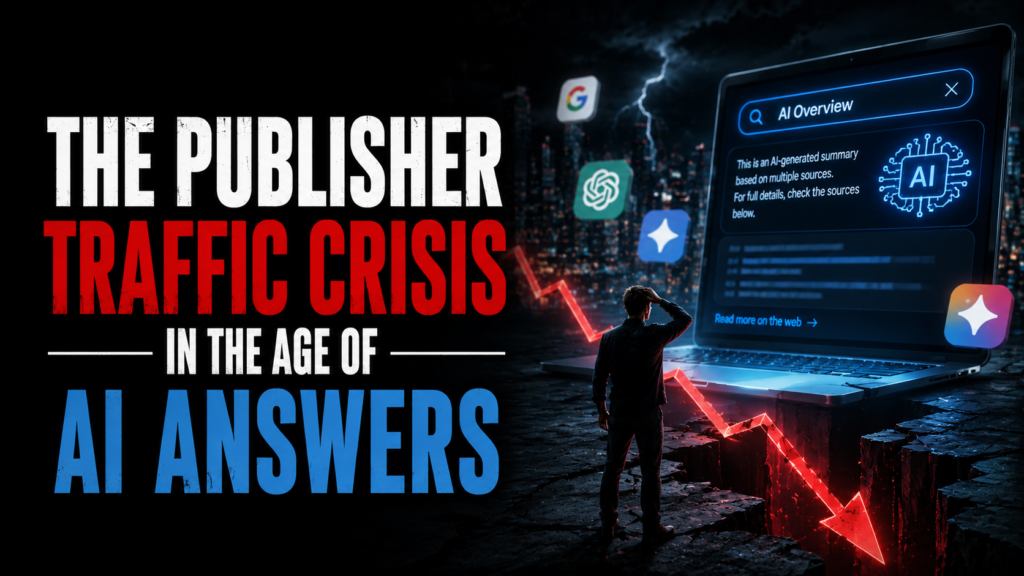
The Zero-Click Revolution
One of the most significant trends affecting publishers is the rise of zero-click experiences.
A zero-click experience occurs when users obtain information without visiting a website.
Examples include:
- Featured snippets
- Knowledge panels
- Instant answers
- AI-generated summaries
AI dramatically expands this concept.
Rather than showing snippets from a webpage, AI may synthesize information from numerous sources into a complete response.
The result?
The user never clicks.
The publisher never receives traffic.
Why Traffic Matters More Than Most People Realize
Many internet users view traffic simply as website popularity.
In reality, traffic is the economic engine of digital publishing.
Without traffic:
- Advertising revenue declines
- Subscription conversions fall
- Affiliate income decreases
- Brand awareness weakens
- Audience growth slows
Traffic supports journalism, education, entertainment, research, and countless forms of online content.
When traffic disappears, sustainability becomes a concern.
How AI Changes User Behavior
AI is not only changing search technology.
It is changing user expectations.
Modern users increasingly expect:
Instant Answers
Waiting feels unnecessary.
Conversational Experiences
People prefer asking questions naturally.
Personalized Information
Users want answers tailored to their needs.
Reduced Research Effort
AI eliminates much of the information-gathering process.
These behavioral shifts reduce the incentive to visit multiple websites.
The information journey becomes shorter.
Unfortunately for publishers, so does the traffic journey.
The New Information Funnel
The traditional internet funnel looked like this:
| Traditional Search Model |
|---|
| User searches |
| Search engine displays links |
| User visits website |
| Publisher earns value |
The AI search funnel increasingly looks like this:
| AI Search Model |
|---|
| User asks question |
| AI generates answer |
| User leaves satisfied |
| Website receives no visit |
The difference appears subtle.
Economically, it is enormous.
Why Publishers Are Concerned
Publishers invest significant resources in content creation.
A single article may require:
- Research
- Interviews
- Editing
- Fact-checking
- Design
- Distribution
These costs are justified when content attracts audiences.
However, AI systems increasingly benefit from published information without necessarily sending users back to the original source.
This creates a difficult question:
Who gets rewarded for creating knowledge?
If publishers lose traffic while AI platforms gain engagement, economic incentives become misaligned.
The AI Content Dependency Problem
AI systems depend heavily on the open web.
They learn from and reference:
- Articles
- Academic papers
- Reviews
- Documentation
- Forums
- Public websites
Without publishers, there is no information ecosystem.
This creates an unusual paradox.
| Publishers Need Traffic | AI Needs Content |
|---|---|
| Revenue depends on visitors | Answers depend on source material |
| Content creation requires investment | AI relies on existing knowledge |
| Sustainability requires audience growth | Quality depends on publishers |
The future health of AI search depends on maintaining a healthy publishing ecosystem.
The Impact on Independent Publishers
Large media organizations often have:
- Diverse revenue streams
- Brand recognition
- Subscription businesses
Independent publishers face greater risks.
Many rely heavily on:
- Organic search traffic
- Affiliate commissions
- Display advertising
Even modest traffic declines can significantly impact profitability.
This may disproportionately affect:
- Niche experts
- Educational websites
- Small businesses
- Independent journalists
- Solo creators
Ironically, these creators often provide some of the internet’s most valuable content.
Why Google EEAT Matters More Than Ever
As AI-generated content becomes widespread, Google’s EEAT framework gains importance.
EEAT stands for:
Experience
First-hand knowledge and real-world expertise.
Expertise
Deep understanding of a subject.
Authoritativeness
Recognition as a trusted source.
Trustworthiness
Accuracy, transparency, and reliability.
AI systems increasingly need trustworthy sources to generate reliable answers.
Publishers who demonstrate strong EEAT signals may become more valuable in the AI ecosystem.
The Future of SEO in an AI World
Search Engine Optimization is entering a new era.
Traditional SEO focused heavily on:
- Keywords
- Rankings
- Backlinks
- Technical optimization
The AI era introduces additional priorities.
Future SEO may increasingly focus on:
Topic Authority
Becoming the definitive source on a subject.
Original Research
Publishing unique information unavailable elsewhere.
Brand Recognition
Building trust beyond search rankings.
Citation Potential
Creating content AI systems are likely to reference.
User Value
Providing insights beyond generic information.
SEO is evolving from ranking optimization to authority optimization.
New Business Models for Publishers
The industry is actively exploring solutions.
Potential models include:
| Future Model | Description |
|---|---|
| Content Licensing | AI companies pay publishers |
| Revenue Sharing | Publishers receive compensation from AI interactions |
| Attribution Systems | Sources receive visibility and recognition |
| Premium Content | High-value information behind subscriptions |
| Brand-Led Publishing | Revenue generated beyond traffic |
The future may involve multiple approaches rather than a single solution.
Why Trust Becomes the Most Valuable Asset
In an internet flooded with AI-generated content, trust becomes increasingly scarce.
Users will continue seeking:
- Credible information
- Expert opinions
- Original reporting
- Human perspectives
Publishers capable of building trust may gain competitive advantages.
The value of trustworthy content may actually increase as AI-generated information becomes more common.
The Long-Term Risks to the Open Internet
If publisher economics weaken significantly, broader consequences may emerge.
Potential risks include:
Reduced Journalism
Investigative reporting becomes harder to fund.
Less Original Content
Creators may reduce investment.
Lower Information Quality
Fewer expert resources are available.
Increased Content Homogenization
Unique perspectives become rarer.
Greater Platform Centralization
Knowledge becomes concentrated within a small number of AI platforms.
These outcomes could weaken the diversity that makes the internet valuable.
How Publishers Can Adapt
While challenges are significant, opportunities still exist.
Successful publishers may focus on:
Building Direct Audiences
Email newsletters and communities reduce dependence on search traffic.
Creating Original Insights
Unique expertise remains difficult to replicate.
Strengthening Brand Identity
Recognition increases resilience.
Expanding Revenue Sources
Diversification reduces risk.
Investing in Authority
Trust becomes a long-term competitive advantage.
Adaptation rather than resistance will likely define future success.
The Future Relationship Between AI and Publishers
The relationship between AI and publishers does not have to be adversarial.
The most sustainable future may involve collaboration.
In this future:
- AI improves information access.
- Publishers continue producing valuable content.
- Attribution becomes standard.
- Revenue-sharing models emerge.
- Trustworthy information is rewarded.
The challenge is creating incentives that support both innovation and content creation.
Without publishers, AI answers become weaker.
Without sustainable economics, publishers struggle to survive.
The two systems are deeply interconnected.
Conclusion
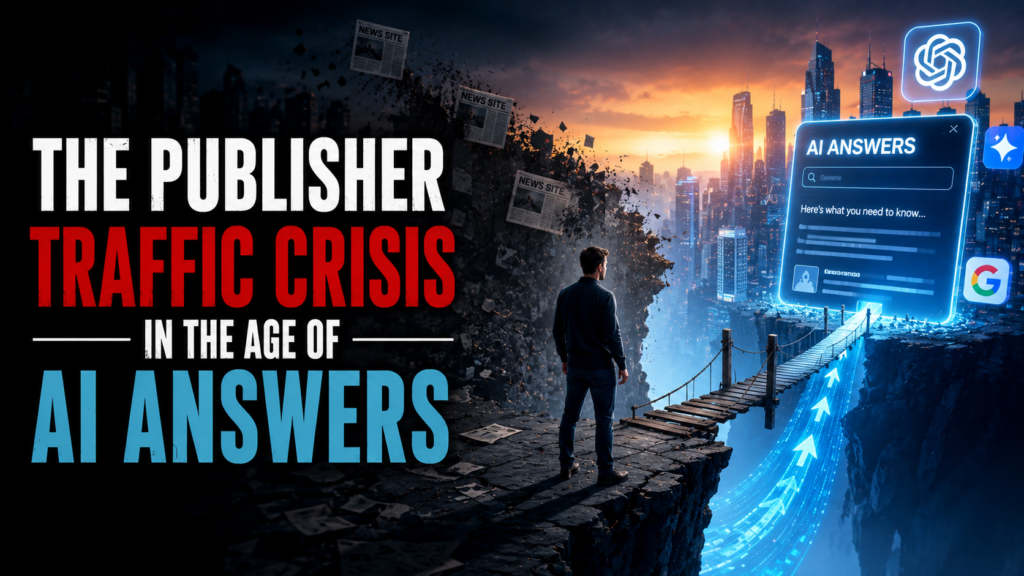
The Publisher Traffic Crisis in the Age of AI Answers represents one of the most important challenges facing the digital economy. AI-powered search is making information more accessible, efficient, and conversational than ever before. For users, the experience is often better.
For publishers, however, the situation is far more complex.
Traffic has long served as the economic foundation of online publishing. As AI systems increasingly provide direct answers, many websites risk losing the audience attention that sustains their businesses.
The future of the open internet depends on finding balance.
Artificial Intelligence requires high-quality content to remain useful. Publishers require sustainable business models to continue creating that content.
The challenge is not choosing between AI innovation and publisher survival.
The challenge is ensuring both can thrive together.
The next decade will determine whether AI strengthens the open web or unintentionally weakens the ecosystem that made it possible.
The outcome will shape the future of journalism, content creation, search, and the internet itself.
Also Read: “The Economics Behind AI-Powered Search“
Frequently Asked Questions (FAQs)
What is the publisher traffic crisis?
The publisher traffic crisis refers to declining website visits caused by AI-generated answers, zero-click searches, and AI-powered search experiences that reduce the need for users to visit websites directly.
Why are AI answers affecting publisher traffic?
AI systems often provide complete answers within search interfaces, reducing the number of users who click through to the original content source.
Can publishers survive the AI era?
Yes. Publishers can adapt by building strong brands, creating original content, developing direct audience relationships, diversifying revenue streams, and focusing on expertise and trust.