


The Complete Guide to Adapting, Competing, and Growing in the Age of Autonomous AI
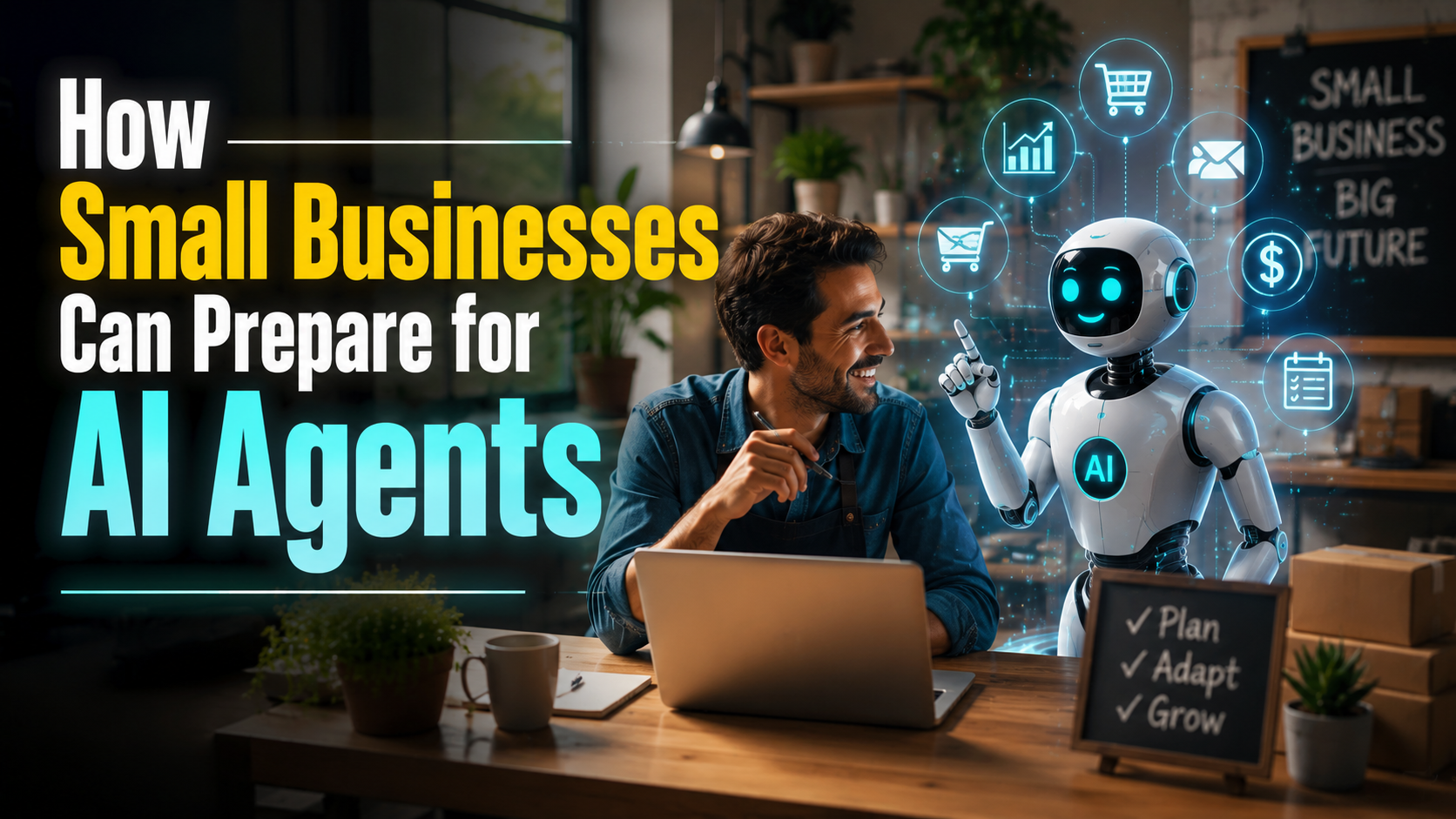
Artificial Intelligence is no longer a futuristic concept reserved for large technology companies. Over the past few years, AI has become accessible to businesses of all sizes, helping automate tasks, improve customer service, enhance marketing efforts, and increase productivity. However, a new evolution of AI is beginning to emerge, AI agents. How Small Businesses Can Prepare for AI Agents.
Unlike traditional AI tools that simply respond to prompts, AI agents can perform tasks autonomously, make decisions, coordinate workflows, interact with software systems, and work toward specific goals with minimal human intervention. Many experts believe AI agents will become as transformative to businesses as websites, smartphones, and cloud computing were in previous decades.
For small businesses, this presents both an opportunity and a challenge. Businesses that prepare early may gain significant competitive advantages. Those that ignore the trend could struggle to keep up as competitors become faster, more efficient, and increasingly automated.
The question is no longer whether AI agents will affect small businesses. The real question is:
How can small businesses prepare for AI agents before they become a standard part of business operations?
This comprehensive guide explores what AI agents are, why they matter, how they will transform small businesses, and practical steps owners can take today to stay ahead of the curve.
Table of Contents
What Are AI Agents?
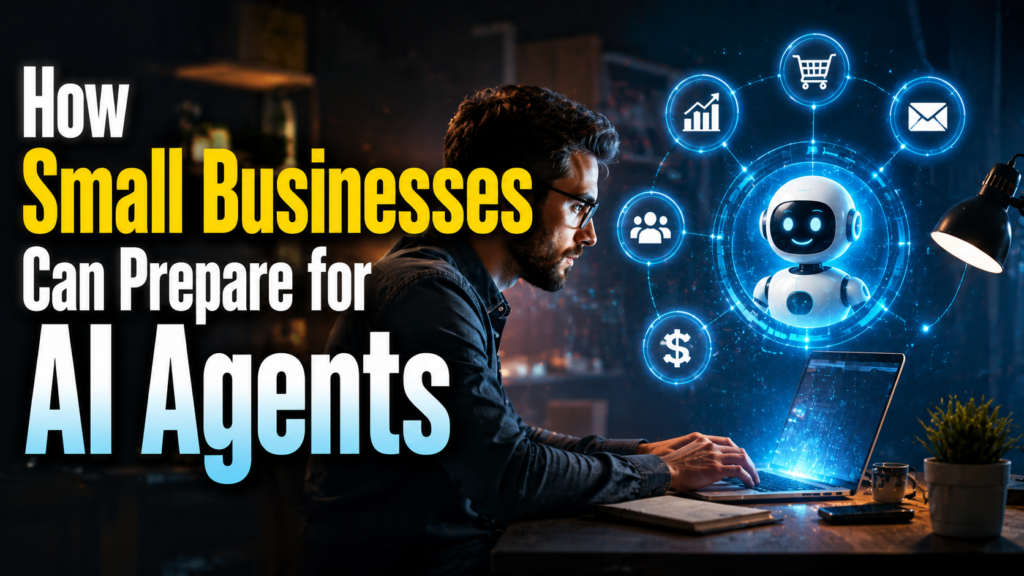
Before discussing preparation strategies, it is important to understand what AI agents actually are.
Traditional AI tools generally operate in a reactive manner. A user asks a question or submits a request, and the system responds.
AI agents go much further.
An AI agent can:
- Understand objectives
- Plan actions
- Execute tasks
- Monitor progress
- Adapt to changing conditions
- Coordinate with other systems
Think of an AI chatbot as a helpful assistant waiting for instructions.
Think of an AI agent as a digital employee capable of working independently.
Traditional AI vs AI Agents
| Traditional AI | AI Agents |
|---|---|
| Responds to prompts | Pursues goals |
| One task at a time | Multi-step workflows |
| Requires constant input | Operates autonomously |
| Limited context | Persistent memory |
| Reactive | Proactive |
This shift from assistance to autonomy represents a major technological milestone.
Why AI Agents Matter for Small Businesses
Historically, large companies enjoyed significant advantages because they could afford:
- Administrative staff
- Marketing teams
- Analysts
- Consultants
- Customer support departments
Small businesses often lacked access to these resources.
AI agents could dramatically level the playing field.
A small company may soon have access to digital workers capable of handling many responsibilities that previously required multiple employees.
This democratization of business capabilities could create unprecedented opportunities for entrepreneurs.
The Economic Impact of AI Agents
One reason AI agents are attracting so much attention is their potential economic impact.
Small businesses often face challenges such as:
- Limited budgets
- Staffing shortages
- Operational inefficiencies
- Time constraints
AI agents directly address many of these issues.
Potential Benefits
| Area | Impact |
|---|---|
| Customer Service | Faster responses |
| Marketing | Improved efficiency |
| Operations | Reduced manual work |
| Sales | Better lead management |
| Administration | Lower workload |
| Research | Faster insights |
The cumulative effect could significantly improve competitiveness.
Understanding the AI Agent Revolution
Many business owners mistakenly believe AI agents are years away.
In reality, elements of agent-based automation are already appearing in:
- Customer support platforms
- Marketing systems
- CRM software
- Productivity tools
- E-commerce solutions
The transition has already begun.
Businesses that start learning now will adapt more easily than those that wait.
Step 1: Build a Strong Digital Foundation
Before implementing AI agents, businesses need solid digital infrastructure.
Many small businesses still rely heavily on:
- Manual processes
- Paper records
- Fragmented software
AI agents perform best when data and systems are organized.
Essential Foundations
- Cloud-based systems
- Digital documentation
- CRM software
- Online payment systems
- Automated workflows
Without a strong foundation, advanced AI capabilities become difficult to deploy effectively.
Step 2: Identify Repetitive Tasks
AI agents excel at handling repetitive activities.
Business owners should conduct an audit of daily operations.
Ask:
Which tasks consume excessive time?
Examples include:
- Data entry
- Appointment scheduling
- Email responses
- Inventory tracking
- Invoice generation
- Customer inquiries
These are prime candidates for future AI agent automation.
Step 3: Improve Data Quality
AI systems depend on data.
Poor-quality data leads to poor outcomes.
Small businesses should focus on:
- Organizing customer information
- Cleaning databases
- Standardizing records
- Eliminating duplicate entries
High-quality data becomes a strategic asset in an AI-driven environment.
Step 4: Prepare Employees for Human-AI Collaboration
One of the biggest misconceptions is that AI agents will simply replace workers.
In reality, many organizations will adopt hybrid models.
Employees and AI agents will work together.
Human Responsibilities
- Strategy
- Relationship building
- Creativity
- Leadership
- Decision-making
AI Responsibilities
- Routine administration
- Data analysis
- Scheduling
- Monitoring
- Reporting
Businesses that train employees to collaborate with AI will gain advantages.
Step 5: Invest in AI Literacy
AI literacy is becoming as important as digital literacy.
Business owners should understand:
- AI capabilities
- AI limitations
- Data privacy concerns
- Automation opportunities
Employees do not need to become AI engineers.
However, they should understand how AI affects their work.
The Most Valuable AI Agents for Small Businesses
Not every AI agent delivers equal value.
Certain categories offer particularly strong returns.
Customer Service Agents
Customer service is often one of the first areas businesses automate.
AI agents can:
- Answer common questions
- Process requests
- Route inquiries
- Provide 24/7 support
Benefits
- Faster response times
- Improved customer satisfaction
- Reduced staffing costs
For many businesses, customer service agents offer immediate ROI.
Marketing Agents
Marketing requires continuous effort.
AI marketing agents can:
- Generate content ideas
- Schedule social posts
- Analyze campaign performance
- Monitor competitors
- Optimize advertisements
This enables small teams to achieve results previously requiring larger departments.
Sales Agents
Sales AI agents help businesses:
- Qualify leads
- Schedule meetings
- Send follow-ups
- Maintain CRM records
By automating administrative work, sales teams spend more time building relationships.
Financial Agents
Financial management remains a challenge for many small businesses.
AI agents can assist with:
- Expense tracking
- Budget analysis
- Cash flow monitoring
- Financial forecasting
While human oversight remains necessary, automation improves efficiency.
Operations Agents
Operations-focused AI agents monitor:
- Inventory
- Supply chains
- Scheduling
- Workflow performance
These systems help identify inefficiencies before they become major problems.
How AI Agents Will Change Customer Expectations
Businesses should recognize that AI adoption affects customer expectations.
Consumers increasingly expect:
- Instant responses
- Personalized experiences
- Continuous availability
Companies unable to meet these expectations may lose competitiveness.
AI agents help bridge this gap.
The Importance of Maintaining Human Touch
Despite automation benefits, human relationships remain essential.
Customers still value:
- Empathy
- Trust
- Personal attention
- Authentic communication
The most successful businesses will use AI to enhance customer experiences rather than eliminate human interaction.
Balanced Approach
| AI Handles | Humans Handle |
|---|---|
| Routine questions | Complex concerns |
| Scheduling | Relationship management |
| Data processing | Strategic decisions |
| Monitoring | Emotional interactions |
Balance is critical.
Cybersecurity Considerations
As businesses adopt AI agents, security becomes increasingly important.
AI systems often access:
- Customer data
- Financial information
- Internal records
Key security practices include:
- Strong authentication
- Access controls
- Employee training
- Regular audits
Security should be part of every AI strategy.
Legal and Compliance Challenges
Businesses must remain aware of:
- Privacy regulations
- Data protection laws
- Industry-specific compliance requirements
AI agents should operate within clear governance frameworks.
Responsible implementation protects both businesses and customers.
Common Mistakes Small Businesses Should Avoid
Waiting Too Long
Businesses that delay adoption risk falling behind competitors.
Automating Everything
Not every process should be automated.
Ignoring Employee Training
Technology alone does not guarantee success.
Overlooking Data Quality
Poor data reduces AI effectiveness.
Neglecting Human Relationships
Automation should support, not replace, customer trust.
Creating an AI Agent Adoption Roadmap
A phased approach often works best.
Phase 1: Assessment
Identify opportunities.
Phase 2: Pilot Projects
Test low-risk applications.
Phase 3: Integration
Connect systems and workflows.
Phase 4: Optimization
Measure results and improve performance.
Phase 5: Scaling
Expand successful implementations.
This structured approach reduces risk.
The Competitive Advantage of Early Adoption
Businesses that prepare early gain several advantages:
- Faster learning curves
- Improved operational efficiency
- Better customer experiences
- Increased adaptability
Waiting until competitors have already embraced AI may make catching up difficult.
How AI Agents Could Transform Small Businesses by 2030
By 2030, many small businesses may operate with teams of specialized AI agents handling:
- Customer support
- Marketing campaigns
- Sales outreach
- Financial monitoring
- Scheduling
- Inventory management
Entrepreneurs may effectively gain access to a digital workforce that operates continuously.
This could dramatically lower operational barriers.
Why Small Businesses Have a Unique Opportunity
Large corporations often face bureaucracy and slow decision-making.
Small businesses are more agile.
They can:
- Experiment quickly
- Implement new technologies faster
- Adapt to changing markets
This agility may become a major advantage during the AI transition.
The Future Belongs to Human-AI Collaboration
The future is unlikely to involve businesses run entirely by AI.
Instead, successful organizations will combine:
- Human creativity
- Human leadership
- Human judgment
with
- AI efficiency
- AI automation
- AI analysis
This partnership model offers the best of both worlds.
Conclusion
AI agents represent the next major evolution in business technology. Unlike traditional software tools, these autonomous systems can perform tasks, manage workflows, monitor operations, and support decision-making with minimal human intervention.
For small businesses, the opportunity is significant. AI agents can help reduce costs, improve productivity, enhance customer experiences, and compete more effectively against larger organizations. However, success requires preparation.
Businesses should begin by strengthening digital infrastructure, improving data quality, identifying automation opportunities, investing in AI literacy, and training employees for human-AI collaboration.
The companies that thrive in the coming decade will not necessarily be the ones with the biggest budgets. They will be the ones that learn how to combine human strengths with intelligent automation.
AI agents are not simply another technology trend. They may become one of the defining business tools of the next generation. Small businesses that prepare today will be better positioned to grow, compete, and innovate in the AI-powered economy of tomorrow.
Also Read: “Generative Search Is Rewriting the Rules of Visibility“
Frequently Asked Questions (FAQs)
1. What is an AI agent in business?
An AI agent is an autonomous software system capable of performing tasks, making decisions, managing workflows, and working toward business goals with limited human supervision.
2. How can small businesses benefit from AI agents?
AI agents can improve customer service, automate repetitive tasks, enhance marketing efforts, support sales activities, and increase operational efficiency.
3. Do AI agents replace employees?
In most cases, AI agents complement employees rather than replace them. They automate routine work while allowing humans to focus on creativity, relationships, leadership, and strategy.
4. How should small businesses prepare for AI agents?
Businesses should strengthen digital infrastructure, improve data quality, invest in AI education, identify automation opportunities, and develop strategies for human-AI collaboration.