









The Surprising Shift in Human Advice-Seeking Behavior
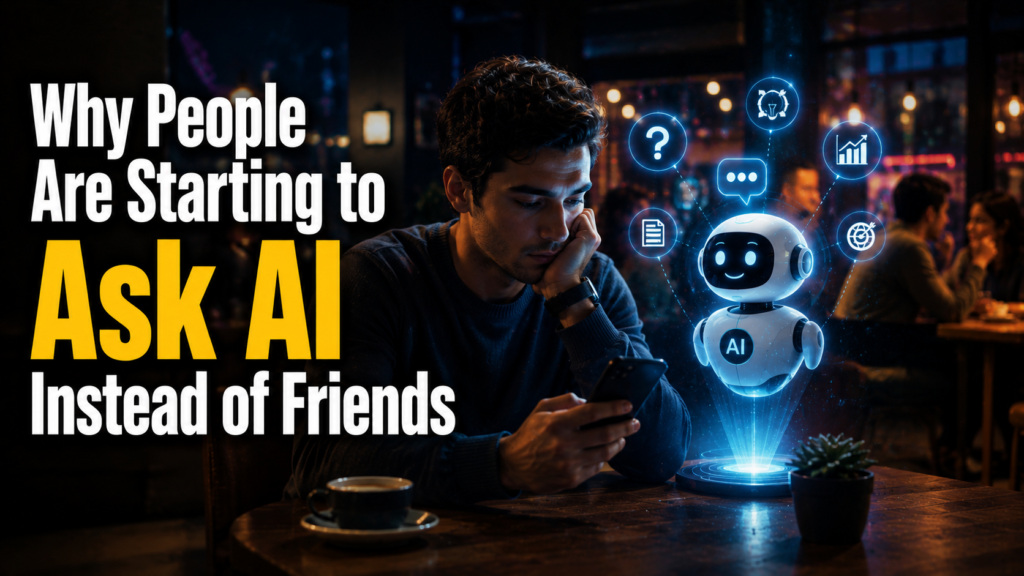
Not long ago, when people had questions, they turned to friends, family members, coworkers, or online communities. Whether seeking relationship advice, career guidance, travel recommendations, or answers to everyday problems, human conversations were the primary source of insight and support. Why People Are Starting to Ask AI Instead of Friends.
Today, a profound shift is taking place.
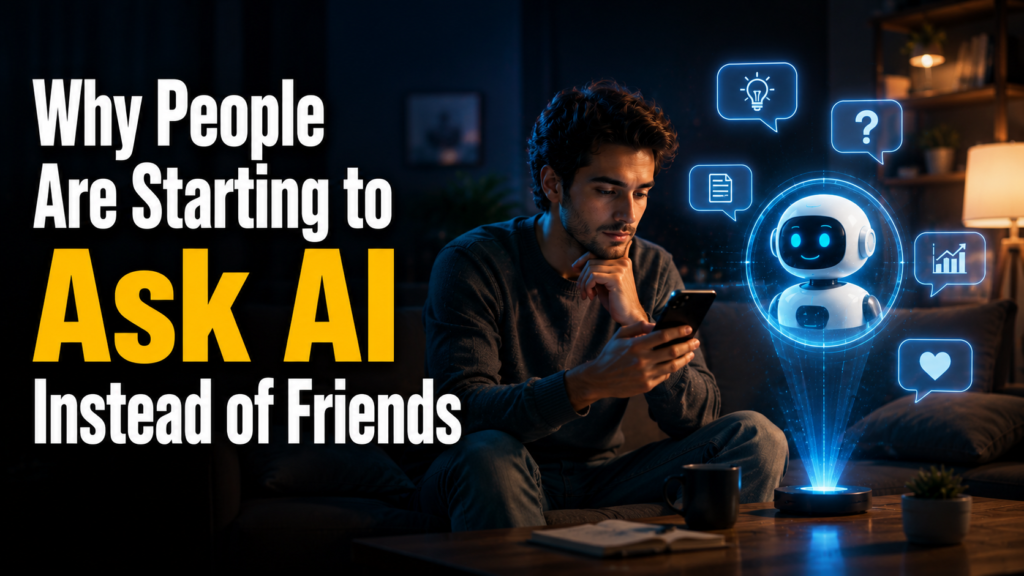
Millions of people are increasingly asking Artificial Intelligence (AI) for answers before consulting the people around them. Instead of texting a friend for productivity tips, users ask AI assistants. Instead of posting questions in online forums, many prefer instant AI-generated responses. Some individuals even seek emotional support, life advice, and personal recommendations from conversational AI systems.
This trend raises a fascinating question:
Why are people starting to ask AI instead of friends?
The answer goes far beyond technology. It touches on psychology, convenience, trust, privacy, social dynamics, and the changing nature of human relationships in the digital age. AI is not merely becoming a search tool; it is increasingly becoming a conversation partner.
While AI cannot replace genuine human connection, it is undeniably changing how people seek information, validation, and advice.
This article explores the reasons behind this growing behavior, the psychological factors driving it, its benefits and risks, and what it reveals about the future of human communication.
Table of Contents
The Evolution of Advice-Seeking

Humans have always relied on others for guidance.
Historically, people sought advice from:
- Family members
- Friends
- Community leaders
- Mentors
- Teachers
- Religious figures
As technology evolved, advice-seeking expanded to include:
- Search engines
- Social media
- Online forums
- Review platforms
- Digital communities
AI represents the next stage of this evolution.
Instead of searching through countless opinions, users can now ask a single intelligent system and receive an immediate response.
The shift feels natural because it builds upon existing digital habits.
Why Convenience Is Winning
One of the biggest reasons people turn to AI before friends is convenience.
Human conversations require timing.
Friends may be:
- Busy
- Sleeping
- Working
- Unavailable
- Distracted
AI is always available.
Traditional Advice Process
- Contact a friend.
- Wait for a response.
- Continue the conversation.
AI Advice Process
- Ask a question.
- Receive an answer instantly.
For many users, this speed is highly attractive.
In a world increasingly focused on efficiency, immediate answers often win.
The Appeal of Judgment-Free Conversations
Many people hesitate to ask friends certain questions.
Common concerns include:
- Fear of embarrassment
- Fear of criticism
- Fear of appearing uninformed
- Fear of being judged
AI removes much of this anxiety.
Users can ask virtually anything without worrying about social consequences.
Examples include:
- Personal insecurities
- Career doubts
- Relationship concerns
- Financial mistakes
- Sensitive health questions
Because AI does not judge, people often feel more comfortable being honest.
This creates a unique psychological advantage.
Why Privacy Matters More Than Ever
Privacy plays a significant role in modern communication.
Many individuals are reluctant to share personal concerns with others.
They may worry about:
- Gossip
- Social consequences
- Professional reputation
- Family reactions
AI offers a sense of confidentiality.
Whether discussing career plans, emotional challenges, or personal goals, users often perceive AI as a safer space for exploration.
This perception encourages deeper engagement.
The Psychology of Instant Validation
Humans naturally seek reassurance.
Friends sometimes challenge opinions.
They may disagree, criticize, or offer uncomfortable truths.
AI often provides responses that feel:
- Supportive
- Understanding
- Helpful
- Encouraging
This creates a sense of validation.
Users may feel heard and understood, even when interacting with a machine.
The psychological impact can be surprisingly powerful.
AI Never Gets Tired of Questions
One challenge in human relationships is the fear of becoming repetitive.
People often hesitate to ask:
- Too many questions
- Basic questions
- Follow-up questions
They worry about annoying others.
AI eliminates this concern.
Users can ask:
- The same question repeatedly
- Endless follow-ups
- Highly detailed inquiries
The AI responds consistently without frustration.
This encourages exploration and curiosity.
Information Versus Opinion
Friends typically offer advice based on personal experiences.
AI often combines information from vast amounts of knowledge.
Friend-Based Advice
- Personal perspective
- Limited experiences
- Emotional insight
AI-Based Advice
- Broader information base
- Multiple viewpoints
- Structured explanations
For factual questions, many users perceive AI as more informative.
This perception contributes to increased reliance.
The Influence of AI’s Communication Style
Modern AI systems communicate in ways specifically designed to be helpful.
Responses are often:
- Organized
- Polite
- Clear
- Non-confrontational
This style contrasts with human conversations, which can be:
- Emotional
- Inconsistent
- Subjective
- Unpredictable
The predictability of AI interactions appeals to many users.
Especially in stressful situations.
Why Younger Generations Are Adopting AI Faster
Younger generations have grown up in a digital-first environment.
They are already accustomed to:
- Online communication
- Digital assistants
- Search engines
- Social media interactions
For many young people, asking AI feels like a natural extension of existing behavior.
Digital-Native Habits
| Traditional Behavior | Emerging Behavior |
|---|---|
| Ask a friend | Ask AI |
| Search forums | Use AI chat |
| Read reviews | Request AI summaries |
| Browse websites | Get direct answers |
The transition feels seamless because it aligns with established habits.
The Role of Social Anxiety
Social anxiety affects millions of people worldwide.
For some individuals, asking questions in person can feel stressful.
Challenges may include:
- Fear of rejection
- Fear of judgment
- Communication difficulties
- Self-consciousness
AI interactions eliminate many social pressures.
Users can engage at their own pace without worrying about social dynamics.
This accessibility is one reason AI is gaining popularity.
Why AI Feels More Objective
Friends often have biases.
Their advice may be influenced by:
- Personal experiences
- Emotions
- Relationships
- Preferences
Many users perceive AI as more objective.
Whether this perception is always accurate is debatable, but it influences behavior.
People often assume AI can provide:
- Neutral analysis
- Balanced perspectives
- Rational explanations
This perceived objectivity increases trust.
The Rise of AI as a Thinking Partner
Increasingly, people are not using AI solely for answers.
They are using it for thinking.
Examples include:
- Brainstorming ideas
- Evaluating decisions
- Organizing thoughts
- Exploring possibilities
In these situations, AI functions less like a search engine and more like a cognitive partner.
This role is fundamentally different from traditional technology.
Can AI Replace Human Friendship?
Despite growing adoption, AI has significant limitations.
Human friendships provide:
- Emotional connection
- Shared experiences
- Empathy
- Social belonging
- Genuine relationships
AI cannot truly experience emotions.
It cannot replace:
- Family bonds
- Close friendships
- Romantic relationships
The value of human connection remains unique.
AI can assist conversations but cannot fully replicate them.
The Risks of Relying Too Much on AI
The growing preference for AI advice raises concerns.
Potential risks include:
Reduced Human Interaction
Overreliance may decrease meaningful conversations.
Echo Chambers
Users may seek answers that reinforce existing beliefs.
Emotional Dependence
Some individuals may become overly attached to AI interactions.
Misinformation Risks
AI systems can occasionally generate inaccurate information.
Maintaining balance is essential.
The Future of Advice-Seeking
The future will likely involve a combination of human and AI guidance.
Questions Better Suited for AI
- General knowledge
- Research assistance
- Productivity advice
- Technical explanations
Questions Better Suited for Humans
- Emotional support
- Personal relationships
- Moral dilemmas
- Life experiences
The most effective approach may involve leveraging both.
How Businesses Are Responding
Companies increasingly recognize this behavioral shift.
Many organizations now integrate AI into:
- Customer support
- Coaching platforms
- Educational services
- Wellness applications
As users grow comfortable seeking guidance from AI, businesses are adapting accordingly.
This trend is likely to accelerate.
What This Reveals About Modern Society
The popularity of AI advice reflects broader societal changes.
People increasingly value:
- Speed
- Convenience
- Privacy
- Accessibility
At the same time, many individuals experience:
- Information overload
- Social fatigue
- Time constraints
AI addresses these challenges effectively.
Its growing role is not simply a technological phenomenon—it is also a social one.
The Human Need That AI Cannot Replace
Even as AI becomes more capable, one truth remains.
Humans are social creatures.
People need:
- Connection
- Belonging
- Understanding
- Shared experiences
AI can provide information.
It can simulate conversation.
It can offer guidance.
But it cannot truly replace the emotional depth of human relationships.
The future will likely involve collaboration between human wisdom and artificial intelligence rather than competition between the two.
Conclusion
The growing tendency to ask AI instead of friends reflects one of the most fascinating behavioral shifts of the digital era. Convenience, privacy, speed, accessibility, and judgment-free interactions have made AI an increasingly attractive source of information and guidance.
For many users, AI offers something uniquely valuable: instant access to answers without social friction. It can help people think through problems, explore ideas, and obtain information efficiently. In some situations, it may even feel easier to talk to an AI than to another person.
However, this trend also highlights the limitations of technology. While AI can provide information, structure, and support, it cannot replace the empathy, emotional understanding, and authentic connection that define human relationships.
The future is unlikely to be a choice between AI and friends. Instead, people will learn to use both in complementary ways. AI will increasingly serve as an intelligent assistant and thinking partner, while friends and family will continue to provide the emotional depth and human understanding that machines cannot replicate.
As society navigates this transition, the most important skill may not be choosing between humans and AI, but understanding when each is most valuable.
Also Read: “The Economics Behind AI-Powered Search“
Frequently Asked Questions (FAQs)
Why do people ask AI instead of friends?
People often prefer AI because it provides instant answers, is available 24/7, offers privacy, and does not judge personal questions or concerns.
Is AI replacing human friendships?
No. AI can assist with information and advice, but it cannot replace genuine emotional connections, empathy, and shared experiences that human friendships provide.
What are the benefits of asking AI for advice?
Benefits include convenience, accessibility, confidentiality, structured responses, and the ability to ask unlimited follow-up questions.
Are there risks in relying too much on AI?
Yes. Potential risks include reduced human interaction, emotional dependence, misinformation, and overreliance on automated advice without critical evaluation.