










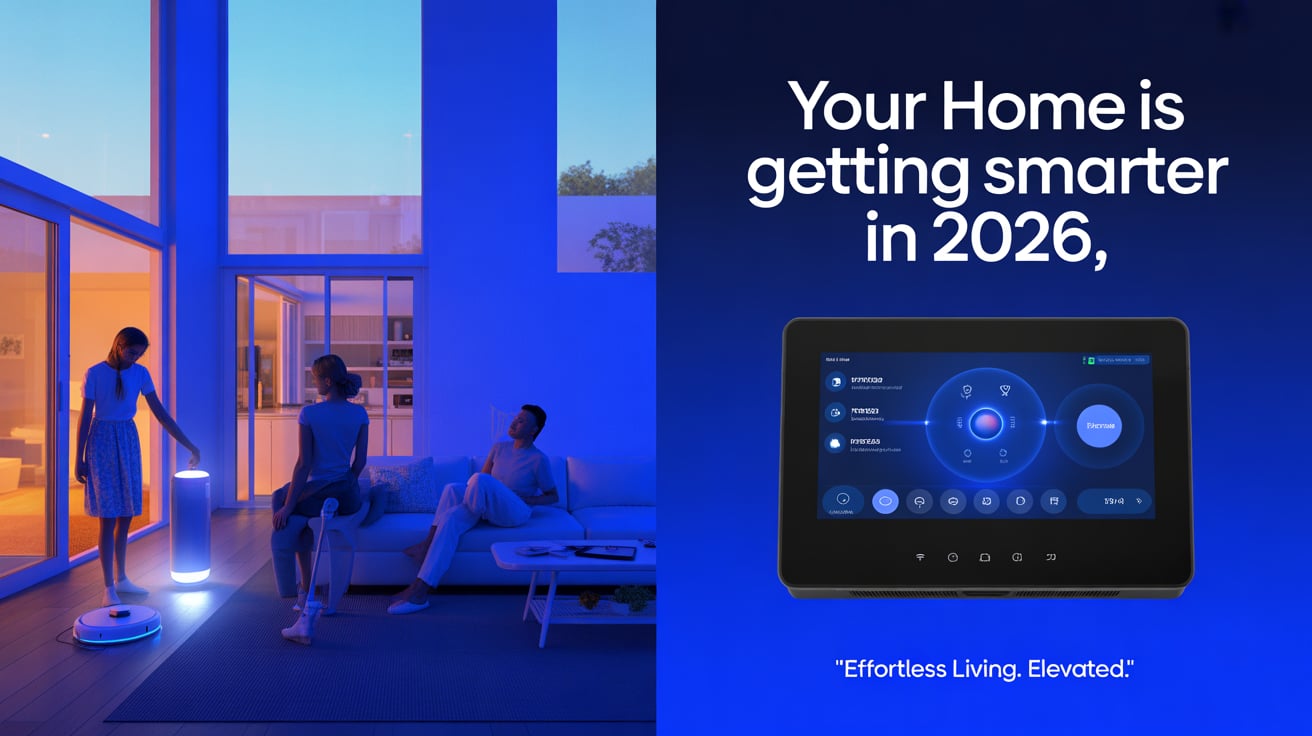
As we head into 2026, the notion of a “smart home” is evolving from novelty to necessity. If you thought your gadgets were getting more connected, think again. The coming wave of innovations promises homes that don’t just respond to your commands but anticipate your needs, learn your habits, and even act for you. This is not sci-fi. It’s the next stage of everyday living ,more convenient, more efficient, and more intuitive. Your Home Is Getting Smarter in 2026.
Table of Contents
Why 2026 Is a Turning Point for Smart Homes
The past few years have seen steady growth in smart home adoption. But 2026 marks a shift: we’re moving from fragmented devices to fully integrated, AI-driven ecosystems. Several major developments are driving this transformation:
- Universal interoperability. The Matter standard backed by industry heavyweights is finally reaching maturity. By 2026, most major manufacturers are expected to ship Matter-certified devices, making it easier than ever for smart devices from different brands to work together smoothly.
- Smarter AI and automation. Smart home systems are shifting from basic on/off routines to truly intelligent, context-aware automation. Homes will learn from your behavior, predict your needs, and adapt without explicit programming
- Efficiency and sustainability. As climate and energy concerns mount, many innovations target energy savings, eco-friendliness, and smarter resource management from lighting to heating, and even renewable energy integration.
- Unified control, fewer apps, fewer hassles. Instead of juggling multiple apps and accounts, homeowners will soon control everything lighting, security, climate, entertainment, appliances through a single unified interface or hub
What a “2026 Smart Home” Could Look Like
Here’s a breakdown of how different parts of your home environment are likely to evolve by 2026:
| Home Aspect | Expected Smart Upgrades for 2026 |
|---|---|
| Connectivity | Matter-certified devices, support for mesh networking protocols like Thread, and possibly adoption of next-gen connectivity (e.g., Wi-Fi 7) for better speed and reliability. |
| Climate & Energy Management | AI-powered thermostats and HVAC systems that learn your schedule and optimize heating/cooling; energy-efficient lighting systems that adapt to natural daylight and occupancy; integration with renewable energy sources and smart load balancing. |
| Security & Monitoring | Smart doorbells, locks, and cameras possibly with AI-driven facial recognition or behavior detection giving real-time alerts; biometric or voice-based access; unified monitoring across all entry points. |
| Home Appliances & Automation | Smart refrigerators that track inventory or expiration, AI ovens that recognize cooking items, washing machines that auto-adjust cycles, and other appliances that learn user habits and optimize operations. |
| Voice & Gesture Control | Enhanced voice assistants or even futuristic gesture recognition allowing you to talk to or wave at your home to control devices, schedule routines, or get information. |
| Unified Smart Hubs | Instead of managing multiple apps for lighting, security, appliances and more, a unified “smart home hub” interfaces with all devices letting you control everything from one place. |
How AI is Changing the Game
AI isn’t just a buzzword. In 2026 smart homes, it’s the brain behind the magic.
- Predictive & Personalized Behavior According to industry insights, AI in smart homes will enable predictive personalization: adjusting temperature, lighting, or even recommending content based on your habits and preferences.
- Automation with Context Smart systems will be able to distinguish between different contexts: you working late vs. relaxing, a family dinner vs. guests visiting, or even vacation vs. normal routine and adjust settings appropriately.
- Local Processing & Privacy-Friendly Automation Instead of relying solely on cloud-based control, some systems are expected to use local on-device AI to process commands and data, reducing latency, increasing reliability, and improving privacy.
- Maintenance & Efficiency Gains Smart homes may soon include proactive maintenance: sensors that detect when an appliance is likely to fail or underperform, offering alerts or even triggering repair/maintenance automatically.

What This Means for Homeowners, Good and Challenging
The Upsides
- True convenience & comfort: Imagine your home knowing it’s cold and pre-warming the living room before you wake up or dimming lights and curating relaxing music as you wind down.
- Energy savings & sustainability: Smarter energy use and efficient appliances mean reduced electricity bills and a smaller carbon footprint.
- Enhanced security & safety: Real-time alerts, smart locks, cameras and potentially biometric access give peace of mind whether you’re home or away.
- Unified experience: No more juggling multiple apps or managing different ecosystems. One hub could truly control your entire home.
The Challenges & Considerations
- Privacy & data security: The more connected devices especially cameras and voice assistants the higher the risk. Local AI processing and strong encryption will help, but vigilance is needed.
- Cost of upgrading: A fully smart home with AI-powered appliances, sensors, and integrated systems can still be expensive, especially for retrofit setups.
- Reliability & maintenance: Over-dependence on automation raises questions what if the system fails, or there’s a power outage? Smart homes must build in fallback mechanisms.
- Ecosystem lock-in or fragmentation: While standards like Matter promise better compatibility, it’s important to choose devices that support common standards and avoid getting locked into a single brand or platform.
The Smart Home of 2026: A Glimpse Into Everyday Life
Here’s a snapshot of how a typical day might look in a smart home in 2026:
- Morning: As your alarm goes off, gentle lights turn on, the thermostat raises temperature in the living room, and the coffee machine starts brewing your morning cup all automatically.
- Commute: As you leave home, smart door locks disengage, unnecessary lights turn off, and the security system arms itself.
- Midday: The kitchen fridge reminds you that milk is running low. You get a notification on your phone.
- Evening: As you return, the thermostat pre-heats the house. Lights adjust to warm, relaxing tones. Cameras turn on outdoor lanterns based on motion, while the AI assistant reads out reminders and weather for tomorrow.
- Night: Smart blinds draw themselves, security locks engage, and the home enters a low-power mode optimizing energy use while still monitoring key sensors.

What to Watch, 2026 and Beyond
As this transformation unfolds, keep an eye on these developments:
- More brands embracing Matter standard: As interoperability becomes reliable, expect a surge in compatible devices across budgets.
- Local-AI & edge processing: Privacy-conscious homeowners will favor devices that do AI processing locally rather than sending data to the cloud.
- Smart energy & sustainability integration: Expect solar panels, battery storage, and energy-aware appliances to converge more and become mainstream.
- Health & wellness features: Beyond lighting and climate control, smart homes may integrate air-quality monitoring, sleep tracking, and wellness reminders tied to your lifestyle>
Conclusion
The next few years will redefine what “home” means. A smart home isn’t just about convenience it’s about creating a living environment that understands you, adapts to you, and responds intuitively to your needs. In 2026, thanks to unified standards like Matter, powerful AI-driven automation, and more efficient energy and appliance systems, our homes are set to become more human than ever almost like living companions.
If you’re considering transforming your living space into a smart home, now might be the perfect time. The tools are maturing. The devices are coming together. And the vision of a home that truly works for you not the other way around is closer than ever.
Also Read: “Big Tech Goes Green in 2026“
FAQ’s
Q: Do I need to replace all my existing devices to make my home “smart”?
A: Not necessarily. With standards like Matter and improved interoperability, many existing devices can be integrated into new smart-home systems, especially if they support common protocols. However, to unlock the full range of 2026’s advanced features (AI automation, unified hub, appliance learning), newer devices will bring the most benefit.
Q: Isn’t privacy compromised with so many connected devices?
A: It can be, but the trend toward on-device AI processing, local data storage, and stronger encryption aims to address these concerns. If privacy is important to you, look for devices that offer local control and minimal cloud dependencies.
Q: Are smart homes worth the cost in energy savings or convenience?
A: For many households, yes. Smart thermostats, lighting, and efficient appliances can significantly reduce energy consumption over time while automation and integration dramatically improve convenience and lifestyle comfort.
Q: Will all smart home devices work together seamlessly?
A: Thanks to the Matter standard and improved network protocols (like Thread or future Wi-Fi standards), cross-brand interoperability is becoming the norm. In many cases, you’ll control various gadgets lights, locks, cameras, appliances from a single hub or app.
Q: What happens if internet goes down or there’s a power outage?
A: Good smart-home systems increasingly rely on local (edge) processing rather than full cloud dependency. That means basic automation, security alerts, and essential controls can still function even if the internet is temporarily unavailable